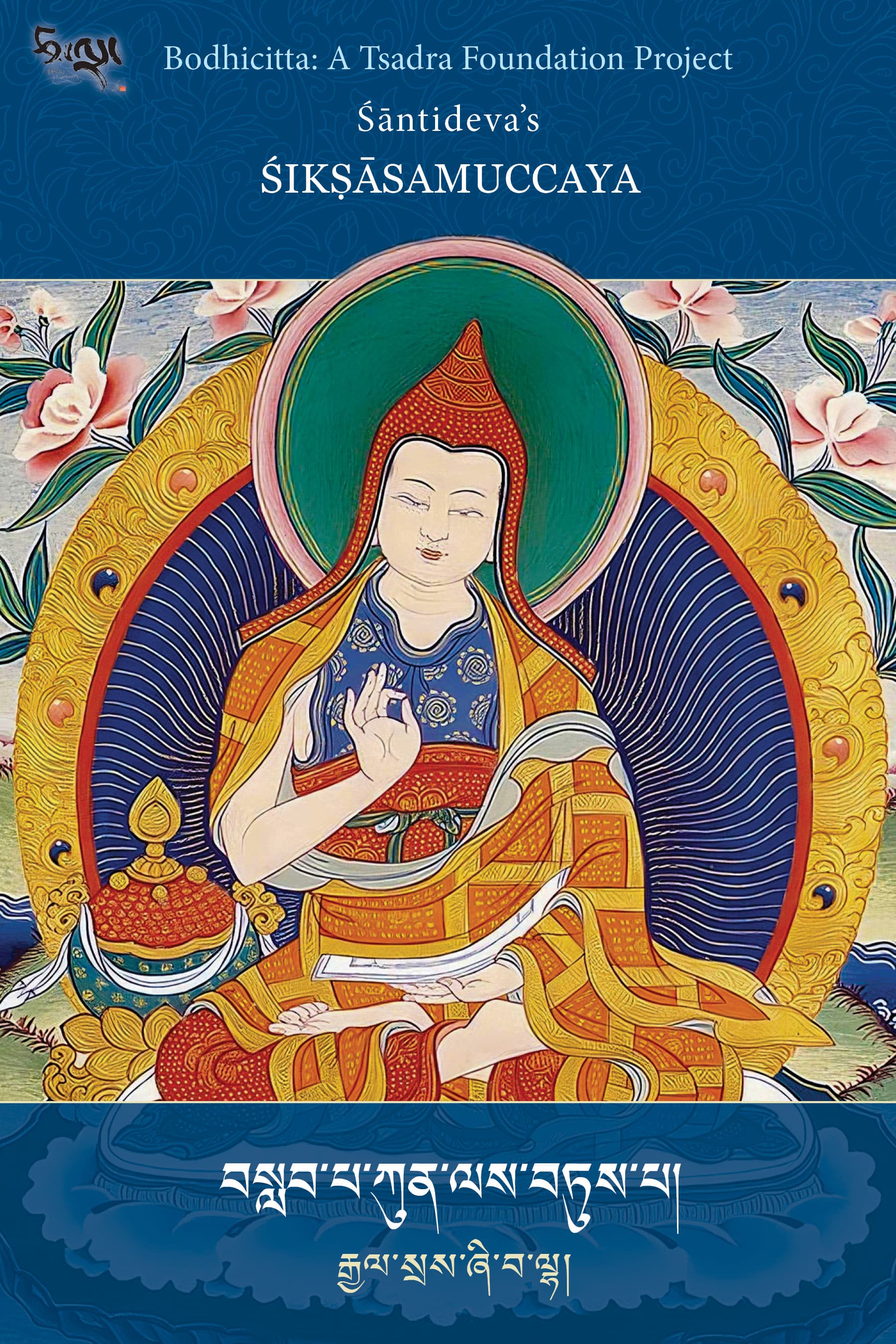
The Training Anthology of Śāntideva
From Bodhicitta
< Books(Redirected from The Training Anthology of Śāntideva)
Books/The Training Anthology of Śāntideva
Books/The Training Anthology of Śāntideva
| 🤓 Admin Zone 🛠️ hidden to non-admins | |
The Training Anthology of Śāntideva: A Translation of the Śikṣā-samuccaya
Book
- A Buddhist 'good life' Theory: Śāntideva's Bodhicaryāvatāra
- A Buddhist Carol
- A Critical Study of Ācārya Śāntideva's Bodhicaryāvatāra
- A Critical Study of Ācārya Śāntideva's Bodhicaryāvatāra (diss)
- A Fearless Heart
- A Flash of Lightning in the Dark of Night
- A Mirror Is for Reflection
- A Response to John Pettit
- A Role for Primordial Wisdom in the Buddhist Free Will Controversy
- A Selfless Response to an Illusory World: A Comparative Study of Śāntideva and Śaṅkara
- A Short Presentation of Śāntideva's Bodhicaryāvatāra
- A Study of Akṣayamati (Śāntideva)'s Bodhisattvacaryāvatāra as Found in the Tibetan Manuscripts From Tun-huang
- A Study of the Ṡikṣasamuccaya of Āchārya Shāntideva
- Account of the Period of the Kings Cala, Pañcamasiṃha and Others
- Akṣayamati and Śāntideva
- Akṣayamati's Bodhisattvacaryāvatāra as Found in the Tibetan Manuscripts from Dūn-huáng
- Altruism and Reality (1998)
- Altruism and Reality-Review by Franco
- Altruism and Reality-Review by Pettit
- Altruism as Antidote to Demagoguery: Shantideva’s Bodhicharyavatara Chapter 3 as Method for Countering Identity Divisions
- Altruism in the Charnel Ground: Śāntideva and Parfit on Anātman, Reductionism and Benevolence
- An Inquiry into the Relationship between the Śikṣāsamuccaya and the Bodhi(sattva)caryāvatāra
- An Intoxication of Mouse Venom: Reading the Guide, Chapter 9
- An Introduction to Buddhist Ethics
- Aspekte der Schulung in der Laufbahn eines Bodhisattva
- Aspekte der Schulung in der Laufbahn eines Bodhisattva-Review by de Jong
- Becoming Bodhisattvas
- Bhadracaryāvidhi in the Śikṣāsamuccaya Chapt. 16
- Bile & Bodhisattvas: Śāntideva on Justified Anger
- Bodhi(sattva)caryāvatāra als Lehrschrift und Vorhaben: Zum Thema Ritual, Religion, Philosophie und Mystik im Buddhismus
- Bodhi(sattva)caryāvatāra and Śikṣāsamuccaya
- Bodhicaryāvatāra (Weeraratne)
- Bodhicaryāvatāra and Bodhicaryāvatāra-Pañjikā (Malalasekera)
- Bodhicaryāvatāra and Tibetan Mind Training (Lojong)
- Bodhisattvacaryāvatāra: Exposition de la pratique des bodhisattvas
- Bodhisattvas of the Forest and the Formation of the Mahayana
- Bodies and Embodiment in the Bodhicaryāvatāra
- Bu ston on the sPyod 'jug (Bodhisattvacaryāvatāra)
- Buddha Mind - Christ Mind
- Buddha's Lions
- Buddhism as Reductionism: Personal Identity and Ethics in Parfitian Readings of Buddhist Philosophy
- From Steven Collins to the Present
- Buddhist Ethics and Globalization on the Basis of Bodhicaryavatara
- Buddhist Ethics in the Context of Conventional Truth: Path and Transformation
- Buddhist Texts Through the Ages
- Built on Emptiness: Śūnyatā as a Basis for Mahāyāna Ethics, With References to Śāntideva’s Bodhicaryāvatāra
- Camino al Despertar
- Can We Kill Illusory People? Some Philosophical Reflections on Bodhi(sattva)caryāvatāra 9:11-13ab
- Compassion and the Net of Indra
- Compassion as a Matter of Fact: The Argument from No-Self to Selflessness in Śāntideva's Śikṣāsamuccaya
- Compassion in Our Day: Learning from Shantideva
- Compassion in Schopenhauer and Śāntideva
- Conclusion: The Socratic Paradigm
- Consequences of Compassion
- Consequences of Compassion: An Interpretation and Defense of Buddhist Ethics-Review by Meyers
- Consequentialism, Agent-Neutrality, and Mahāyāna Ethics
- Consequentialism, Particularism, and the Emptiness of Persons: A Response to Vishnu Sridharan
- Cooking Living Beings: The Transformative Effects of Encounters with Bodhisattva Bodies
- Demandingness, Self-Interest and Benevolence in Santideva's Introduction to the Practice of Awakening (Bodhicaryavatara)
- Did Śāntideva Destroy the Bodhisattva Path?
- Die "Vollkommenheiten" im BCA und seinen tibetischen Kommentaren
- Does "Buddhist Ethics" Exist?
- Does Anātman Rationally Entail Altruism? On Bodhicaryāvatāra 8:101-103
- Drops of Nectar: Khenpo Kunpal's Commentary on Shantideva's Entering the Conduct of the Bodhisattvas
- Emptiness and Moral Perfection
- Enlightenment to Go
- Entering the Path of Enlightenment
- Entering the Path of Enlightenment-Review by Cook
- Entering the Path of Enlightenment-Review by Seyfort Ruegg
- Epitome of the Bodhicaryāvatāra with Its Pañjikā, Chap. IX
- Ethical Revaluation in the Thought of Śāntideva
- Ethics (Garfield)
- Ethics and the Subversion of Conceptual Reification in Lévinas and Śāntideva
- Ethics in Indian and Tibetan Buddhism
- Ethics in Schopenhauer and Buddhism
- Ethics in the Śikṣāsamuccaya: A Study in Mahāyāna Morality
- Ethics without Self, Dharma without Atman
- Experience and Morality: Buddhist Ethics as Moral Phenomenology
- Extreme Giving: The Vessantara Jātaka and Shantideva's A Guide to the Bodhisattva Way of Life
- Facts or Fictions: Reconsidering Śāntideva's Names, Life, and Works
- Features of Śraddhā in the Śikṣāsamuccaya
- Fierce Devotion to all Beings: The Role of Emotions in Śāntideva’s Introduction to the Way of the Bodhisattva (Bodhicaryāvatāra)
- Freedom from Responsibility: Agent-Neutral Consequentialism and the Bodhisattva Ideal
- From Madhyamaka to Consequentialism: A Road Map
- General Introduction: Śāntideva and His World
- Gleichheit und Mitgefühl: Prajñākaramatis Kommentar zu Bodhicaryāvatāra VIII. 89-108
- Guidance for the Spiritual Caregiver from the Bodhicaryavatara by Shantideva
- Healing Anger
- Healing Anger: The Power of Patience from a Buddhist Perspective-Review by Naga
- How to Be a Bodhisattva: Introduction to the Practice of the Bodhisattva Path (The Bodhicaryāvatāra)
- Hume as a Western Mādhyamika: The Case from Ethics
- Indian Madhyamaka Buddhist Philosophy after Nagarjuna, Vol. 2
- Innate Human Connectivity and Śāntideva's Cultivation of Compassion
- La conception de la realité dans L'Entrèe dans la voie de l'illumination de Santideva
- La légende de Śāntideva
- Madhyamaka Ethics
- Mahasiddhas: La vie de 84 sages de l'Inde
- Mapping the Bodhicaryāvatāra
- Masters of Mahāmudrā
- Mental Purification (Blo sbyong): A Native Tibetan Genre of Religious Literature
- MindFulness in Santideva's Siksasamuccaya
- Moderation or the Middle Way: Two Approaches to Anger
- Moonpaths: Ethics and Emptiness
- Moral Pluralism, Skillful Means, and Environmental Ethics
- Moral Theory in Śāntideva's Śikṣāsamuccaya
- Moral Theory in Śāntideva's Śikṣāsamuccaya-Review by Osto
- Moral Theory in Śāntideva's Śikṣāsamuccaya: Cultivating the Fruits of Virtue-Review by Goodman
- Notes on the Deśanā-ritual in the Bodhicaryāvatāra: Evidence of Its Revision
- Notes on the Interpretation of Bodhi(sattva)caryāvatāra V.104–106
- Of the Progresse of the Bodhisattva
- Of the Progresse of the Bodhisattva: The Bodhisattvamārga in the Śikṣāsamuccaya
- On Akṣayamati's Bodhisattvacaryāvatāra
- On Altruism and Rebirth: Philosophical Comments on Bodhicaryāvatāra 8: 97-8
- On Another Sūtrasamuccaya
- On Learning to Overhear the "Vanishing Poet"
- On the Classification of Śāntideva's Ethics in the Bodhicaryāvatāra
- On the Pariṇāmanā Chapter of the Bodhicaryāvatāra
- On Śāntideva's Position in the History of Mādhyamika Philosophy
- Patience and Perspective
- Plant Seed, Pull Weed
- Prolegomena to an English Translation of the Sūtrasamuccaya
- Proof of the Authenticity of the Mahāyāna in Akṣayamati's Bodhi(sattva)caryāvatāra
- Puṇya and Pāp in Public Health: Everyday Religion, Material Culture, and Avenues of Buddhist Activism in Urban Kathmandu
- Readings of Śāntideva's Guide to Bodhisattva Practice
- Readings of Śāntideva's Guide to Bodhisattva Practice-Review by Harris
- Reason and Knowledge on the Path: A Protreptic Reading of the Guide
- Reason, Irrationality and Akrasia (Weakness of the Will) in Buddhism: Reflections upon Śāntideva's Arguments with Himself
- Relocation of the Verses on "The Equality of Self and Others" in the Bodhicaryāvatāra
- Remarks on Akṣayamati (Blo gros mi zad pa), Being the Author of the Earlier Version of the Bodhisattvacaryāvatāra
- Remarks on an Instance of Intertextuality in the Eleventh Chapter of the Śikṣāsamuccaya and the Phrase Tṛṇagulmauṣadhivanaspati in Buddhist Sūtra Literature
- René Girard, Śāntideva, and the Emptiness of Desire
- Reply to Paul Williams
- Resentment and Reality: Buddhism on Moral Responsibility
- Response to Mark Siderits' Review
- Santideva (Indian Antiquary, Vol. 42, 1913)
- Santideva's Bodhicaryāvatāra
- Santideva, un mistico del Buddhismo
- Seeing Sentient Beings: Śāntideva's Moral Phenomenology
- Self-Sceptical Ethics and Selfless Morality: A Historical and Cross-Cultural Overview
- Selfhood and the Metaphysics of Altruism
- Selfless Ethics: The Equality of Non-Existence
- Selflessness and Normativity: Śāntideva and Emptiness Ethics
- Seven Important Points (Marmasthāna) in the Śikṣāsamuccaya
- Shantideva (From Butön's History of Buddhism in India and Its Spread to Tibet, Translated by Lisa Stein and Ngawang Zangpo)
- Shantideva (Nariman)
- Shantideva's Bodhicaryavatara: An Internal Pilgrimage to Universal Peace and Compassion
- Shantideva's Teaching
- Shantideva: How to Wake Up a Hero
- Shāntideva (Tib. Shi-wa-lha)
- Spinoza through the Prism of Later 'East-West' Exchanges: Analogues of Buddhist Themes in the Ethics and the Works of Early Spinozists
- Stoics and Bodhisattvas: Spiritual Exercise and Faith in Two Philosophical Traditions
- Stotra, Psychological Conditioning, and the Bodhicaryāvatāra: Together with a Translation of the Bodhicittānuśaṃsapariccheda
- Studies in the Philosophy of the Bodhicaryāvatāra (2000)
- The Absence of Self and the Removal of Pain: How Śāntideva Destroyed the Bodhisattva Path
- The Bodhi-caryâvatāra and Its Monastic Aspects: On the Problem of Representation
- The Bodhisattva Doctrine in Buddhist Sanskrit Literature
- The Bodhisattva Path: Śāntideva's Bodhicaryāvatāra
- The Case of the Vanishing Poet: New Light on Śāntideva and the Śikṣā-samuccaya
- The Center of the Sunlit Sky
- The Changing Way of the Bodhisattva: Superheroes, Saints, and Social Workers
- The Compassionate Gift of Vice: Śāntideva on Gifts, Altruism, and Poverty
- The Concept of Bodhicitta in Śāntideva's Bodhicaryāvatāra (Diss)
- The Connection between Ontology and Ethics in Madhyamaka Thought
- The Contrasts between the Bodhisattvayāna and the Śrāvakayāna in the Śikṣāsamuccaya's Theory of Bodhicitta
- The Elusive Buddhist Self: Preliminary Reflections on Its Denial
- The Ethics of Mahāyāna Buddhism in the Bodhicaryāvatāra
- The Ethics of Śaṅkara and Śāntideva
- The Ethics of Śaṅkara and Śāntideva-Review by Abramson
- The Ethics of Śaṅkara and Śāntideva-Review by Javanaud
- The Ethics of Śaṅkara and Śāntideva-Review by O'Leary
- The Literature of the Madhyamaka School of Philosophy in India
- The Mahāsiddha Bhusuku (Śāntideva), The Idle Monk
- The Masters and Poets of the Mahāyāna
- The Metaphysical Basis of Śāntideva's Ethics
- The Path of the Bodhisattva
- The Perfection of Wisdom (Schopen)
- The Reality of Altruism: Reconstructing Śāntideva, A Review of Altruism and Reality: Studies in the Philosophy of the Bodhicāryāvatāra, by Paul Williams
- The Relationship between Morality and the Body in Monastic Training according to the Śikṣāsamuccaya
- The Resolve to Become a Buddha
- The Self and the Suffering Other: Levinas and Śāntideva on the Ethics of Compassion
- The Selfless Removal of Pain: A Critical Glance at Śāntideva's Argument in Bodhicaryāvatāra 8: 101–3
- The Social Message of Mahayana Buddhism
- The Training Anthology of Śāntideva
- The Transmission of the Bodhicaryāvatāra: The History, Diffusion, and Influence of a Mahāyāna Buddhist Text
- The Triskandha, Practice in Three Parts: Study of an Early Mahāyāna Buddhist Ritual
- The Way of the Bodhisattva: An Introduction and Commentary to Shantideva's The Way of Life of the Bodhisattva
- The Way of the Translators: Three Recent Translations of Śāntideva's Bodhicaryāvatāra
- Theory and Comparison in the Discussion of Buddhist Ethics
- Traces of Consequentialism and Non-Consequentialism in Bodhisattva Ethics
- Uses of the Illusion of Agency: Why Some Buddhists Should Believe in Free Will
- Verses by Śāntideva in the Śikṣāsamuccaya: A New English Translation
- Virtuous Bodies
- What Is It Like to Be a Bodhisattva? Moral Phenomenology in Śāntideva's Bodhicaryāvatāra
- Where Does the Cetanic Break Take Place? Weakness of Will in Śāntideva’s Bodhicaryāvatāra
- Why War? Why Not Peace? Santideva's Answer to Einstein's Famous Question to Freud
- Çikshāsamuccaya: A Compendium of Buddhistic Teaching (1897–1902)
- Ācārya Śantideva's Humanism
- Śikshā-samuccaya: A Compendium of Buddhist Doctrine (1922)
- Śikṣāsamuccaya (Anthology of Instruction)
- Śikṣāsamuccaya et Sūtrasamuccaya
- Śāntideva (Internet Encyclopedia of Philosophy)
- Śāntideva (Potter, Kalupahana, and Sweet)
- Śāntideva (Stanford Encyclopedia of Philosophy)
- Śāntideva and Bodhicaryāvatāra
- Śāntideva and Kant: An East-West Comparative Study in Ethics
- Śāntideva and an Ethic of Radical Compassion
- Śāntideva and the Mādhyamika: The Prajñāpāramitā-Pariccheda of the Bodhicaryāvatāra
- Śāntideva as a Mantracarin
- Śāntideva in the History of Mādhyamika Philosophy
- Śāntideva on Developing the Thought of Awakening
- Śāntideva on Roots and Resolutions of Violence
- Śāntideva's Ethics of Impartial Compassion
- Śāntideva's Impartialist Ethics
- Śāntideva's Statement about Confession
- Śāntideva's Śikṣāsamuccaya-kārikās
- Śāntideva, A Mystic of Buddhism
- Śāntideva, Virtue, and Consequentialism
- Śāntideva, il Bodhicaryāvatāra e le kārikā del Śikṣāsamuccaya
- Śāntideva, il Bodhicaryāvatāra e le kārikā del Śikṣāsamuccaya-Review by Pāsādika
- Śāntideva: Mystique Bouddhiste des VIIe et VIIIe siècles
- Śāntideva: Mystique Bouddhiste des VIIe et VIIIe siècles-Review by Cabezón
- Śāntideva: The Author and His Project
- Śāntidevas Bodhicaryāvatāra: Das Weiterwirken des Werkes dargestellt anhand der Überlieferungsgeschichte des Textes und seiner Kommentare
Please note that many items in our library are simply pages that represent a detailed library catalog entry and citation of someone else's work, presentation, or performance. Read our General Disclaimer for more information.

Description
The Training Anthology—or Śikṣā-samuccaya—is a collection of quotations from Buddhist sutras with illuminating and insightful commentary by the eighth-century North Indian master Śāntideva. Best known for his philosophical poem, the Bodhicaryāvatāra, Śāntideva (or Shantideva) has been a vital source of spiritual guidance and literary inspiration to Tibetan teachers and students throughout the history of Tibetan Buddhism. Charles Goodman offers a translation of this major work of religious literature, in which Śāntideva has extracted, from the vast ocean of the Buddha's teachings, a large number of passages of exceptional value, either for their practical relevance, philosophical illumination, or aesthetic beauty. The Training Anthology provides a comprehensive overview of the Mahāyāna path to Awakening and gives scholars an invaluable window into the religious doctrines, ethical commitments, and everyday life of Buddhist monks in India during the first millennium CE. (Source: back cover)
Citation
Goodman, Charles, trans. The Training Anthology of Śāntideva: A Translation of the Śikṣā-samuccaya. New York: Oxford University Press, 2016.
Table of contents
- List of Abbreviationsvii
- The Training Anthology in Its Cultural and Religious Contextsix
- Śāntideva's Life: History and Legendsix
- The Great Journey to Awakeningxii
- The Indian Buddhist Monastery as a Social Institutionxviii
- The Cultural World of Śāntideva: Some Major Featuresxxiii
- The Structure of the Training Anthologyxxvii
- The Supreme Worshipxxviii
- The Training Anthology Todayxxx
- The Philosophy of the Training Anthologyxxxv
- Reason, Emotion, and Rhetoricxxxv
- Ethical Theoryxxxvii
- Lexical Priority of Valuesxlviii
- Plants, Animals, and the Environmentl
- Theory of Well-Beinglii
- No-Self, Causation, and Emptinessliv
- Notes on the Translationlix
- Root Verses of the Training Anthologylxxiii
- 1. The Perfection of Generosity1
- 2. Upholding the Holy Dharma38
- 3. Protecting the Dharma Teacher and So On49
- 4. Giving Up What Is Harmful63
- 5. Giving Up What Is Harmful through the Perfection of Moral Discipline100
- 6. Protecting the Body116
- 7. Protecting Possessions and Goodness139
- 8. Clearing Away Vile Actions155
- 9. The Perfection of Patient Endurance177
- 10. The Perfection of Perseverance186
- 11. Praise of the Wilderness190
- 12. Preparing the Mind199
- 13. The Applications of Mindfulness222
- 14. Purifying the Body233
- 15. Purifying Possessions and Goodness255
- 16. The Ritual of Good Conduct261
- 17 Benefits of Reverential Actions279
- 18. Recollection of the Three Jewels294
- 19. Enhancing Goodness323
- Appendix A: Training Anthology Ch. 18, B. 344-347, Tibetan Version339
- Appendix B: Partial List ofTranslation Choices349
- Appendix C: Texts Quoted in the Training Anthology of Śāntideva351
- Notes361
- Works Cited421
- Index425
Interconnections
2 Full translation of

Śikṣāsamuccaya (T. Bslab pa kun las btus pa; C. Dasheng ji pusa xue lun; J. Daijōjū bosatsugakuron; K. Taesǔng chip posal hak non 大乘集菩薩學論). In Sanskrit, "Compendium of Training," a work by the eighth-century Indian Mahāyāna master Śāntideva. It consists of twenty-seven stanzas on the motivation and practice of the bodhisattva, including bodhicitta, the six perfections (pāramitā), the worship of buddhas and bodhisattvas, the benefits of renunciation, and the peace derived from the knowledge of emptiness (śūnyatā). The topic of each of the stanzas receives elaboration in the form of a prose commentary by the author as well as in illustrative passages, often quite extensive, drawn from a wide variety of Mahāyāna sūtras. Some ninety-seven texts are cited in all, many of which have been lost in their original Sanskrit, making the Śikṣāsamuccaya an especially important source for the textual history of Indian Buddhism. These citations also offer a window into which sūtras were known to a Mahāyāna author in eighth-century India. The digest of passages that Śāntideva provides was repeatedly drawn upon by Tibetan authors in their citations of sūtras. Although Śāntideva's Bodhicaryāvatāra and Śikṣāsamuccaya both deal with similar topics, the precise relation between the two texts is unclear. Several of the author's verses appear in both texts and some of the sūtra passages from the Śikṣāsamuccaya also appear in the Bodhicaryāvatāra. One passage in the Bodhicaryāvatāra also refers readers to the Śikṣāsamuccaya, but this line does not occur in the Dunhuang manuscript of the text and may be a later interpolation. (Source: "Śikṣāsamuccaya." In The Princeton Dictionary of Buddhism, 821. Princeton University Press, 2014. http://www.jstor.org/stable/j.ctt46n41q.27.)
These are the root verses of Śāntideva's Compendium of Spiritual Disciplines (Śikṣāsamuccaya).
1 Reviews

This is Amod Lele's review of the book The Training Anthology of Śāntideva: A Translation of the Śikṣā-samuccaya, by Charles Goodman.
2 Scholarship on
Śikṣāsamuccaya (T. Bslab pa kun las btus pa; C. Dasheng ji pusa xue lun; J. Daijōjū bosatsugakuron; K. Taesǔng chip posal hak non 大乘集菩薩學論). In Sanskrit, "Compendium of Training," a work by the eighth-century Indian Mahāyāna master Śāntideva. It consists of twenty-seven stanzas on the motivation and practice of the bodhisattva, including bodhicitta, the six perfections (pāramitā), the worship of buddhas and bodhisattvas, the benefits of renunciation, and the peace derived from the knowledge of emptiness (śūnyatā). The topic of each of the stanzas receives elaboration in the form of a prose commentary by the author as well as in illustrative passages, often quite extensive, drawn from a wide variety of Mahāyāna sūtras. Some ninety-seven texts are cited in all, many of which have been lost in their original Sanskrit, making the Śikṣāsamuccaya an especially important source for the textual history of Indian Buddhism. These citations also offer a window into which sūtras were known to a Mahāyāna author in eighth-century India. The digest of passages that Śāntideva provides was repeatedly drawn upon by Tibetan authors in their citations of sūtras. Although Śāntideva's Bodhicaryāvatāra and Śikṣāsamuccaya both deal with similar topics, the precise relation between the two texts is unclear. Several of the author's verses appear in both texts and some of the sūtra passages from the Śikṣāsamuccaya also appear in the Bodhicaryāvatāra. One passage in the Bodhicaryāvatāra also refers readers to the Śikṣāsamuccaya, but this line does not occur in the Dunhuang manuscript of the text and may be a later interpolation. (Source: "Śikṣāsamuccaya." In The Princeton Dictionary of Buddhism, 821. Princeton University Press, 2014. http://www.jstor.org/stable/j.ctt46n41q.27.)
These are the root verses of Śāntideva's Compendium of Spiritual Disciplines (Śikṣāsamuccaya).