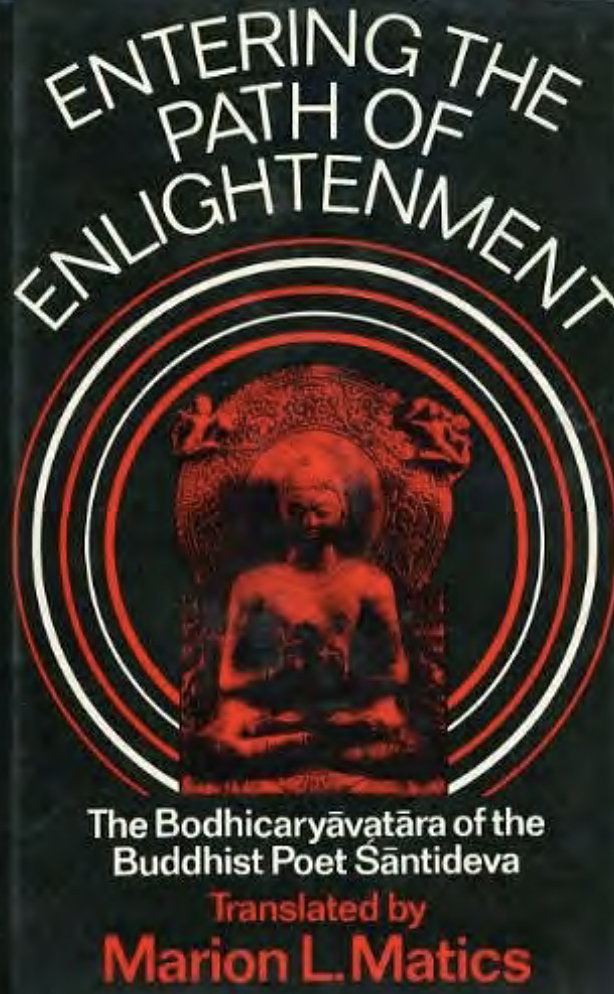
Entering the Path of Enlightenment-Review by Cook
| 🤓 Admin Zone 🛠️ hidden to non-admins | |
- A Guide to the Bodhisattva Way of Life (Bodhicaryāvatāra)-Review by Cantwell
- A Guide to the Bodhisattva Way of Life-Review by De Jong
- A Guide to the Bodhisattva Way of Life-Review by Pettit
- A Short Presentation of Śāntideva's Bodhicaryāvatāra
- A Study of Akṣayamati (Śāntideva)'s Bodhisattvacaryāvatāra as Found in the Tibetan Manuscripts From Tun-huang
- Account of the Period of the Kings Cala, Pañcamasiṃha and Others
- Akṣayamati and Śāntideva
- Bodhi(sattva)caryāvatāra als Lehrschrift und Vorhaben: Zum Thema Ritual, Religion, Philosophie und Mystik im Buddhismus
- Bodhisattvas of the Forest and the Formation of the Mahayana
- Bu ston on the sPyod 'jug (Bodhisattvacaryāvatāra)
- Buddha Mind - Christ Mind
- Buddha's Lions
- Buddhist Texts Through the Ages
- Drops of Nectar: Khenpo Kunpal's Commentary on Shantideva's Entering the Conduct of the Bodhisattvas
- Entering the Path of Enlightenment
- Entering the Path of Enlightenment-Review by Cook
- Entering the Path of Enlightenment-Review by Seyfort Ruegg
- Ethical Revaluation in the Thought of Śāntideva
- Ethics in the Śikṣāsamuccaya: A Study in Mahāyāna Morality
- Facts or Fictions: Reconsidering Śāntideva's Names, Life, and Works
- Fierce Devotion to all Beings: The Role of Emotions in Śāntideva’s Introduction to the Way of the Bodhisattva (Bodhicaryāvatāra)
- General Introduction: Śāntideva and His World
- Gleichheit und Mitgefühl: Prajñākaramatis Kommentar zu Bodhicaryāvatāra VIII. 89-108
- How to Be a Bodhisattva: Introduction to the Practice of the Bodhisattva Path (The Bodhicaryāvatāra)
- La légende de Śāntideva
- Mahasiddhas: La vie de 84 sages de l'Inde
- Masters of Mahāmudrā
- Mental Purification (Blo sbyong): A Native Tibetan Genre of Religious Literature
- Moral Theory in Śāntideva's Śikṣāsamuccaya
- Moral Theory in Śāntideva's Śikṣāsamuccaya-Review by Osto
- Moral Theory in Śāntideva's Śikṣāsamuccaya: Cultivating the Fruits of Virtue-Review by Goodman
- On Akṣayamati's Bodhisattvacaryāvatāra
- Proof of the Authenticity of the Mahāyāna in Akṣayamati's Bodhi(sattva)caryāvatāra
- Readings of Śāntideva's Guide to Bodhisattva Practice
- Readings of Śāntideva's Guide to Bodhisattva Practice-Review by Harris
- Reason, Irrationality and Akrasia (Weakness of the Will) in Buddhism: Reflections upon Śāntideva's Arguments with Himself
- Remarks on Akṣayamati (Blo gros mi zad pa), Being the Author of the Earlier Version of the Bodhisattvacaryāvatāra
- Santideva's Bodhicaryāvatāra
- Santideva, un mistico del Buddhismo
- Shantideva (From Butön's History of Buddhism in India and Its Spread to Tibet, Translated by Lisa Stein and Ngawang Zangpo)
- Shantideva (Nariman)
- Shantideva's Bodhicaryavatara: An Internal Pilgrimage to Universal Peace and Compassion
- Shantideva's Teaching
- Shāntideva (Tib. Shi-wa-lha)
- Stotra, Psychological Conditioning, and the Bodhicaryāvatāra: Together with a Translation of the Bodhicittānuśaṃsapariccheda
- The Bodhi-caryâvatāra and Its Monastic Aspects: On the Problem of Representation
- The Bodhicaryāvatāra: A Guide to the Buddhist Path to Awakening-Review by Gethin
- The Bodhisattva Doctrine in Buddhist Sanskrit Literature
- The Center of the Sunlit Sky
- The Concept of Bodhicitta in Śāntideva's Bodhicaryāvatāra (Diss)
- The Ethics of Śaṅkara and Śāntideva
- The Ethics of Śaṅkara and Śāntideva-Review by Abramson
- The Ethics of Śaṅkara and Śāntideva-Review by Javanaud
- The Ethics of Śaṅkara and Śāntideva-Review by O'Leary
- The Literature of the Madhyamaka School of Philosophy in India
- The Mahāsiddha Bhusuku (Śāntideva), The Idle Monk
- The Masters and Poets of the Mahāyāna
- The Perfection of Wisdom (Schopen)
- The Resolve to Become a Buddha
- The Training Anthology of Śāntideva
- The Triskandha, Practice in Three Parts: Study of an Early Mahāyāna Buddhist Ritual
- The Way of the Bodhisattva: A Translation of the Bodhicharyāvatāra-Review by Cantwell
- The Way of the Translators: Three Recent Translations of Śāntideva's Bodhicaryāvatāra
- Śāntideva (Internet Encyclopedia of Philosophy)
- Śāntideva (Potter, Kalupahana, and Sweet)
- Śāntideva (Stanford Encyclopedia of Philosophy)
- Śāntideva and Bodhicaryāvatāra
- Śāntideva and the Mādhyamika: The Prajñāpāramitā-Pariccheda of the Bodhicaryāvatāra
- Śāntideva as a Mantracarin
- Śāntideva in the History of Mādhyamika Philosophy
- Śāntideva, A Mystic of Buddhism
- Śāntideva, il Bodhicaryāvatāra e le kārikā del Śikṣāsamuccaya
- Śāntideva, il Bodhicaryāvatāra e le kārikā del Śikṣāsamuccaya-Review by Pāsādika
- Śāntideva: Mystique Bouddhiste des VIIe et VIIIe siècles
- Śāntideva: Mystique Bouddhiste des VIIe et VIIIe siècles-Review by Cabezón
- Śāntideva: The Author and His Project
- Śāntidevas Bodhicaryāvatāra: Das Weiterwirken des Werkes dargestellt anhand der Überlieferungsgeschichte des Textes und seiner Kommentare
Description
The Bodhicaryavātāra, by the eighth century Buddhist poet, Śāntideva, is one of several important Buddhist works devoted to the exposition of the Bodhisattva's career. This ardent and detailed account of the heroic acts and grand ideals which characterize the Bodhisattva on his way to enlightenment has now been translated, with an introductory commentary, by Professor Marion L. Matics, under the title Entering the Path of Enlightenment.
Śāntideva was an adherent of the doctrine of emptiness (śūnyatā), apparently as taught by the Mādhyamika School of Nāgārjuna. Like many other Buddhist authors, Śāntideva follows the traditional scheme of the successive stages (bhūmi) of the Bodhisattva's career, with their corresponding perfections, or virtues (pāramitā) in structuring his poem. With the exception of the substitution of several sections on the "thought of enlightenment" (bodhicitta) for the traditional first two perfections, giving (dāna) and morality (śīla), the poem leads one gradually through the perfections of patience (kṣānti), vigor (vīrya, translated by Matics as "strength"), concentration (dhyāna, translated as "contemplation"), and wisdom, (prajñā). The poem ends with a chapter on pariṇāmanā, the transfer of one's own accumulated merit to all other living beings.
Professor Matics's lucid translation is greatly enhanced by a lengthy introductory commentary, which deals with the historical and doctrinal background of the poem and the concepts of the poem. Of particular value and interest is his commentary on the important Mahāyāna concept of "arousing the thought of enlightenment," the literature on which is exceedingly uncommon in English. Also noteworthy is his commentary on vīrya, which contributes greatly in dispelling a common western stereotype of Buddhism as a refuge for the lazy and indolent. Matics's commentary is based not only on a close and sympathetic reading of the Bodhicaryāvatāra itself, but also on a vast body of primary and secondary material. (Cook, "Review," 123–4) Read more here