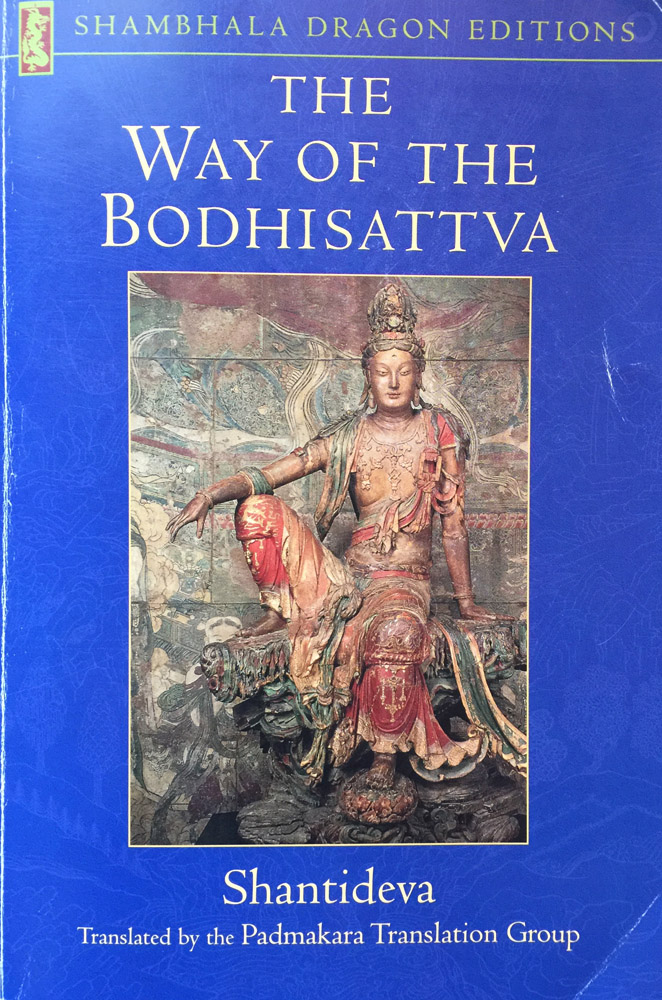
The Way of the Bodhisattva: A Translation of the Bodhicharyāvatāra-Review by Cantwell
| 🤓 Admin Zone 🛠️ hidden to non-admins | |
- A Guide to the Bodhisattva Way of Life (Bodhicaryāvatāra)-Review by Cantwell
- A Guide to the Bodhisattva Way of Life-Review by De Jong
- A Guide to the Bodhisattva Way of Life-Review by Pettit
- Entering the Path of Enlightenment-Review by Cook
- Entering the Path of Enlightenment-Review by Seyfort Ruegg
- The Bodhicaryāvatāra: A Guide to the Buddhist Path to Awakening-Review by Gethin
- The Way of the Bodhisattva: A Translation of the Bodhicharyāvatāra-Review by Cantwell
- The Way of the Translators: Three Recent Translations of Śāntideva's Bodhicaryāvatāra
Description
This is a beautiful and competent English translation of the standard Tibetan version of the Bodhicaryāvatāra of the renowned Indian Buddhist master Śāntideva. This short inspirational exposition of the bodhisattva path has had a central place in all the Tibetan Buddhist traditions and some sections are widely used in regular recitation practices. For example, verses from Chapter 2 are used in making offering and confession, while the verses expressing the bodhisattva aspiration in Chapter 3 are universally used in recitations of the bodhisattva vow.
However, the first question which the Buddhist studies student will inevitably ask of this new translation is whether its publication was necessary at all. Given the number of translations already available in European languages, both from Sanskrit and Tibetan, and furthermore, considering how many important Tibetan Buddhist works have yet to be rendered in English at all, what justification is there for another English version? The principal translator, Wulstan Fletcher, is acutely aware of this issue and directly tackles it at the outset with a rather impassioned and vigorous defence. In a spirit which is likely to evoke some sympathy from Tibet Journal readers, Fletcher (p. 27) argues that the Tibetan rather than the Sanskrit text deserves to be treated as "the original" [my italics!] for translation purposes since, along with its commentaries, it represents mainstream Mahāyāna scholarship and practice, kept alive in an unbroken tradition down to the present day. Having justified the principle of a translation based on the Tibetan, Fletcher (p. 28) then points out that the Padmakara Translation Group's work is of the particularly vibrant and widely influential Eastern Tibetan tradition stemming from the 19th century Dza Patrul Rinpoche, which has been extremely dynamic and productive in the last century, responsible for a number of important commentaries. The translation especially draws from the commentary of Khenpo Kunzang Palden, the oral teachings of Jigme Khyentse Rinpoche and other contemporary lamas of rNying ma pa and bKa' brgyud pa affiliations, while other translations (such as the English translation of Stephen Batchelor and the German translation of Georges Driessens) have mainly drawn on dGe lugs pa sources. (Cantwell, "Review," 144–45) Read more here
-front.jpg)