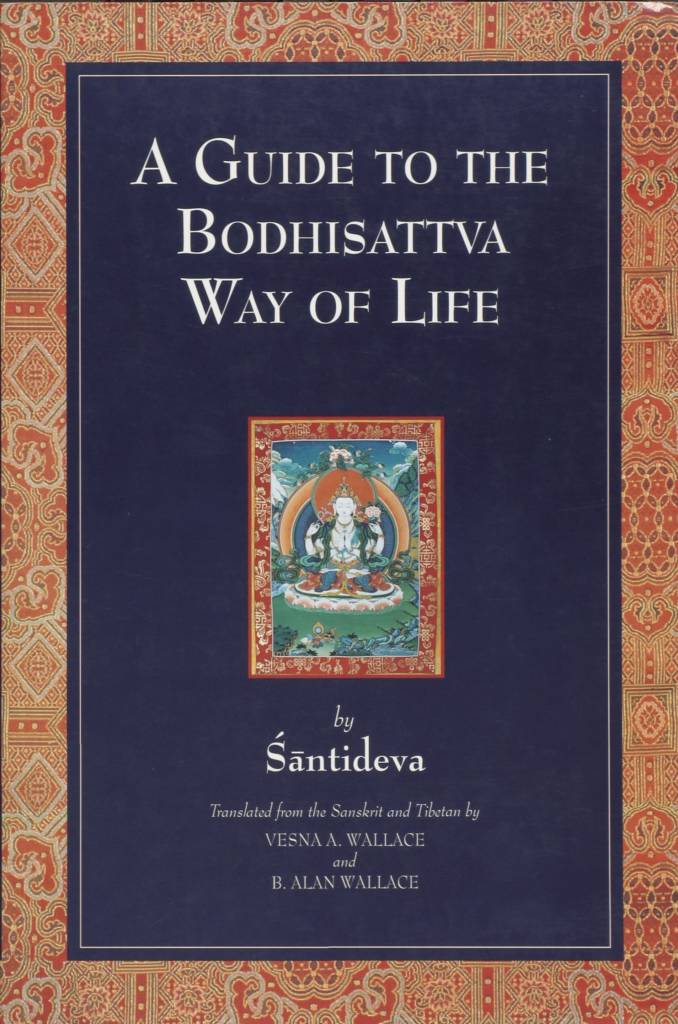
A Guide to the Bodhisattva Way of Life-Review by De Jong
| 🤓 Admin Zone 🛠️ hidden to non-admins | |
- A Guide to the Bodhisattva Way of Life (Bodhicaryāvatāra)-Review by Cantwell
- A Guide to the Bodhisattva Way of Life-Review by De Jong
- A Guide to the Bodhisattva Way of Life-Review by Pettit
- Entering the Path of Enlightenment-Review by Cook
- Entering the Path of Enlightenment-Review by Seyfort Ruegg
- The Bodhicaryāvatāra: A Guide to the Buddhist Path to Awakening-Review by Gethin
- The Way of the Bodhisattva: A Translation of the Bodhicharyāvatāra-Review by Cantwell
- The Way of the Translators: Three Recent Translations of Śāntideva's Bodhicaryāvatāra
Description
The Bodhicaryāvatāra (BCA) has been translated many times, cf. bibliography pp. 147-8 which even mentions the translation of one chapter into Dutch by Ensink but omits a complete translation into the same language by Ria Kloppenborg: De weg tot het inzicht (Amsterdam, Meulenhoff, 1980). According to the translators (WW) their version is the first to be based upon the Sanskrit text, the Sanskrit commentary by Prajñākaramati, the Tibetan translation and two Tibetan commentaries. However, there is already a translation from the Tibetan by Stephen Batchelor (Dharamsala, 1979) of which they have made use without acknowledging it.
According to the translators they have primarily based their translation on the Sanskrit version and its commentary. However, it is obvious that often their translation is based rather upon the Tibetan version. For instance, Chapter I, verse 4a reads: kṣaṇasaṃpad iyaṃ sudurlabhā. WW translate: "This leisure and endowment, which are so difficult to obtain, have been acquired." This rendering is based upon the Tibetan equivalent for akṣaṇa dal-'byor which Batchelor translated as "leisure and endowment." The translation "leisure" for kṣaṇa is particularly inappropriate and is due to the fact that the Tibetan equivalents dal-ba and khom-pa are rendered by "leisure" in Tibetan dictionaries. In the American Tibetological school of the Foe Destroyers the rendering "leisure" is generally adopted (cf. IIJ 20, 1978, p. 138). In this school it seems to be a rule never to translate a Sanskrit text when there is a Tibetan translation available. In this case WW seem not to have consulted the Sanskrit commentary from which they could have learned that kṣaṇasaṃpad is not a dvandva compound. Edgerton rendered it by "the good luck of (this) favorable birth", cf. Buddhist Hybrid Dictionary s.v. kṣaṇa. According to WW "endowment" refers to the conjunction of circumstances deemed essential for the successful practice of Dharma (p. 18, n. 4). Perhaps they have found this information in a Tibetan commentary which wrongly took dal-'byor to be a dvandva compound. In the same note WW state that the Pañjikā specifies the eight non leisures (sic) in the order in which they are listed in Śāntideva's quotation of the Gaṇḍavyūha in his Śikṣāsamuccaya. However, this quotation does not list the eight akṣaṇas but ten items which are difficult to obtain. The first of them is aṣṭākṣaṇavinivṛttiḥ. The eight akṣaṇas are mentioned further on in the Sanskrit commentary, cf. ed. L. de La Vallée Poussin (Calcutta, 1901-1914), p. 10, lines 14–15: narakapretatiryañco, etc. (de Jong, "Review," 75–76) Read more here