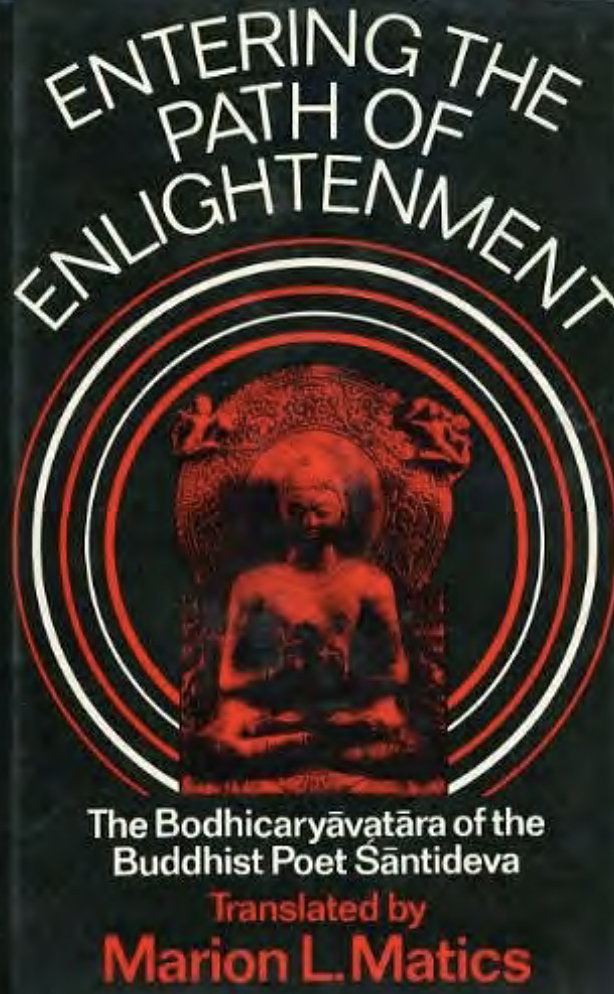
Entering the Path of Enlightenment-Review by Seyfort Ruegg
| 🤓 Admin Zone 🛠️ hidden to non-admins | |
- A Guide to the Bodhisattva Way of Life (Bodhicaryāvatāra)-Review by Cantwell
- A Guide to the Bodhisattva Way of Life-Review by De Jong
- A Guide to the Bodhisattva Way of Life-Review by Pettit
- A Short Presentation of Śāntideva's Bodhicaryāvatāra
- A Study of Akṣayamati (Śāntideva)'s Bodhisattvacaryāvatāra as Found in the Tibetan Manuscripts From Tun-huang
- Account of the Period of the Kings Cala, Pañcamasiṃha and Others
- Akṣayamati and Śāntideva
- Bodhi(sattva)caryāvatāra als Lehrschrift und Vorhaben: Zum Thema Ritual, Religion, Philosophie und Mystik im Buddhismus
- Bodhisattvas of the Forest and the Formation of the Mahayana
- Bu ston on the sPyod 'jug (Bodhisattvacaryāvatāra)
- Buddha Mind - Christ Mind
- Buddha's Lions
- Buddhist Texts Through the Ages
- Drops of Nectar: Khenpo Kunpal's Commentary on Shantideva's Entering the Conduct of the Bodhisattvas
- Entering the Path of Enlightenment
- Entering the Path of Enlightenment-Review by Cook
- Entering the Path of Enlightenment-Review by Seyfort Ruegg
- Ethical Revaluation in the Thought of Śāntideva
- Ethics in the Śikṣāsamuccaya: A Study in Mahāyāna Morality
- Facts or Fictions: Reconsidering Śāntideva's Names, Life, and Works
- Fierce Devotion to all Beings: The Role of Emotions in Śāntideva’s Introduction to the Way of the Bodhisattva (Bodhicaryāvatāra)
- General Introduction: Śāntideva and His World
- Gleichheit und Mitgefühl: Prajñākaramatis Kommentar zu Bodhicaryāvatāra VIII. 89-108
- How to Be a Bodhisattva: Introduction to the Practice of the Bodhisattva Path (The Bodhicaryāvatāra)
- La légende de Śāntideva
- Mahasiddhas: La vie de 84 sages de l'Inde
- Masters of Mahāmudrā
- Mental Purification (Blo sbyong): A Native Tibetan Genre of Religious Literature
- Moral Theory in Śāntideva's Śikṣāsamuccaya
- Moral Theory in Śāntideva's Śikṣāsamuccaya-Review by Osto
- Moral Theory in Śāntideva's Śikṣāsamuccaya: Cultivating the Fruits of Virtue-Review by Goodman
- On Akṣayamati's Bodhisattvacaryāvatāra
- Proof of the Authenticity of the Mahāyāna in Akṣayamati's Bodhi(sattva)caryāvatāra
- Readings of Śāntideva's Guide to Bodhisattva Practice
- Readings of Śāntideva's Guide to Bodhisattva Practice-Review by Harris
- Reason, Irrationality and Akrasia (Weakness of the Will) in Buddhism: Reflections upon Śāntideva's Arguments with Himself
- Remarks on Akṣayamati (Blo gros mi zad pa), Being the Author of the Earlier Version of the Bodhisattvacaryāvatāra
- Santideva's Bodhicaryāvatāra
- Santideva, un mistico del Buddhismo
- Shantideva (From Butön's History of Buddhism in India and Its Spread to Tibet, Translated by Lisa Stein and Ngawang Zangpo)
- Shantideva (Nariman)
- Shantideva's Bodhicaryavatara: An Internal Pilgrimage to Universal Peace and Compassion
- Shantideva's Teaching
- Shāntideva (Tib. Shi-wa-lha)
- Stotra, Psychological Conditioning, and the Bodhicaryāvatāra: Together with a Translation of the Bodhicittānuśaṃsapariccheda
- The Bodhi-caryâvatāra and Its Monastic Aspects: On the Problem of Representation
- The Bodhicaryāvatāra: A Guide to the Buddhist Path to Awakening-Review by Gethin
- The Bodhisattva Doctrine in Buddhist Sanskrit Literature
- The Center of the Sunlit Sky
- The Concept of Bodhicitta in Śāntideva's Bodhicaryāvatāra (Diss)
- The Ethics of Śaṅkara and Śāntideva
- The Ethics of Śaṅkara and Śāntideva-Review by Abramson
- The Ethics of Śaṅkara and Śāntideva-Review by Javanaud
- The Ethics of Śaṅkara and Śāntideva-Review by O'Leary
- The Literature of the Madhyamaka School of Philosophy in India
- The Mahāsiddha Bhusuku (Śāntideva), The Idle Monk
- The Masters and Poets of the Mahāyāna
- The Perfection of Wisdom (Schopen)
- The Resolve to Become a Buddha
- The Training Anthology of Śāntideva
- The Triskandha, Practice in Three Parts: Study of an Early Mahāyāna Buddhist Ritual
- The Way of the Bodhisattva: A Translation of the Bodhicharyāvatāra-Review by Cantwell
- The Way of the Translators: Three Recent Translations of Śāntideva's Bodhicaryāvatāra
- Śāntideva (Internet Encyclopedia of Philosophy)
- Śāntideva (Potter, Kalupahana, and Sweet)
- Śāntideva (Stanford Encyclopedia of Philosophy)
- Śāntideva and Bodhicaryāvatāra
- Śāntideva and the Mādhyamika: The Prajñāpāramitā-Pariccheda of the Bodhicaryāvatāra
- Śāntideva as a Mantracarin
- Śāntideva in the History of Mādhyamika Philosophy
- Śāntideva, A Mystic of Buddhism
- Śāntideva, il Bodhicaryāvatāra e le kārikā del Śikṣāsamuccaya
- Śāntideva, il Bodhicaryāvatāra e le kārikā del Śikṣāsamuccaya-Review by Pāsādika
- Śāntideva: Mystique Bouddhiste des VIIe et VIIIe siècles
- Śāntideva: Mystique Bouddhiste des VIIe et VIIIe siècles-Review by Cabezón
- Śāntideva: The Author and His Project
- Śāntidevas Bodhicaryāvatāra: Das Weiterwirken des Werkes dargestellt anhand der Überlieferungsgeschichte des Textes und seiner Kommentare
Description
Combining as it does the theoretical with the practical sides of Mahayana Buddhism, Śāntideva's Bodhicaryāvatarā is one of the best known and most frequently used treatises of the pure Madhyamaka school, of which it is one of the latest productions of Indian origin (7th century). Śāntideva was also the complier of an extensive anthology of Sūtra texts dealing largely with the same topics, the Śikṣāsamuccaya; compared with this work the Bodhicaryāvatāra is practically more methodical and philosophically more systematic, but the fact that it is composed entirely in verse no doubt gives rise to many a difficulty in interpretation. In Tibet there are a number of important commentaries on this work (and in particular on its ninth chapter dealing with the Perfection of transcending discriminative understanding) which testify to the significance attached to it by the Indo-Tibetan Buddhist tradition.
While there exist an English translation of Śāntideva's Śikṣāsamuccaya by C. Bendall and W. Rouse (London, 1922) and also two French translations of the Bodhicaryāvatarā, one by L. de La Vallée Poussin (Paris, 1907) and the other by L. Finot (Paris, 1920), in English it has been available only in the partial translation by L. D. Barnett first published in 1909 (second ed. 1947, with reprints). Mention should also be made of a recent monograph on the life, works and thought of Śāntideva by Amalia Pezzali (Śāntideva, mystique bouddhiste des VIIe et VIIIe siècles, Florence, 1968).
The present work is therefore the first attempt to provide a complete English translation of this important Madhyamaka treatise. In conformity with the prevalent conception of Śāntideva as a poet, mystic and practiser, it is the religious aspect of the work that seems to have been the focus of the translator's interest. Now in much of the Buddhist tradition religious thought is hardly separable from philosophy; and that Śāntideva was a philosopher is very clear, in particular from chapter IX, the longest in the book, which, as a quasi-independent treatise on prajñāpāramitā and vipaśyanā, has been the subject of the separate and very detailed Tibetan commentaries mentioned above. But this aspect of Śāntideva's work has scarcely received the attention it merits from most Western scholars, this onesided evaluation of the Bodhicaryāvatāra being reflected for example in Barnett's abridged translation where the fundamental ninth chapter is given only two out of a total of 84 pages. As evidenced by the work under review this evaluation seems to linger on—at least in the English-speaking world where the Bodhicaryāvatāra appears to have come to be regarded as an easy introduction to the Mahāyāna for the pious and religious minded—and to have hindered the understanding of this work as an important treatise of the Madhyamaka philosophical tradition. (Seyfort Ruegg, "Review," 88–89) Read more here