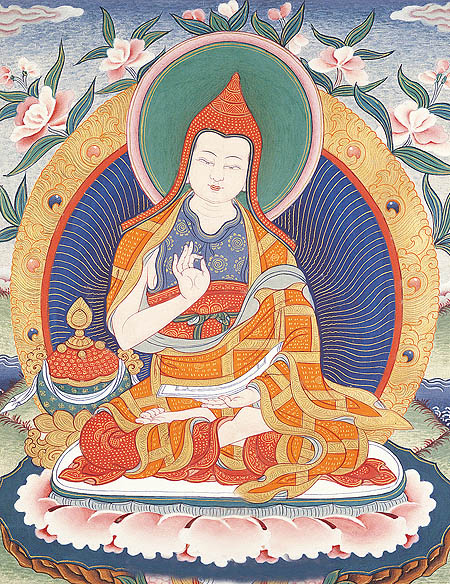
On this page you will find everything about Śāntideva's foundational text, the Śikṣāsamuccaya (Compendium of Training). The information below explores the text's structure and scriptural sources, its authorship and eighth-century Indian context, its profound influence on Tibetan Buddhist scholarship, its central role as an anthology of bodhisattva training teachings, and essential resources for further study and practice.
From here you can read the text in Tibetan and Sanskrit.
Charles Goodman offers a translation of the Śikṣāsamuccaya, a major work of religious literature by Śāntideva, in which he brings together a large number of sūtra passages.
Translation
Read the Text
Read the chapters in bilingual presentation.
Chapter I
Śikṣāsamuccaya
Śikṣāsamuccaya (T. Bslab pa kun las btus pa; C. Dasheng ji pusa xue lun; J. Daijōjū bosatsugakuron; K. Taesǔng chip posal hak non 大乘集菩薩學論). In Sanskrit, "Compendium of Training," a work by the eighth-century Indian Mahāyāna master Śāntideva. It consists of twenty-seven stanzas on the motivation and practice of the bodhisattva, including bodhicitta, the six perfections (pāramitā), the worship of buddhas and bodhisattvas, the benefits of renunciation, and the peace derived from the knowledge of emptiness (śūnyatā). The topic of each of the stanzas receives elaboration in the form of a prose commentary by the author as well as in illustrative passages, often quite extensive, drawn from a wide variety of Mahāyāna sūtras. Some ninety-seven texts are cited in all, many of which have been lost in their original Sanskrit, making the Śikṣāsamuccaya an especially important source for the textual history of Indian Buddhism. These citations also offer a window into which sūtras were known to a Mahāyāna author in eighth-century India. The digest of passages that Śāntideva provides was repeatedly drawn upon by Tibetan authors in their citations of sūtras. Although Śāntideva's Bodhicaryāvatāra and Śikṣāsamuccaya both deal with similar topics, the precise relation between the two texts is unclear. Several of the author's verses appear in both texts and some of the sūtra passages from the Śikṣāsamuccaya also appear in the Bodhicaryāvatāra. One passage in the Bodhicaryāvatāra also refers readers to the Śikṣāsamuccaya, but this line does not occur in the Dunhuang manuscript of the text and may be a later interpolation. (Source: "Śikṣāsamuccaya." In The Princeton Dictionary of Buddhism, 821. Princeton University Press, 2014. http://www.jstor.org/stable/j.ctt46n41q.27.)
Explore all the works cited by Śāntideva in The Compendium of Training.
The Śikṣāsamuccaya (Compendium of Training) is a thorough presentation of bodhicitta cultivation in classical Mahāyāna literature, yet it remains much less studied than its companion work, the Bodhicaryāvatāra. Attributed to the eighth-century Indian master Śāntideva, this large anthology organizes scriptural passages around twenty-seven memorial verses to give an authoritative foundation for understanding altruistic motivation and the complete bodhisattva path. Paul Harrison's groundbreaking research challenges traditional scholarly assessments of the work as mere compilation, showing instead a complex integration of scriptural authority with profound authorial insight.
The text presents bodhicitta through a unique organizational matrix centered on giving, protecting, purifying, and enhancing one's body, possessions, and merit for universal benefit. This framework includes both aspiration bodhicitta—the initial vow to attain enlightenment for others—and applied bodhicitta—the systematic engagement in bodhisattva practices including ethical discipline, compassionate action, and wisdom cultivation. The work's philosophical complexity appears in its treatment of ethical revaluation, where conventional goods are reconceptualized as spiritual obstacles while apparent harms become opportunities for virtue cultivation, all grounded in extensive scriptural quotations that establish canonical authority.
Beyond its systematic presentation of bodhisattva training, the Śikṣāsamuccaya serves as an invaluable repository for understanding Mahāyāna doctrinal development, preserving fragments from approximately thirty-six named sūtras, many no longer extant in their original Sanskrit. The text's reception history shows sustained influence through figures like Atiśa and Prajñākaramati. In Tibet, the text became one of the foundational works of the Kadam school, though its technical nature limited popular circulation compared to the more accessible Bodhicaryāvatāra. Contemporary scholarship shows renewed appreciation for its relevance to engaged Buddhist practice, therapeutic applications of compassion cultivation, and systematic approaches to moral development that integrate individual transformation with service to others.
This page was written or translated by the Tsadra Foundation staff as part of the editorial project of this website. It is original content written or translated for the Bodhicitta Project.
The work circulates under the Sanskrit title Śikṣāsamuccaya, which literally means "Compendium of Training" or "Collection of Precepts" (śikṣā + samuccaya), accurately reflecting its character as a systematic compilation of training materials. Its Tibetan rendering, Bslab pa kun las btus pa, maintains this meaning as "Compendium of All Trainings." The Chinese version is titled 大乘集菩薩學論 (Dàchéng jí púsà xué lùn), or Mahāyāna Treatise on Bodhisattva Training, explicitly identifying its doctrinal orientation.
Versions of the Text
The systematic preservation of the text's twenty-seven foundational verses as an independent work—the Śikṣāsamuccayakārikā (Toh 3939)—shows that these verses were considered to be a coherent doctrinal summary capable of standing alone. This textual separation, accomplished by the same early Tibetan translation team as mentioned above, could have been motivated by the need for a brief aide-mémoire or doctrinal compendium. As discussed further in the "Content and Structure" section, these verses function as the "vital points" (marmasthāna) of the text, with significant thematic overlap with verses in the Bodhicaryāvatāra.
The manuscript tradition of the Śikṣāsamuccaya itself shows both remarkable preservation and clear limits. The sole surviving complete Sanskrit witness is the Cambridge manuscript Add. 1478 written in Bengali script. Scholars report a colophon linking it to the thirteenth-century scholar Vibhūticandra of Jagaddala, indicating use within late Indian Buddhism. The codex entered the Cambridge University Library in the 1870s as part of the Wright Collection after being obtained in Kathmandu, and it is now available in high resolution through the Cambridge University Digital Library. On the basis of this single witness, Cecil Bendall produced the first printed edition under the title Çikshāsamuccaya, a Compendium of Buddhist Teaching, published in installments between 1897 and 1902. In 1961 P. L. Vaidya issued a Devanagari version that largely reproduces Bendall's text rather than constituting an independent recension. Most digital Sanskrit renditions in use today follow this line of transmission from the Cambridge manuscript through Bendall and Vaidya.
A single Chinese translation of the Śikṣāsamuccaya is preserved in the Taishō canon as No. 1636 under the title 大乘集菩薩學論 (Dàshèng jí púsà xué lùn), a translation translated in the Song by Dharmapāla (Fǎhù) and Nicheng, among others. The Taishō entry presents the text as a treatise authored by the bodhisattva Dharmayaśa/Dharmakīrti" (法稱, Facheng), while modern scholarship treats this attribution as mistaken. The translation is generally dated to the first half of the eleventh century and circulated under this alternative title in East Asia. A notable feature of the Chinese witness is its authorial ascription to "Dharmakīrti" rather than to Śāntideva, together with consistent internal signals that help separate the treatise voice from quoted scripture. The phrase 論曰 ("The treatise/text says:") functions as a marker for Śāntideva's own prose and verse, aiding the identification of original material within the anthology. Early comparative work established that this Chinese text corresponds to the Sanskrit and Tibetan Śikṣāsamuccaya, though with minor reordering such as the portion counted as the end of chapter eighteen aligning with chapter nineteen in the other witnesses. Despite the availability of this translation, reception in the Chinese tradition appears limited and did not produce a significant commentary lineage. The Chinese version also compresses several passages, though it generally aligns with the Sanskrit and Tibetan witnesses.
The Tibetan translation history of the Śikṣāsamuccaya shows a distinct early version followed by a later revision. The first translation was produced at the beginning of the ninth century by Jinamitra, Dānaśīla, and Yeshe De and is preserved in the Tengyur under the title Bslab pa kun las btus pa, Toh 3940. The work is attested in the early Tibetan catalogues and is widely regarded as an official product of the royal translation enterprise. In the eleventh century the Kashmiri scholar Tilakakalaśa and the Tibetan master Ngok Lotsāwa Loden Sherab prepared a substantial revision that replaced or supplemented portions of the earlier rendering. Evidence from Tibetan manuscript fragments indicates that material from an unrevised stratum persisted, suggesting that the early and revised versions likely circulated side by side for a time. The Tibetan tradition is an essential but complex witness. Harrison's analysis shows that the translators sometimes rendered Śāntideva’s citations themselves, sometimes adopted existing canonical translations, and sometimes produced mixed results, so the Tibetan is frequently more expansive than the surviving Sanskrit and can overwrite deliberate omissions in the source text. This patchwork, ad hoc approach reflects the milieu of the early ninth-century translation project, in which the same team also worked on many of the very sūtras quoted in the anthology. As a result, the Tibetan version is invaluable for study yet must be controlled against the Sanskrit and weighed citation by citation rather than treated as a single, uniformly independent witness.
Content and Structure
The Śikṣāsamuccaya presents its extensive materials through a complex organizational framework built around twenty-seven kārikās that serve as both structural armature and mnemonic guideposts. These verses, identified by scholars as the text's "vital points" (marmasthāna), provide the organizational plan for the entire work. The shared motif of vowing one's "body, possessions, and merit" for the sake of others, which also appears in the Bodhicaryāvatāra, supports reading the kārikā set as a bodhicitta-oriented mnemonic program embedded in the anthology.
The fourth kārikā (ŚSK 4) provides the comprehensive framework for the work, establishing a 4x3 matrix consisting of four primary activities applied to three fundamental bases of the practitioner's existence. The verse states: "ātmabhāvasya bhogānāṃ tryadhvavṛtteḥ śubhasya ca / utsargaḥ sarvasattvebhyas tadrakṣāśuddhivardhanam //" ("Giving away to all sentient beings your body, your possessions, and your good gained in the past, present, and future, and protecting, purifying, and enhancing them"). The three bases (tribhūmi) encompass the practitioner's complete spiritual resources:
The Body (ātmabhāva): The physical person and psychophysical continuum.
Possessions (bhoga): All material and experiential resources.
Merit (śubha): The accumulated store of positive karmic potential from all wholesome actions.
The four activities (caturvidhakarma) to be applied systematically to these bases are:
Giving (utsarga): The complete dedication of the three bases for others' welfare.
Protecting (rakṣā): Guarding the bases from harm and degeneration.
Purifying (śuddhi): Cleansing the bases of defilements, attachment, and wrong views.
Enhancing (vardhana): Actively increasing and developing the positive potential of the bases.
The nineteen chapters of the work can be analyzed through this four-activity sequence, which is interleaved with the six perfections as a cross-cutting organizational scaffold.
Chapter 1 addresses Giving (utsarga), establishing the foundational practice of complete self-offering and introducing faith (śraddhā) as its essential prerequisite.
Chapters 2–7 focus on Protection (rakṣā), covering ethical discipline, mindful conduct, and avoidance of the eighteen root downfalls (mūlāpatti).
Chapters 8–15 address Purification (śuddhi), detailing methods such as confession, patience cultivation, and the practice of equalizing and exchanging self with others.
Chapters 16–19 concentrate on Enhancement (vardhana), exploring advanced practices of effort, meditation, and wisdom that culminate in the universal dedication of merit.
Each chapter typically begins with one or more kārikās, followed by Śāntideva's prose commentary and extensive sūtra quotations that provide scriptural authority. This structure facilitates multiple approaches to study, allowing practitioners to work through the entire curriculum systematically or concentrate on relevant sections, while the abundance of scriptural quotations provides ready access to authoritative teachings for contemplation drawn from at least thirty-six named Mahāyāna sūtras. The proportion of original material to quoted passages is significant, a point elaborated on in the "Scholarly Assessment" section.
Table 1: Structural Organization of the Śikṣāsamuccaya
Chapter Range
Primary Activity
Key Perfections
Major Themes
Doctrinal Focus
1
Giving (utsarga)
Generosity (dāna)
Self-offering, gift of body and goods, dedication of merit, faith as foundation
Establishing bodhicitta and foundational motivation
Enhancement and dedication of merit, recollection of the Three Jewels, review and consolidation
Integrating insight, consolidating virtue, orienting practice toward realization
Overview of Śāntideva's Śikṣāsamuccaya
In-Depth Chapter Overviews
An extensive, in depth, chapter-by-chapter exploration of Śāntideva's Śikṣāsamuccaya (The Compendium of Training). There are twenty-seven stanzas in the root text, and each of the stanzas is elaborated upon in a prose commentary by the Śāntideva himself. Around 100 early Sanskrit texts are cited in support of the commentary, which makes it an important source for understanding how eighth-century Indian Mahāyāna authors thought about sūtra sources. The extensive citations reveal rich intertextual connections and offer a window into the larger world of Mahāyāna source material. We present here one way that the Tibetan commentarial tradition organizes the nineteen chapters of the text into the topics of Giving, Protecting, Purifying, and Enhancing.
Giving
Chapter 1 of The Compendium of Training discusses the first of four activities that make up the practice of a bodhisattva—giving one's body, possessions, and virtues to all sentient beings.
Chapter 1
Protecting
Chapters 2–7 discuss the various practices bodhisattvas can engage in to guard and protect their body, possessions, and virtues.
Click to expand
Śikṣāsamuccaya - Chapter 2
Śikṣāsamuccaya - Chapter 3
Śikṣāsamuccaya - Chapter 4
Śikṣāsamuccaya - Chapter 5
Śikṣāsamuccaya - Chapter 6
Śikṣāsamuccaya - Chapter 7
Purifying
In chapter 8–15, Śāntideva turns to the topic of purification and discusses the various practices bodhisattvas can engage in to purify themselves of sinful actions and afflictive emotions. These actions include: confession and atonement, the practice of patience, putting forth effort in study and learning, purifying the mind through meditation, and applying the mind to the practice of mindfulness.
Click to expand
Śikṣāsamuccaya - Chapter 8
Śikṣāsamuccaya - Chapter 9
Śikṣāsamuccaya - Chapter 10
Śikṣāsamuccaya - Chapter 11
Śikṣāsamuccaya - Chapter 12
Śikṣāsamuccaya - Chapter 13
Śikṣāsamuccaya - Chapter 14
Śikṣāsamuccaya - Chapter 15
Enhancing
Chapters 16–19 cover the enhancement of the body, possessions, and merit.
Click to expand
Śikṣāsamuccaya - Chapter 16
Śikṣāsamuccaya - Chapter 17
Śikṣāsamuccaya - Chapter 18
Śikṣāsamuccaya - Chapter 19
Explore the Śikṣāsamuccaya
A new, interactive way to navigate the text via its outline and related themes and chapters. Click on the Miro Mindmaps here. Use two fingers to move the cursor and to zoom in and out.
Śikṣāsamuccaya Outline Miro Mindmap
Śāntideva's second and only other known text, A Compendium of Training, is like a companion to the Bodhicaryāvatāra and deals extensively with the motivation and practice of the bodhisattva.
Miro Mindmap
Part 2: About the Author
Traditional Attribution and Profile
Traditional Indo-Tibetan historiography unanimously attributes the Śikṣāsamuccaya to Śāntideva, an eighth-century master associated with the great monastic university of Nālandā and the broader Madhyamaka philosophical tradition. Vibhūticandra (fl. c. 1200), Butön (1290–1364), Tāranātha (1575–1608), and Sumpa Khenpo (1704–1776?) consistently ascribe three works to Śāntideva: the Śikṣāsamuccaya, the Bodhicaryāvatāra, and a Sūtrasamuccaya. This unanimous attribution across several centuries of Tibetan scholarship, maintained despite variations in other biographical details, strengthens confidence in Śāntideva's authorship despite the absence of surviving Sanskrit colophons or contemporary Indian testimonies. The traditional account maintaining Śāntideva's authorship of all three texts is part of a transmission line that includes Vibhūticandra, Butön, Tāranātha, and Sumpa Khenpo, representing a consistent lineage of scholarly understanding about the composition.
The traditional biographical framework presents Śāntideva as a learned scholar-practitioner who composed his major works during the flourishing period of Indian Mahāyāna Buddhism at Nālandā Monastery. Butön's influential account, which supplied the later Tibetan tradition with basic ideas about Śāntideva's life and works, places him within the institutional context of Nālandā and credits him with extraordinary learning combined with deep spiritual realization. The famous legendary account relates that Śāntideva was initially dismissed by other monks as lazy, earning the derisive nickname Bhusuku (an acronym for "eat, sleep, and defecate"), but during a public recitation delivered the entire Bodhicaryāvatāra extemporaneously, miraculously ascending into the sky and vanishing at the climax of the wisdom chapter while his voice continued to complete the recitation. This narrative, found in sources like Prajñākaramati's commentary and various Tibetan chronicles, while clearly embellished, symbolically underscores both Śāntideva's profound mastery of Dharma and the transformative power of his teachings. Traditional accounts, likely stemming from Vibhūticandra, hold that Śāntideva composed all three texts while at Nālandā before his famous recitation, suggesting the Bodhicaryāvatāra's exhortation to read the other two texts indicates all three were complete and available at the time of the recitation.
Historical dating estimates vary among contemporary scholars, though general consensus places Śāntideva's productive period in the eighth century. Saitō initially suggested ca. 650–700 for Śāntideva's floruit, later revising to ca. 690–750, while Pezzali's detailed study reasoned that the productive period likely fell between 685 and 763 CE. These chronological assessments locate Śāntideva within the mature period of Indian Mahāyāna literary development, when major monastic universities like Nālandā fostered sophisticated philosophical and literary creativity under the political stability provided by regional dynasties following the decline of Harsha's empire and preceding the rise of the Pāla dynasty.
The institutional context at Nālandā provided an ideal environment for the kind of comprehensive scholarly work represented by the Śikṣāsamuccaya. The university's extensive library resources, diverse faculty representing different philosophical schools, and emphasis on both theoretical study and contemplative practice would have supported Śāntideva's ambitious project of compiling and organizing the vast corpus of Mahāyāna sūtra literature into a systematic training manual. The legendary account of his dramatic departure symbolically underscores both his profound mastery of Dharma and provides Harrison's apt metaphor for Śāntideva's "disappearance" within his own anthology, where his authorial voice becomes obscured beneath layers of scriptural quotations only recently recovered through careful philological analysis.
The Authorship Debate
Contemporary scholarship has identified several challenges to the traditional authorship assumptions, stemming primarily from manuscript discoveries at Dunhuang. These manuscripts contain an earlier, nine-chapter recension of the Bodhicaryāvatāra (often called BSA-I), which complicates the relationship between Śāntideva's works and raises questions about their compositional sequence.
The central issue is that this early version (BSA-I) does not contain the verses found in the later, standard ten-chapter edition (BCA V.104–106) that recommend the study of the Śikṣāsamuccaya and attribute the Sūtrasamuccaya to Nāgārjuna. The absence of these references in the earlier recension suggests it was composed before the Śikṣāsamuccaya was written or had gained prominence. Conversely, the inclusion of these verses in the later, expanded BCA suggests that by the time it reached its final form the Śikṣāsamuccaya had been completed and was held in high regard. This textual evidence has led modern philological scholars to propose a sequential composition, a view detailed in the following section.
Table 2: Evidence Supporting Traditional Attribution
Scholar/Source
Evidence Type
Specific Details
Source
Prajñākaramati
Commentary linkage
Bodhicaryāvatārapañjikā relies extensively on ŚS quotations and cites roughly half of the ŚSK in similar order
Lele 2007
Atiśa
Explicit citation and attribution
In Bodhimārgapradīpapañjikā (Tengyur D3948), explicitly names Śāntideva in relation to the Śikṣāsamuccaya
Bodhimārgapradīpapañjikā (D3948)
Tibetan catalogs
Canonical listings
Early imperial catalogues (Denkarma, Phangthangma) attest the translation and official status of Bslab pa kun las btus pa; Tibetan translation colophons explicitly name the author and list translators and revisers. This combination confirms ŚS was composed and attributed to Śāntideva by the early ninth century.
Denkarma; Phangthangma; Saitō 2010
Traditional historians
Historiographical attribution
Butön, Tāranātha, Sumpa Khenpo attribute the Śikṣāsamuccaya, Sūtrasamuccaya, and Bodhicaryāvatāra to Śāntideva
Saitō 2010
Another focus of debate is the relationship between Śāntideva and Akṣayamati, a name to whom the earlier recension is attributed in some manuscripts. While the Dunhuang evidence may suggest they were distinct historical figures, some scholars argue that Akṣayamati was an epithet for Śāntideva, noting the frequent citation of the Akṣayamatinirdeśasūtra in the Śikṣāsamuccaya. Some have speculated that the final verse of the Bodhicaryāvatāra (10.58), which contains the word matiḥ ("mind"), could be a poetic double-entendre for "(Akṣaya-)Mati," offering tentative internal evidence for the identity of the two names, though this remains inconclusive.
Table 3: Authorship and Attribution—Evidence and Interpretive Positions
Scholar
Evidence Type
Specific Details
Source
Dunhuang manuscripts
Alternative attribution
The early Tibetan Dunhuang recension names Akṣayamati (Blo gros mi zad pa) as author of the Bodhicaryāvatāra and lacks the verse recommending the Śikṣāsamuccaya.
Distinguishes two versions, assigning a nine-chapter recension to Akṣayamati and a ten-chapter recension to Śāntideva.
Lele 2007
Textual criticism (Saitō, Harrison)
Compositional complexity
Redactional layering is at issue; one hypothesis is that a single author composed the earlier recension, then the Śikṣāsamuccaya, and later augmented the Bodhicaryāvatāra for the canonical recension.
Harrison 2007
Contemporary scholars (Lele)
Methodological skepticism
Frames "Śāntideva" as a postulated author distinct from the historical composer, reflecting caution about conflating textual persona with historical figure.
Lele 2007
Scholarly Disagreements
Scholarly views on the compositional sequence of Śāntideva's works diverge, largely based on interpretations of the textual evidence discussed above. Three main hypotheses have emerged:
1. Traditional View (Concurrent Composition): Traditional Indo-Tibetan historians like Vibhūticandra, Butön, and Tāranātha maintain that Śāntideva authored the Śikṣāsamuccaya, Sūtrasamuccaya, and Bodhicaryāvatāra concurrently while at Nālandā. This view interprets the cross-references in the Bodhicaryāvatāra as evidence that all three texts were complete and available as an integrated set at the time of his famous recitation, reflecting a unified pedagogical plan.
2. Source-Critical View (Sequential Composition): Modern philological scholars, particularly Akira Saitō and Paul Harrison, propose a chronological sequence based on analysis of the Dunhuang manuscripts. This view posits that the explicit recommendation of the Śikṣāsamuccaya (BCA V.104–106) in addition to the Nāgārjuna's Sūtrasamuccaya (BCA V.106) is a later addition found only in the expanded or "updated" version of the Bodhicaryāvatāra. Because the earliest recension of the text (BSA-I) lacks these references, it follows that the Śikṣāsamuccaya probably didn’t exist when this early version was composed. In addition, since a verse in the Dunhuang version (BSA-I, 8.48) is shared with the Śikṣāsamuccaya but is not found in the later BCA version, Saitō suggests the following sequence: early BCA (BSA-I) → Śikṣāsamuccaya → expanded BCA. In this view, the final redaction of the BCA was edited to incorporate references that would promote the anthology and establish its authority. Harrison's identification of original verses within the compilation supports this model by demonstrating a compositional sophistication that builds upon the earlier poetic work.
3. Iterative Composition Hypothesis: Karma Phuntsho offers an alternative to the linear, sequential model of Śāntideva's compositions by proposing a more fluid and interactive creative process. He posits that the deep thematic and textual links between the Śikṣāsamuccaya and the Bodhicaryāvatāra, along with traditional narratives of their joint discovery, suggest that a strictly chronological production is unlikely. Instead, Phuntsho argues for an iterative development, where Śāntideva likely worked on both texts concurrently, moving back and forth to revise and refine them. In an era without formal publication, multiple drafts could easily have existed simultaneously. Textual evidence in regard to the complex state of the primary sources supports this hypothesis in the following way: The shorter and longer versions of the Bodhicaryāvatāra do not share all their verses. In addition, the Śikṣāsamuccaya contains material unique to each of those versions. Phuntsho concludes that it is therefore more accurate to view the different versions not as distinct, sequential works resulting from a linear composition process but as a single work captured at various points in an ongoing process of revision and enhancement.
The Sūtrasamuccaya Question
The traditional attribution of a third work, the Sūtrasamuccaya, to Śāntideva remains a point of significant contention. While later Tibetan historians unanimously attribute all three works to him, modern text-critical analysis suggests this is a misunderstanding. The canonical version of the Bodhicaryāvatāra itself (V.106) recommends studying the Sūtrasamuccaya compiled by Ārya Nāgārjuna, explicitly distinguishing this earlier work from Śāntideva’s own compilations. Contemporary research indicates that Nāgārjuna's compilation functioned as a direct source and methodological template for Śāntideva's anthology. Harrison observes that, in places, Śāntideva reproduces extended runs of the earlier work's sūtra citations with minimal alteration, a pattern that would count today as unattributed borrowing. The confusion likely arose because later Tibetan catalogers, seeing the titles grouped together, inferred unified authorship. The current scholarly consensus is that Nāgārjuna should be credited with the Sūtrasamuccaya, while Śāntideva composed the Bodhicaryāvatāra and the Śikṣāsamuccaya.
Śāntideva's Life and Works
Explore Śāntideva's life stories and his historical context. What do we know about the life of Śāntideva? What kind of world did he live in? How did his works become so influential? And why do his works continue to inspire generations of practitioners and scholars? This section provides a brief overview of Śāntideva's cultural milieu and the influence his writings have had in India and beyond.
Śāntideva's Life and Cultural World
Śāntideva's life is shrouded in legend, as most of what we know about him comes from the various hagiographies written in the centuries after his time. But much can be understood about his life based on his religious and cultural environment and the education he received at the famed Buddhist university of Nalanda, in northern India.
Explore
Part 3: Text Significance and Reception
Significance for Bodhicitta Studies
The Śikṣāsamuccaya occupies a unique position within Buddhist literature for its systematic presentation of bodhicitta, integrating altruistic motivation throughout its entire framework. Later commentators argued that bodhicitta is the central theme of both of Śāntideva's works, a view supported by the text's organizational structure, where every aspect of bodhisattva training is presented as an expression or cultivation of this altruistic motivation. While Śāntideva does not offer a formal definition in this work, he clearly understood bodhicitta as the altruistic aspiration to attain perfect enlightenment for the sake of all sentient beings. The text's distinctive contribution lies in its comprehensive integration of theory and practice, demonstrating how bodhicitta functions as both inspiration and method. It systematically encompasses both aspiration bodhicitta (praṇidhicitta), the initial wish to attain buddhahood for others, and applied bodhicitta (prasthānacitta), the active engagement in bodhisattva practices like the six perfections. This dual approach establishes the work as an authoritative guide for complete bodhicitta development, complementing the inspirational tone of the Bodhicaryāvatāra with detailed scriptural support. A key concept woven into the memorial verses is the definition of bodhisattva practice as being śūnyatākaruṇāgarbha—"having voidness and universal compassion as its essence"—a formulation that inseparably unites wisdom and compassionate action.
Philosophical and Ethical Significance
The Śikṣāsamuccaya's contribution extends beyond soteriology to sophisticated treatments of ethics and philosophy. Barbra Clayton identifies its ethical framework as a form of consequentialism centered on mental purity and compassionate action, where the value of actions is determined by their effect on altruistic motivation and the reduction of suffering. A central aspect of this framework is the collapse of a rigid distinction between facts and values; Buddhist ethics is presented as inherently "naturalistic," meaning moral concepts are defined in terms of ontological properties, so that seeing reality correctly is inseparable from the cultivation of virtue.
One of the most distinctive features of Śāntideva's thought is the practice of "ethical revaluation," a cognitive reframing where conventionally valued goods are reinterpreted as potentially harmful and conventionally perceived harms are revalued as beneficial opportunities for spiritual practice. For example, conventional goods like wealth and reputation are revalued as spiritually dangerous because they fuel attachment and pride, while conventional harms like being insulted or injured are revalued as precious opportunities to cultivate patience. The text systematically provides authoritative, sūtra-based justifications for these challenging ethical positions, grounding them in canonical Buddhist teachings.
The text's philosophical sophistication is particularly evident in its final chapters, which include a refutation of Sāṃkhya dualism—the idea of an independent consciousness (puruṣa) and primordial matter (prakṛti). Śāntideva employs Madhyamaka-style reasoning to dismantle wrong views about the self and phenomena, demonstrating that bodhisattva training requires not only compassion but also penetrating understanding of the very nature of things and therefore of reality itself.
Importance for Preserving Lost Literature
As an anthology, the Śikṣāsamuccaya preserves fragments of Buddhist literature that would otherwise be lost. Its many citations from Mahāyāna sūtras no longer extant in Sanskrit make it indispensable for text-critical work and for reconstructing the intellectual landscape of eighth-century Indian Buddhism. Scholars stress that Śāntideva's compilation functions as a repository of canonical material, preserving voices from across schools. Research has shown that his selections transmit passages from traditions such as the Mahāsāṃghika-Lokottaravādin that are otherwise inaccessible. One example is Yuyama's analysis of a passage from the Bhikṣuprakīrṇaka, a text of the Mahāsāṃghika-Lokottaravādin Vinaya, which illustrates how the Śikṣāsamuccaya supports the recovery of early Vinaya materials and highlights the diversity of early Buddhist scholasticism.
Reception History
The Śikṣāsamuccaya's historical reception demonstrates sustained influence, though it remained more limited compared to the more accessible Bodhicaryāvatāra. In India, it was recognized by significant figures like Atiśa, who treated it as an authoritative source for bodhisattva ethics in his Bodhimārgapradīpapañjikā. The most significant early reception occurred through Prajñākaramati's commentary on the Bodhicaryāvatāra, which quotes heavily from the Śikṣāsamuccaya and treats both works as a unified corpus, establishing a precedent for reading them as complementary components of Śāntideva's pedagogical system.
Table 4: Historical Reception Patterns
School/Period
Key Interpreters
Distinctive Approach
Emphasis
Influence
Indian Madhyamaka
Prajñākaramati, Atiśa
Integrative commentary
Unified BCA/ŚS corpus
Moderate
Early Tibetan
Yeshe De, translators
Canonical preservation
Scriptural authority
High
Kadampa
Atiśa's disciples, Potowa
Six scriptural pillars
Practice lineage
High
Later Tibetan
Patrul Rinpoche
Commentary tradition
BCA emphasis, ŚS reference
Limited
East Asian
Chinese translators
Doctrinal classification
Treatise status
Minimal
Contemporary
Dalai Lama, scholars
Revival interest
Practice relevance
Growing?
In Tibet, the text's influence was firmly established by Atiśa and the subsequent Kadam school. Atiśa and his disciples classed Śāntideva's two major works among the "six scriptural pillars of the Kadampa" (bka' gdams gzhung drug), a status which ensured their study in major monastic centers. This institutional recognition provided the text with sustained scholarly attention and practical application, though it typically served as supplementary material for understanding the more widely memorized Bodhicaryāvatāra. The nineteenth-century master Patrul Rinpoche championed Śāntideva's legacy, but his disciples' commentaries focused primarily on the Bodhicaryāvatāra, with the Śikṣāsamuccaya receiving comparatively less popular attention.
Reception in East Asia remained minimal despite a Chinese translation being completed in the eleventh century. Circulating under a different title and attribution, the text failed to generate a significant commentary tradition or practical application within major Chinese Buddhist schools, likely due to its late arrival and anthology format. Contemporary reception demonstrates renewed scholarly and practical interest, sparked in part by the current Dalai Lama's teachings on the text, in which he called it a "key which can unlock all the teachings of the Buddha," highlighting its enduring relevance.
Read More About the Textual History and Reception of Śāntideva's Śikṣāsamuccaya
Karma Phuntsho's deep dive into the Śikṣāsamuccaya unravels this pivotal Buddhist text's fascinating journey from its mysterious eighth-century origins through centuries of cross-cultural transmission and scholarly debate. The article navigates complex relationships between Śāntideva's works, examines heated academic discussions about compositional sequences, and reveals how this anthology became a cornerstone of Tibetan Buddhist education despite receiving less attention than the Bodhicaryāvatāra. From early translations to colonial-era rediscovery and contemporary academic renaissance, Phuntsho traces how the text has continuously adapted while preserving ancient wisdom—providing the roadmap you need to explore one of Buddhism's most important but underappreciated masterworks.
Read this article
Part 4: Study the Text
Key Verses and Passages
The Śikṣāsamuccaya's teachings emerge through carefully selected passages that demonstrate both the theory and application of altruistic motivation. As noted previously, the architecture of the work is anchored in twenty-seven memorial verses (kārikās) that function as a mnemonic and contemplative framework. The following passages illustrate key aspects of its presentation of bodhicitta.
Passage 1: The Foundational Role of Faith (Śikṣāsamuccaya, Chapter 1: "The Perfection of Giving")
Śāntideva opens the work by making faith (śraddhā) the very first major theme: it is framed as the ground on which the intention for awakening is set and from which it can reliably grow. To establish this, Śāntideva arrays scriptural proofs—most prominently verses from the Ratnolkādhāraṇī—and corroborates them with the Daśadharmasūtra, Lalitavistara, and Siṃhaparipṛcchā. Only once this "root" is stabilized does he pivot to strengthening bodhicitta itself, illustrated through a string of similes drawn from the Gaṇḍavyūha that portray the mind of awakening as seed, field, support, protector, and treasure, among others. Together these moves position faith as the enabling condition for bodhicitta and the wider bodhisattva curriculum.
Passage 2: The Transformative Power of Bodhicitta (Śikṣāsamuccaya, Chapter 8: "Expiation of Sinful Actions")
In the section on confession and atonement, Śāntideva singles out bodhicitta as a preeminent support for purification. Phuntsho notes that Śāntideva (citing the Maitreyavimokṣa) characterizes bodhicitta as capable of consuming negativities like a universal conflagration and, by classical alchemical comparison, as something that transmutes what is base without itself being altered; it is also likened to a lamp that instantly removes long-standing darkness. From a purely practical perspective, even repeated failings can be remedied when bodhicitta is upheld. As long as the bodhisattva strives to combine wisdom and compassion, negative actions can be purified.
Passage 3: The Equality of Self and Others (Śikṣāsamuccaya, Chapter 19: "Enhancing Merit")
Śāntideva frames bodhicitta by pairing two trainings—equalizing and exchanging self and others—and grounds them in a critique of reified identity. Just as "here/there" are only relative designations, "self/other" are conventionally constructed; on ultimate analysis there is no enduring subject to privilege. From this it follows that restricting concern to one's own happiness is irrational: if lack of direct experience excused neglect of others' pain, it would also excuse neglect of one's own future pain. To block that error, Śāntideva rejects any abiding essence (such as Sāṃkhya's prakṛti or Vaiśeṣika atoms) and even undermines continuity and aggregate as ultimately real. The practical benefit of this approach is impartiality: one cultivates merit and undertakes all practices for oneself and others alike. With habituation, this orientation matures into a cheerful readiness to relieve others' suffering—without expectation, pride, or jealousy—signaling genuine entry into the bodhisattva vehicle as an heir of the Buddha.
Core Concepts and Typologies
The Śikṣāsamuccaya develops a comprehensive conceptual framework for understanding bodhicitta, organized around systematic typologies.
Bodhicitta Typology
As discussed in the "Significance for Bodhicitta Studies" section above, the text follows the traditional Mahāyāna distinction between aspiration bodhicitta, the initial vow to become a Buddha, and applied bodhicitta, the active engagement in the six perfections that translates the aspiration into lived reality. The text extols the supreme value of bodhicitta with powerful metaphors drawn from the Gaṇḍavyūhasūtra, describing it as the "seed of all the qualities of the Buddha," the "field to grow the positive dharmas," the "earth that supports the entire world," and the "father who protects all bodhisattvas," establishing it as the vital life-force of the entire path.
Merit Enhancement Framework
The text's core organizational principle is, as previously mentioned, a framework derived from its fourth verse, centered on the protection, purification, and enhancement of one's body, possessions, and merit. Śāntideva defines these activities in relation to the four "right strivings": protection is preventing sinful actions from arising, purification is abandoning those that have arisen, and enhancement is cultivating and increasing virtuous actions. This framework demonstrates a sophisticated spiritual psychology that addresses preventive, corrective, and developmental strategies for cultivating bodhicitta.
Ethical Revaluation Framework
One of the text's most distinctive features is the practice of "ethical revaluation." This involves a cognitive reframing where conventional goods (e.g., wealth, praise) are revalued as spiritually dangerous, while conventional harms (e.g., insults, injury) are revalued as precious opportunities to cultivate virtues like patience. By grounding this radical revaluation in extensive scriptural quotations, the text presents these challenging positions as central components of the bodhisattva's training.
Bodhisattva Precepts and Confession Framework
A significant portion of the text is dedicated to ethical commitments, with particular emphasis on the eighteen root downfalls (mūlāpatti) detailed in the Ākāśagarbhasūtra. These precepts are pragmatically divided based on social circumstances, distinguishing between those for rulers and those for ordinary practitioners. For moral purification, the text outlines a comprehensive method based on the four opponent powers as taught in the Caturdharmakasūtra: the power of remorse, the power of applying antidotes (such as meditation on emptiness or mantra recitation), the power of resolve to refrain from future transgressions, and the power of support (relying on the Three Jewels and bodhicitta itself).
Commentarial Lineages
The Śikṣāsamuccaya's commentarial tradition is more limited than that of the Bodhicaryāvatāra, though it demonstrates sustained scholarly engagement. The most significant early "commentary" emerged through Prajñākaramati's extensive use of the Śikṣāsamuccaya to explicate the Bodhicaryāvatāra. His strategy of integrating materials from both works created a unified interpretive framework that treated Śāntideva's corpus as a coherent whole, a precedent that influenced the entire Indo-Tibetan tradition. Later, in India, Atiśa explicitly cited both works as authoritative sources for the bodhisattva vows and practical aspects of the path, placing Śāntideva in the esteemed Madhyamaka lineage descending from Nāgārjuna.
The relative scarcity of independent commentaries may be attributed to several factors. Harrison notes that the text has produced virtually no commentarial literature, implying that scholars either regarded it as sufficiently self-explanatory or preferred to focus on the more philosophically dense Bodhicaryāvatāra. The text's nature as an anthology that already functions as a commentary on sūtras may also have reduced the perceived need for additional explication. While traditional scholarship emphasizes a unity of interpretive approach, modern academic scholarship raises questions about whether later commentarial integration reflects the original textual intention or a subsequent systematization.
Scholarly Assessment and Future Research
Current Consensus, Debates, and Open Questions
Contemporary scholarship on the Śikṣāsamuccaya reflects areas of emerging consensus alongside significant ongoing debates. There is general agreement on the text's importance for understanding Mahāyāna bodhisattva practice, its role in preserving lost literature, and its anthology character built around twenty-seven memorial verses. Scholars also agree that the Śikṣāsamuccaya and Bodhicaryāvatāra are products of related compositional activity, sharing introductory verses and representing complementary pedagogical approaches—one offering scriptural authority and practical detail, the other poetic inspiration and philosophical argument.
A central point of modern scholarship, which has fundamentally revised earlier views, concerns the extent of Śāntideva's original authorship within the text. Traditional academic reception, from Winternitz to Vaidya, portrays the work as consisting almost entirely of quotations with little originality, estimating that citations make up roughly 95 percent or more of the text. However, Paul Harrison's systematic text-critical analysis has overturned this assessment. By identifying 160 verses as Śāntideva's original compositions rather than scriptural citations, Harrison's research compels a fundamental revision of these estimates and challenges the characterization of the work as a mere compilation.
Ongoing debates, as detailed in the "Authorship" section, continue to focus on the text's compositional history. A significant open question involves the text's relationship to Nāgārjuna's Sūtrasamuccaya. As previously discussed, Śāntideva drew heavily from this earlier work, raising complex questions about compilation methodology and intertextuality. Other open questions include the need for a more systematic investigation of the text's relationship to the broader Madhyamaka philosophical tradition and a full source-critical analysis to definitively separate all of Śāntideva's contributions from his sources.
Research Directions and Methodological Needs
Future research on the Śikṣāsamuccaya would benefit from several specific methodological approaches. A fundamental need is a new critical edition based on a comprehensive comparative analysis of the Sanskrit, Tibetan, and Chinese textual witnesses, which would establish a more reliable foundation for all subsequent research. Such a project would need to account for the complex redactional history of the Tibetan translation.
Another priority is the critical examination of the sūtra quotations. A systematic comparison of these citations against extant sūtra literature would clarify Śāntideva's editorial choices, though as noted above, such studies must proceed with caution, as the Tibetan translation can sometimes obscure the original selections in relation to the extant Sanskrit manuscript. Further historical research is needed to investigate the text's institutional context within eighth-century Indian monasticism. Finally, there is great potential for interdisciplinary studies exploring the text's contemporary relevance for modern ethics, psychology, and social engagement, examining how its systematic approach to altruistic motivation can inform modern approaches to moral development.
Part 5: Practice the Text
Traditional Practice Applications
The Śikṣāsamuccaya was designed not merely as a theoretical text but as a practical guide for bodhicitta cultivation. Its systematic organization around the six perfections and the framework of giving, protecting, purifying, and enhancing body, possessions, and merit provided a comprehensive curriculum for contemplative practice. Traditional teachers could use the work as a reference manual to address specific difficulties that arose in practice, with the extensive scriptural quotations providing authoritative support for instruction.
The text also functioned as a manual for specific ritual and protective practices. Chapter 6 contains numerous mantras and dhāraṇīs for practical applications such as protection from harm, purification of food, and averting malevolent influences, indicating its use in a context where ritual recitation was integral to a bodhisattva's daily discipline. Furthermore, its treatment of confession provided a systematic framework for moral purification that remains central to Mahāyāna practice. The detailed presentation of the four opponent powers—regret, reliance, remedy, and resolve—offered practitioners a comprehensive method for addressing moral failures. This, along with the detailed explanation of the eighteen root downfalls (mūlāpatti), made the text an essential resource for ordination instruction, retreat guidance, and ongoing ethical formation within monastic communities.
Contemporary Relevance
The Śikṣāsamuccaya's relevance for addressing modern spiritual challenges has been rediscovered, particularly regarding the integration of contemplative practice with social engagement. Its comprehensive treatment of the relationship between individual transformation and service to others speaks to contemporary concerns about balancing personal development with social responsibility. The text's systematic extension of compassion to all beings provides a theoretical foundation for engaged Buddhist approaches to social justice, environmental protection, and other issues that require sustained commitment to others' welfare.
The text's systematic approach to mental training also provides potentially interesting resources for modern psychological applications. The detailed guidance for cultivating equanimity, patience, and compassionate motivation can inform mindfulness and compassion-based interventions that address depression, anxiety, and interpersonal difficulties stemming from excessive self-concern. Therapists, counselors, and social activists can draw on the text's framework for understanding how care for others can provide meaning and direction while supporting individual healing and well-being. The work’s emphasis on gradual development through systematic practice offers a structured curriculum for communities seeking a coherent framework that integrates ethical conduct, mental cultivation, and wisdom.
Part 6: Resources & References for Further Exploration
Annotated Bibliography of Key Sources
Primary Sources and Critical Editions
Bendall, Cecil, ed. Çikṣāsamuccaya: A Compendium of Buddhistic Teaching. Bibliotheca Buddhica 1. St. Petersburg: Imperial Russian Academy of Sciences, 1897–1902. The foundational critical edition based on the single surviving Sanskrit manuscript (Cambridge Add. 1478). While reflecting the philological standards of its era, it remains essential for Sanskrit textual study. Limitations include reliance on single manuscript testimony and editorial decisions that require reevaluation through contemporary textual criticism.
Bslab pa kun las btus pa (Tibetan translation). Tengyur, Toh 3940. Derge edition. The authoritative Tibetan translation by Jinamitra, Dānaśīla, and Yeshe De (early ninth century), providing crucial comparative evidence for textual interpretation. Generally consistent with Sanskrit tradition while providing expanded quotations from cited sūtras. Essential for understanding early reception and interpretation within Tibetan Buddhist educational contexts.
Goodman, Charles, trans. The Training Anthology of Śāntideva: A Translation of the Śikṣā-samuccaya. Oxford: Oxford University Press, 2016. The most recent complete English translation, offering contemporary scholarship and accessible presentation. Represents significant improvement over Bendall-Rouse translation while maintaining scholarly accuracy and providing extensive annotation that clarifies scriptural sources and doctrinal contexts.
Vaidya, P.L., ed. Śikṣāsamuccaya of Śāntideva. Buddhist Sanskrit Texts 11. Darbhanga: Mithila Institute of Post-Graduate Studies and Research in Sanskrit Learning, 1961. Reprint of Bendall's edition with minor corrections, providing more accessible format for study. Includes index of scriptural sources and technical terminology valuable for comparative research.
Contemporary Scholarly Studies
Harrison, Paul. "The Case of the Vanishing Poet: New Light on Śāntideva and the Śikṣāsamuccaya." In Indica et Tibetica: Festschrift für Michael Hahn, Zum 65. Geburtstag von Freunden und Schülern überreicht, edited by Konrad Klaus and Jens-Uwe Hartmann, 215–48. Wiener Studien zur Tibetologie und Buddhismuskunde 66. Wien: Arbeitskreis für Tibetische und Buddhistische Studien Universität Wien, 2007. Groundbreaking text-critical study revealing previously unrecognized original verses within the Śikṣāsamuccaya. Essential for understanding compositional questions and relationship to the Bodhicaryāvatāra. Methodologically sophisticated with important implications for authorship debates and assessment of Śāntideva's originality.
. "Verses by Śāntideva in the 'Śikṣāsamuccaya': A New English Translation." Bulletin of the Asia Institute 23 (2009): 87–103. Provides new translations of approximately 160 verses discovered through text-critical analysis. Valuable for understanding poetic elements within the compilation and their relationship to parallel passages in the Bodhicaryāvatāra. Demonstrates Śāntideva's sophistication as poet and philosopher.
. "Problems with a Source Text: Remarks on the Sanskrit Manuscript of the Śikṣāsamuccaya." Journal of the International Association of Buddhist Studies 41 (2018): 221–44. Technical analysis of manuscript issues and translation problems that affect interpretation. Important for understanding limitations of textual evidence and methodological challenges in studying the work.
Saitō, Akira. "An Inquiry into the Relationship between the Śikṣāsamuccaya and the Bodhi(sattva)caryāvatāra." Indo Tetsugaku Bukkyōgaku Kenkyū 17 (2010): 3–18. Comprehensive analysis of textual relationships incorporating Dunhuang manuscript evidence. Essential for understanding compositional chronology and authorship questions. Particularly valuable for its systematic approach to comparative analysis and assessment of different redactional hypotheses.
Specialized Studies
Clayton, Barbra. Moral Theory in Śāntideva's Śikṣāsamuccaya: Cultivating the Fruits of Virtue. London: Routledge, 2006. The most comprehensive modern study of the Śikṣāsamuccaya's ethical system. Strengths include systematic analysis of moral psychology and integration with contemporary ethical theory. Important for understanding the philosophical dimensions of bodhicitta cultivation and the text's approach to virtue ethics.
. "Śāntideva, Virtue Ethics, and the Bodhisattva Ideal." Contemporary Buddhism 2, no. 2 (2001): 263–81. Analysis of the naturalistic ethics implicit in Śāntideva's work, demonstrating how factual understanding of reality supports ethical development rather than undermining it.
Lele, Amod. "The Compassionate Gift of Vice: Śāntideva on Ethics, Politics, and Self." PhD diss., Harvard University, 2007. Sophisticated philosophical analysis treating both Śikṣāsamuccaya and Bodhicaryāvatāra as unified corpus. Valuable for understanding integration between texts and contemporary philosophical relevance. Methodologically innovative in treating "Śāntideva" as textual character rather than biographical figure.
Phuntsho, Karma. "Overview of Śāntideva's Śikṣāsamuccaya." Digital publication. Bodhicitta: A Tsadra Foundation Initiative, 2025. https://bca.tsadra.org/index.php/Articles/Chapter_1:_Giving_One%27s_Body,_Possessions,_and_Virtues. Contemporary scholarly analysis. Detailed chapter-by-chapter analysis providing comprehensive overview of textual content and doctrinal progression. Essential for understanding the work's systematic presentation of bodhicitta teachings and practical applications. Particularly valuable for its assessment of the text's reception history and contemporary relevance.
. "The Textual History and Reception of Śāntideva's Śikṣāsamuccaya." Digital publication. Bodhicitta: A Tsadra Foundation Initiative, 2025. https://bca.tsadra.org/index.php/Articles/The_Textual_History_and_Reception_of_%C5%9A%C4%81ntideva%27s_%C5%9Aik%E1%B9%A3%C4%81samuccaya. Contemporary scholarly analysis. Comprehensive examination of the text's transmission and interpretation across different cultural contexts. Important for understanding how the work functioned within traditional educational systems and its influence on later Buddhist thought.
Yuyama, Akira. "Some Remarks on the Canonical Texts Quoted by Madhyamaka Masters." The Indian International Journal of Buddhist Studies 3 (2002): 197–205. Important for understanding the Śikṣāsamuccaya's role in preserving canonical materials from otherwise lost sūtras. Demonstrates the text's significance for accessing early Mahāyāna literature while raising questions about compilation practices and editorial methodology.
Historical and Comparative Studies
Miyazaki, Izumi. "Atiśa (Dīpaṃkaraśrījñāna)—His Philosophy, Practice and its Sources." The Memoirs of the Toyo Bunko 65 (2007): 61–85. Analysis of how Śāntideva's works influenced later Indian Buddhism through Atiśa's teachings. Important for understanding the text's practical applications and influence on Tibetan Buddhist educational and contemplative traditions.
Sasaki, Shizuka. "A Study on the Origin of Mahāyāna Buddhism." The Eastern Buddhist 38, nos. 1–2 (2005): 79–115. Examination of key doctrinal formulations within the Śikṣāsamuccaya that influenced later Buddhist thought, particularly the integration of emptiness and compassion in bodhisattva practice.
Digital Resources and Archives
Digital access to the primary textual witnesses is available through several institutional repositories providing crucial resources for contemporary research and study that have transformed accessibility and research possibilities. The sole surviving Sanskrit manuscript is accessible as a digital facsimile from the Cambridge University Digital Library (Add. 1478), allowing scholars worldwide to examine the primary source directly and verify editorial decisions in existing editions while conducting independent paleographical and codicological analysis. High-resolution imaging has revealed previously unnoticed features of the manuscript that contribute to understanding of its production and transmission history. See https://cudl.lib.cam.ac.uk/view/MS-ADD-01478/1.
Tibetan Tengyur versions, including the Derge (Toh 3940) and Peking (5336) editions, are available through standard reprints and institutional scans via repositories such as the Resources for Kanjur and Tanjur Studies (rKTs), providing the various Tengyur editions of the text as scans and in a digital format. See http://www.rkts.org/cat.php?id=3281&typ=2.
The Chinese translation (Taishō 1636) can be accessed via the SAT Daizōkyō Text Database and CBETA (Chinese Buddhist Electronic Text Association), providing additional comparative material and insight into the text's reception within East Asian Buddhist traditions. Digital humanities platforms increasingly provide searchable versions of these texts with sophisticated query capabilities, facilitating comparative analysis and investigation of technical terminology across linguistic traditions while enabling systematic study of the text's scriptural quotations and their relationship to other canonical sources. See SAT https://21dzk.l.u-tokyo.ac.jp/SAT2018/master30.php and CBETA https://cbetaonline.dila.edu.tw/en/T1636.
Complete Bibliography
Primary Sources
Bendall, Cecil, ed. Çikshāsamuccaya: A Compendium of Buddhistic Teaching. Bibliotheca Buddhica 1. St. Petersburg: Imperial Russian Academy of Sciences, 1897–1902.
go to page
Bendall, Cecil, and W.H.D. Rouse, trans. Śikshā-samuccaya: A Compendium of Buddhist Doctrine. London: John Murray, 1922.
go to page
Śāntideva. "Bslab pa kun las btus pa." In Bstan 'gyur (sde dge), edited by Zhu chen tshul khrims rin chen, translated by Sna nam btsun pa ye shes sde and Rngog blo ldan shes rab, 111:7–390. Delhi: Delhi Karmapae Choedhey, Gyalwae Sungrab Partun Khang, 1982–1985. http://purl.bdrc.io/resource/MW23703_3940.
go to page
Dasheng ji pusa xue lun 大乘集菩薩學論. Taishō Tripiṭaka 1636. Chinese translation attributed to Dharmakīrti, rendered by Dharmapāla and others, 11th century.
go to page
Goodman, Charles, trans. The Training Anthology of Śāntideva: A Translation of the Śikṣā-samuccaya. Oxford: Oxford University Press, 2016.
go to page
Śikṣāsamuccaya-kārikā. Tengyur, Toh 3939. Derge edition.
go to page
Vaidya, P.L., ed. Śikṣāsamuccaya of Śāntideva. Buddhist Sanskrit Texts 11. Darbhanga: Mithila Institute of Post-Graduate Studies and Research in Sanskrit Learning, 1961.
go to page
Secondary Sources
Clayton, Barbra. "Compassion as a Matter of Fact: The Argument from No-Self to Selflessness in Śāntideva's Śikṣāsamuccaya." Contemporary Buddhism 2, no. 1 (2001): 83-97.
go to page
. Moral Theory in Śāntideva's Śikṣāsamuccaya: Cultivating the Fruits of Virtue. London: Routledge, 2006.
go to page
de Jong, J.W. "La légende de Śāntideva." Indo-Iranian Journal 16, no. 3 (1975): 161–82.
go to page
Goodman, Charles. The Training Anthology of Śāntideva: A Translation of the Śikṣā-samuccaya. Oxford: Oxford University Press, 2016.
go to page
Harrison, Paul. "The Case of the Vanishing Poet: New Light on Śāntideva and the Śikṣā-samuccaya." In Indica et Tibetica: Festschrift für Michael Hahn, Zum 65. Geburtstag von Freunden und Schülern überreicht, edited by Konrad Klaus and Jens-Uwe Hartmann, 215–48. Wiener Studien zur Tibetologie und Buddhismuskunde 66. Wien: Arbeitskreis für Tibetische und Buddhistische Studien Universität Wien, 2007.
go to page
. "Verses by Śāntideva in the 'Śikṣāsamuccaya': A New English Translation." Bulletin of the Asia Institute 23 (2009): 87–103.
go to page
. "Problems with a Source Text: Remarks on the Sanskrit Manuscript of the Śikṣāsamuccaya." Journal of the International Association of Buddhist Studies 41 (2018): 221–44.
go to page
Lele, Amod. "Ethical Revaluation in the Thought of Śāntideva." PhD diss., Harvard University, 2007.
go to page
. "The Compassionate Gift of Vice: Śāntideva on Gifts, Altruism, and Poverty." Journal of Buddhist Ethics 20 (2013): 702–34.
go to page
Mahoney, Richard. Of the Progresse of the Bodhisattva: The Bodhisattvamārga in the Śikṣāsamuccaya. Oxford, New Zealand: Indica et Buddhica, 2016.
go to page
Miyazaki, Izumi. "Atiśa (Dīpaṃkaraśrījñāna)—His Philosophy, Practice and its Sources." The Memoirs of the Toyo Bunko 65 (2007): 61–85.
go to page
Pezzali, Amalia. Śāntideva: Mystique Bouddhiste des VIIe et VIIIe Siècles. Florence: Vallecchi, 1968.
go to page
Phuntsho, Karma. "Overview of Śāntideva's Śikṣāsamuccaya." Digital publication. Bodhicitta: A Tsadra Foundation Initiative, 2025.
go to page
. "The Textual History and Reception of Śāntideva's Śikṣāsamuccaya." Digital publication. Bodhicitta: A Tsadra Foundation Initiative, 2025.
go to page
Saitō, Akira. "Bodhi(sattva)caryāvatāra to Śikṣāsamuccaya." Indogaku Bukkyōgaku Kenkyū 16 (2001): 353–341.
go to page
. "An Inquiry into the Relationship between the Śikṣāsamuccaya and the Bodhi(sattva)caryāvatāra." Indo Tetsugaku Bukkyōgaku Kenkyū 17 (2010): 3–18.
go to page
Sasaki, Shizuka. "A Study on the Origin of Mahāyāna Buddhism." The Eastern Buddhist 30, no. 1 (1997): 79–113.
go to page
Yuyama, Akira. "Some Remarks on the Canonical Texts Quoted by Madhyamaka Masters." The Indian International Journal of Buddhist Studies 3 (2002): 197–205.
go to page
. "The Bhikṣu-Prakīrṇaka of the Mahāsāṃghika-Lokottaravādins Quoted by Śāntideva in his Śikṣāsamuccaya." Annual Report of The International Research Institute for Advanced Buddhology (ARIRIAB) 6 (March 2003): 3–17.
go to page
Read the Text
शिक्षासमुच्चय Śikṣāsamuccaya
See the library entry for the text here with detailed scholarly information and metadata.
Library Entry
Resources
Source Texts
Short introduction to the textual environment of the Śikṣāsamuccaya as a work that is available in various Buddhist canonical languages.
Resources
Canonical Sources
Short introduction to the texts cited or referred to in the Śikṣāsamuccaya.
Resources
Translations
Short introduction to the various available translations of the Śikṣāsamuccaya.
Resources
Textual History and Reception of the Śikṣāsamuccaya
This article by Karma Phuntsho provides a comprehensive overview of the Śikṣāsamuccaya's origins, spread, and influence.
Resources
Notes
Śāntideva (ཞི་བ་ལྷ་). Śikṣāsamuccaya [शिक्षासमुच्चय]. bslab pa kun las btus pa [བསླབ་པ་ཀུན་ལས་བཏུས་པ།]. [The Compendium of Training]. Tengyur, RKTST 3281 http://www.rkts.org/cat.php?id=3281&typ=2.
Śāntideva (ཞི་བ་ལྷ་). Śikṣāsamuccaya [शिक्षासमुच्चय]. bslab pa kun las btus pa [བསླབ་པ་ཀུན་ལས་བཏུས་པ།]. [The Compendium of Training]. Tengyur, RKTST 3281 http://www.rkts.org/cat.php?id=3281&typ=2.
Śāntideva (ཞི་བ་ལྷ་). Śikṣāsamuccaya [शिक्षासमुच्चय]. bslab pa kun las btus pa [བསླབ་པ་ཀུན་ལས་བཏུས་པ།]. [The Compendium of Training]. Tengyur, RKTST 3281 http://www.rkts.org/cat.php?id=3281&typ=2.
Śāntideva (ཞི་བ་ལྷ་). Śikṣāsamuccaya [शिक्षासमुच्चय]. bslab pa kun las btus pa [བསླབ་པ་ཀུན་ལས་བཏུས་པ།]. [The Compendium of Training]. Tengyur, RKTST 3281 http://www.rkts.org/cat.php?id=3281&typ=2.
Bodhisattva - A person who seeks enlightenment for the sake of others. In Mahāyāna Buddhism, a bodhisattva is a compassionate being who is training on the path to buddhahood and aspires to eliminate the suffering of all beings and take all sentient beings to the state of enlightenment. The Mahāyāna sūtras including those on buddha-nature generally have bodhisattvas as the main audience or interlocutors for the Buddha's discourses. Skt बोधिसत्त्व Tib བྱང་ཆུབ་སེམས་དཔའ། Ch 菩薩
Bodhisattva - A person who seeks enlightenment for the sake of others. In Mahāyāna Buddhism, a bodhisattva is a compassionate being who is training on the path to buddhahood and aspires to eliminate the suffering of all beings and take all sentient beings to the state of enlightenment. The Mahāyāna sūtras including those on buddha-nature generally have bodhisattvas as the main audience or interlocutors for the Buddha's discourses. Skt बोधिसत्त्व Tib བྱང་ཆུབ་སེམས་དཔའ། Ch 菩薩
Bodhisattva - A person who seeks enlightenment for the sake of others. In Mahāyāna Buddhism, a bodhisattva is a compassionate being who is training on the path to buddhahood and aspires to eliminate the suffering of all beings and take all sentient beings to the state of enlightenment. The Mahāyāna sūtras including those on buddha-nature generally have bodhisattvas as the main audience or interlocutors for the Buddha's discourses. Skt बोधिसत्त्व Tib བྱང་ཆུབ་སེམས་དཔའ། Ch 菩薩
Sūtra - Sūtras mainly refer to the discourses delivered by the Buddha and his disciples, and the Sūtra corpus is one of the three main sets of teachings which form the Buddhist canon. Skt सूत्र Tib མདོ། Ch 佛经
Sūtra - Sūtras mainly refer to the discourses delivered by the Buddha and his disciples, and the Sūtra corpus is one of the three main sets of teachings which form the Buddhist canon. Skt सूत्र Tib མདོ། Ch 佛经
Sūtra - Sūtras mainly refer to the discourses delivered by the Buddha and his disciples, and the Sūtra corpus is one of the three main sets of teachings which form the Buddhist canon. Skt सूत्र Tib མདོ། Ch 佛经
Mahāyāna - Mahāyāna, or the Great Vehicle, refers to the system of Buddhist thought and practice which developed around the beginning of the Common Era, focusing on the pursuit of the state of full enlightenment of the Buddha through the realization of the wisdom of emptiness and the cultivation of compassion. Skt महायान Tib ཐེག་པ་ཆེན་པོ། Ch 大乘
Bodhicitta - The altruistic thought to seek enlightenment for the sake of all sentient beings. It is said to have two aspects: compassion aimed at sentient beings and their problems and the wisdom of enlightenment as the solution. Skt बोधिचित्त Tib བྱང་ཆུབ་སེམས། Ch 菩提心
Bodhicitta - The altruistic thought to seek enlightenment for the sake of all sentient beings. It is said to have two aspects: compassion aimed at sentient beings and their problems and the wisdom of enlightenment as the solution. Skt बोधिचित्त Tib བྱང་ཆུབ་སེམས། Ch 菩提心
Pāramitā - The six or ten types of practices which lead an individual to Buddhahood. The practice of perfections is particularly important in Mahāyāna Buddhism in which the entire path of the Bodhisattva to reach full enlightenment is included in the six or ten perfections. The six perfections are that of giving, of discipline, patience, zeal, meditation, and wisdom. The perfection of skill-in-means, aspirations, power, and pristine wisdom are added to them to make ten perfections. Skt पारमिता Tib ཕར་ཕྱིན།;ཕ་རོལ་ཏུ་ཕྱིན་པ། Ch 波羅蜜
Bodhisattva - A person who seeks enlightenment for the sake of others. In Mahāyāna Buddhism, a bodhisattva is a compassionate being who is training on the path to buddhahood and aspires to eliminate the suffering of all beings and take all sentient beings to the state of enlightenment. The Mahāyāna sūtras including those on buddha-nature generally have bodhisattvas as the main audience or interlocutors for the Buddha's discourses. Skt बोधिसत्त्व Tib བྱང་ཆུབ་སེམས་དཔའ། Ch 菩薩
Bodhisattva - A person who seeks enlightenment for the sake of others. In Mahāyāna Buddhism, a bodhisattva is a compassionate being who is training on the path to buddhahood and aspires to eliminate the suffering of all beings and take all sentient beings to the state of enlightenment. The Mahāyāna sūtras including those on buddha-nature generally have bodhisattvas as the main audience or interlocutors for the Buddha's discourses. Skt बोधिसत्त्व Tib བྱང་ཆུབ་སེམས་དཔའ། Ch 菩薩
Bodhisattva - A person who seeks enlightenment for the sake of others. In Mahāyāna Buddhism, a bodhisattva is a compassionate being who is training on the path to buddhahood and aspires to eliminate the suffering of all beings and take all sentient beings to the state of enlightenment. The Mahāyāna sūtras including those on buddha-nature generally have bodhisattvas as the main audience or interlocutors for the Buddha's discourses. Skt बोधिसत्त्व Tib བྱང་ཆུབ་སེམས་དཔའ། Ch 菩薩
Sūtra - Sūtras mainly refer to the discourses delivered by the Buddha and his disciples, and the Sūtra corpus is one of the three main sets of teachings which form the Buddhist canon. Skt सूत्र Tib མདོ། Ch 佛经
Sūtra - Sūtras mainly refer to the discourses delivered by the Buddha and his disciples, and the Sūtra corpus is one of the three main sets of teachings which form the Buddhist canon. Skt सूत्र Tib མདོ། Ch 佛经
Sūtra - Sūtras mainly refer to the discourses delivered by the Buddha and his disciples, and the Sūtra corpus is one of the three main sets of teachings which form the Buddhist canon. Skt सूत्र Tib མདོ། Ch 佛经
Śāntideva (ཞི་བ་ལྷ་). Bodhicaryāvatāra [बोधिचर्यावतार]. byang chub sems dpa'i spyod pa la 'jug pa [བྱང་ཆུབ་སེམས་དཔའི་སྤྱོད་པ་ལ་འཇུག་པ།]. [The Way of the Bodhisattva]. Tengyur, RKTST 3216 http://www.rkts.org/cat.php?id=3216&typ=2.
Sūtra - Sūtras mainly refer to the discourses delivered by the Buddha and his disciples, and the Sūtra corpus is one of the three main sets of teachings which form the Buddhist canon. Skt सूत्र Tib མདོ། Ch 佛经
Sūtra - Sūtras mainly refer to the discourses delivered by the Buddha and his disciples, and the Sūtra corpus is one of the three main sets of teachings which form the Buddhist canon. Skt सूत्र Tib མདོ། Ch 佛经
Sūtra - Sūtras mainly refer to the discourses delivered by the Buddha and his disciples, and the Sūtra corpus is one of the three main sets of teachings which form the Buddhist canon. Skt सूत्र Tib མདོ། Ch 佛经
Puṇya - The positive energy or potential created through performing good deeds, such as generosity or kindness. In Buddhism, accumulating this positive force is seen as essential for finding happiness in future lives, and crucial as a foundation for following the spiritual path. Skt पुण्य Tib བསོད་ནམས་ Ch 福;功德
Puṇya - The positive energy or potential created through performing good deeds, such as generosity or kindness. In Buddhism, accumulating this positive force is seen as essential for finding happiness in future lives, and crucial as a foundation for following the spiritual path. Skt पुण्य Tib བསོད་ནམས་ Ch 福;功德
Puṇya - The positive energy or potential created through performing good deeds, such as generosity or kindness. In Buddhism, accumulating this positive force is seen as essential for finding happiness in future lives, and crucial as a foundation for following the spiritual path. Skt पुण्य Tib བསོད་ནམས་ Ch 福;功德
Prajñā - One of the key terms for wisdom or knowledge, most often having the sense of insight, transcendent knowledge, or perhaps gnosis. In some contexts it can also refer to cognition or intellectual understanding. Skt प्रज्ञा Tib ཤེས་རབ་ Ch 般若
Prajñā - One of the key terms for wisdom or knowledge, most often having the sense of insight, transcendent knowledge, or perhaps gnosis. In some contexts it can also refer to cognition or intellectual understanding. Skt प्रज्ञा Tib ཤེས་རབ་ Ch 般若
Puṇya - The positive energy or potential created through performing good deeds, such as generosity or kindness. In Buddhism, accumulating this positive force is seen as essential for finding happiness in future lives, and crucial as a foundation for following the spiritual path. Skt पुण्य Tib བསོད་ནམས་ Ch 福;功德
Puṇya - The positive energy or potential created through performing good deeds, such as generosity or kindness. In Buddhism, accumulating this positive force is seen as essential for finding happiness in future lives, and crucial as a foundation for following the spiritual path. Skt पुण्य Tib བསོད་ནམས་ Ch 福;功德
Puṇya - The positive energy or potential created through performing good deeds, such as generosity or kindness. In Buddhism, accumulating this positive force is seen as essential for finding happiness in future lives, and crucial as a foundation for following the spiritual path. Skt पुण्य Tib བསོད་ནམས་ Ch 福;功德
Kadam - The Kadam tradition, which traces its origin to the teachings of Atiśa, was the first of the so-called New Schools of Tibetan Buddhism, traditions which arose during or after the Second Propagation of Buddhism (phyi dar) in the tenth century. Tib བཀའ་གདམས་
Karuṇā - The profound wish for all sentient beings to be free from suffering and the causes of suffering. It is a core virtue in Buddhism and, in the Mahāyāna tradition, develops into 'great compassion' (mahākaruṇā), the driving force behind the pursuit of enlightenment for the benefit of others. Skt करुणा Tib ཐུགས་རྗེ་ Ch 悲
Bodhicitta - The altruistic thought to seek enlightenment for the sake of all sentient beings. It is said to have two aspects: compassion aimed at sentient beings and their problems and the wisdom of enlightenment as the solution. Skt बोधिचित्त Tib བྱང་ཆུབ་སེམས། Ch 菩提心
Bodhicitta - The altruistic thought to seek enlightenment for the sake of all sentient beings. It is said to have two aspects: compassion aimed at sentient beings and their problems and the wisdom of enlightenment as the solution. Skt बोधिचित्त Tib བྱང་ཆུབ་སེམས། Ch 菩提心
Bodhisattva - A person who seeks enlightenment for the sake of others. In Mahāyāna Buddhism, a bodhisattva is a compassionate being who is training on the path to buddhahood and aspires to eliminate the suffering of all beings and take all sentient beings to the state of enlightenment. The Mahāyāna sūtras including those on buddha-nature generally have bodhisattvas as the main audience or interlocutors for the Buddha's discourses. Skt बोधिसत्त्व Tib བྱང་ཆུབ་སེམས་དཔའ། Ch 菩薩
Bodhisattva - A person who seeks enlightenment for the sake of others. In Mahāyāna Buddhism, a bodhisattva is a compassionate being who is training on the path to buddhahood and aspires to eliminate the suffering of all beings and take all sentient beings to the state of enlightenment. The Mahāyāna sūtras including those on buddha-nature generally have bodhisattvas as the main audience or interlocutors for the Buddha's discourses. Skt बोधिसत्त्व Tib བྱང་ཆུབ་སེམས་དཔའ། Ch 菩薩
Bodhisattva - A person who seeks enlightenment for the sake of others. In Mahāyāna Buddhism, a bodhisattva is a compassionate being who is training on the path to buddhahood and aspires to eliminate the suffering of all beings and take all sentient beings to the state of enlightenment. The Mahāyāna sūtras including those on buddha-nature generally have bodhisattvas as the main audience or interlocutors for the Buddha's discourses. Skt बोधिसत्त्व Tib བྱང་ཆུབ་སེམས་དཔའ། Ch 菩薩
Śāntideva (ཞི་བ་ལྷ་). Śikṣāsamuccayakārikā [शिक्षासमुच्चयकारिका]. bslab pa kun las btus pa'i tshig le'ur byas pa [བསླབ་པ་ཀུན་ལས་བཏུས་པའི་ཚིག་ལེའུར་བྱས་པ།]. [Verses of the Compendium of Study Materials (84000)]. Tengyur, RKTST 3280 http://www.rkts.org/cat.php?id=3280&typ=2.
Puṇya - The positive energy or potential created through performing good deeds, such as generosity or kindness. In Buddhism, accumulating this positive force is seen as essential for finding happiness in future lives, and crucial as a foundation for following the spiritual path. Skt पुण्य Tib བསོད་ནམས་ Ch 福;功德
Puṇya - The positive energy or potential created through performing good deeds, such as generosity or kindness. In Buddhism, accumulating this positive force is seen as essential for finding happiness in future lives, and crucial as a foundation for following the spiritual path. Skt पुण्य Tib བསོད་ནམས་ Ch 福;功德
Puṇya - The positive energy or potential created through performing good deeds, such as generosity or kindness. In Buddhism, accumulating this positive force is seen as essential for finding happiness in future lives, and crucial as a foundation for following the spiritual path. Skt पुण्य Tib བསོད་ནམས་ Ch 福;功德
Āvaraṇa - Literally, that which obscures or conceals. Often listed as a set of two obscurations (sgrib gnyis): the afflictive emotional obscurations (Skt. kleśāvaraṇa, Tib. nyon mongs pa'i sgrib pa) and the cognitive obscurations (Skt. jñeyāvaraṇa, Tib. shes bya'i sgrib pa). By removing the first, one becomes free of suffering, and by removing the second, one becomes omniscient. Skt आवरण Tib སྒྲིབ་པ་
Pāpadeśanā - The Buddhist practice of 'confession' or 'laying aside evil.' It involves honestly acknowledging past mistakes and negative actions with regret, then committing not to repeat them. This process helps clear the mind of guilt and negative karmic imprints, creating space for positive qualities to grow. Skt पापदेशना Tib སྡིག་པ་བཤགས་པ་ Ch 懺悔;披露罪過
Kṣānti - Patience is the ability to remain calm and composed when facing difficulties, suffering, or harm from others, without becoming angry or discouraged. Skt क्षान्ति Tib བཟོད་པ་ Ch 忍;忍辱
Kṣānti - Patience is the ability to remain calm and composed when facing difficulties, suffering, or harm from others, without becoming angry or discouraged. Skt क्षान्ति Tib བཟོད་པ་ Ch 忍;忍辱
Kṣānti - Patience is the ability to remain calm and composed when facing difficulties, suffering, or harm from others, without becoming angry or discouraged. Skt क्षान्ति Tib བཟོད་པ་ Ch 忍;忍辱
Kṣānti - Patience is the ability to remain calm and composed when facing difficulties, suffering, or harm from others, without becoming angry or discouraged. Skt क्षान्ति Tib བཟོད་པ་ Ch 忍;忍辱
Gtong len - A contemplative practice, particularly in the Tibetan tradition, where one visualizes taking on the suffering and negative actions of others and giving them one's own happiness, well-being, and merit. It is performed to enhance compassion (karuṇā) and develop the ultimate aspiration of bodhicitta. Tib གཏོང་ལེན་
Prajñā - One of the key terms for wisdom or knowledge, most often having the sense of insight, transcendent knowledge, or perhaps gnosis. In some contexts it can also refer to cognition or intellectual understanding. Skt प्रज्ञा Tib ཤེས་རབ་ Ch 般若
Prajñā - One of the key terms for wisdom or knowledge, most often having the sense of insight, transcendent knowledge, or perhaps gnosis. In some contexts it can also refer to cognition or intellectual understanding. Skt प्रज्ञा Tib ཤེས་རབ་ Ch 般若
Madhyamaka - Along with Yogācāra, it is one of the two major philosophical schools of Mahāyāna Buddhism. Founded by Nāgārjuna around the second century CE, it is rooted in the Prajñāpāramitā Sūtras, though its initial exposition was presented in Nāgārjuna's Mūlamadhyamakakārikā. Skt मध्यमक Tib དབུ་མ་ Ch 中觀見
Prajñākaramati (ཤེས་རབ་འབྱུང་གནས་བློ་གྲོས་). Bodhicaryāvatārapañjikā [बोधिचर्यावतारपञ्जिका]. byang chub kyi spyod pa la 'jug pa'i dka' 'grel [བྱང་ཆུབ་ཀྱི་སྤྱོད་པ་ལ་འཇུག་པའི་དཀའ་འགྲེལ།]. [A Commentary on the Difficult Points of (Śāntideva’s) "Entering into the Deeds of a Bodhisattva" (84000)]. Translated by Gnyan lo tsA ba, Sumatikīrti, Mar pa do pa chos kyi dbang phyug. Tengyur, RKTST 3217 http://www.rkts.org/cat.php?id=3217&typ=2.
Atiśa (ཇོ་བོ་རྗེ་ཨ་ཏི་ཤ་). Bodhimārgapradīpapañjikā [बोधिमार्गप्रदीपपञ्जिका]. byang chub lam gyi sgron ma'i dka' 'grel [བྱང་ཆུབ་ལམ་གྱི་སྒྲོན་མའི་དཀའ་འགྲེལ།]. [Commentary on the Difficult Points of the "A Lamp for the Path to Enlightenment" (84000)]. Tengyur, RKTST 3289 http://www.rkts.org/cat.php?id=3289&typ=2.
Akṣayamatinirdeśasūtra [आर्याक्षयमतिनिर्देशनाममहायानसूत्र]. 'phags pa blo gros mi zad pas bstan pa zhes bya ba theg pa chen po'i mdo [འཕགས་པ་བློ་གྲོས་མི་ཟད་པས་བསྟན་པ་ཞེས་བྱ་བ་ཐེག་པ་ཆེན་པོའི་མདོ།]. [The Sūtra of the Teaching of Akṣayamati (84000)]. Translated by Dharmatāśīla, Chih-yen, Pao-yün, Dharmarakṣa. Kangyur, RKTSK 175 http://www.rkts.org/cat.php?id=175&typ=1.
Anumāna - A form of conceptual cognition that does not apprehend its object directly, but by using logical signs and valid reasons to infer the existence of more subtle phenomena that are not immediately accessible to our sense consciousnesses. Skt अनुमान Tib རྗེས་དཔག་ Ch 比量
Vinaya - Vinaya refers to the corpus of Buddhist teachings on moral discipline and precepts and is one of the three canonical sets of teachings alongside Sūtra and Abhidharma. It also refers to the monastic tradition which has been passed down since the Buddha's time until our time. Skt विनय Tib འདུལ་བ། Ch 毘奈耶
Bodhicitta - The altruistic thought to seek enlightenment for the sake of all sentient beings. It is said to have two aspects: compassion aimed at sentient beings and their problems and the wisdom of enlightenment as the solution. Skt बोधिचित्त Tib བྱང་ཆུབ་སེམས། Ch 菩提心
Bodhicitta - The altruistic thought to seek enlightenment for the sake of all sentient beings. It is said to have two aspects: compassion aimed at sentient beings and their problems and the wisdom of enlightenment as the solution. Skt बोधिचित्त Tib བྱང་ཆུབ་སེམས། Ch 菩提心
Bīja - A seed, commonly used figuratively in the sense of something which has the potential to develop or grow, and likewise as the basic cause for this development or growth. Skt बीज Tib ས་བོན་ Ch 無漏種
Maitreyavimokṣa [मैत्रेयविमोक्ष]. byams pa'i rnam par thar pa [བྱམས་པའི་རྣམ་པར་ཐར་པ།]. [Liberation of Maitreya]. Translated by Jinamitra, Surendrabodhi, Ye shes sde, Prajñā (translator), Sheng-chien, Divākara. Kangyur, D44, chap. 45. http://www.rkts.org/cat.php?id=44-45&typ=1.
Nyingma - The Nyingma, which is often described as the oldest tradition of Tibetan Buddhism, traces its origin to Padmasambhava, who is said to have visited Tibet in the eighth century. Tib རྙིང་མ་
Bodhi - Enlightenment or awakening. In Tibetan it is translated as "purified" (byang) and "perfected" (chub), which corresponds to Siddhartha Gautama's achievement of purifying all obscurations and perfecting or attaining all qualities associated with a buddha. Skt बोधि Tib བྱང་ཆུབ་ Ch 菩提;悟;覺