Bodhipathapradīpa
On this page you will find everything about the Bodhipathapradīpa (Lamp for the Path to Enlightenment), a foundational sixty-eight-verse synthesis composed by Atiśa Dīpaṃkaraśrījñāna in 1042 CE that established the graduated path framework central to all Tibetan Buddhist schools.
The information below explores the text's Sanskrit-Tibetan transmission and textual heritage, including Helmut Eimer's critical edition and Orna Almogi's analysis of its dual canonical placement. You will find detailed treatment of Atiśa's biographical credentials and philosophical positions within Indian Buddhism, the text's distinctive three-person typology organizing practitioners by motivation, and the text's systematic integration of bodhicitta cultivation, ethical discipline, the six perfections, emptiness realization, and tantric practice. The page documents the text's remarkable reception history from its Kadam origins through its Geluk elaboration by the Paṇchen Lamas, its Karma Kagyu Mahāmudrā integration, and Jamgön Kongtrul's Rime synthesis. Finally, you will encounter the rich commentarial traditions spanning early Kadam masters to contemporary teachers across all schools, along with essential resources for both scholarly research and contemplative practice.
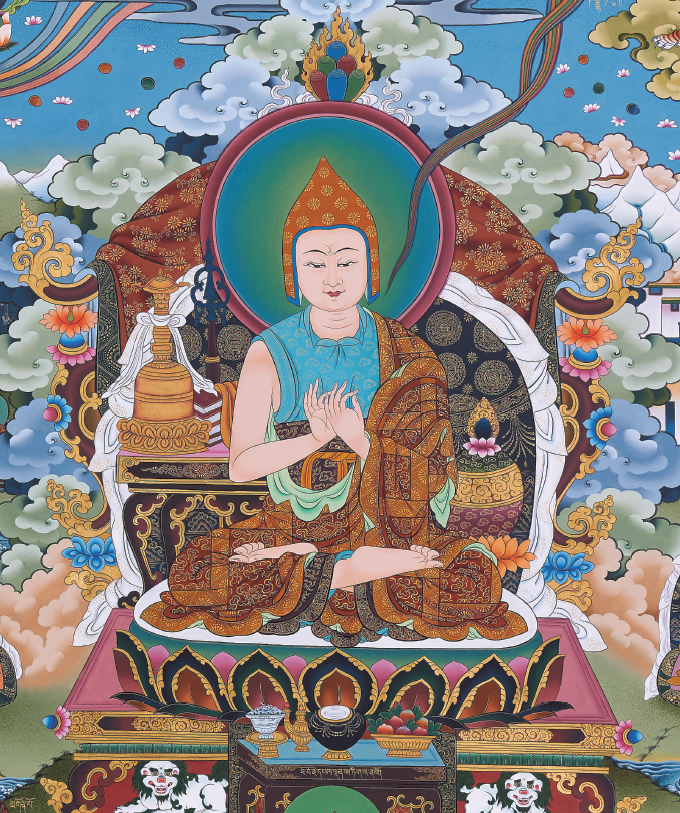
Comprising just sixty-eight verses totaling 276 lines, the text demonstrates remarkable terseness, providing a complete roadmap from initial aspiration through ultimate realization while remaining memorizable and suitable for repeated contemplation. Atiśa synthesizes Mahāyāna sūtra teachings with Madhyamaka philosophical analysis and Vajrayāna methods, showing how each vehicle's practices serve practitioners at different developmental stages. The text's systematic presentation of aspirational versus engaged bodhicitta, its integration of prātimokṣa and bodhisattva vow structures, its articulation of method-wisdom unity, and its careful specification of tantric practice boundaries for monastics established precedents that would shape Tibetan Buddhist pedagogy for the next millennium, giving rise to the lamrim (stages of the path) genre that became central to virtually all Tibetan schools.
This study examines the Bodhipathapradīpa's textual heritage, including its dual canonical placement and the editorial politics explained in Almogi's recent research on the Jo bo chos chung collection, as well as Atiśa's biographical profile and philosophical positions. It also examines the text's core conceptual frameworks organizing bodhicitta cultivation, provides a detailed analysis of key passages, and looks at the commentarial reception spanning from early Kadampa masters through Geluk systematic elaboration, Karma Kagyu Mahāmudrā integration, and Rime trans-sectarian synthesis. Throughout, we attend to how this eleventh-century formulation continues guiding contemporary practice from traditional Tibetan institutions to Western meditation centers, illustrating the text's enduring capacity to provide systematic paths toward awakening grounded in compassionate motivation.
Part 1: About the Text
Titles of the Text
The work bears consistent titles across its textual transmission. The Sanskrit title Bodhipathapradīpa translates literally as "Lamp for the Path to Awakening" or "Lamp for the Path to Enlightenment," with bodhi indicating awakening or enlightenment, patha meaning path, and pradīpa signifying lamp or light. The Tibetan rendering བྱང་ཆུབ་ལམ་གྱི་སྒྲོན་མ། (Byang chub lam gyi sgron ma) maintains semantic fidelity: byang chub corresponds to bodhi, lam to patha, and sgron ma to pradīpa. This precise correspondence between Sanskrit and Tibetan demonstrates the translation's careful adherence to the source language's meaning and structure.
Extracanonical witnesses—manuscripts and blockprints circulating outside formal Tengyur editions—sometimes expand the title to emphasize particular aspects. Variants include ཐེག་པ་ཆེན་པོའི་ལམ་གྱི་རིམ་པའི་གཟུང་བྱང་ཆུབ་ལམ་གྱི་སྒྲོན་མ། (Theg pa chen po'i lam gyi rim pa'i gzung byang chub lam gyi sgron ma, Lamp for the Path to Enlightenment, An Ornament for the Stages of the Path of the Great Vehicle), making explicit the text's Mahāyāna orientation and graduated structure. These extended titles, while not representing the original form, reflect how later Tibetan Buddhist institutions understood and categorized the work.
Textual Heritage and Transmission
The original Sanskrit composition, produced around 1042 CE at Töling (Mtho lding) Monastery in western Tibet, has not survived. This loss mirrors the broader pattern of medieval Indian Buddhist texts, many of which now exist only in Tibetan translation. However, the circumstances of this text's translation provide unusual confidence in the Tibetan version's reliability. Atiśa himself collaborated with the Tibetan translator Gewa Lodrö (also known as Naktso Lotsāwa) in rendering the text into Tibetan immediately upon or shortly after its composition. This authorial supervision of the translation, rare in medieval Buddhist literature, ensures close correspondence between the Sanskrit original and the Tibetan rendering.
While the core text is relatively stable, Eimer's critical edition documents several distinct transmission branches with notable variant readings and omissions. His critical edition, made in 1978, collates sixteen witnesses: seven canonical Tengyur witnesses, eight extracanonical blockprints, and one manuscript. This comprehensive collation establishes stemmatic relationships among witnesses, demonstrating that despite geographic and temporal separation, variant readings remain relatively minor, typically involving orthographic differences, case particle variations, or synonymous word choices rather than substantial semantic divergences.
Dual Canonical Placement and Editorial Politics
The text appears in Tibetan canonical collections under two distinct placements, reflecting not merely different interpretations of genre but also complex editorial decisions shaped by sectarian affiliations and canonical formation politics. In the Derge, Narthang, Peking, and Cone editions of the Tengyur, the text resides in the Madhyamaka (dbu ma) section, classified under the philosophical school emphasizing the middle way between existence and nonexistence. This placement underscores the text's philosophical content, particularly its extensive treatment of emptiness and the two truths. The Derge edition catalogs it as Toh. 3947 in the Madhyamaka section. However, the same canonical collections also include the text in the Jo bo chos chung (Minor Teachings of the Lord) section, where it appears as Toh. 4465 in the Derge edition. This collection, consisting of 103 works (D4465–D4567) attributed to Atiśa or scholars in his immediate circle, has a complex transmission history that illuminates the editorial principles and sectarian dynamics shaping Tibetan canonical formation.
The Jo bo chos chung: Formation and Early Transmission
Recent research by Orna Almogi (2022) has illuminated the complex editorial history of the Jo bo chos chung collection, revealing how canonical formation was shaped by sectarian affiliations and editorial philosophies. The Jo bo chos chung emerged as a coherent collection early in the Tibetan canonical tradition. The Old Narthang edition of the Tengyur, produced in the early fourteenth century, included this collection as a separate set despite containing works already present elsewhere in the canon. This inclusion reflected the strong doctrinal affinity of the Narthang tradition with the Kadampa lineage stemming from Atiśa. The collection's coherence as a unified corpus of Atiśa's teachings justified its preservation as an independent unit, even at the cost of creating duplicates throughout the canonical corpus. The Tshal pa Tengyur edition (1317–1323), however, adopted a different editorial policy. As Almogi explains, its compilers excluded the Jo bo chos chung as a separate cluster, instead including individual works only once in their thematically appropriate sections. This decision reflects the Tshal pa tradition's general policy against duplicates and suggests that the collection held no particular significance for editors lacking strong Kadampa sectarian affiliation.
Butön's Editorial Decision
Butön Rinchen Drup (1290–1364), in compiling the influential Zhalu Tengyur edition (completed 1335), articulated an explicit policy against including duplicates. Yet he made a deliberate exception for the Jo bo chos chung, which appears as the final volume of the Madhyamaka section in his edition. In his catalog, Butön explained this decision with notable precision. He acknowledged that these works constitute duplicates of materials already present elsewhere in the corpus, yet he justified their inclusion on two grounds: first, they form a coherent collection deserving preservation as a unified set, and second, earlier Tengyur editions had established precedent for including them as a separate volume. Butön was certainly referring to the Old Narthang edition, though the identity of any other early editions he may have consulted remains unclear.
Butön's decision had a profound influence on subsequent canonical editions. The mainstream Tengyur editions—Peking, Golden, and Narthang xylographs—followed Butön's precedent, including the Jo bo chos chung as a distinct collection despite their general policies regarding duplicate avoidance. These editions, all produced within Gelukpa circles (though under considerable Nyingma influence in some cases), maintained the collection's status as a coherent unit, reflecting the Geluk school's self-identification as heirs to Atiśa's doctrinal legacy.
The Derge Exception: Zhuchen's Radical Reorganization
The Derge Tengyur, edited by Zhuchen Tsultrim Rinchen (1697–1774), presents a striking departure from this nearly five-hundred-year-old canonical tradition. As Almogi has documented, Zhuchen took the unprecedented step of removing the Jo bo chos chung not merely from the Madhyamaka section but from the Tengyur proper altogether. In the Tōhoku reprint edition, the collection appears after the Miscellanea (sna tshogs) section and before the two appended catalogs. Most tellingly, the volume bears neither standard section labels (as marginal captions) nor a volume number indicating its placement within the edition. Instead, it carries only the distinctive collective marginal caption "Jo bo chos chung."
This unusual positioning strongly suggests that the Jo bo chos chung was not an integral part of the Derge Tengyur as originally conceived but was rather appended to it. However, when this appendage occurred and by whose authority remains uncertain. The collection's contents in the Derge Tengyur largely correspond to the 103 works found in the Peking, Golden, and Narthang editions, though with minor variations in individual titles.
The motivations behind Zhuchen's radical editorial decision remain a subject of scholarly speculation. As Almogi analyzes, several factors may have contributed. Editorial considerations alone might have prompted this reorganization, as the collection created extensive duplication throughout the canon. However, religio-philosophical or religio-political factors cannot be excluded. Zhuchen's school affiliation and the geographical distance of Derge from the political center of Gelukpa hegemony—whose rulers considered themselves guardians of Atiśa's doctrinal legacy—may have enabled or encouraged this departure from established tradition. The Geluk establishment's proprietary attitude toward Atiśa's teachings could have generated resistance in regions with different sectarian orientations. Economic and logistical factors, while less ideologically compelling, cannot be entirely ruled out either.
Interestingly, the Peking and Golden editions bear the marginal caption "Byang chub lam sgron" (Lamp for the Path to Awakening) for the entire Jo bo chos chung volume. This may indicate that the Fifth Dalai Lama's edition, which served as the principal exemplar for both, employed this alternative designation, perhaps emphasizing the Bodhipathapradīpa as the collection's defining text.
Variability in the Collection's Contents
The Jo bo chos chung did not achieve its final form immediately after Atiśa's death. Almogi's examination of the Mustang Tengyur catalog (1447), compiled by Ngorchen Kunga Zangpo (1382–1456), reveals significant variations in content and organization. Ngorchen lists merely 82 or 83 works in the collection, seven of which do not appear in the set as transmitted in other Tengyur editions, while one remains entirely unidentifiable. The Mustang collection also occasionally differs in the organization and sequencing of works. This evidence suggests that the collection attained its standardized form—largely traceable to the Zhalu edition—at a relatively late date, certainly not within the first decades following Atiśa's lifetime.
Ngorchen's general editorial policy avoided duplicates, which explains why he did not include Jo bo chos chung works individually in their thematic sections. However, unlike the Tshal pa editors, he opted to present the works as a unified set rather than distributing them throughout the canon. This decision may reflect the Sakya school's generally stronger affinity with the Kadampa tradition compared to the Tshal pa, even while maintaining a more conservative stance on duplication than traditions with direct Kadampa lineage connections.
Stemmatic Relationships and Textual Branches
The canonical witnesses divide into two main families based on Tengyur placement. The Madhyamaka section witnesses (dbu ma)—represented in Derge (D), Narthang (N), Peking (P), and Cone (C) editions—share certain readings distinguishing them from the Jo bo chos chung witnesses. This bifurcation demonstrates that scribes and editors at different monasteries made independent copying and editorial decisions, creating distinct textual lineages. However, both families derive from a common archetype, as evidenced by shared readings distinguishing all Tengyur witnesses from extracanonical sources.
The extracanonical witnesses, while generally less reliable due to accumulating scribal errors over time, preserve occasional unique readings of potential significance. Blockprints from Aginsk (Buryatia), Tashilhunpo, Kalimpong, and other Tibetan Buddhist centers establish the text's widespread circulation and continued practical use beyond formal scholastic contexts. Some extracanonical witnesses omit certain verses or present simplified readings, suggesting adaptation for specific pedagogical or devotional purposes. These witnesses provide valuable evidence for how different communities understood and applied the text in practice.
The Autocommentary and Early Secondary Witnesses
Atiśa's autocommentary, the Bodhimārgadīpapañjikā (Byang chub lam gyi sgron ma'i 'grel pa, Toh. 3948), constitutes an independent transmission line of immense importance. According to Eimer, this commentary, composed shortly after the root text, quotes approximately 140 of the 276 lines of the root text while providing doctrinal elaboration, scriptural citations, and responses to anticipated objections. The commentary's quotations sometimes present readings diverging slightly from the root text's canonical recension, offering an additional control for establishing original readings. However, the commentary occasionally simplifies or paraphrases root text passages, requiring careful judgment about whether quoted forms represent authentic variants or deliberate pedagogical modifications.
Early secondary witnesses further corroborate textual stability. Gampopa's Jewel Ornament of Liberation (Dam chos yid bzhin gyi nor bu thar pa rin po che'i rgyan, c. 1120–1140) extensively quotes the Bodhipathapradīpa, providing an independent witness from the text's first century. These quotations, predating most extant Tengyur manuscripts by over a century, generally agree with canonical readings, confirming that the text achieved stable form early in its transmission history.
Modern Scholarly Editions
Modern scholarly editions begin with Sarat Chandra Das's 1893 English translation and Tibetan edition, pioneering but limited by a narrow textual base. Helmut Eimer's 1978 critical edition represents the first comprehensive scholarly treatment, establishing a stemma of textual relationships and providing a detailed apparatus documenting variant readings across all available witnesses. This edition remains foundational for contemporary scholarship. Subsequent translations by Richard Sherburne (1983, 2003), Ruth Sonam/Geshe Sonam Rinchen (1997), and most recently Artemus B. Engle (2024) have built upon Eimer's textual work while offering diverse interpretive perspectives shaped by their respective methodological commitments and intended audiences.
Table 1: Major Textual Witnesses and Editorial Principles
| Witness/Edition | Date/Provenance | Notables | Editorial Principles |
|---|---|---|---|
| Bodhimārgadīpapañjikā | 11th c., Tibet | Toh 3948; autocommentary quotes ~140 lines | Primary exegetical witness; occasional simplified readings |
| Narthang Tengyur | 13th–14th c., Narthang | dbu ma, vol. ki; independent transmission | Significant for establishing early readings; some distinctive errors |
| Gampopa quotations | c. 1120–1140, Tibet | Jewel Ornament of Liberation | Early secondary witness; confirms textual stability |
| Derge Kangyur | 18th c., Derge | Toh 3947; dbu ma section; generally authoritative | Standard reference for scholarly work; minimal unique errors |
| Peking Tengyur | 18th c., Beijing | Q 5343; imperial edition | Represents distinct editorial tradition; useful for variant readings |
| Sarat Chandra Das | 1893, India | First modern edition and translation | Pioneering but limited textual base; superseded by later work |
| Eimer critical edition | 1978, Germany | Collates 7 canonical + paracanonical witnesses | First comprehensive critical edition; detailed apparatus; foundational for modern scholarship |
Content and Structure Overview
The Bodhipathapradīpa comprises sixty-eight verses totaling 276 lines in Eimer's critical edition, making it a remarkably concise synthesis of the Buddhist path. This compression reflects deliberate pedagogical design: the text provides a complete roadmap from initial aspiration through ultimate realization while remaining memorizable and suitable for repeated contemplation. The brevity necessitates commentarial expansion for full comprehension, following Indian Buddhist conventions privileging pithy root texts (mūla) requiring oral elaboration (bhāṣya).
The text follows a clear structure: opening homage (verses 1–2), the three-person typology framework (verses 2–5), preliminary practices for lesser and middling persons (verses 6–10), extensive treatment of the supreme person's path including bodhicitta generation (verses 11–32), the six perfections (verses 33–41), method-wisdom unity (verses 42–46), wisdom realization (verses 47–58), meditation development (verses 53–61), tantric integration (verses 62–67), and colophon (verse 68). This graduated structure became the template for the lamrim (stages of the path) genre that would dominate Tibetan Buddhist pedagogy for the next millennium.
Table 2: Thematic Structure of the Bodhipathapradīpa
| Section/Verse Range | Primary Theme | Key Concepts |
|---|---|---|
| Verses 1–2 | Homage and occasion | Three Jewels, Mañjuśrī, royal patronage |
| Verses 2–5 | Three practitioner types | Lesser, middling, supreme capacities |
| Verses 6–10 | Preliminary practices | Refuge, ethical discipline, renunciation |
| Verses 11–32 | Bodhicitta generation | Aspirational vs. engaged bodhicitta; vow structure |
| Verses 33–41 | Six perfections | Generosity through concentration |
| Verses 42–46 | Method-wisdom unity | Two truths, upāya-prajñā integration |
| Verses 47–58 | Wisdom realization | Emptiness, Madhyamaka analysis |
| Verses 53–61 | Meditative development | Śamatha, vipaśyanā, their union |
| Verses 62–67 | Tantric integration | Four tantra classes, ethical boundaries |
| Verse 68 | Colophon | Authorship, patronage, translation |
Part 2: About the Author
Traditional Attribution and Profile
Atiśa Dīpaṃkaraśrījñāna (982–1054) stands as one of the most influential Buddhist masters in both Indian and Tibetan Buddhist history. Born into a royal family in Bengal, he received extensive education in Buddhist philosophy, meditation, and tantra from numerous Indian masters. His studies spanned the major Buddhist philosophical schools—Madhyamaka and Yogācāra—as well as logic and epistemology under masters like Dharmakīrti's successors. Particularly significant was his training with Dharmakīrti of Suvarṇadvīpa (modern Sumatra), from whom he received extensive instructions on bodhicitta cultivation and mind training, teachings that profoundly shaped his later presentation of the graduated path.
Atiśa's philosophical position within Indian Buddhism requires careful evaluation. Traditional Tibetan doxographies classify him within the Madhyamaka-Prāsaṅgika subschool, emphasizing his connection to Candrakīrti's interpretation of Nāgārjuna. However, modern scholarship reveals a more complex picture. Atiśa studied with masters representing diverse Madhyamaka lineages, including both Svātantrika and Prāsaṅgika approaches. His own writings, including the Bodhipathapradīpa's autocommentary, cite both Bhāvaviveka (paradigmatic Svātantrika master) and Candrakīrti (Prāsaṅgika founder) as authoritative. This synthetic approach, characteristic of late Indian Buddhism, resists neat classification into the rigid Svātantrika-Prāsaṅgika distinction that later Tibetan scholastics developed.
His tantric qualifications were equally impressive. Atiśa received initiations and instructions in the three major tantric systems current in eleventh-century India: Guhyasamāja, Cakrasaṃvara, and Hevajra cycles. He demonstrated particular expertise in the Yoginī Tantras (Cakrasaṃvara and Hevajra), composing ritual manuals and philosophical treatises explicating these systems. However, his tantric approach emphasized ethical discipline and graduated training over charismatic display or claims to extraordinary attainments, an orientation reflecting his broader pedagogical philosophy prioritizing systematic method over spontaneous realization.
Before traveling to Tibet, Atiśa held prestigious positions within Indian Buddhism's institutional landscape. Atiśa rose to prominence as a senior scholar at Vikramaśīla, one of India’s major Buddhist universities, where he taught hundreds of monks and maintained the institution's curriculum. This experience shaped his later pedagogical work in Tibet: he understood how to systematize teachings for institutional transmission while maintaining doctrinal integrity and contemplative effectiveness. In 1042, at approximately age sixty, Atiśa accepted an invitation from the western Tibetan king Jangchub Ö to teach in Tibet. This decision, undertaken despite his advanced age and the knowledge that he likely would not return to India, demonstrates his commitment to preserving and transmitting Buddhist teachings. The journey proved arduous—crossing the Himalayas and traveling to remote western Tibetan regions—but Atiśa remained in Tibet for the final twelve years of his life, establishing the foundations for what would become the Kadam school of Tibetan Buddhism.
His teaching curriculum in Tibet centered on several key works: Śāntideva's Bodhicaryāvatāra (The Way of the Bodhisattva), Asaṅga's Bodhisattvabhūmi (The Stages of the Bodhisattva Path), and his own compositions including the Bodhipathapradīpa and its autocommentary. He emphasized ethical discipline, systematic study, and contemplative practice over tantric ritual elaboration, though he provided tantric instructions to qualified students. His teaching style reportedly combined scholarly precision with practical accessibility, making complex philosophical and meditational topics comprehensible to diverse audiences.
Authorship Certainty
Unlike some medieval Buddhist texts, the Bodhipathapradīpa faces no serious scholarly challenge to its traditional attribution to Atiśa. This unusual scholarly consensus derives from multiple converging lines of evidence. The text's explicit self-identification through colophonic statements, early biographical corroboration, immediate commentarial tradition, and institutional reception all point consistently to Atiśa as author. No alternative attributions have been proposed, and internal evidence regarding doctrinal positions, terminological usage, and pedagogical approach all align with what is known about Atiśa from other sources.
The autocommentary's attribution proves slightly more complex. While Tibetan tradition uniformly treats the Bodhimārgadīpapañjikā as Atiśa's own commentary on his root text, some scholars have noted occasional passages that seem potentially inconsistent with positions Atiśa defends elsewhere. David Seyfort Ruegg mentions "doubtful statements" within the commentary without providing specific examples or detailed analysis. However, this observation has not generated significant scholarly discussion, and most specialists continue accepting the traditional attribution based on the commentary's consistent citation in early Kadam literature, its sophisticated engagement with Indian source materials, and its detailed knowledge of Atiśa's specific teachings.
The strongest positive evidence for the traditional attribution comes from the text's immediate reception and use. Unlike texts whose authorship becomes controversial precisely because early sources remain silent about them, the Bodhipathapradīpa appears prominently in biographical literature from Atiśa's own generation. Traditional accounts, though hagiographic in style, consistently attribute this text to Atiśa. The rapid development of commentarial literature by Atiśa's direct students suggests they recognized the text as authentically representing his teachings and requiring elaboration for complete understanding.
Comparative analysis with Atiśa's other authenticated works strengthens confidence in the attribution of the text to Atiśa. When we examine his Satyadvayvāvatāra (addressing the two truths in detail) and various liturgical compositions, we find consistent philosophical positions, similar pedagogical strategies, and overlapping source citations. The Bodhipathapradīpa fits naturally within this corpus as a synthetic work bringing together themes Atiśa treats separately elsewhere, rather than representing foreign material falsely attributed to him.
Philosophical Positions and Scholarly Debates
Atiśa's philosophical positions, as revealed through the Bodhipathapradīpa and related works, represent a sophisticated integration of diverse Buddhist traditions while maintaining clear soteriological priorities. On the nature of ultimate reality, Atiśa follows the Madhyamaka position that phenomena lack intrinsic existence (svabhāva) while appearing conventionally. His two-truth framework distinguishes conventional truth (saṃvṛtisatya)—how things appear in ordinary experience—from ultimate truth (paramārthasatya)—their actual mode of being. Unlike some Madhyamaka interpreters who treat these as entirely separate perspectives, Atiśa emphasizes their complementarity: ultimate truth reveals conventional truth's emptiness without negating conventional functionality.
The relationship between philosophical understanding and contemplative realization receives particular attention in Atiśa's system. The Bodhipathapradīpa insists that the intellectual analysis of emptiness, while necessary, remains insufficient for liberation. Practitioners must unite conceptual understanding with direct nonconceptual realization through meditation, progressively undermining conceptual elaborations until the mind rests in nonconceptual equipoise directly knowing emptiness.
While often classified as Prāsaṅgika in later Tibetan doxographies, some modern scholarship emphasizes a more syncretic stance, noting his use of both Prāsaṅgika and Svātantrika sources. Traditional Tibetan doxography, particularly in Geluk presentations, identifies Atiśa as a Prāsaṅgika, emphasizing his citations of Candrakīrti and his ultimate philosophical positions. However, David Seyfort Ruegg notes that Atiśa's actual writings display a more eclectic approach, freely drawing on both Svātantrika sources (particularly Bhāvaviveka) and Prāsaṅgika materials. Ruegg argues that the rigid Svātantrika-Prāsaṅgika distinction represents a later Tibetan development, projecting onto Indian Buddhism a debate structure that emerged primarily in Tibet itself. From this perspective, Atiśa represents late Indian Buddhism's synthetic approach, attempting to harmonize different Madhyamaka lineages rather than defending one against others. Current scholarly consensus suggests that while Atiśa's ultimate positions align more closely with Prāsaṅgika, he worked before the debate became as rigid as it later became in Tibet, making strict classification somewhat anachronistic.
A second scholarly debate concerns the text's relationship to earlier Indian literature versus its character as a Tibetan adaptation. Some scholars emphasize the Bodhipathapradīpa's innovative features: the three-person typology, though having precedents in Vasubandhu and others, receives distinctive systematization here; the explicit integration of sūtra and tantra within a graduated framework addresses specifically Tibetan questions; the emphasis on systematic method over spontaneous realization reflects pedagogical adaptation. Other scholars stress a continuity with Indian antecedents, noting that the three-person framework appears in earlier Indian texts, that the integration of vehicles reflects late Indian Buddhism's general tendency toward synthesis, and that the emphasis on systematic training characterizes major Indian monasteries like Nālandā and Vikramaśīla. Both positions capture genuine aspects of the text's character: Atiśa simultaneously represents the Indian Buddhist tradition's culmination and inaugurates distinctively Tibetan approaches to organizing Buddhist teachings.
Part 3: Significance and Relevance for Bodhicitta
Why the Bodhipathapradīpa Is Essential for Understanding and Practicing Bodhicitta
The Bodhipathapradīpa achieves something unique in Buddhist literature: it places bodhicitta as the organizing principle for the entire Buddhist path, demonstrating that all teachings—from basic ethics through advanced tantric practices—are successive stages in bodhicitta's cultivation.
Three Distinctive Contributions Make This Text Indispensable:
- 1. Practical Accessibility Over Mystical Experience or Complex Doctrinal Analysis: Rather than presenting bodhicitta as a spontaneous mystical attainment available only to those with special karmic propensities, Atiśa provides step-by-step instructions anyone can implement: recognizing all beings as former mothers, contemplating their kindness, generating loving-kindness and compassion, developing personal responsibility, and finally aspiring to buddhahood as the means for helping all beings. This methodological clarity enabled widespread practice across diverse contexts.
- 2. Integration of Graduated Motivation: The text's three-person framework validates diverse entry points while maintaining clear standards. Practitioners initially seeking better rebirth or personal liberation can progressively develop toward the supreme motivation—making bodhicitta training neither discouraging nor diluted but genuinely transformative for practitioners at all levels.
- 3. Essential Foundation for All Buddhist Practice: The Dalai Lama emphasizes that the entirety of Buddhist scripture can be understood as either preparation for bodhicitta practice, the actual cultivation of bodhicitta itself, or the ethical commitments that follow from taking the bodhicitta pledge. The text demonstrates that bodhicitta benefits practitioners at every stage—even intellectual understanding brings immediate benefit, while on the path it expedites merit accumulation, and upon buddhahood it sustains enlightened activity.
Atiśa's rhetorical question about whether anything besides bodhicitta practice truly advances one toward enlightenment encapsulates why this text remains the foundational manual for bodhicitta cultivation across all Tibetan Buddhist traditions.
Part 4: Study the Text
Core Concepts and Their Integration
This section provides the authoritative treatment of the Bodhipathapradīpa's major conceptual frameworks. Each concept receives detailed analysis here; subsequent sections reference this material rather than repeating it.
The Three-Person Typology
The typology of three persons (skyes bu gsum) provides the foundational organizing principle for the entire graduated path. This classification appears in verses 2–5, where Atiśa announces that persons should be understood as lesser (chung ngu), middling ('bring), or supreme (mchog) based on their spiritual motivations and capacities.
The lesser person, described in verse 3, employs various means to pursue happiness within cyclic existence ('khor ba). This practitioner recognizes karma's operations—that virtuous actions lead to favorable results, while negative actions produce suffering—and seeks to accumulate merit generating better rebirths and improved worldly conditions. However, the lesser person has not yet developed renunciation (nges 'byung) of saṃsāric existence itself, remaining oriented toward optimizing conditions within the cycle of birth and death rather than seeking escape from it. The practices associated with this level include refuge-taking, basic ethical observances, and merit accumulation through generosity and devotional activities.
The middling person, defined in verse 4, has progressed beyond worldly concerns to develop disenchantment with saṃsāra in its entirety. Recognizing that even the highest worldly pleasures remain unsatisfactory and impermanent, this practitioner seeks personal liberation (nirvāṇa) through eliminating afflictive emotions and their karmic propensities. The middling person has generated renunciation—the determination to be free from cyclic existence—but this aspiration remains self-focused. The practices associated with this level include detailed contemplation of suffering's pervasiveness, analysis of the four noble truths, development of the three higher trainings (ethics, concentration, wisdom), and cultivation of insight realizing personal selflessness. This category corresponds roughly to the Śrāvakayāna practitioner ideal, which involves seeking arhat status through individual liberation effort.
The supreme person, characterized in verse 5, transcends self-oriented motivation entirely. The defining verse states: "One who, through the suffering of his or her own continuum, truly desires to terminate completely all the suffering of others is a supreme person." This formulation makes compassionate identification with others' suffering the essential criterion rather than philosophical sophistication or meditative attainment. The phrase "through the suffering of his or her own continuum" (rang gi rgyud kyi sdug bsngal gyis) indicates that authentic bodhicitta arises from visceral recognition that others experience suffering equivalent to one's own, not from abstract intellectual understanding or moral duty. The term "continuum" (santāna, rgyud) refers to the ongoing stream of mental and physical processes constituting personhood, suggesting that this recognition must penetrate one's experiential core rather than remaining conceptual.
The verse's emphasis on "truly desires" (yang dag 'dod) or "genuinely wishes" distinguishes authentic bodhicitta from mere verbal profession or temporary emotional response. The aspiration must be sincere, sustained, and motivating actual behavior change. The phrase "terminate completely" (yongs su 'joms) indicates thoroughgoing commitment—not merely wishing to reduce suffering but aspiring to eliminate it entirely for all beings.
This three-person typology serves multiple functions within the text's pedagogical architecture. First, it validates diverse entry points to Buddhist practice, acknowledging that practitioners begin with different motivations and capacities. Rather than dismissing worldly concerns or personal liberation aspirations as inadequate, the framework recognizes these as legitimate starting points while showing their progressive relationship to bodhicitta. Second, it establishes clear criteria for assessing spiritual development based on motivation rather than external markers like knowledge accumulation or meditation duration. Third, it demonstrates how apparently disparate Buddhist teachings serve practitioners at different developmental stages, resolving questions about the doctrine's internal coherence. Fourth, it provides a roadmap showing how lesser and middling motivations can progressively deepen toward supreme bodhicitta through systematic training and contemplation.
Bodhicitta: Aspirational and Engaged
Bodhicitta itself receives a two-aspect analysis distinguishing aspirational from engaged forms, introduced in verses 18–19. Aspirational bodhicitta (smon pa'i sems bskyed) refers to the initial generation of the wish to attain enlightenment for all beings' benefit. Verses 11–17 provide instructions for cultivating this aspiration through structured contemplation: recognizing all beings as former mothers, contemplating their kindness when in that role, wishing to repay their kindness, generating loving-kindness and compassion, developing the extraordinary attitude of personal responsibility, and finally aspiring to buddhahood as a means for helping all beings achieve liberation. This systematic approach transforms compassion from a vague benevolence into a focused determination with a clear goal and method.
However, aspirational bodhicitta alone proves insufficient for sustained practice. Verses 18–19 explain that without proceeding to formal vow commitment, the aspiration remains unstable, subject to weakening or abandonment when facing obstacles. Verse 19 explicitly states that "without the vow" (sdom pa med par), "the correct aspiration will not become stronger" (smon lam yang dag mi 'phel).
Engaged bodhicitta ('jug pa'i sems bskyed) establishes a structured ethical commitment through the bodhisattva vow ceremony, creating accountability and a ritual framework supporting long-term cultivation. The passage addresses practical psychology: momentary inspiration, however genuine, easily dissipates without structural support. The bodhisattva vow provides a ritual framework creating accountability and establishing formal obligation. Taking the vow before qualified witnesses or even self-administering it following scriptural procedures transforms private aspiration into public or, at minimum, formally recognized commitment, creating psychological and social reinforcement for maintaining practice through obstacles.
This two-stage model addresses a perennial challenge in spiritual development: translating inspiring experiences or realizations into lasting character transformation. Buddhism generally recognizes that peak experiences, while valuable, require integration through sustained practice to generate stable change. The aspiration-to-engagement progression provides a concrete methodology for this integration within the bodhicitta context. Engaged bodhicitta manifests through systematic training in the six perfections, transforming aspiration into concrete behavioral patterns.
Prātimokṣa Foundation
The relationship between prātimokṣa and bodhisattva vows, addressed in verses 20–32, establishes the ethical foundation for bodhicitta practice. Verse 20 states that one should possess prātimokṣa vows in one of seven ranks before receiving bodhisattva precepts. The seven ranks include: fully ordained monks and nuns, probationary nuns, male and female novices, and male and female lay devotees. This hierarchical relationship between vow systems raised questions: Does Mahāyāna commitment supersede Śrāvakayāna ethics? Can lay practitioners fully engage the bodhisattva path? Must monastics maintain individual liberation vows even after taking the universal bodhisattva commitment?
Atiśa's autocommentary clarifies that prātimokṣa vows establish basic ethical discipline preventing gross negative actions—killing, stealing, sexual misconduct, lying, and intoxication. These prohibitions create the baseline moral restraint necessary for any advanced spiritual practice. Without such a foundation, claims to altruistic bodhicitta ring hollow while actions continue causing harm. The autocommentary explains that prātimokṣa vows "have become ancillary to the bodhisattva vow," functioning as supporting structure rather than ultimate goal. They are "held in order to enhance the development of the bodhisattva vow. Therefore, the person who has the vows of prātimokṣa is a fit vessel" for receiving the bodhisattva commitment.
This "ancillary" relationship indicates a hierarchical integration rather than a simple addition. Prātimokṣa vows function as a supporting structure, maintained not as the ultimate goal but as a means for enabling bodhisattva practice's flourishing. This framework resolves apparent tensions: a bodhisattva might technically violate prātimokṣa precepts through compassionate action (such as lying to protect someone from harm) without violating the bodhisattva commitment to benefit beings, yet such exceptions require genuine bodhicitta motivation rather than rationalizing self-interest or destructive behavior. The prātimokṣa foundation ensures claimed exceptions represent skillful means rather than ethical collapse.
The passage also raises interpretive questions about vow reception procedures. Verses 24–32 address this, explaining that while receiving the vow from a qualified master proves preferable, citing the Ākāyamatinirdeśasūtra's precedent allows self-administration when qualified teachers are unavailable. This flexibility ensured bodhicitta practice remained accessible across diverse geographical and institutional contexts.
The Six Perfections as Systematic Training
The six perfections (ṣaṭpāramitā, pha rol tu phyin pa drug), addressed in verses 33–41, constitute the systematic training program implementing engaged bodhicitta. Each perfection cultivates specific capacities while integrating them into a unified development:
- Generosity (dāna, sbyin pa) trains one in overcoming attachment to possessions, body, and merit while actively providing material support, protection from fear, and Dharma teachings.
- Ethical discipline (śīla, tshul khrims) establishes behavioral patterns consistent with bodhicitta, encompassing restraint from harm, accumulation of virtue, and accomplishment of others' welfare.
- Patience (kṣānti, bzod pa) develops the capacity to maintain equanimity and compassionate motivation even when facing adversity, ingratitude, or direct harm from others, while also cultivating confidence in Dharma teachings.
- Diligence (vīrya, brtson 'grus) sustains enthusiastic effort in virtue across the extended time frames required for complete buddhahood.
- Concentration (dhyāna, bsam gtan) stabilizes the mind, enabling the sustained focus essential for insight development and preventing distraction by competing motivations.
- Wisdom (prajñā, shes rab) realizes phenomena's empty nature, preventing grasping at substantial existence while enabling understanding of how to benefit beings ultimately.
The text presents these perfections within a developmental framework where earlier perfections create conditions for later ones: generosity overcomes attachment, discipline prevents harm, patience counters anger, diligence enables sustained practice, concentration unifies mind, and wisdom realizes ultimate reality.
The Unity of Method and Wisdom
The method-wisdom unity (thabs shes zung 'brel) emphasized in verses 42–46 reveals crucial insight about the six perfections' integration and Buddhist soteriology more broadly. Verse 46 states: "One who combines mastery of the means (thabs) with true cultivation of insight (lhag mthong) will swiftly attain enlightenment, but not by cultivating merely non-self (bdag med)."
The first five perfections—generosity through concentration—constitute "method" or "skillful means," developing merit, ethical transformation, and compassionate capacity. Wisdom, the sixth perfection, realizes emptiness and generates liberating insight. Neither alone suffices: method without wisdom remains bound to saṃsāra despite virtuous qualities, while wisdom without method may achieve personal liberation but lacks the scope, motivation, and skillful capacity characteristic of Mahāyāna buddhahood.
The phrase "not by cultivating merely non-self" critiques approaches emphasizing wisdom while neglecting compassionate activity. Such one-sided cultivation might lead to personal liberation but cannot produce complete buddhahood characterized by omniscience and perfect skillful means. This passage became foundational for understanding Mahāyāna distinctiveness, resolving major sectarian disputes in eleventh-century Tibet between those emphasizing philosophical study and meditation on emptiness versus those prioritizing ethical conduct and compassionate activity. Atiśa's integration showed both as essential, preventing the path from fragmenting into competing approaches.
Wisdom: Two Truths and Emptiness
The wisdom component receives systematic analysis through frameworks of two truths and four logical reasonings in verses 47–52. Conventional truth (saṃvṛtisatya, kun rdzob bden pa) encompasses all phenomena as they appear to ordinary perception, including persons as conventional designations, karma's operations, and the efficacy of spiritual practices. Ultimate truth (don dam bden pa, paramārthasatya) refers to phenomena's empty nature (śūnyatā, stong pa nyid)—their lack of intrinsic existence (svabhāva, rang bzhin) when subjected to ultimate analysis.
Verses 47–52 cite Nāgārjuna's works—the Seventy Verses on Emptiness (Śūnyatāsaptatikārikā) and Root Verses on the Middle Way (Mūlamadhyamakakārikā)—as authoritative sources for understanding emptiness. By referencing these foundational Madhyamaka texts, Atiśa signals alignment with Nāgārjuna's philosophical approach while indicating that practitioners should study these works for detailed analysis.
The verses establish that phenomena's empty nature means they lack "intrinsic nature"—independent, inherent, unchanging essence. The aggregates (skandhas), sense-bases (āyatanas), and elements (dhātus) comprising experience "do not arise" in the ultimate sense of possessing substantial existence, though they appear conventionally and function effectively within relative frameworks. The text alludes to the reasoning (yukti, rigs pa) for establishing emptiness in the way of analysis such as the analysis of arising from the four extremes, analysis of atomic particles, examination of unity and multiplicity, and investigation of dependent origination.
This philosophical position—neither affirming substantial existence nor falling into nihilistic denial of conventional functioning—characterizes Madhyamaka thought. The verses provide a framework for understanding how liberation functions: by realizing emptiness, practitioners cut the root of ignorance grasping at phenomena as substantially existent, thereby eliminating afflictive emotions and karmic propensities binding them to cyclic existence.
Meditative Development: Śamatha and Vipaśyanā
The meditation section (verses 53–61) addresses śamatha (calm abiding) and vipaśyanā (special insight) cultivation as a unified practice leading to direct realization. Verses 53–-56 detail śamatha prerequisites and development, emphasizing renunciation, ethical conduct, and systematic attention training. Śamatha develops single-pointed concentration, unifying the mind and enabling sustained focus.
Verses 57–61 describe vipaśyanā's analytical component, applying Madhyamaka reasoning to direct contemplative experience. Vipaśyanā involves both analytical meditation (vicāra) and placement meditation (sthāpana). The analytical component progressively undermines conceptual elaborations through applying reasoning to direct experience, while placement meditation allows the mind to rest in nonconceptual equipoise directly knowing emptiness.
The union of śamatha and vipaśyanā—analytical stability—enables the nonconceptual direct realization of emptiness, removing obscurations progressively and leading to liberation. This integration of conceptual analysis with nonconceptual realization became foundational for later Tibetan meditation instructions.
Tantric Integration with the Graduated Path
The tantric section (verses 62–67) addresses Vajrayāna integration within the graduated path, specifying which initiations monastics maintaining celibacy vows may appropriately receive. Atiśa carefully specifies that tantric practices require proper initiation from qualified masters and must conform to ethical commitments.
Verses 64–65 explicitly state that monastics maintaining celibacy vows should not receive the "secret" (guhya) and "wisdom" (prajñā) consecrations, which in some tantric systems involve consort practices. However, the "vase" (kumbha) and "teacher's" (ācārya) initiations remain appropriate, enabling monastics to study and practice tantric methods compatible with their vows.
This qualification addressed practical questions about Vajrayāna compatibility with monastic discipline and established important boundaries that influenced how Tibetan Buddhism integrated tantric and sūtra approaches. Atiśa resolved tensions between established monastic institutions and newer tantric movements by showing compatibility while specifying ethical limits. The passage validates tantric efficacy while subordinating it to ethical discipline and graduated training, preventing antinomian interpretations. The text explains that lower tantras provide powerful concentration methods, symbolic frameworks for understanding reality's nature, and techniques for transforming ordinary activities into enlightenment's causes, while highest yoga tantra offers the swiftest path to complete buddhahood when practiced with the proper foundation.
Superknowledges as Skillful Means
The superknowledges (abhijñā, mngon shes) described in verses 34–37 represent extraordinary capacities naturally emerging from meditative attainment, enabling more effective benefit for others. These include the divine eye perceiving beings' deaths and rebirths, the divine ear hearing sounds across vast distances, knowledge of others' minds, recollection of past lives, and miraculous powers manifesting various transformations. While potentially subject to pride or misuse if developed without proper motivation, these capacities serve bodhisattva activity by enabling practitioners to understand beings' capacities, karmic situations, and which methods will be effective.
Table 3: Core Conceptual Frameworks
| Concept/Term | Where It Appears | Function | Significance |
|---|---|---|---|
| Three persons (skyes bu gsum) | Verses 2–5 | Foundational framework organizing entire path | Template for lamrim genre; validates multiple entry points |
| Aspirational bodhicitta | Verses 11–17 | Initial wish for enlightenment | Generated through systematic contemplation |
| Engaged bodhicitta | Verses 18–19 | Formal vow commitment | Stabilizes aspiration; enables sustained practice |
| Prātimokṣa seven ranks | Verse 20 | Ethical foundation | Establishes basic discipline as prerequisite |
| Six perfections | Verses 33–41 | Systematic bodhisattva training | Progressive cultivation; first five are "method" |
| Method (upāya, thabs) | Verses 42–46 | First five perfections | Compassionate activity; incomplete without wisdom |
| Wisdom (prajñā, shes rab) | Verses 47–58 | Realizes emptiness | Liberating insight; incomplete without method |
| Two truths | Verses 47–52 | Philosophical framework | Prevents nihilism and eternalism |
| Emptiness (stong pa nyid) | Verses 47–58 | Ultimate reality | Lack of intrinsic existence |
| Śamatha | Verses 53–56 | Calm abiding | Single-pointed concentration |
| Vipaśyanā | Verses 57–61 | Special insight | Realizes emptiness directly |
| Tantra integration | Verses 62–67 | Vajrayāna methods | Ethical boundaries for monastics |
Key Verses: The Practitioner's Path to Awakening
This section examines verses that illuminate the practitioner's journey from entry through culmination, focusing on how the Bodhipathapradīpa guides actual contemplative development rather than merely presenting doctrinal positions. These verses trace the arc from motivational foundation through meditative realization, revealing Atiśa's distinctive integration of compassion cultivation with wisdom practice.
Verse 5: The Gateway—Defining the Supreme Person
One who, through the suffering of his or her own continuum, truly desires to terminate completely all the suffering of others is a supreme person. (5)
This verse establishes the motivational gateway distinguishing Mahāyāna from lesser vehicles. The phrase "through the suffering of his or her own continuum" indicates that authentic bodhicitta arises from visceral recognition that others experience suffering equivalent to one's own, not from abstract intellectual understanding. The term continuum (santāna, rgyud)—the ongoing stream of mental and physical processes constituting personhood—suggests this recognition must penetrate one's experiential core. "Truly desires" distinguishes genuine aspiration from mere verbal profession, while "terminate completely" indicates thoroughgoing commitment rather than merely wishing to reduce suffering. For practitioners, this verse provides the measuring standard: Have I actually connected my own experience of suffering with universal suffering in a way that generates sustained determination? The verse makes clear that philosophical sophistication, meditative attainment, and ritual accomplishment remain insufficient without this motivational foundation.
Verse 11: Entry—Generating the Irreversible Pledge
Then, with the desire to liberate the world from the suffering of suffering, suffering, and the causes of suffering, generate the enlightenment mind that makes an irreversible pledge. (11)
Following contemplation of beings' suffering in the three realms, birth states, and death transitions (verse 10), this verse marks the practitioner's formal entry point. The triple formulation—"suffering of suffering, suffering, and the causes of suffering"—encompasses all three types of suffering recognized in Buddhist analysis: the suffering of pain (duḥkhaduḥkhatā), the suffering of change (vipariṇāmaduḥkhatā), and the all-pervasive suffering of conditioning (saṃskāraduḥkhatā). The phrase "irreversible pledge" signals that this generation constitutes more than momentary inspiration; it establishes commitment sustained across lifetimes and obstacles. For practitioners, the verse's placement after detailed contemplation instructions indicates that bodhicitta generation requires preparatory cultivation—recognizing all beings as former mothers, contemplating their kindness, wishing to repay it, generating loving-kindness and compassion—rather than arising spontaneously. This structured approach democratizes bodhicitta practice, making it accessible through systematic method rather than depending on special karmic propensities.
Verses 18–19: Stabilization—From Aspiration to Engagement
After having generated the aspirational enlightenment mind, you should cause it to develop through many exertions; and, in order to recall it even in other rebirths, you should also observe the precepts as they have been taught. (18)
Without the vow whose nature is active enlightenment mind, the correct aspiration will not become stronger. Therefore, one who desires to strengthen the vow to attain complete enlightenment must diligently adopt this vow. (19)
These verses address the universal challenge of translating peak experiences into lasting transformation. Aspirational bodhicitta, however genuine, remains unstable without structural support. The phrase "without the vow . . . the correct aspiration will not become stronger" articulates a crucial psychological insight: momentary inspiration easily dissipates when facing obstacles unless it is reinforced through formal commitment. The bodhisattva vow ceremony transforms a private aspiration into a recognized commitment, creating accountability and a ritual framework that supports long-term cultivation. For practitioners, this passage prevents common pitfalls: mistaking temporary inspiration for stable realization, or assuming informal practice suffices for genuine development. The emphasis on "many exertions" and maintaining precepts "in order to recall it even in other rebirths" signals that bodhicitta cultivation constitutes lifelong—indeed, lives-long—work requiring sustained discipline rather than sudden awakening.
Verses 40–41: Meditative Foundation—Śamatha and Its Limitations
Therefore, one who is well established in the essential limbs taught in the Chapter on the Requisites for One-Pointed Concentration should fix the mind on any one of the many virtuous meditation objects. (40)
Once a meditator has attained quiescence, he or she will also achieve supernatural knowledge. However, without the practice of perfection of wisdom, the obscurations cannot be destroyed. (41)
These verses establish śamatha (calm abiding, quiescence) as necessary but insufficient for liberation. Verse 40 references specific prerequisites detailed in Asaṅga's Bodhisattvabhūmi: solitude, contentment with simple requisites, abandonment of distracting activities, pure ethical conduct, and elimination of desirous thoughts. The instruction to "fix the mind on any one of the many virtuous meditation objects" indicates methodological flexibility—practitioners may focus on breath, Buddha images, or other suitable supports—while emphasizing that single-pointed concentration (ekāgratā) itself constitutes the essential accomplishment.
Verse 41's "however" introduces a crucial limitation that prevents practitioners from mistaking meditative calm for ultimate liberation. While śamatha enables supernatural knowledge (abhijñā)—clairvoyance, clairaudience, mind-reading, past-life recollection, and miraculous powers that facilitate helping others—it cannot by itself "destroy the obscurations." This refers to both afflictive obscurations (kleśāvaraṇa) preventing liberation and cognitive obscurations (jñeyāvaraṇa) preventing omniscience. For practitioners, this verse guards against a persistent danger: achieving stable concentration and perhaps even supernatural capacities, then assuming one has completed the path. The verse demands integration of concentration with wisdom practice, preparing for the method-wisdom synthesis articulated in subsequent verses.
Verses 42–43, 46: Integration Principle—Method-Wisdom Unity
Therefore, in order to abandon entirely the obscurations of the mental afflictions and to that which needs to be known, one should meditate continually on the practice of perfection of wisdom that is accompanied by means. (42)
Because both wisdom without means and means without wisdom were declared to be bondage, do not abandon either of them. (43)
One who meditates upon wisdom with a nature influenced by cultivation of means will attain enlightenment quickly, not by meditating on selflessness alone. (46)
These verses articulate the Bodhipathapradīpa's central integrative principle, resolving sectarian disputes in eleventh-century Tibet between those emphasizing philosophical study and emptiness meditation versus those prioritizing ethical conduct and compassionate activity. Verse 42 establishes that wisdom practice (prajñāpāramitā) must be "accompanied by means" (upāyasaṃpannā, thabs dang bcas pa), while verse 43 warns that cultivating either in isolation constitutes "bondage"—remaining trapped in cyclic existence despite virtuous qualities.
The formulation proves philosophically precise: method without wisdom remains bound to saṃsāra because it lacks liberating insight cutting ignorance's root, while wisdom without method may achieve personal liberation but cannot produce complete buddhahood characterized by omniscience and perfect skillful capacity. Verse 46 makes explicit that "meditating on selflessness alone"—the arhat's realization of personal identitylessness—proves insufficient for Mahāyāna goals.
For practitioners, these verses establish clear guidelines: the first five perfections—generosity, ethical discipline, patience, diligence, concentration—constitute "method" (upāya), developing merit, ethical transformation, and compassionate capacity. Wisdom, the sixth perfection, realizes emptiness and generates liberating insight. Neither alone suffices. This prevents path fragmentation into competing approaches while providing specific direction: continue both compassionate activity and the philosophical-contemplative investigation of emptiness, integrating them through the recognition that ultimate reality's empty nature enables, rather than negates, conventional functioning and ethical responsibility.
Verses 53–54: Wisdom's Nature—From Conceptual Analysis to Direct Realization
Therefore, this very meditation on the selflessness that is the nonapprehension of an essence in relation to the totality of entities is meditation upon wisdom. (53)
Just as with all entities, regarding which wisdom does not see an essence, meditate in a nonconceptual manner on that very wisdom that has been analyzed with discerning awareness. (54)
Verse 53 defines wisdom meditation as "the nonapprehension of an essence in relation to the totality of entities"—not merely intellectual understanding that phenomena lack intrinsic existence (svabhāva) but actual nonperception of substantial reality when examining any phenomenon whatsoever. The phrase "meditation upon wisdom" indicates that this nonapprehension must become direct contemplative experience rather than remaining conceptual conclusion.
Verse 54 reveals the methodological pivot crucial for practitioners: having analyzed emptiness "with discerning awareness"—applying Madhyamaka reasoning to systematically undermine beliefs in substantial existence—one must then "meditate in a nonconceptual manner on that very wisdom." This instruction integrates two apparently contradictory modes: analytical meditation (vicāra) progressively undermining conceptual elaborations, and placement meditation (sthāpana) allowing the mind to rest in nonconceptual equipoise.
The verse addresses a perennial contemplative challenge: practitioners often separate analysis from meditation, treating them as distinct practices. Some emphasize analytical investigation of emptiness through Madhyamaka reasoning while neglecting direct contemplative application. Others attempt nonconceptual meditation while avoiding difficult philosophical analysis. Verse 54 integrates both: use analysis until conceptual understanding matures, then let that very understanding—the wisdom recognizing emptiness—become the object of nonconceptual meditation. Eventually, subject-object duality dissolves and direct realization emerges. For practitioners, this provides clear methodological guidance while warning against premature abandonment of conceptual analysis or, conversely, remaining trapped in mere intellectual understanding.
Verses 56–58: Culmination—The Nonconceptual Path to Liberation
Moreover, the Bhagavān declared this in the following manner: "Conceptual thought is the great ignorance that causes one to fall into the ocean of samsara. One who abides in the concentration that is free of conceptual thought shines like the stainless sky." (56)
The Avikalpapraveśadhāraṇīsūtra also declares: "Once a victor's offspring has developed a nonconceptual attitude toward this true Dharma and gone beyond concepts that are difficult to transcend, he or she will in due course attain freedom from conception." (57)
Having ascertained the unoriginated and insubstantial nature of all entities on the basis of scripture and reasoning, one should meditate free of conception. (58)
These three verses work together as a unified instruction on the path's culmination, establishing both the goal (verses 56–57) and the method for reaching it (verse 58). Verse 56 quotes the Buddha identifying "conceptual thought" as "the great ignorance" perpetuating cyclic existence. This formulation proves startling: not merely wrong conceptual thought but conceptuality itself—the mind's habitual tendency to divide experience into discrete categories, reify those categories as substantially existing, and grasp at them as real—constitutes the root ignorance binding beings to saṃsāra. The contrast image of one who "shines like the stainless sky" while "abiding in concentration that is free of conceptual thought" suggests the luminous, spacious quality of nonconceptual wisdom—not blank or unconscious, but vividly aware without reifying objects of awareness.
Verse 57 reinforces this teaching through a citation from the Avikalpapraveśadhāraṇīsūtra (Dhāraṇī on Entering Nonconceptuality), addressing "a victor's offspring"—the bodhisattva who has generated bodhicitta. The phrase "developed a nonconceptual attitude toward this true dharma" indicates that nonconceptuality must be cultivated (bskyed, literally "generated" or "developed") through systematic practice rather than arising spontaneously. "Gone beyond concepts that are difficult to transcend" acknowledges the challenge practitioners face: conceptual elaboration proves deeply habitual, continuously reasserting itself even after the intellectual understanding of emptiness is achieved. Yet the promise remains clear: "he or she will in due course attain freedom from conception"—persistent practice eventually yields complete liberation from conceptual bondage.
Verse 58 then provides the complete methodology, resolving apparent tension between conceptual analysis and nonconceptual meditation. "Scripture and reasoning" constitute the dual epistemic authorities establishing emptiness. Scripture (āgama) refers to authoritative Buddhist texts—particularly Nāgārjuna's Mūlamadhyamakakārikā and Śūnyatāsaptatikārikā cited in verses 49 and 52—providing a Madhyamaka philosophical framework. Reasoning (yukti) encompasses logical analysis, such as the examination of production from the four extremes (self, other, both, neither), the analysis of atomic particles, the investigation of unity versus multiplicity, and dependent origination analysis.
"Having ascertained" indicates thorough conviction, not superficial intellectual acceptance. Practitioners must examine phenomena systematically using both scriptural authority and logical analysis until they achieve a firm understanding that entities are "unoriginated" (anutpanna) and "insubstantial" (abhāva)—lacking inherent production and substantial essence when subjected to ultimate analysis. Only after such ascertainment should one "meditate free of conception."
This sequence resolves the paradox: How can conceptual analysis lead to nonconceptual realization? The answer lies in understanding the function of concepts. Madhyamaka reasoning employs concepts strategically to undermine grasping at concepts, using thorns to remove thorns. Through systematic analysis, practitioners recognize that conceptual designations lack ultimate referents—the categories we project onto experience do not correspond to independently existing entities. As this recognition deepens through repeated contemplation, conceptual grasping naturally relaxes. The mind no longer automatically reifies its categories or treats them as capturing substantial reality. At this point, nonconceptual meditation becomes possible: resting in direct awareness without superimposing conceptual elaborations.
For practitioners, these verses provide both inspiration and clear guidance. They establish that liberation requires transcending conceptuality, not merely correcting wrong concepts or accumulating right ones. Yet they prevent premature abandonment of conceptual analysis: verse 58's "having ascertained" means conceptual work remains essential until firm conviction emerges. The threefold sequence—scriptural study, logical reasoning, nonconceptual meditation—became paradigmatic for Tibetan Buddhist education, preventing two persistent errors: attempting nonconceptual meditation without proper conceptual preparation, which risks merely suppressing thought without generating liberating insight; or remaining satisfied with intellectual understanding without proceeding to direct contemplative realization.
The verses' placement following earlier instructions on bodhicitta generation, ethical training, method-wisdom integration, and śamatha development indicates that nonconceptual realization crowns the graduated path rather than replacing it. Each preliminary practice prepares the practitioner: bodhicitta ensures a proper motivation preventing the pursuit of self-centered liberation; ethical discipline and śamatha stabilize the mind, enabling sustained contemplation; method-wisdom integration prevents one-sided development; philosophical study and reasoning establish correct view. Only with these foundations in place does nonconceptual meditation yield authentic realization. The image of shining "like the stainless sky" captures the goal: vast, luminous awareness free from the clouds of conceptual elaboration yet not empty of cognizance—the union of emptiness and clarity that characterizes buddha-wisdom.
Table 4: Key Verses and Their Function in the Practitioner's Path
| Verse(s) | Stage | Function | Contemplative Focus |
|---|---|---|---|
| 5 | Gateway | Defines authentic Mahāyāna motivation | Personal suffering → universal compassion |
| 11 | Entry | Generates irreversible bodhicitta | Formal commitment to liberate all beings |
| 18–19 | Stabilization | Transitions aspiration to engagement | Why vows matter for sustaining practice |
| 40–41 | Foundation | Establishes śamatha and its limits | Concentration necessary but insufficient |
| 42–43, 46 | Integration | Unifies method and wisdom | Neither alone suffices for buddhahood |
| 53–54 | Wisdom Nature | Describes emptiness meditation | From analysis to nonconceptual knowing |
| 56–58 | Wisdom Method | Provides complete development sequence | Scripture → reasoning → meditation: The nonconceptual path to liberation |
Part 5: Practice the Text
Historical Reception and Commentarial Engagement
The Bodhipathapradīpa's impact on Tibetan Buddhism extends across centuries and sectarian boundaries. Within decades of its composition in 1042, the text became foundational for multiple schools and generated extensive commentarial literature. Its organizational framework—particularly the three-person typology and graduated path structure—shaped how Tibetan Buddhism conceptualized spiritual progress. While all major Tibetan Buddhist traditions engaged with Atiśa's framework to varying degrees, documentary evidence reveals that three traditions developed the most substantial commentarial engagement: the Kadampa school (including its Geluk successor), the Karma Kagyu lineage, and, to a lesser degree, the Rime tradition.
Early Kadampa Reception
The Kadampa school, founded by Atiśa's principal Tibetan disciple Dromtönpa (1005–1064), made the Bodhipathapradīpa absolutely central to their identity and curriculum. Dromtönpa established Radreng (i.e., Reting) Monastery in 1056 as the school's main seat, creating an institutional structure ensuring the text's systematic study and contemplative application. The earliest commentarial layer consists of several anonymous works preserved in the Kadampa tradition, including concise summaries (bsdus don) and elaborate explanations (rnam bshad) that elaborated the root text's pithy verses into detailed practice manuals.
Early Kadam masters like Potowa Rinchen Sal (1027–1105), Puchungwa Shönnu Gyaltsen (1031–1106), and Chekawa Yeshe Dorje (1101–1175) developed a distinctive interpretive approach emphasizing practical orientation over philosophical speculation. While fully engaging philosophical questions, Kadam masters consistently directed students toward concrete application: how to generate bodhicitta in actual practice, how to maintain it amid obstacles, how to integrate it with daily activities.
This practical emphasis manifested most powerfully in the lojong (mind training) literature, which extracts principles from the Bodhipathapradīpa and applies them to specific life situations. Works like Chekawa's Seven Points of Mind Training and Langri Tangpa's Eight Verses on Mind Training distill bodhicitta cultivation into memorable aphorisms accompanied by practical instructions. These texts transform the Bodhipathapradīpa's comprehensive framework into portable practices applicable in any circumstance. The Lojong tradition's emphasis on using adversity to strengthen bodhicitta, treating obstacles as opportunities, and maintaining practice continuity regardless of external conditions directly extends the Bodhipathapradīpa's graduated approach while making it immediately actionable.
Geluk Systematic Elaboration
Je Tsongkhapa (1357-1419), the founder of the Geluk tradition, recognized in the Bodhipathapradīpa not merely a pedagogical framework but a philosophical and soteriological synthesis that could provide a blueprint for his own comprehensive Buddhist curriculum. His Great Treatise on the Stages of the Path (Lamrim Chenmo) unpacks this synthesis with unprecedented comprehensiveness, subjecting each principle to rigorous philosophical analysis while maintaining perfect fidelity to Atiśa's structure. His work integrates Indian Buddhist sources, engages philosophical debates in detail, provides extensive meditation instructions, and addresses virtually every conceivable question about practice implementation—all while maintaining the Bodhipathapradīpa's basic organizational framework.
Following Tsongkhapa, the Paṇchen Lama lineage continued this commentarial tradition with particular distinction. The Fourth Paṇchen Lama, Lobzang Chökyi Gyaltsen (1570–1662), produced influential works on the graduated path, including his Commentary on the Three Principal Aspects of the Path (Lam gyi gtso bo rnam gsum gyi 'grel pa). As the first to receive the title Paṇchen Lama during his lifetime, Lobzang Chökyi Gyaltsen served as teacher to the Fifth Dalai Lama and became one of the most eminent Buddhist masters in Tibetan history. His close relationship with the Fifth Dalai Lama—who declared him an emanation of Amitābha and gave him Tashilhunpo Monastery—solidified the Paṇchen Lamas' role as authoritative interpreters of the graduated path tradition. Lobzang Chökyi Gyaltsen's texts, including the celebrated Guru Puja (Lama Chöpa), integrated lamrim principles with tantric practice, demonstrating the Bodhipathapradīpa's relevance across the full spectrum of Buddhist practice.
The commentarial tradition continued through subsequent Paṇchen Lamas. The Ninth Paṇchen Lama, Chökyi Nyima (1883–1937), composed the Concise Explanation of the Lamp for the Path—Stairway for Traversing the Path to Liberation (Byang chub lam gyi sgron ma'i rnam bshad mdor bsdus thar lam bgrod pa'i thems skas), a work that condensed the Bodhipathapradīpa's teachings for contemporary practitioners. Despite political difficulties that forced him into exile in 1924, Chökyi Nyima continued teaching and writing, maintaining the Geluk tradition's engagement with Atiśa's framework during a turbulent period in Tibetan history.
Other notable Geluk commentators include Chone Drakpa Shedrup (1675–1748), a scholar-yogi renowned for his mastery of both sūtra and tantra, who composed Clear Brief Commentary on the Lamp for the Path (Byang chub lam gyi sgron ma'i 'grel pa nyung ngu rnam gsal), and Kirti Lobzang Trinle Tenpa Gyatso (1849–1904), the Eighth Kirti Rinpoche from Amdo, who produced a structural outline (sa bcad) of the text that aided students in understanding its architecture.
The Geluk tradition enshrined the graduated path as the conceptual and practical foundation of its entire spiritual and educational system. While the formal academic curriculum for the Geshe degree is structured around two decades of rigorous study of the "Five Great Texts" of Indian Buddhism, the lamrim provides the overarching framework that contextualizes all other studies. Teachings on lamrim and lojong (mind training) serve to integrate the dense philosophy into a coherent, step-by-step path to enlightenment. This foundational role meant that virtually every Geluk monk received extensive instruction in the graduated path, primarily through Je Tsongkhapa's masterpiece, the Lamrim Chenmo, which is itself a vast elaboration of Atiśa's Bodhipathapradīpa. This created generations of scholars and practitioners intimately familiar with the structure and principles of Atiśa's original framework.
Tsongkhapa's interpretation emphasized the integration of study and practice, insisting that contemplative training without philosophical understanding produces unstable realization, while study without practice remains mere intellectualism. The Bodhipathapradīpa's integration of scriptural analysis, logical reasoning, and meditation instructions provided the model for this balanced approach.
The Dalai Lama lineage, beginning with Gendün Drup (1391–1474), Tsongkhapa's direct disciple, continued emphasizing lamrim teachings as central to Geluk identity. Each Dalai Lama composed lamrim texts or gave extensive teachings based on the graduated path framework, ensuring the tradition's contemporary relevance through successive generations.
Karma Kagyu Integration
The Karma Kagyu school, while developing its distinctive Mahāmudrā meditation traditions, also engaged substantively with the Bodhipathapradīpa.
Gampopa’s (1079–1153) Jewel Ornament of Liberation (Dwags po thar rgyan) is widely seen as a synthesis that integrates the Kadam tradition’s graduated path structure with Mahāmudrā teachings. This foundational synthesis established the pattern that later Karma Kagyu masters, including the Gyaltsab lineage, would continue developing.
The Fourth Tsurphu Gyaltsab, Drakpa Dondrup (1550–1617), composed Butter Essence Commentary on the Lamp for the Path to Awakening (Byang chub lam sgron gyi 'grel ba mar gyi nying khu), demonstrating the text's continued relevance within the Karma Kagyu institutional framework. As one of the four principal heart-disciples of the Karmapas (along with the Shamarpa, Tai Situpa, and Jamgön Kongtrul lineages), the Gyaltsab Rinpoches served as regents during the minority of successive Karmapas and maintained crucial transmission lineages. Drakpa Dondrup's commentary exemplifies the Karma Kagyu approach of integrating the Bodhipathapradīpa's graduated structure with Mahāmudrā meditation instructions. Rather than viewing these as competing systems, Karma Kagyu masters recognized the Bodhipathapradīpa as providing essential Mahāyāna foundations—particularly refuge, renunciation, and bodhicitta—that prepared practitioners for direct recognition practices characteristic of Mahāmudrā.
Rime Preservation and Trans-sectarian Recognition
The nineteenth-century Rime (nonsectarian) movement, led by figures like Jamgön Kongtrul Lodrö Thaye (1813–1899) and Jamyang Khyentse Wangpo (1820–1892), approached the Bodhipathapradīpa as a trans-sectarian Buddhist teaching transcending school distinctions. Jamgön Kongtrul composed Commentary on the Lamp for the Path—Thoroughly Clear Illumination of the Path to Awakening (Byang chub lam gyi sgron ma'i 'grel pa byang chub lam gyi snang ba rab tu gsal ba), a work that synthesized multiple interpretive traditions while emphasizing the text's universal applicability.
Kongtrul's massive Treasury of Instructions (Gdams ngag mdzod) anthology includes multiple commentaries on Atiśa's text, treating it as one of the eight major practice lineages of Tibet. This classification recognized the Bodhipathapradīpa as a foundational teaching applicable across sectarian boundaries while acknowledging its specific Kadam origins.
Rime scholars emphasized that despite different schools' distinctive practices, all shared the Bodhipathapradīpa's fundamental framework: refuge as entrance to Buddhism, renunciation as foundation for liberation, bodhicitta as Mahāyāna defining feature, wisdom as ultimate liberating factor. This recognition of common ground amid diversity characterized Rime's ecumenical spirit while respecting each tradition's unique contributions.
Table 5: Documentary Evidence of Commentarial Traditions
| Author | Dates | Affiliation | Commentary Title | Distinctive Features |
|---|---|---|---|---|
| Anonymous | N/A | Kadam | Multiple bsdus don and rnam bshad | Early systematic elaborations; practical orientation |
| Drakpa Dondrup | 1550–1617 | Karma Kagyu (4th Gyaltsab) | Mar gyi nying khu | Integration with Mahāmudrā; regent lineage |
| Lobzang Chökyi Gyaltsen | 1570–1662 | Geluk (4th Paṇchen Lama) | Lam gyi gtso bo rnam gsum gyi 'grel pa | Integration with Guru Puja; teacher of 5th Dalai Lama |
| Chone Drakpa Shedrup | 1675–1748 | Geluk | Nyung ngu rnam gsal | Scholar-yogi perspective |
| Jamgön Kongtrul Lodrö Thaye | 1813–1899 | Rime/Kagyu | Byang chub lam gyi snang ba rab tu gsal ba | Trans-sectarian synthesis |
| Kirti Lobzang Trinle | 1849–1904 | Geluk (8th Kirti) | Sa bcad (Structural Outline) | Pedagogical architecture |
| Chökyi Nyima | 1883–1937 | Geluk (9th Paṇchen Lama) | Mdor bsdus thar lam bgrod pa'i thems skas | Condensed for modern practitioners |
Contemporary Relevance and Practice
The Bodhipathapradīpa's influence extends vigorously into contemporary Buddhist practice, both within traditional Tibetan contexts and in modern adaptations worldwide. Multiple factors contribute to the text's ongoing relevance: its systematic framework appeals to methodologically-minded modern practitioners, its psychological sophistication regarding compassion cultivation resonates with contemporary interests in contemplative science, its ethical emphasis addresses modern concerns about integrating spirituality with responsible action, and its graduated structure accommodates diverse practitioner needs in pluralistic contexts.
Traditional Institutional Contexts
Within Tibetan Buddhist institutions in Tibet, India, Nepal, and the broader Himalayan region, the Bodhipathapradīpa maintains a central curricular position through various pedagogical formats. Monastic colleges continue teaching graduated path frameworks as foundational study, though institutional disruptions in Tibet during the mid-twentieth century and ongoing political constraints affect traditional education's continuity. Exile institutions in India—particularly the major Geluk monastic universities refounded at Mundgod, Bylakuppe, and Dharamsala—preserve traditional curricula with Lamrim as a core component.
Contemporary Tibetan teachers adapt traditional presentations for modern audiences while maintaining doctrinal integrity. His Holiness the Fourteenth Dalai Lama exemplifies this approach through extensive Lamrim teachings delivered to both Tibetan and international audiences. His commentaries on Tsongkhapa's Lamrim Chenmo and Atiśa's root text itself preserve traditional scholastic precision while incorporating contemporary examples, scientific findings, and cross-cultural perspectives. These teachings, widely documented through publications and recordings, make authentic Lamrim instruction globally accessible in ways unprecedented historically.
Other senior teachers from all Tibetan schools continue the tradition. Sakya Trizin teaches Lamrim within Sakya institutional contexts; Kagyu teachers like Thrangu Rinpoche and Traleg Rinpoche present Gampopa's synthesis extensively; Nyingma teachers like Dzigar Kongtrul Rinpoche and Chökyi Nyima Rinpoche teach the graduated path as a Dzogchen preliminary. This cross-school consistency demonstrates the framework's trans-sectarian utility despite different schools' distinctive higher practices.
Western and Modern Asian Contexts
The Bodhipathapradīpa's transmission to Western audiences began in earnest during the 1970s with Tibetan diaspora teachers establishing centers in Europe, North America, and Australia. Several translation and teaching strategies emerged, each with distinctive strengths and challenges for conveying traditional material in new cultural contexts. Academic translations and studies, like those by Richard Sherburne and Helmut Eimer, prioritize philological accuracy and scholarly apparatus, making the text accessible to researchers while potentially intimidating general readers. These works establish reliable textual bases for further study but often lack the oral commentary traditional contexts provide for bringing terse root verses alive.
Contemporary teacher presentations, delivered through teachings, retreats, and publications, emphasize practical application over scholastic precision. Teachers like Lama Zopa Rinpoche (Foundation for the Preservation of the Mahāyāna Tradition), Thrangu Rinpoche (Kagyu tradition), and various Geluk, Sakya, and Nyingma masters present Lamrim frameworks adapted to Western practitioners' questions, cultural contexts, and daily life circumstances. For example, the Foundation for the Preservation of the Mahāyāna Tradition (FPMT), established by Lama Thubten Yeshe and Lama Zopa Rinpoche, exemplifies institutional adaptation. FPMT centers worldwide teach structured Lamrim programs, providing systematic study over months or years, supported by written materials, meditation instructions, and teacher guidance. FPMT centers teach from the Lamrim Chenmo as the main text, a work whose architecture and themes derive from Atiśa's Bodhipathapradīpa.
Part 6: Resources & References
Key Bibliographical Resources
The following resources have been used to prepare this work page:
- Almogi, Orna. "Editors as Canon-Makers: The Formation of the Tibetan Buddhist Canon in the Light of Its Editors' Predilections and Agendas." In Evolution of Scriptures, Formation of Canons: The Buddhist Case, edited by Orna Almogi, 351–447. Indian and Tibetan Studies 13. Hamburg: Department of Indian and Tibetan Studies, Universität Hamburg, 2022. go to page
- Apple, James B. Jewels of the Middle Way: The Madhyamaka Legacy of Atiśa and His Early Tibetan Followers. Somerville, MA: Wisdom Publications, 2018. go to page
. Atiśa Dīpaṃkara: Illuminator of the Awakened Mind. Boulder, CO: Shambhala Publications, 2019. go to page- Dalai Lama, Tenzin Gyatso (H.H. the 14th Dalai Lama). Illuminating the Path to Enlightenment: A Commentary on Atisha Dīpamkara Śrījñāna's A Lamp for the Path to Enlightenment and Lama Tsong Khapa's Lines of Experience. Translated by Thupten Jinpa. Boston: Lama Yeshe Wisdom Archive, 2002. go to page
. Lighting the Way. Ithaca: Snow Lion Publications, 2004. go to page
. An Introduction to Buddhism: Teachings on the Four Noble Truths, The Eight Verses on Training the Mind, and the Lamp for the Path to Enlightenment. Boulder: Shambhala Publications, 2018. go to page- Damdul, Geshe Dorji. The Blaze of Non-Dual Bodhicittas: A Manual for Study, Reflection and Meditation on Bodhicitta and the Wisdom of Emptiness. 7th ed. New Delhi: Tibet House, 2019. go to page
- Eimer, Helmut. Bodhipathapradīpa: Ein Lehrgedicht des Atiśa (Dīpaṃkaraśrījñāna) in der tibetischen Überlieferung. Asiatische Forschungen 59. Wiesbaden: Otto Harrassowitz, 1978. go to page
. "Again: On Atiśa's Bodhipathapradīpa." Bulletin of Tibetology 22, no. 2 (1986): 5–15. go to page- Engle, Artemus B., trans. Kadam: Stages of the Path, Mind Training and Esoteric Practice, Part 1. Vol. 3 of The Treasury of Precious Instructions: Essential Teachings of the Eight Practice Lineages of Tibet (Gdams ngag rin po che'i mdzod), compiled by Jamgön Kongtrul Lodrö Taye. Tsadra Foundation Series. Boulder, CO: Snow Lion, 2024. go to page
- Guenther, Herbert V., trans. The Jewel Ornament of Liberation. By Gampopa (sgam po pa). The Clear Light Series. Boston: Shambhala Publications, 1989. First published 1959 by Rider & Co. (London). go to page
- Hahn, Michael. "Leben und Wirken des Atiśa: Ein Forschungsbericht." Göttingische Gelehrte Anzeigen 233, no. 3/4 (1981): 307–323. go to page
- Jinpa, Thupten, trans. and ed. Mind Training: The Great Collection. Compiled by Shönu Gyalchok (Gzhon nu rgyal mchog) and Könchok Gyaltsen (Dkon mchog rgyal mtshan). Library of Tibetan Classics 1. Boston: Wisdom Publications, 2006. go to page
- Kawagoe, Eishin (川越英真). "Rin chen bzaṅ po の生涯とその活動" (The Life and Activities of Rin chen bzaṅ po). 文化 (Culture) 46, no. 1/2 (1982): 44–73. go to page
- Köppl, Karin. Uniting Wisdom and Compassion: Commentary on the Thirty-Seven Practices. Ithaca: Snow Lion Publications, 2004. go to page
- Kritzer, Robert. Review of Calming the Mind and Discerning the Real: Buddhist Meditation and the Middle View, by Alex Wayman. Philosophy East and West 31, no. 3 (1981): 380–382. go to page
- Lindtner, Christian. "Atiśa's Introduction to the Two Truths, and Its Sources." Journal of Indian Philosophy 9, no. 2 (1981): 161–214. go to page
- Miyazaki, Izumi. "Atisa (Dīpaṃkaraśrījñāna)—His Philosophy, Practice and its Sources." Memoirs of the Research Department of the Toyo Bunko 65 (2007): 61–89. go to page
- Nagashima, Jundo. "The Distinction between Svātantrika and Prāsaṅgika in Late Madhyamaka: Atiśa and Bhavya as Prāsaṅgikas." Nagoya Studies in Indian Culture and Buddhism: Sambhāṣā 24 (2004): 65–98. go to page
- Roesler, Ulrike. "The Kadampa: A Formative Movement of Tibetan Buddhism." In Oxford Research Encyclopedia of Religion, October 30, 2019. https://doi.org/10.1093/acrefore/9780199340378.013.568. go to page
- Ruegg, David Seyfort. "Problems in the Transmission of Vajrayāna Buddhism in the Western Himalaya about the Year 1000." Acta Indologica 6 (1984): 369–381. go to page
- Sherburne, Richard, trans. A Lamp for the Path and Commentary. London: George Allen & Unwin, 1983. go to page
, trans. The Complete Works of Atīśa (Dīpaṃkara Śrījñāna): The Lamp for the Path and the Commentary. New Delhi: Aditya Prakashan, 2003. go to page- Sonam Rinchen, Geshe. Atisha's Lamp for the Path: An Oral Teaching by Geshe Sonam Rinchen. Translated and edited by Ruth Sonam. Ithaca: Snow Lion Publications, 1997. go to page
- Wayman, Alex, trans. Calming the Mind and Discerning the Real: Buddhist Meditation and the Middle View. From the Lam rim chen mo of Tsoṅ-kha-pa. New York: Columbia University Press, 1978. go to page

