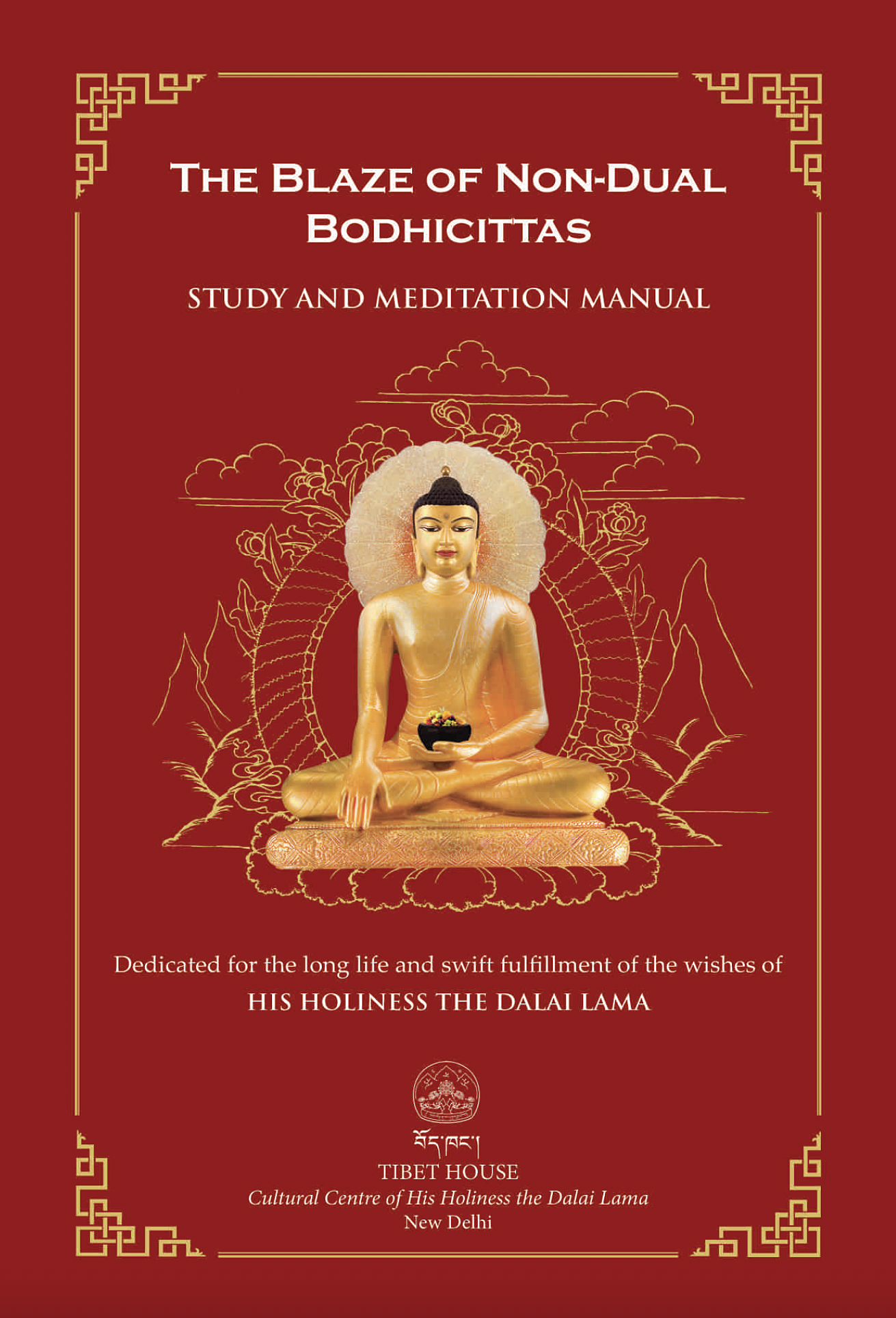
The Blaze of Non-Dual Bodhicittas (Damdul 2019)
Books/The Blaze of Non-Dual Bodhicittas (Damdul 2019)
| 🤓 Admin Zone 🛠️ hidden to non-admins | |

Description
The book is divided into five parts:
I. Daily Recitation and Practice
II. Selected Texts for Study, Reflection and Meditation
III. Additional Prayers, Vows and Commitments
IV. Daily Dedication Prayers
V. Appendix
Part I and Part IV serve as a useful guide for all, who have an inclination towards dharma practice, but do not know how to start and design a daily practice session. It is also useful for those seekers who might be misguided and surmise that dharma practice comprises only of mantra recitation and so forth, thereby missing its essence.
Part II helps strengthen the practitioner’s dharma practice on the basis of selected compositions of great scholars and yogis. The actual breakthrough in the mental transformation happens through changes in the thought process, for which study and reflection are the cornerstones. Any of these profound texts and short extracts may be selected for study, reflection or meditation, on an on-going basis.
Part III reinforces and rejuvenates dharma practice and to that end, may be undertaken on a regular or occasional basis.
Part V introduces the reader to meditation practices, both shamatha (calm abiding) and vipasyana (special insight), including meditation on the breath, as well as methods to cultivate Bodhicitta and the wisdom of emptiness. While there are many texts on the wisdom of emptiness, the meditation included here is designed for all those who are not thoroughly introduced to this subject and still want to familiarise and habituate themselves with the wisdom of emptiness.
Brief notes, Endnotes and Glossary have been added to help the readers unfold the meanings of the texts with ease. (preface, xiv–xv)
- Prefacexi
- I. Daily Recitation and Practice
- 1. Preliminary Prayers3
- 2. Blessing the Speech9
- [Tib. ngag byin rlabs]
- 3. The Noble Sūtra Remembering the Three Jewels12
- [Skt. ārya ratnatraya anusmṛti sūtra; Tib. 'phags pa dkon mchog rjes su dran pa'i mdo]
- 4. Praise to Śhākyamuni Buddha14
- [Tib. rgyun chags gsum pa]
- 5. The Drumbeat of Truth:16
- Supplication to Śhākyamuni Buddha
- [Tib. bden pa'i rnga sgra]
- His Holiness the XIV Dalai Lama
- 6. Sun Illuminating the Threefold Faith:19
- Praise to the Seventeen Nālānda Masters
- [Tib. dpal nalanda' pangrub bchu bdun gyi gsol 'debs]
- His Holiness the XIV Dalai Lama
- 7. Meditation on the Four Immeasurables26
- [Skt. chatvāribrahmavihārāh; Tib. tshad med bzhi]
- 8. The Heart Sūtra: The Perfection of Wisdom Sūtra29
- [Skt. ārya bhagavati prajñāpāramitā hṛidaya sūtra; Tib. shes rab snying po]
- 9. Seven Points for Training the Mind32
- [Tib. blo sbyong don bdun ma]
- Geshe Chekawa Yeshé Dorjé
- 10. Eight Verses for Training the Mind35
- [Tib. blo sbyong tshig brgyad ma]
- Geshe Langri Thangpa
- 11. Seven Limb Practice: Excerpt from the King of Prayers - The Extraordinary Aspiration of the Practice of Samantabhadrā37
- [Skt. samantabhadrācaryā praṇidhānaraja; Tib. 'phags pa bzang po spyod pa’i smon lam gyi rgyal po]
- 12. Short Mandala Offering40
- [Tib. man dal bsdus pa]
- 13. The Foundation of All Good Qualities42
- [Tib. yon tan gzhir gyur ma]
- 14. Generating the Mind of Consummate Yoga45
- [Tib. thams cad rnal 'byor gyi sems bskyed pa]
- 15. Mantra Recitations54
- II. Selected Texts for Study, Reflection and Meditation
- 16. The Noble Mahāyāna Sūtra "Wisdom at the Hour of Death"59
- [Skt. āryātyayajñānanāmamahāyānasūtra; Tib. 'phags pa 'da' ka ye shes zhes bya ba theg pa chen po'i mdo]
- 17. The Noble Mahāyāna Sūtra "Dependent Arising"61
- [Skt. āryapratītyasamutpādanāmamahāyanāsūtra; Tib. 'phags pa rten cing 'brel bar 'byung ba zhes bya ba theg pa chen po'i mdo]
- 18. The Noble Mahāyāna Sūtra "The Rice Seedling"63
- [Skt. āryasālistambhanāmamahāyānasūtra; Tib. 'phags pa sa lu'i ljang pa zhes bya ba theg pa chen po'i mdo]
- 19. Three Principal Aspects of the Path78
- [Tib. lam gtso rnam gsum]
- Lama Tsongkhapa
- 20. The Sūtra on Impermanence81
- [Skt. anityatāsūtra; Tib. mi rtag pa nyid kyi mdo]
- 21. Heart-Spoon: Encouragement through Recollecting Impermanence83
- [Tib. snying gi thur ma mi rtag dran bskul ma]
- Pabongka Rinpoche
- 22. In Praise of Dharmadhātu90
- [Skt. dharmadhātustava; Tib. chos dbyings bstod pa]
- Aryā Nāgārjuna
- 23. In Praise of Dependent Origination104
- [Tib. rten 'brel bstod pa]
- 24. Fundamental Wisdom of the Middle Way113
- [Skt. mūlamadhyamakakārikā; Tib. dbu ma rtsa ba shes rab]
- Aryā Nāgārjuna
- Chapter 1 Examination of Conditions113
- Chapter 18 Examination of Self and Phenomena115
- Chapter 22 Examination of the Tathagata117
- Chapter 24 Examination of the Four Noble Truths119
- Chapter 25 Examination of Nirvana125
- Chapter 26 Examination of the Twelve Links of Samsaric Existence128
- 25. A Lamp for the Path to Enlightenment131
- [Skt. bodhipathapradīpa; Tib. byang chub lam sgron]
- Atiśa Dīpaṃkara Śrījñāna
- 26. Thirty-Seven Practices of a Bodhisattva141
- [Tib. rgyal sras lag len so bdun ma]
- 27. Commentary on the Awakening Mind149
- [Skt. Bodhicittavivāraṇa; Tib. byang chub sems 'grel]
- Aryā Nāgārjuna
- 28. Hymn to [The Buddha] The World Transcendent165
- [Skt. lokātistava; Tib. 'jig rten las 'das pa'i bstod pa]
- Aryā Nāgārjuna
- 29. The Benefits of Generating Bodhicitta:169
- A Compilation of Verses from Sūtras and Treatises
- 30. The Benefits of the Awakening Mind:176
- Chapter One, A Guide to the Bodhisattva's Way of Life
- Skt. Bodhisattvacharyāvatāra; Tib. byang chub sems dpa'i spyod pa la 'jug pa]
- Bodhisattva Shantideva
- 31. Recognising the Mother:182
- A Song on the Experience of the Middle Way View
- [Tib. lam rim nyams mgur]
- 32. A Song of the Stages of the Path to Enlightenment187
- [Tib. rtogs brjod 'dun legs ma]
- 33. Rain Shower of Feats:195
- A Song of the Four Mindfulnesses as a Guide to the View of the Middle Way
- [Tib. lta mgur dran pa bzhi ldan]
- His Holiness the VII Dalai Lama
- 34. Noble Pursuit:197
- Revealing One's Personal Realisations
- [Tib. rtogs brjod 'dun legs ma]
- Lama Tsongkhapa
- 35. The Three Essential Points205
- [Tib. snying po don gsum]
- Yogi Mitra Joki
- 36. Summary of the Stages of Meditation:207
- An Excerpt from the Great Treatise on the Stages of the Path to Enlightenment, Vol. III
- Lama Tsongkhapa
- 37. Dependent Origination and Emptiness:213
- A Compilation of Excerpts from Sūtras and Treatises
- 38. Ultimate Reality in Madhyamaka Philosophy:221
- Excerpt from Illuminating the Clear Intention
- [Tib: dbu ma dgongs pa rab gsal]
- Lama Tsongkhapa
- 39. The Ganga Mahāmudrā:223
- Pith Instruction given by Master Tilopa to Naropa
- [Skt. mahamudraupadhaysham; Tib. phyag chen gang ga ma]
- Saint Tilopa
- 40. A Guide to the Two Truths229
- [Skt. satya-dvaya-avatara; Tib. bden pa gnyis la ’jug pa]
- Atiśa Dīpaṃkara Śrījñāna
- III. Additional Prayers, Vows and Commitments
- 41. Guru Pūjā237
- [Tib. bla ma mchod pa]
- 42. Mahāyāna Eight Precept Ceremony259
- [Tib. theg chen gso sbyong]
- IV. Daily Dedication Prayers
- 43. Song of Immortality:267
- Prayer for the Long Life of His Holiness the Dalai Lama
- [Tib. rgyal ba'i zhabs rten rab 'byams rgyal ba ma]
- Ling Rinpoche & Trijang Rinpoche
- 44. King of Prayers: The Extraordinary Aspiration of the Practice of Samantabhadrā271
- [Skt. samantabhadrācaryā praṇidhānaraja; Tib. 'phags pa bzang po spyod pa'i smon lam gyi rgyal po]
- Panchen Lobsang Choegyen
- 45. Dedication: Chapter Ten,281
- A Guide to the Bodhisattva’s Way of Life
- [Skt. Bodhisattvacharyāvatāra; Tib. byang chub sems dpai' spyod pa la 'jug pa]
- Bodhisattva Shantideva
- 46. Lamrim Dedication Prayer290
- [Tib. lam rim smon lam]
- 47. Ngag-rim Dedication Prayer292
- [Tib. sngags rim smon lam]
- 48. Additional Dedication Prayers294
- 49. Food Offering Prayers300
- V. Appendix
- 50. Staircase to Emptiness:305
- Meditation on Ultimate Reality
- 51. Methods to Cultivate Bodhicitta321
- 52. Categories of Bodhicitta323
- 53. Wheel of Life:328
- The Twelve Links of Dependent Origination
- [Skt. bhavachakra; Tib. srid pa 'khor lo]
- 54. Shamatha Meditation on the Breath342
- 55. Shamatha Meditation:344
- Nine Stages of Training the Mind
- Glossary351
- Endnotes374
- Respect for Sacred Books411


cultivating the awakening mind of compassion, wisdom, and love. This eight-verse lojong enshrines the very heart of Dharma, revealing the true essence of the Mahayana path to liberation. Even a single line of this practice can be seen as encapsulating the entire teaching of the Buddha. For even a single statement of this mind training practice has the incredible power to help us subdue our self-oriented behavior and mental afflictions. The fundamental theme of mind training practice is the profound reorientation of our basic attitude, both toward our own self and toward our fellow human beings, as well as toward the events around us. The goal of mind training practice is the radical transformation of our thoughts, attitudes, and habits. Presently, we tend to cherish the welfare of our own self at the expense of all others. However, the mind training teaching challenges us to reverse this process. This involves a deep understanding of others as true friends, and the recognition that our
true enemy lies inside of ourselves, not outside. Source Accessed Jan 30, 2025)

- All phenomena that arise from causes,
The Tathāgata has taught their cause,
And that which is their cessation,
Thus has proclaimed the Great Renunciant.


The King of Aspiration Prayers: Samantabhadra’s “Aspiration to Good Actions” (Zangchö Mönlam) from the Gaṇḍavyūha chapter of the Avataṃsaka Sūtra. Many translations of this text exist as it is regularly chanted around the world in many different traditions. For an example, see Lotsawa House.
Bhadracarīpranidhāna. (T. Bzang po spyod pa'i smon lam; C. Puxian pusa xingyuan zan; J. Fugen bosatsu gyōgansan; K. Pohyǒn posal haengwǒn ch'an 普賢菩薩行願讚). In Sanskrit, "Vows of Good Conduct," the last section of the Gaṇḍavyūha in the Avataṃsakasūtra and one of the most beloved texts in all of Mahāyāna Buddhism; also known as the Samantabhadracarīpraṇidhānarāja. The Bhadracarīpraṇidhāna focuses on the ten great vows (praṇidhāna) taken by Samantabhadra to realize and gain access to the dharmadhātu, which thereby enable him to benefit sentient beings. The ten vows are: (1) to pay homage to all the buddhas, (2) to praise the tathāgatas, (3) to make unlimited offerings, (4) to repent from one's transgressions in order to remove karmic hindrances (cf. karmāvaraṇa), (5) to take delight in others' merit, (6) to request the buddhas to turn the wheel of dharma (dharmacakrapravartana), (7) to request the buddhas to continue living in the world, (8) always to follow the teachings of the Buddha, (9) always to comply with the needs of sentient beings, and (10) to transfer all merit to sentient beings for their spiritual edification. The text ends with a stanza wishing that sentient beings still immersed in evil be reborn in the Pure Land of Amitābha. The text was translated into Chinese in 754 by Amoghavajra (705–774). Other Chinese recensions appear in the Wenshushili fayuan jing ("Scripture on the Vows made by Mañjuśrī"), translated in 420 by Buddhabhadra (359–429), which corresponds to the verse section from Ru busiyi jietuo jingjie Puxian xingyuan pin, the last roll of the forty-roll recension of the Huayan jing translated by Prajña in 798. (There is no corresponding version in either the sixty- or the eighty-roll translations of the
Huajan jing.) The verses are also called the "Précis of the Huayan jing (Lüe Huayan jing), because they are believed to constitute the core teachings of the Avataṃsakasūtra. In the main Chinese recension by Amoghavajra, the text consists of sixty-two stanzas, each consisting of quatrains with lines seven Sinographs in length, thus giving a total number of 1,736 Sinographs. In addition to the sixty-two core stanzas, Amoghavajra's version adds ten more stanzas of the Bada pusa zan ("Eulogy to the Eight Great Bodhisattvas") from the Badapusa mantuluo jing ("Scripture of the Maṇḍalas of the Eight Great Bodhisattvas") . . . Buddhabhadra's version consists of forty-four stanzas with 880 Sinographs, each stanza consisting of a quatrain with lines five Sinographs in length. Prajña's version contains fifty-two stanzas with each quatrain consisting of lines seven Sinographs in length. There are five commentaries on the text attributed to eminent Indian exegetes, including Nāgārjuna, Dignāga, and Vasubandhu, which are extant only in Tibetan translation. In the Tibetan tradition, the prayer is called the "king of prayers" (smon lam gyi rgyal po). It is incorporated into many liturgies; the opening verses of the prayer are commonly incorporated into a Tibetan's daily recitation. (Source: "Bhadracarīpraṇidhāna." In The Princeton Dictionary of Buddhism, 106. Princeton University Press, 2014. http://www.jstor.org/stable/j.ctt46n41q.27.).jpg)
Written as a supplement to Nagarjuna’s Fundamental Verses on the Middle Way, Candrakīrti’s text integrates the central insight of Nagarjuna’s thought—the rejection of any metaphysical notion of intrinsic existence—with the well-known Mahayana framework of the ten levels of the bodhisattva, and it became the most studied presentation of Madhyamaka thought in Tibet.
Completed the year before the author’s death, Tsongkhapa’s exposition of Candrakīrti's text is recognized by the Tibetan tradition as the final standpoint of Tsongkhapa on many philosophical questions, particularly the clear distinctions it draws between the standpoints of the Madhyamaka and Cittamatra schools.
Written in exemplary Tibetan, Tsongkhapa’s work presents a wonderful marriage of rigorous Madhyamaka philosophical analysis with a detailed and subtle account of the progressively advancing mental states and spiritual maturity realized by sincere Madhyamaka practitioners. (Source: Thupten Jinpa, Illuminating the Intent, 2021)
- Library Items
- Books
- Damdul, Dorji
- Nāgārjuna
- Śāntideva
- Tsong kha pa
- Atiśa
- 'chad kha ba
- Dge bshes glang ri thang pa
- Pha bong kha
- Dalai Lama, 7th
- Tilopa
- Ling Rinpoche, 6th
- Trijang, 3rd
- Panchen Lama, 4th
- Dalai Lama, 14th
- Mitrayogin
- Tibet House, New Delhi
- Topic: BCA Chapter 1
- Topic: BCA Chapter 10
- Topic: Mind Training
- Topic: pratītyasamutpāda
- Decade: 2010s