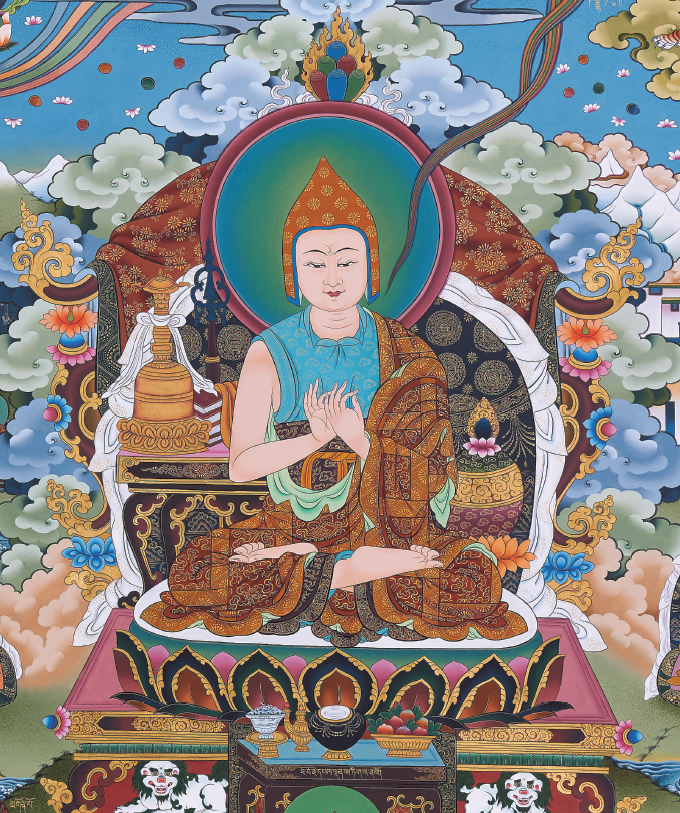
Again: On Atiśa's Bodhipathapradīpa

From Bodhicitta
LibraryArticlesAgain: On Atiśa's BodhipathapradīpaFull text
< Articles
(Redirected from Again: On Atiśa's Bodhipathapradīpa)
Articles/Again: On Atiśa's Bodhipathapradīpa

Again: On Atiśa's Bodhipathapradīpa
Journal Article


Please note that many items in our library are simply pages that represent a detailed library catalog entry and citation of someone else's work, presentation, or performance. Read our General Disclaimer for more information.

Description

This paper examines the textual transmission and Sanskrit restoration of Atiśa's Bodhipathapradīpa (Byang chub lam gyi sgron ma), one of his most important works composed in Western Tibet around 982-1054 CE. The author evaluates Losang Norbu Shastri's 1984 Sanskrit restoration, comparing it with earlier attempts by Mrinalkanti Gangopadhyaya.

Eimer demonstrates that the Tibetan text is transmitted through three distinct lines: (a) the Madhyamaka sections of Tengyur xylographs, (b) the Jo bo'i chos chung sections of various Tengyurs, and (c) paracanonical manuscripts and blockprints. Through detailed textual criticism, he identifies numerous variant readings and problematic renderings in Shastri's edition, providing corrections based on multiple canonical and noncanonical sources.

The paper highlights significant challenges in Sanskrit restoration from Tibetan translations, including issues with meter, word choice, and technical terminology. Eimer shows that while traditional translation dictionaries like the Mahāvyutpatti provide guidelines, many of Shastri's Sanskrit equivalents deviate from standard conventions. A key contribution is the presentation of the original Sanskrit version of lines 229-232, preserved in manuscripts of the Avikalpapraveśadhāraṇī, which demonstrates how multiple restoration attempts can differ significantly from the authentic text.


Citation
Eimer, Helmut. "Again: On Atiśa's Bodhipathapradīpa." Bulletin of Tibetology 22, no. 2 (1986): 5–15.


Scholarship on

 
Bodhipathapradīpa. (T. Byang chub lam gyi sgron ma). In Sanskrit, "Lamp for the Path to Enlightenment"; a work composed by the Indian scholar Atiśa Dīpamkaraśrījñāna at Tho ling gtsug lag khang shortly after he arrived in Tibet in 1042. Tibetan histories often note that Atiśa wrote this text in order to clarify problematic points of Buddhist practice, especially tantra, which were thought to have degenerated and become distorted, and to show that tantra did not render basic Buddhist practice irrelevant. The Bodhipathapradīpa emphasizes a gradual training in the practices of the Mahāyāna and vajrayāna and became a prototype and textual basis first for the bstan rim, or "stages of the teaching" genre, and then for the genre of Tibetan religious literature known as lam rim, or "stages of the path." It is also an early source for the instructions and practice of blo sbyong, or "mind training." Atiśa wrote his own commentary (pańjikā) (Commentary on the Difficult Points of the Lamp for the Path to Enlightenment) to the text. The text says bodhisattvas must first follow one of the sets of prātimokṣa disciplinary rules; based on those precepts, they practice the six perfections (pāramitā); with those perfections as a solid foundation, they finally practice Buddhist tantra. (Source: "Bodhipathapradīpa." In The Princeton Dictionary of Buddhism, 133. Princeton University Press, 2014. http://www.jstor.org/stable/j.ctt46n41q.27.)
Text