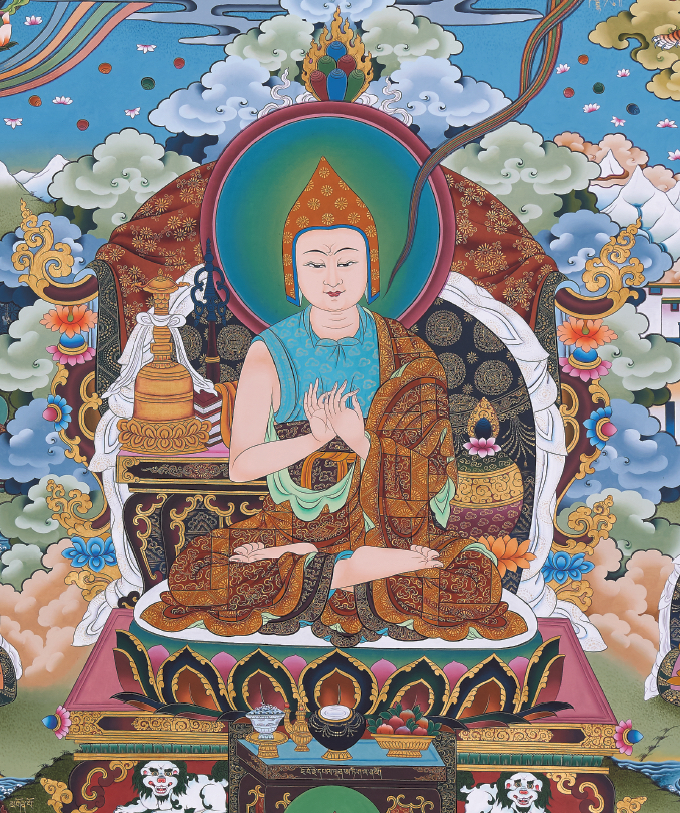
The Complete Works of Atīśa
From Bodhicitta
| 🤓 Admin Zone 🛠️ hidden to non-admins | |
The Complete Works of Atīśa: The Lamp for the Path and Commentary, together with the newly translated Twenty-five Key Texts
Book
Please note that many items in our library are simply pages that represent a detailed library catalog entry and citation of someone else's work, presentation, or performance. Read our General Disclaimer for more information.

Description
The complete works of Atīśa Śrī Dīpaṁkara Jñāna, Jo-bo-rje : The lamp for the path and commentary, together with the newly translated Twenty-five key texts (Tibetan and English texts)
Citation
Sherburne, Richard, trans. The Complete Works of Atīśa, Śrī Dīpaṁkara Jñāna, jo-bo-rje: The Lamp for the Path and Commentary, Together with the Newly Translated Twenty-five Key Texts. New Delhi: Aditya Prakashan, 2003.
Table of contents
- Preface to Second Editionvii
- Forewordxi
- Introductionxv
- Abbreviationsxix
- A Lamp for the Enlightenment Path [Poem]1
- Commentary on the Lamp for the Path21
- Dedication and Theme23
Vehicle of the Perfections
- Part One: Higher Conduct33
- CHAPTER 1 THE TRIPLE REFUGE37
- CHAPTER 2 THE ENLIGHTENMENT THOUGHT67
- CHAPTER 3 THE MONASTIC LIFE111
- CHAPTER 4 THE BODHISATTVA VOW147
- Part Two: Higher Meditation
- CHAPTER 5 THE SUPERKNOWLEDGES191
- Part Three: Higher Insight
- CHAPTER 6 INSIGHT AND MEANS217
Vehicle of Mysticism
- CHAPTER 7 TANTRA279
- COLOPHONS311
- Appendices
- CHART I THE FIVE PATHS323
- CHART II TANTRIC INITIATIONS324
- The Key Texts of Atīśa327
- 1. The Lamp for the Path329
- 2. A Lamp for Essential Practice347
- 3. Introduction to the Two Truths353
- 4. Instruction on the Middle Way361
- 5. Gathering the Essence367
- 6. The Essence Clearly Explained371
- 7. The Jewel Garland of the Bodhisattva379
- 8. Brief instruction on Bodhisattva Practice387
- 9. A Song: Mind Deliverance from Rebirth397
- 10. A song for the Practice407
- 11. Song of the Dharmadhatu View413
- 12. Instruction on Single Awareness415
- 13. Instruction on Entering the Path421
- 14. A Teaching on Taking the Refuges431
- 15. Mahayana Meditations in Verse439
- 16. Outline of Mahayana Path Meditation463
- 17. Encouragement in One 's Daily Practice467
- 18. The Compendium of the Sūtras473
- 19. The Ten Unvirtuous Actions489
- 20. Classification of Actions [karma]495
- 21. Concentration Equipment519
- 22. Sevenfold Worship523
- 23. Ritual before Recitation and Reading527
- 24. Ritual for Molding Offerings529
- 25. Steps in the Guru Duties533
- 26. Bodhisattva Vow Ritual537
- Glossary553
- Bibliography574
- Index591
Interconnections
12 Full translation of

Atiśa's work on the bodhisattva vow ceremony according to the Mind Only tradition stemming from Maitreya and Asaṅga that he received from his teacher Suvarṇadvīpa Dharmakīrti, known to Tibetans as Serlingpa.
Bodhipathapradīpa. (T. Byang chub lam gyi sgron ma). In Sanskrit, "Lamp for the Path to Enlightenment"; a work composed by the Indian scholar Atiśa Dīpamkaraśrījñāna at Tho ling gtsug lag khang shortly after he arrived in Tibet in 1042. Tibetan histories often note that Atiśa wrote this text in order to clarify problematic points of Buddhist practice, especially tantra, which were thought to have degenerated and become distorted, and to show that tantra did not render basic Buddhist practice irrelevant. The Bodhipathapradīpa emphasizes a gradual training in the practices of the Mahāyāna and vajrayāna and became a prototype and textual basis first for the bstan rim, or "stages of the teaching" genre, and then for the genre of Tibetan
religious literature known as lam rim, or "stages of the path." It is also an early source for the instructions and practice of blo sbyong, or "mind training." Atiśa wrote his own commentary (pańjikā) (Commentary on the Difficult Points of the Lamp for the Path to Enlightenment) to the text. The text says bodhisattvas must first follow one of the sets of prātimokṣa disciplinary rules; based on those precepts, they practice the six perfections (pāramitā); with those perfections as a solid foundation, they finally practice Buddhist tantra. (Source: "Bodhipathapradīpa." In The Princeton Dictionary of Buddhism, 133. Princeton University Press, 2014. http://www.jstor.org/stable/j.ctt46n41q.27.)
Bodhisattvamaṇyāvalī [alt. Bodhisattvamaṇevalī] (T. byang chub sems dpa'i nor bu'i phreng ba), or The Bodhisattva’s Garland of Jewels, is a lojong text attributed to Atiśa.
According to Thupten Jinpa,
"Although this text appears in the Tengyur (Toh 3951) as a self-standing work, it also exists almost in its entirety in another of Atiśa's works, entitled Letter of Unblemished Precious Jewels (Toh 4188), a letter sent by Atiśa to the Indian Bengali royalty Nayapāla from Nepal. Noting this, the Tibetan historian Pawo Tsuklak Trengwa asserts that Bodhisattva's Jewel Garland may actually have been compiled by Dromtönpa by drawing from Atiśa's writings. See his Joyful Feast for the Learned (Mkas pa'i dga' ston), p. 709." (Source Accessed Mar 14, 2025)Atiśa's commentary on the difficult points of his Lamp for the Path to Enlightenment. The text says bodhisattvas must first follow one of the sets of prātim okṣa disciplinary rules; based on those precepts, they practice the six perfections
(pāramitā); with those perfections as a solid foundation, they finally practice Buddhist tantra. (Source: "Bodhimārgapradīpa." In The Princeton Dictionary of Buddhism, 133. Princeton University Press, 2014. http://www.jstor.org/stable/j.ctt46n41q.27.)
Atiśa based his teaching of Madhyamaka thought and practice on the two realities, conventional reality (saṃvṛtisatya) and ultimate reality(paramārthasatya). Entry to the Two Realities succinctly lays out in twenty-eight verses a general exposition on the two realities. Atiśa composed this work between 1012 and 1025 while residing in Sumatra and studying under Serlingpa. Serlingpa inquired about Atiśa's philosophical views in a letter and Atiśa composed this set of verses as a response. Atiśa wrote Entry to the Two Realities in order to change the philosophical view of Serlingpa from a Yogācāra position to that of the Madhyamaka. Atiśa's introductory text on Madhyamaka presents his understanding based on the synthesis of a number of previous Indian Madhyamaka thinkers. (Source: James Apple, Atiśa Dīpaṃkara: Illuminator of the Awakened Mind, 127.
The Garbhasaṃgraha (Tibetan: Snying po bsdus pa, "Gathering the Essence") by the 11th-century Buddhist master Atiśa is a concise eight-verse summary of the complete Buddhist path to enlightenment. Written for practitioners living in degenerate times when life is short and obstacles many, the text systematically progresses from diagnosing the root causes of suffering (karma, afflictions, and grasping at dualistic realities) through the cultivation of wisdom (understanding emptiness and dependent origination) and compassion, to the ultimate fruition in buddhahood's Three Bodies. Atiśa presents this "essence of all Buddhas" as both a practical guide for spiritual development and a condensed teaching that can be quickly grasped by those unable to engage in extensive scriptural study, exemplifying his skill at making profound Buddhist doctrine accessible while maintaining doctrinal completeness.
The Caryāsaṃgrahapradīpa outlines the essential elements of the Buddhist path, beginning with generating bodhicitta (the awakening mind) and taking bodhisattva vows. Atiśa emphasizes maintaining pure moral conduct, proper eating habits, and dividing daily practice between meditation, study, and virtuous activities.
Key practices include: moderating food intake and dividing meals into offerings to deities, dharma protectors, and all beings; balancing seated meditation with walking, circumambulation, and study; maintaining awareness that all phenomena are illusion-like; and adapting one's practice based on the stability of one's meditation.
The text concludes with practical advice about conforming to social conventions when necessary and maintaining good intentions even when engaging with worldly matters. Written in Nepal at a friend's request, this guide represents Atiśa's integration of sūtra and tantra approaches, offering a balanced daily routine for serious Buddhist practitioners seeking enlightenment through the bodhisattva path.Atiśa's Hṛdayanikṣepa is a concise teaching on the Buddhist path from suffering to enlightenment. The basic message: All suffering comes from grasping at "self" and believing things truly exist. The solution is to realize all phenomena are empty and sky-like, while cultivating love, compassion, and bodhicitta (the awakening mind).
The path involves taking refuge, maintaining moral conduct, practicing the six perfections (pāramitās), and progressing through stages of realization to achieve the three bodies of a Buddha. Atiśa emphasizes urgency - in these degenerate times with short lifespans and many obstacles, practitioners must quickly grasp the essence of the teachings rather than getting caught up in elaborate analysis.
This is Atiśa's Brief Instruction on the Deeds of a Bodhisattva, a concise guide for practitioners seeking enlightenment to benefit all beings. The text begins with foundational principles: taking refuge in the Three Jewels, cultivating compassion, generating bodhicitta (the enlightenment mind), and crucially, taming one's own mind before attempting to help others. It then provides extensive practical guidance on ethical conduct, including treating all beings equally, speaking truthfully, avoiding the eight worldly concerns (praise/blame, gain/loss, etc.), practicing contentment with few desires, and maintaining mindfulness in all activities. The instruction emphasizes mental training through overcoming the three poisons (greed, hatred, delusion), accepting suffering without clinging to comfort, and viewing all sentient beings as one's own children. The text concludes with the ultimate goal of transcending cyclic existence, purifying obscurations, accumulating merit and wisdom, and attaining the enlightened state where one can effortlessly benefit others. Written by the influential 11th-century Indian master Atiśa, this practical manual reflects his systematic approach to Buddhist training and his significant role in revitalizing Buddhism in Tibet.
Atiśa's Teaching on Entering into the Path of a Bodhisattva Beginner is a comprehensive daily practice manual for beginning bodhisattvas. After finding a qualified teacher and generating bodhicitta, practitioners should maintain complete humility and dedicate all actions to benefiting others. The daily routine includes elaborate dawn prayers with the seven-limb practice (prostrations, offerings, confession, etc.), meditation sessions combining śamatha and vipaśyanā while viewing phenomena as illusion-like, and dividing meals into four parts for offerings, personal use, charity, and feeding animals. The practice is structured around six daily sessions totaling 54 moments of continuous spiritual activity, with the understanding that dedicated practitioners have no fixed sleeping schedule since they're constantly generating merit for the benefit of all beings.
This text by Atiśa (Dīpaṃkaraśrījñāna) is a concise guide to Mahāyāna Buddhist practice that begins with recognizing the precious rarity of human life and the urgency to practice due to impermanence, emphasizing taking refuge in the Three Jewels and maintaining ethical conduct as foundational steps. The core of the practice involves generating bodhicitta (the enlightened mind), which is described as essential for all Mahāyāna practice, since without it, even practicing the six perfections remains incomplete. The method requires combining skillful means and wisdom, like "father and mother," to produce the "bodhisattva child," emphasizing the cultivation of both śamatha (calm abiding) and vipaśyanā (insight meditation) in balanced unity. Throughout the path, practitioners are advised to avoid attachments, dwell in solitude when needed, maintain vigilance and mindfulness, see all beings as teachers, with special guidance given for ordained practitioners. The ultimate goal is attaining perfect enlightenment to benefit all sentient beings, becoming like a wish-fulfilling jewel that spontaneously helps others through a systematic path that unites compassionate method with transcendent wisdom from initial motivation through advanced meditation practices.
This text by Atiśa (Dīpaṃkaraśrījñāna) presents a condensed outline of the Mahāyāna Buddhist path, beginning with taking refuge in the Three Jewels, abandoning nonvirtuous actions, and maintaining pure ethical discipline as the foundation for bodhicitta (the enlightened mind). Practitioners are urged to cultivate constant mindfulness of death to spur diligent practice and quickly cross saṃsāra (cyclic existence) to attain buddhahood. The core practice involves undertaking bodhisattva vows and practicing the six perfections while training in both skillful means and wisdom to achieve nonabiding nirvāṇa. Like someone persistently rubbing a fire-stick to create flame, practitioners should meditate constantly with devotion and freedom from attachment to quickly attain buddhahood, becoming like a wish-fulfilling jewel that spontaneously fulfills others' needs. The text concludes with the aspiration that all beings will practice the Mahāyāna path and that the author may guide all beings upon attaining enlightenment.