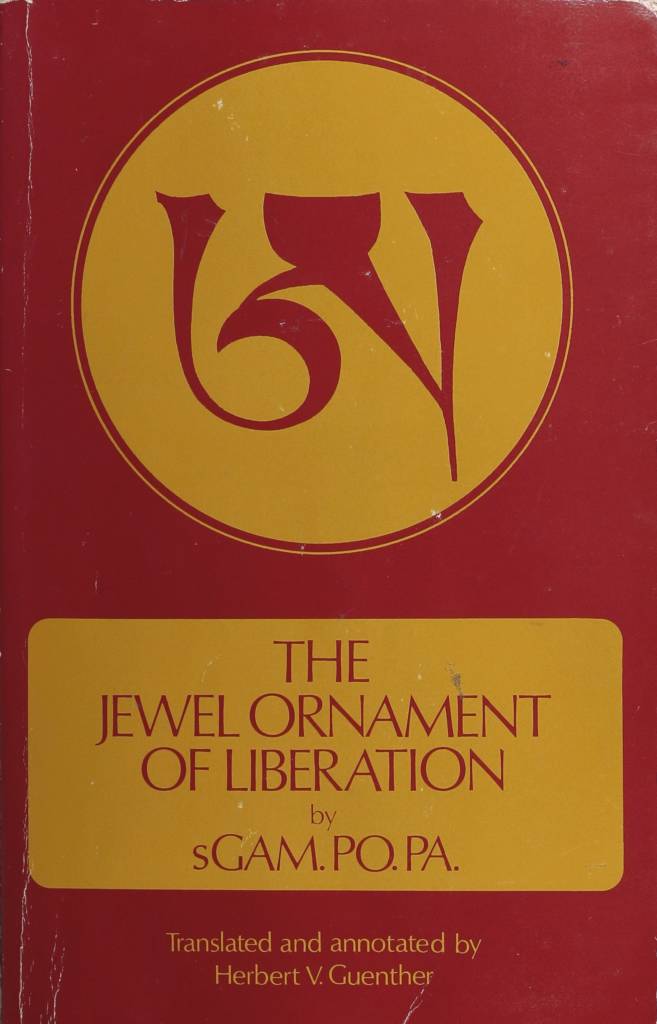
The Jewel Ornament of Liberation (Guenther)
From Bodhicitta
| 🤓 Admin Zone 🛠️ hidden to non-admins | |
The Jewel Ornament of Liberation (Guenther)
Book
Please note that many items in our library are simply pages that represent a detailed library catalog entry and citation of someone else's work, presentation, or performance. Read our General Disclaimer for more information.
-front.jpg)
Description
In this skillful translation, Herbert Guenther offers English-speaking readers sGam.po.pa's comprehensive and authoritative exposition of the stages of the Buddhist path. A masterly survey of Tibetan Buddhism, The Jewel Ornament of Liberation explains how an enlightened attitude is strengthened by practicing the six perfections (generosity, discipline, patience, exertion, meditation, and knowledge) and offers a concise presentation of Buddhism as a living experience.
As Chögyam Trungpa writes in his foreword: "It is in the flow of karma that this book materialized in 1959 on the very eve of the destruction of the spiritual land of Tibet. Professor Guenther was instrumental in making available the only commentary and guide in English to the bodhisattva tradition of Tibet, Japan, and China. The book remains the classic text of all Buddhists."
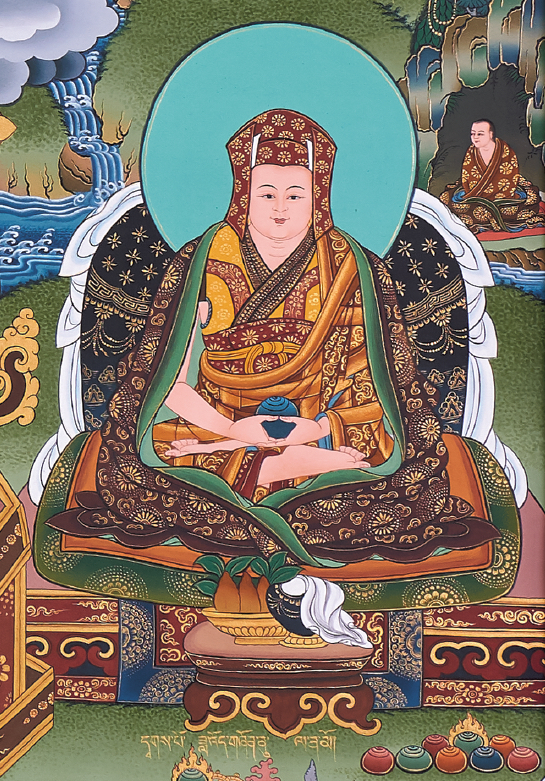
sGam.po.pa, who lived in the eleventh and twelfth centuries, was the organizer of the Kagyü order of Tibetan Buddhism.
Herbert V. Guenther is Professor Emeritus in the Department of Far Eastern Studies at the University of Saskatchewan.
(Source: back cover)
Citation
Guenther, Herbert V., trans. The Jewel Ornament of Liberation. By Gampopa (sgam po pa). The Clear Light Series. Boston: Shambhala Publications, 1989. First published 1959 by Rider & Co. (London).
Table of contents
- Foreword by Chogyam Trungpavii
- Prefaceix
- Introductionxi
- 1. The Motive1
- 2. The Working Basis 14
- 3. Meeting Spiritual Friends 30
- 4. The Instruction in the Transitoriness of the Composite 41
- 5. The Vicious State of Saṃsāra 55
- 6. Karma and Its Result 74
- 7. Benevolence and Compassion 91
- 8. Taking Refuge 99
- 9. The Acquisition of an Enlightened Attitude 112
- 10. The Training in an Enlightened Attitude 142
- 11. The Six Perfections 148
- 12. The Perfection of Liberality 152
- 13. The Perfection of Ethics and Manners 163
- 14. The Perfection of Patience 173
- 15. The Perfection of Strenuousness 181
- 16. The Perfection of Meditative Concentration 187
- 17. The Perfection of Awareness 202
- 18. The Five Paths 232
- 19. The Spiritual Levels 239
- 20. Perfect Buddhahood 257
- 21. Buddha Activity 271
- Pronunciation Guide 277
- Index of Book Titles, A. Tibetan 283
- B. Sanskrit 291
- C. Pali 294
- Index of Technical Terms, A. Tibetan 295
- B. Sanskrit 302
- Index of Names and Subjects 311
Interconnections
1 Full translation of

One of Gampopa's (b. 1079–d. 1153) most enduring works. It was one of the first "stages of the path" (lam rim) texts to be written by a Tibetan after the genre was introduced by Atiśa through his famous composition Bodhipathapradīpa, The Lamp for the Path to Enlightenment. Sometimes called the Dakpo Targyen (དྭགས་པོ་ཐར་རྒྱན།), Tharpa Rinpoche Gyen (ཐར་པ་རིན་པོ་ཆེའི་རྒྱན།) or simply Targyen (ཐར་རྒྱན། ) for short, it is one of the core Lamrim treatises of the Kagyu school by one of the early founders of the Kagyu tradition. The text presents a graduated path to enlightenment, synthesizing the Kadam teachings of Atiśa and the Mahāmudrā teachings of Milarepa and Marpa.