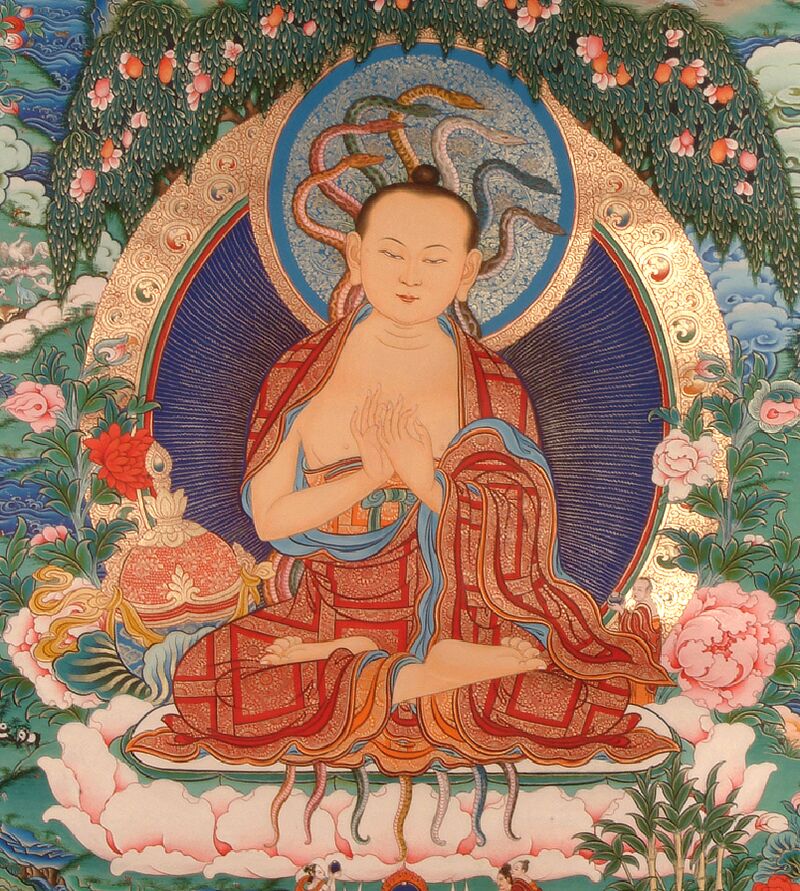
Part 1: About the Text
Titles of the Text
The Sanskrit title Bodhicittavivaraṇa (bodhi-citta-vivaraṇa) literally translates as "Commentary on the Awakening Mind."
Chinese canonical collections preserve a paraphrastic version titled Pu ti xin li xiang lun (菩提心離相論) in Taishō 1661, meaning "Treatise on the Awakening Mind Free of Characteristics," translated by the Kashmiri monk Dānapāla in 1005 CE during the Song Dynasty.
The Tibetan translation byang chub sems kyi 'grel pa is a calque of Sanskrit. It employs standard Tibetan equivalents for bodhicitta and vivaraṇa. The word 'grel pa emphasizes the text's commentarial function. Across major editions of the Tibetan Tengyur, including the Derge and Peking redactions, the Bodhicittavivaraṇa (D1800) is consistently classified within the Tantra Commentary section (རྒྱུད་འགྲེལ་, rgyud 'grel). This tantric classification stems exclusively from the text's introductory elements: an invocation to the tantric deity Vajrasattva and the quotation of a foundational verse drawn from chapter 2 of the Guhyasamājatantra. Despite this placement, the main body of the work is a philosophical treatise on Madhyamaka, focusing on the two truths and a critique of the Yogācāra school, and is devoid of further tantric concepts or ritual instructions. Modern scholarly consensus therefore regards the work as fundamentally a Mahāyāna philosophical text whose canonical cataloging reflects a decision based on its explicit tantric framing rather than a systematic analysis of its predominantly philosophical content. Note that there is a second translation available in many Tibetan canonical printings at D1801, which appears to be simply a second translation by Jayānanda (a Kashmiri paṇḍita) and Khu Mdo sde 'bar.
Textual Heritage and Transmission
The Sanskrit manuscript tradition presents a complex picture of partial preservation and scattered fragments, with no complete Sanskrit manuscript discovered to date. Cambridge MS Or. 713 preserves Sanskrit fragments alongside related texts. According to Lindtner, additional Sanskrit fragments survive as quotations throughout Indian commentarial literature, such as the Ālokamālāṭīkā (containing verse 20 of the Bodhicittavivaraṇa). Later commentaries, including Abhayākaragupta's Abhayapaddhati, Raviśrījñāna's Amṛtakaṇikā, and Vibhūticandra's Amṛtakaṇikoddyotanāmatippaṇī, preserve substantial portions, allowing partial textual reconstruction.
Explore Cambridge MS Or. 713
The Tibetan translation history reveals a sophisticated and complex selection process, improving textual accuracy over several centuries. The initial translation by the Indian abbot Guṇākara, working with Tibetan translator Rapzhi Shenyen, represents a first-wave transmission during the later propagation period. Subsequent revision by Kanakavarma, collaborating with the renowned translator Patsap Nyima Drak, produced what scholars consider the authoritative version. Patsap Nyima Drak's involvement proves particularly significant given his role in transmitting Prāsaṅgika Madhyamaka texts and his reputation for translation precision. However, we know from the commentaries of Rongtönpa, Śākya Chokden, and the Fourth Shamarpa, that a larger number of translations of the text were available up to the sixteenth century.
Explore Tibetan Recensions
This situation must have represented a significant scholastic challenge that was navigated in various ways by the three main commentators of the text. Rongtön Sheja Kunrik (1367–1449) approached the issue as a master textual critic and editor. His colophon reveals that he consulted six different Tibetan translations (by Rabzhi Chökyi Shenyen, Gurab Chökyi Sherab, Sengkar Shakya Ö, Sherab Drakpa, Marpa Chökyi Wangchuk, and Patsab Nyima Drak) and meticulously collated them to produce a composite root text based on what he judged to be the "best of the words and meanings." Following him, Śākya Chokden (1428–1507) mentions thirteen extant translations, including the one written down by the great scholar Tsangnakpa Tsöndru Senge. However, instead of collating, he made a deliberate choice to base his entire philosophical project on a single authoritative version: the translation by Patsab Lotsāwa Nyima Drak. Completing this chronological triad, the Fourth Shamarpa, Chökyi Drakpa Yeshe Pal Zangpo (1453–1524), mentions four major Tibetan translations: Smṛtijñānakīrti's translation, which was transmitted alongside his commentary, Khu Lotsāwa Dödebar’s prose translation, Lotsāwa Chökyi Sherab’s translation based on teachings from Paṇḍita Kṛṣṇa, and Patsab Lotsāwa Nyima Drak’s famous translation.
Modern critical editions emerged through modern scholarly efforts beginning with Christian Lindtner's pioneering reconstruction in his Nagarjuniana (1982). Lindtner's methodology involved collating available Sanskrit fragments with Tibetan witnesses. He identified two primary translation lines (A and B) and a third one (C) corresponding to the Tibetan translation found in Smṛtijñānakīrti's commentary, which happens to contain quotes of the root text. His edition distinguishes between readings preserving older transmission layers and those reflecting editorial standardization, providing an apparatus noting significant variants. Harunaga Isaacson's subsequent identification of Sanskrit quotations in tantric commentaries expanded the available corpus.
The Chinese version of the text, Taishō 1661, is a complete prose paraphrase rather than a literal verse-by-verse translation. It is still significant as a witness to the text's transmission since all 112 verses are represented, although sometimes only as slight traces within the interpretive prose. While its paraphrastic nature limits its use for critically reconstructing the original Sanskrit, this version provides valuable evidence. It confirms that the text was circulating and translated by the turn of the eleventh century and shows how the work's philosophical ideas were understood and transmitted within the Chinese Buddhist tradition.
Available Translations
In English, two resources reliably anchor present study. First, Christian Lindtner’s translation in Nagarjuniana (1982) offers a philologically rigorous rendering keyed to Tibetan witnesses and the surviving Sanskrit fragments. His apparatus highlights variant readings and transmission lines, which makes it especially useful for close comparison of technical terms and for tracking how specific verses read across the A/B/C translation streams. Second, Thupten Jinpa's translation prioritizes clarity of exposition while maintaining terminological discipline; brief orienting notes help nonspecialists follow the argumentative arc from the invocatory frame to the Madhyamaka core.
Content and Structure
The Bodhicittavivaraṇa opens with an homage to Vajrasattva followed by a declaration of intent to explain bodhicitta cultivation, immediately establishing its dual theoretical and practical orientation. The prose introduction quotes a verse from the Guhyasamājatantra's second chapter:
From the beginning, the mind is unborn.
It is empty of an essence, free from all elaboration.
The versified exposition unfolds through carefully structured philosophical progression demonstrating remarkable architectural coherence. Opening verses (4–11) establish foundations by refuting non-Buddhist concepts of a permanent self, examining various ātman theories from brahmanical schools and demonstrating their logical inconsistencies. This critique extends beyond mere polemic by introducing key Madhyamaka principles about the absence of inherent existence while showing how even sophisticated philosophical positions can harbor subtle substantialism.
The analysis then addresses Buddhist Abhidharma positions (verses 12–25), particularly reification of aggregates, elements, and sense-fields, demonstrating how analytical categories themselves require Madhyamaka deconstruction.
The work's central philosophical contribution emerges in verses 26–56, presenting a detailed Madhyamaka critique of Yogācāra positions. This section systematically examines consciousness-only doctrine, the three natures theory, and ālayavijñāna concepts, demonstrating how seemingly sophisticated analyses still harbor attachments to inherent existence. The critique specifically targets any attempt to establish consciousness as ultimately real while denying external objects, showing this position's internal contradictions through detailed argumentation.
Verses 57–72 establish the Madhyamaka alternative by presenting emptiness not as another philosophical position but as the absence of all inherent existence, including consciousness itself.
Final sections (73–112) demonstrate how realizing emptiness naturally manifests as compassionate activity, resolving apparent tensions between ultimate understanding and conventional engagement. This integration represents the text's distinctive contribution, showing that genuine realization of emptiness spontaneously generates universal compassion rather than nihilistic withdrawal. The work concludes with verses praising bodhicitta's benefits and dedicating merit, traditional elements framing philosophical analysis within soteriological purpose while encouraging practical application of theoretical insights.
Table 1: Structural Analysis of the Bodhicittavivaraṇa
| Section |
Verses |
Primary Focus |
Philosophical Method |
Significance
|
| Introduction
|
Prose + 1–3
|
Homage, introduction to the two bodhicittas
|
Scriptural authority, conceptual framework
|
Establishes tantric context and fundamental distinction
|
| Refutation of Non-Buddhist Self
|
4-11
|
Critique of ātman theories
|
Logical analysis, reductio arguments
|
Clears conceptual ground for emptiness analysis
|
| Analysis of Buddhist Reification
|
12-25
|
Aggregates, elements, sense-fields
|
Internal critique of Abhidharma categories
|
Demonstrates subtlety of substantialist thinking
|
| Yogācāra Critique
|
26-56
|
Consciousness-only, trisvabhāva, ālaya
|
Systematic philosophical deconstruction
|
Extensive Madhyamaka critique of Yogācāra
|
| Madhyamaka Synthesis
|
57-72
|
Emptiness and dependent origination
|
Apophatic definition through negation
|
Positive exposition through complete negation
|
| Compassionate Activity
|
73-104
|
Bodhisattva conduct and ethics
|
Integration of ultimate and conventional
|
Demonstrates wisdom-compassion unity
|
| Conclusion
|
105-112
|
Benefits, dedication of merit
|
Aspirational verses, traditional closure
|
Frames philosophical analysis within soteriological purpose
|
Part 2: About the Author
Traditional Attribution and Profile
The colophon unambiguously attributes the Bodhicittavivaraṇa to "the great master Ārya Nāgārjuna," placing the work within the corpus of Buddhism's most influential post-canonical philosopher. Nāgārjuna stands as the foundational figure of Madhyamaka philosophy and among the most important thinkers in Buddhist intellectual history. His life story is a blend of historical fact and legendary tales. Traditional accounts place his origins in the Andhra Pradesh region of southern India. According to these traditions, Nāgārjuna was born into a brahmin family but later converted to Buddhism. He was seen as a remarkable prodigy who quickly mastered the entire collection of Buddhist scriptures. His true genius, however, shone through when he systematically developed the philosophical doctrine of emptiness (śūnyatā).
His association with Nālandā, whether as founder or early teacher, positions Nāgārjuna at the center of Indian Buddhist institutional development. Traditional accounts of his residence at Śrīparvata Mountain in South India connect him to important patronage networks, suggesting that his influence extended beyond purely monastic circles into royal courts and broader society. The Tibetan tradition preserves over one hundred texts attributed to him, ranging from fundamental philosophical treatises to devotional hymns, medical works, and alchemical texts. This vast attributed corpus suggests multiple historical figures may have borne the name Nāgārjuna. Multiple attributions reflect both prolific output and pseudepigraphic tendencies (see analysis in The Authorship Debate below). According to modern scholarship, the "tantric Nāgārjuna," associated with esoteric practices and alchemical pursuits, represents a distinct historical figure whose works became conflated with the earlier philosopher. Traditional Tibetan sources also sometimes distinguish these figures while maintaining that both represent authentic expressions of Nāgārjuna's teaching lineage.
Tibetan historians, however, generally regarded the tantric and philosophical Nāgārjunas as expressions of one enlightened master capable of teaching across multiple vehicles. Traditional accounts describe Nāgārjuna as having produced works addressing the Three Wheels of Doctrine: while the Mūlamadhyamakakārikā represents a second wheel emphasis on emptiness, the Bodhicittavivaraṇa aligns with third wheel positive descriptions of ultimate reality.
The Authorship Debate
The Bodhicittavivaraṇa's coherent structure and balanced treatment of topics suggest single authorship rather than compilation from diverse sources. Modern scholarship, however, questions whether the Bodhicittavivaraṇa was composed by the same Nāgārjuna who authored the Mūlamadhyamakakārikā, generating extensive controversy illuminating broader methodological issues in Buddhist studies. Christian Lindtner emerged as the primary advocate for authentic attribution, incorporating the text into his influential list of thirteen genuine Nāgārjuna works based on comprehensive stylistic and doctrinal analysis. His methodology employs the Mūlamadhyamakakārikā as a baseline for comparison, examining philosophical consistency, argumentative strategies, technical terminology, and compositional patterns. This approach argues that the Bodhicittavivaraṇa's sophisticated structure, philosophical depth, and stylistic features align perfectly with accepted works like the Yuktiṣaṣṭikā and Ratnāvalī.
Evidence supporting traditional attribution includes frequent citations by later Madhyamaka commentators who treated it as authoritative, suggesting established recognition within Indian Buddhist scholarship. The text's systematic critique of Yogācāra positions fits Nāgārjuna's general opposition to substantialist philosophies, while its integration of emptiness analysis with bodhicitta cultivation represents logical development of his philosophical project. Isaacson's discovery of Bodhicittavivaraṇa verses embedded in Abhayākaragupta's Abhayapaddhati demonstrates the text's circulation by the eleventh century among tantric commentators who explicitly attributed it to Nāgārjuna.
The case against traditional attribution rests on several significant observations about the text's absence from early commentarial literature and apparent anachronisms. The foundational Prāsaṅgika commentators omit this text despite its relevance (see Table 2 below). This silence appears particularly significant given Candrakīrti's comprehensive knowledge of Nāgārjuna's corpus and tendency to cite extensively from authentic works. The text first appears definitively in Bhāviveka's mature work but remains absent from his earlier compositions, suggesting either later composition or initially limited circulation.
Table 2: Evidence in the Attribution Debate
| Evidence Type |
Supporting Traditional Attribution |
Questioning Traditional Attribution
|
| Stylistic Analysis
|
Similar to Yuktiṣaṣṭikā, Ratnāvalī, Catuḥstava (Lindtner)
|
Differs from negative dialectics of MMK (Dragonetti)
|
| Citation History
|
Quoted by Bhāviveka, Aśvabhāva, Śāntarakṣita (Lindtner)
|
Absent from Buddhapālita, Candrakīrti
|
| Doctrinal Content
|
Systematic Madhyamaka methodology
|
Sophisticated engagement with later Yogācāra ideas (Williams, Buescher)
|
| Textual Evidence
|
Stanza 57 in Maitrīpa's Pañcākāra
|
Quotes verse 71 from Madhyāntavibhāga (Dragonetti)
|
| Manuscript Attribution
|
Consistently attributed in traditional sources
|
Attributions can be honorary
|
| Dating Indicators
|
Could indicate skilled imitation
|
Guhyasamāja quotation, Vajrasattva invocation suggest later tantric context
|
| Philosophical Method
|
Consistent with Nāgārjuna's approach
|
Positive language unusual for early Madhyamaka
|
| Historical Context
|
Sophisticated understanding possible later
|
Post-fourth-century dating likely
|
Scholarly Disagreements
The debate reflects methodological tensions between traditional attribution and critical analysis, with some scholars distinguishing "philosophical authenticity" from historical authorship. Paul Williams argues convincingly that the sophisticated Yogācāra critique indicates composition after the full development of consciousness-only philosophy in the fourth–fifth centuries, while Carmen Dragonetti's analysis highlights specific philosophical positions appearing anachronistic for the second century.
The defense emphasizes the text's philosophical consistency with established Nāgārjuna works and its systematic treatment of emerging Mahāyāna concepts that could have been present in nascent forms during the classical period. Critics respond that the level of technical engagement with Yogācāra terminology requires familiarity with developed scholastic systems unavailable before the fourth century. The debate has evolved beyond simple attribution questions to examine what constitutes philosophical authenticity in Buddhist literature, with some scholars suggesting that doctrinal coherence matters more than historical authorship for understanding the text's significance.
Yochimizu's analysis of the Guhyasamāja quotation in the text's opening provides additional evidence for later composition, noting that the specific way this tantric material is integrated suggests familiarity with developed esoteric traditions rather than early experimentation with tantric vocabulary. Mathes notes that the Guhyasamāja quotation in the text's opening may indicate that the author could have been the tantric Nāgārjuna of the Ārya tradition of the Guhyasamājatantra.
Recent scholarship explores possibilities of multiple authorship layers, suggesting the text might preserve authentic Nāgārjuna teachings with later elaborations or represent sophisticated pseudepigraphic composition by someone deeply familiar with his philosophical approach. This theory could explain both stylistic similarities to accepted works and the presence of apparently anachronistic elements. From this standpoint, the sophisticated integration of philosophical argument with practical instruction might reflect editorial synthesis rather than single authorship, a common pattern in Indian philosophical literature where texts evolved through commentary and revision processes.
Part 3: Text Significance and Reception
Significance for Bodhicitta Studies
The Bodhicittavivaraṇa represents a philosophically sophisticated exposition of bodhicitta in classical Indian Buddhist literature. As mentioned previously, it provides a systematic integration of the awakening mind doctrine with Madhyamaka emptiness philosophy. Unlike texts treating bodhicitta as merely ethical, this work establishes its fundamental identity with the realization of emptiness and thus prioritizes teaching ultimate bodhicitta. From the text's perspective, the ultimate bodhicitta, defined as a direct realization of emptiness, spontaneously manifests as conventional bodhicitta through natural expression of wisdom recognizing the arbitrary nature of self-other distinctions.
Conventional bodhicitta emerges not merely as motivation or attitude but as the natural expression of wisdom, while ultimate bodhicitta transcends any conceptual elaboration. This nondual approach differs from treatises presenting these as sequential stages or separate practices insofar as, according to the author of the Bodhicittavivaraṇa, a genuine understanding of emptiness necessarily generates universal compassion. As the belief in inherent self-existence collapses, the conventional nature of boundaries limiting empathy and compassion falls apart, and bodhicitta in its conventional aspect shines forth.
Reception History
The Bodhicittavivaraṇa is a work that stands at the intersection of scholastic Madhyamaka philosophy and tantric practice, defined by its systematic use of philosophical reasoning within an explicit tantric framework. This positioning is key to understanding its reception history in India and Tibet. The text's synthesis is characteristic of the intellectual and religious environment of tenth-century India, a period when scholar-adepts sought to integrate formal philosophy with tantric methodologies. Its reception reflects this context: largely overlooked by earlier Indian Mādhyamikas, the Bodhicittavivaraṇa became an important text for later siddhas and for the Tibetan traditions that continued their project of unifying the sūtra and tantra paths.
The Influence of the Text in India
The early history of the Bodhicittavivaraṇa in India is marked by a conspicuous silence from the great Madhyamaka masters. As Paul Williams notes, the text is never mentioned or cited by key figures like Buddhapālita, the authentic Bhāviveka, or Candrakīrti. This absence suggests that if the work existed in their time, it was not considered an authoritative part of the Nāgārjunian corpus by the principal representatives of the school.
Evidence for the text's circulation only began to appear in later Indian literature. The Bodhicittavivaraṇa gained prominence among the late Indian mahāsiddhas, a claim substantiated by its use in the eleventh century by the siddha Maitrīpa. He quotes stanza 57 of the text in his Pañcākāra, indicating that the Bodhicittavivaraṇa was circulating and held authority within these tantric contemplative circles. While sources do not state that Maitrīpa explicitly named Nāgārjuna when quoting, the act of quoting from a text traditionally attributed to the master signifies an acceptance of its authority within his lineage. Further evidence of its status comes from Smṛtijñānakīrti (c. tenth century), who composed a commentary on the Bodhicittavivaraṇa, and from Bhāvya (a later tantric author also named Bhāviveka), the author of the Madhyamakaratnapradīpa, who relied heavily on the Bodhicittavivaraṇa. This pattern shows that the text, regardless of its true origin, became an important work in India during the final flourishing of Buddhism, valued for its unique ability to bridge Madhyamaka philosophy with the Vajrayāna worldview.
The Early Kadam Tradition
The transmission of the Bodhicittavivaraṇa to Tibet was decisively shaped by the Bengali master Atiśa Dīpaṃkara Śrījñāna (982–1054). Recognizing its value for synthesizing sūtra and tantra, Atiśa brought the text to Tibet and, as Apple has shown, quotes extensively from it in his short treatises. In his work on bodhicitta, The Open Basket of Jewels (Ratnakaraṇḍodghāṭa), the Bodhicittavivaraṇa and Śāntideva's text are the most quoted works. Considering the status of the Bodhisattvacaryāvatāra for his followers in the Kadam school, this must have established the Bodhicittavivaraṇa as an authoritative text in this lineage.
The Kadam tradition resolved the text’s hybrid nature by interpreting it as a unique bridge between the Pāramitāyāna and the Vajrayāna. This view is particularly articulated by the twelfth-century scholar Majapa Tsöndru Senge. As Paul Williams discusses, Majapa's textual classification—which is not merely a later interpretation but a documented historical categorization—places the Bodhicittavivaraṇa in a special category of its own as the single text that demonstrates that the sūtra and tantra corpora share "a single meaning or goal." He saw it as a commentary on the Guhyasamājatantra's discussion of ultimate bodhicitta, using Madhyamaka reasoning to elucidate a core tantric principle. For the Kadampas, the Bodhicittavivaraṇa was not merely a philosophical treatise but a practical manual for cultivating the correct view necessary for advanced practice.
The Geluk Tradition
As the spiritual successors to the Kadam school, the Geluk tradition founded by Tsongkhapa Lobzang Drakpa (1357–1419) inherited and amplified the Kadam interpretation of the Bodhicittavivaraṇa. Following the precedent set by Majapa, Tsongkhapa and later Geluk masters like Khedrub Je consistently cite the Bodhicittavivaraṇa in a tantric context, treating it as an authoritative commentary on the Guhyasamājatantra.
Tsongkhapa and Khedrub Je fully embraced the text's tantric framing and purpose while using its Madhyamaka philosophical core as the basis for doctrinal arguments. In the Geluk curriculum, the text provides a Nāgārjunian foundation for the doctrine of emptiness as it is understood within the Vajrayāna, making its analysis an indispensable preparation for the generation and completion stages of Highest Yoga Tantra. From that perspective, the nature of emptiness mentioned in the introduction of the Bodhicittavivaraṇa can be understood as referring to the innate mind of clear light.
The Kagyu Tradition
The Kagyu tradition also holds the Bodhicittavivaraṇa in high esteem but reinterprets it to provide doctrinal support for its central practice of Mahāmudrā, the "Great Seal." The text's importance is underscored by the Seventh Karmapa, Chödrak Gyatso (1454–1506), who, as Klaus-Dieter Mathes notes, included it in his influential collection of "Indian Mahāmudrā Works" (Chakgya Chenpo Gyazhung), cementing its place in the Kagyu canon.
The Kagyu reading, exemplified in the commentary by the Fourth Shamarpa, Chökyi Drakpa Yeshe Pal Zangpo, foregrounds passages that support direct, nonconceptual meditation on the nature of mind. While the Bodhicittavivaraṇa does not explicitly use the term luminosity (prabhāsvara), the Kagyu tradition interprets its description of ultimate bodhicitta as a direct reference to the luminous, empty awareness realized in Mahāmudrā. This interpretive move equates the text's nondual philosophical conclusions with the direct experience of the mind's nature, thus transforming its Madhyamaka analysis into a practical manual for stabilizing nonconceptual awareness.
Table 3: Reception History at a Glance
| Tradition |
Period |
Key Interpreters |
Primary Use
|
| Indian Siddha Tradition
|
10th–11th c
|
Maitrīpa, Smṛtijñānakīrti
|
Bridging Madhyamaka philosophy and Vajrayāna
|
| Kadampa
|
11th–14th c.
|
Atiśa, Majapa
|
Manual for cultivating the correct view for tantra
|
| Geluk
|
14th c.–present
|
Tsongkhapa, Khedrub Je, 14th Dalai Lama
|
Philosophical preparation for Highest Yoga Tantra
|
| Kagyu
|
15th c.–present
|
7th Karmapa, 4th Shamarpa
|
Doctrinal support for Mahāmudrā practice
|
Part 4: Study the Text
Key Verses and Passages
The Bodhicittavivaraṇa's influence stems largely from several key verses that encapsulate its distinctive synthesis of Madhyamaka analysis with positive descriptions of ultimate reality, creating interpretive challenges that have generated centuries of scholarly discussion.
The opening invocation immediately establishes the text's dual nature by invoking Vajrasattva, a tantric deity, while promising exposition of bodhicitta cultivation that transcends sectarian boundaries. The reference to destroying three types of existence frames bodhicitta as liberative rather than merely ethical, prefiguring the integration of practice and philosophy throughout the work.
Homage to glorious Vajrasattva!
It has been stated [in the Guhyasamājatantra]:
- Devoid of all real entities;
Utterly discarding all objects and subjects,
Such as aggregates, elements and sense-fields;
Due to sameness of selflessness of all phenomena,
One's mind is primordially unborn;
It is in the nature of emptiness.
[...]
Those bodhisattvas who practice by means of the secret mantra, after having generated awakening mind in terms of its conventional aspect in the form of an aspiration, must [then] produce the ultimate awakening mind through the force of meditative practice. I shall therefore explain its nature.
Verse 2 provides a concise Madhyamaka definition of the ultimate awakening mind:
The Buddhas maintain the awakening mind
To be not obscured by such conceptions
As consciousness of "self," "aggregates" and so on;
It is always characterized by emptiness.
In this verse, bodhicitta is not defined as a mere intention but as the mind's natural state when unobscured by the conceptual grasping at a "self" or at seemingly solid "aggregates" (skandhas). Its essential, ever-present characteristic is emptiness. Atiśa, in his Ratnakaraṇḍodghāṭa, quotes this verse as an authoritative statement by Nāgārjuna to summarize the nature of the ultimate mind. For Atiśa, it shows how a practitioner, established in both compassion and emptiness, comes to realize this nondual state, demonstrating the verse's long-standing role as a definitive instruction.
Verse 20 illustrates the limitation of subjective imputation through a famous example:
With respect to the same female body,
Three different notions are entertained
By the ascetic, the lustful and a (wild) dog,
As a corpse, an object of lust, or food.
This verse explains that identical phenomena appear differently depending on mental conditioning, driving home the Madhyamaka point that perceived objects lack inherent nature and are labeled by a mind influenced by conceptual frameworks and karmic conditioning.
The teaching in verse 25 proceeds with the text's graduated refutation of progressively subtler views:
To overcome grasping at selfhood
[The Buddha] taught aggregates, elements and so on.
By abiding in the [state of] mind only,
The beings of great fortune even renounce that [teaching].
In this verse, it is explained that the teachings on "aggregates" and "elements" were given as an antidote to grasping at a permanent self. It then introduces the Yogācāra standpoint of "mind only" (cittamātra) as a higher, provisional method used by "beings of great fortune" to renounce even the subtle grasping at those very aggregates and elements. The verse functions as a skillful transition, presenting the mind-only view as a necessary step on the path.
The pivotal verse 27 explains that Yogācāra's foundational doctrine is of limited validity when considered from a higher perspective:
"All of this is but one's mind,"
That which was stated by the Able One
Is to alleviate the fear of the childish;
It is not (a statement) of (final) truth.
This verse distinguishes between denying external objects and affirming consciousness's ultimate reality, arguing Buddha's consciousness-only teaching served a therapeutic, provisional purpose rather than a final, metaphysical one.
Verse 43 makes a radical apophatic statement about the ultimate nature of mind, powerfully undercutting any tendency to reify consciousness:
In brief the buddhas have never seen
Nor will they ever see [such a mind];
So how can they see it as intrinsic nature
That which is devoid of intrinsic nature.
The author states here that not even the buddhas, with their omniscient wisdom, have ever perceived "the mind" as a distinct, findable entity. The concluding rhetorical question makes clear that it is impossible to see an intrinsic nature in that which is fundamentally devoid of it. In his Ratnakaraṇḍodghāṭa, Atiśa quotes this verse immediately after scriptural citations on the mind's clear light nature, using Nāgārjuna's authority to guide the practitioner away from subtle grasping at consciousness itself as an ultimately real thing.
Verse 46's pure negation—"without characteristics and unborn"—exemplifies Madhyamaka methodology by indicating absence rather than positive metaphor while insisting on language's limits:
Devoid of characteristics and origination,
Devoid of substantive reality and transcending speech,
Space, awakening mind, and enlightenment
Possess the characteristics of nonduality.
This verse operates by indicating an absence of limiting characteristics, comparing ultimate bodhicitta to space to suggest freedom from conceptual boundaries. The identity between bodhicitta and enlightenment collapses conventional path-goal distinctions by suggesting the awakening mind already expresses the goal.
A key section for understanding the text's historical context is found in verses 71–73. Verse 71 provides a series of synonyms for ultimate bodhicitta:
It is described as suchness and as the reality-limit,
As signlessness and as the ultimate truth,
As the supreme awakening mind;
It is described also as emptiness.
This verse is a focal point of scholarly controversy, as its list of terms closely corresponds to a verse in the Madhyāntavibhāga (1.14), a foundational Yogācāra text, suggesting a later composition date for the Bodhicittavivaraṇa. The passage culminates in verse 73, which links this philosophical insight directly to practice:
When this emptiness (as explained)
Is thus meditated upon by yogis,
No doubt there will arise in them
A sentiment attached to other's welfare.
This verse encapsulates the Bodhicittavivaraṇa's unique approach. It argues that universal compassion is not simply an exercise in imagination or an emotional response to past kindness but rather the natural and inevitable result of realizing the empty, dependent nature of all phenomena. For the author, seeing that the self and others lack inherent existence dissolves the very basis of self-cherishing, allowing a concern for the welfare of others to arise spontaneously.
Verse 88 addresses the fundamental challenge of integrating the ultimate view of emptiness with the practice of discipline on the conventional level, presenting their synthesis as the pinnacle of the path:
Those who understand this emptiness of phenomena
Yet (also) conform to the law of karma and its results,
That is more amazing than amazing!
That is more wondrous than wondrous!
Core Concepts and Frameworks
The Bodhicittavivaraṇa's primary aim is to provide a precise philosophical framework for understanding the ultimate nature of the awakening mind (bodhicitta). It achieves this by defining bodhicitta through the lens of Madhyamaka philosophy and outlining a systematic method of analysis to realize it directly. This approach integrates profound wisdom with compassionate practice.
The Two Aspects of the Awakening Mind
The text's analysis is built upon the Mahāyāna distinction between two aspects of bodhicitta, which it presents as complementary dimensions of a single awakened state:
- Conventional Awakening Mind (saṃvṛtibodhicitta): It includes the wish to attain enlightenment for the benefit of all beings (aspirational bodhicitta) and the active engagement in the practices that lead to that goal (engaged bodhicitta). The text treats this compassionate engagement not as a preliminary stage to be discarded but as the natural and necessary expression of wisdom within the world of conventional reality.
- Ultimate Awakening Mind (paramārthabodhicitta): This is the direct, nonconceptual realization of emptiness (śūnyatā). The text defines it as a mind free from all conceptual elaboration (prapañca) and beyond the duality of subject and object. In a radical claim, the author identifies this ultimate bodhicitta with enlightenment itself, not merely as a cause that leads to it. This collapses the conventional distinction between the path and the goal, suggesting that the mind that directly realizes emptiness is already expressing the awakened state.
The Method: A Fourfold Refutation
To guide the practitioner toward the realization of ultimate bodhicitta, the text employs a systematic, four-stage process of negation. This progressive analysis is designed to dismantle all conceptual attachments to inherent existence (svabhāva), moving from the most coarse to the most subtle.
- Negation of the Non-Buddhist Self: The analysis begins by refuting the theories of a permanent, independent, and unitary self or soul (ātman) as found in non-Buddhist Indian philosophies. This is the standard starting point for Buddhist analysis, clearing away the most obvious form of grasping.
- Negation of the Substantial Reality of Phenomena (dharmas): The critique then turns inward to Buddhist philosophy, specifically the Abhidharma view. While Abhidharma deconstructs the self into its constituent components (dharmas), it can lead to a subtle grasping at these components as being ultimately real. The Bodhicittavivaraṇa demonstrates that these dharmas are also empty of inherent existence.
- Negation of the Inherent Existence of Consciousness: This is the most extensive part of the refutation. It represents a detailed critique of the Yogācāra school. After demonstrating the emptiness of external objects, the mind or consciousness itself can become the last object of grasping. The text systematically refutes the idea that consciousness (specifically the ālayavijñāna or "storehouse consciousness") is an ultimately real foundation, showing that it too is devoid of inherent existence.
- Negation of the Negation Itself: The final step prevents the practitioner from turning "emptiness" into a new philosophical position or a subtle object of attachment. By negating the negation, the analysis avoids the extremes of eternalism (affirming some ultimate reality) and nihilism (negating conventional reality). This final move ensures that Madhyamaka remains a "middle way" that transcends all fixed conceptual standpoints.
Table 4: Core Concepts and Technical Terms
| Sanskrit |
Tibetan |
English |
Philosophical Function
|
| śūnyatā
|
stong pa nyid
|
Emptiness
|
The absence of inherent existence; the ultimate nature of all phenomena.
|
| svabhāva
|
rang bzhin
|
Inherent Existence
|
The object of negation in Madhyamaka analysis; a self-sufficient, independent mode of being.
|
| pratītyasamutpāda
|
rten 'byung
|
Dependent Origination
|
The positive description of conventional reality; how things exist interdependently.
|
| prapañca
|
spros pa
|
Mental Proliferation
|
The conceptual elaboration that obscures a direct realization of emptiness.
|
| nirvikalpa
|
rnam par mi rtog
|
Nonconceptual
|
The mode of cognition that directly realizes ultimate bodhicitta.
|
| ālayavijñāna
|
kun gzhi rnam shes
|
Storehouse Consciousness
|
The foundational Yogācāra concept of mind
|
The commentarial tradition surrounding the Bodhicittavivaraṇa reveals how philosophical texts evolve through interpretive communities that elaborate, clarify, and sometimes transform original meanings while adapting content to new contexts and audiences. These commentaries not only explain difficult passages but also demonstrate the text's continuing relevance across diverse cultural and philosophical contexts throughout Buddhist history.
The commentary on the Bodhicittavivaraṇa by the eleventh-century Indian paṇḍita Smṛtijñānakīrti, the Bodhicittavivaraṇaṭīkā, represents one of the most sophisticated tantric interpretations of Nāgārjuna's treatise. From its opening verses, where the author humbly states his intention to eliminate conceptual elaborations (rtog pa kun spangs pa) motivated purely by faith (dad pas) rather than worldly concerns, the commentary positions itself as a profound integration of Madhyamaka philosophy with Vajrayāna practice. Significantly, Smṛtijñānakīrti immediately frames the Bodhicittavivaraṇa's instructions as originating from the Guhyasamājatantra and being specifically intended for "yogis and yoginis" (rnal 'byor pha dang ma), thereby establishing the text not as a general Mahāyāna treatise but as an essential guide for tantric practitioners.
Methodologically, the commentary employs a classical Indian doxographical structure, systematically dismantling competing philosophical positions to establish the supremacy of Madhyamaka. The author provides extensive refutations of tīrthika (non-Buddhist), Vaibhāṣika, Sautrāntika, and Cittamātra positions, with particular emphasis on deconstructing the Yogācāra notion of substantially existent self-awareness (svasaṃvedana, so so rang rig). Through sophisticated logical analysis, including his famous "sensation-triad" critique (tshor ba po, tshor byed, tshor bya - vedaka, vedya, vedanā), Smṛtijñānakīrti demonstrates that even immediate self-awareness is merely conceptual construction lacking inherent existence.
Ultimate Bodhicitta as Vajrasattva Mahāmudrā
The commentary's most significant contribution is its explicit identification of the path's ultimate goal. It describes the fully ripened result of ultimate bodhicitta as the "essence of nonabiding nirvana that is the support of all tathāgatas of the three times." This fruition, the commentary states, is none other than the "form of Vajrasattva Mahāmudrā" (rdo rje sems dpa'i sku phyag rgya chen po'o).
To clarify this, the commentary explains the symbolism of the vajra itself:
- The vajra is the "self-nature of emptiness, the essence of the five wisdoms and five families" (ye shes lnga dang rigs lnga'i rang bzhin).
It functions as a "weapon" (mtshon cha) that destroys the afflictions arising from wrong views.
The commentary's treatment of ultimate bodhicitta reveals its distinctive tantric orientation. Rather than presenting emptiness as a mere negation, the commentary describes the intrinsic nature of the mind as "unborn from the beginning" (gdod nas ma skyes pa) and possessing the "nature of emptiness" (stong pa nyid kyi rang bzhin). This unconditioned awareness, which Nāgārjuna's root text likens to a "precious jewel" (rin chen) that cannot be stolen by afflictions, is the ultimate object of realization.
To recognize this nature, the author prescribes space-like meditation (nam mkha' sgom pa) as the direct means. The commentary explains this is necessary because the mind is fundamentally "inexpressible" (mtshon bya med pa); it cannot be captured by concepts of existence or nonexistence, and therefore its "abiding nature is that of space" (gnas pa nam mkha'i mtshan nyid yin).
The Practice of Space-Like Meditation
The commentary provides a profoundly practical explanation of space-like meditation grounded in the philosophical view of the root text. It clarifies that this method is not a mere mental exercise but a direct means of realizing the mind's fundamental nature, which is established from the outset as "unborn from the beginning" (gdod nas ma skyes pa) and possessing the "nature of emptiness" (stong pa nyid kyi rang bzhin). This foundational view immediately refutes the extremes of existence and nonexistence, positioning the practice as a direct experience of the Middle Way.
The method involves resting in a state of "nonfixation" (dmigs pa med pa), which the commentary explains is not an object for the mind (citta) or mental factors (caitta). This state has the defining "characteristic of space" (nam mkha'i mtshan nyid), an analogy the text unpacks with precision. Just as space exists conventionally but is found to be empty upon analysis, so too is the mind. The commentary emphasizes the nonduality of this relationship, stating that space and the mind of awakening (bodhicitta) "are not separate; they are indivisible." Therefore, the practice is not one of mind observing an external space, but of realizing the mind's own space-like, inexpressible nature—a nature that cannot be pinned down by the conceptual labels of "existence" or "nonexistence."
This state is further defined not as a blank void but as "emptiness-wisdom" (stong pa ye shes), a nonconceptual awareness that is simultaneously empty and luminous. The commentary succinctly defines the practice with the pith instruction: "to master meditation on space is asserted to be meditation on emptiness" (nam mkha' sgom pa chud pa ni stong pa nyid ni bsgom par 'dod). It glosses the term for mastery, chud pa, as "to realize the meaning" (don rtogs pa'o), underscoring that the goal is direct, experiential understanding, not mere intellectual assent. To firmly ground this method in scriptural authority, the commentary cites the Prajñāpāramitā Sūtras as a source, quoting the line: "Subhūti, to meditate on space is to meditate on the perfection of wisdom." This connection situates the practice at the very heart of Mahāyāna philosophy, presenting it as the definitive technique for actualizing the ultimate nature of reality.
Read Smṛtijñānakīrti's Commentary
Rongtön Sheja Kunrik's fifteenth-century commentary, titled A Commentary on the Bodhicittavivaraṇa Called Rays of the Sun (Byang chub kyi sems kyi 'grel bshad nyi ma'i 'od zer), was composed at Nalendra Monastery during a period when Rongtön perceived significant deficiencies in contemporary Tibetan scholarship. It reflects Rongtön's formation in Sangphu Monastery's analytical tradition as well as his deep engagement with multiple meditation lineages. The commentary follows the root text's classical division between conventional and ultimate bodhicitta. While the opening section on conventional bodhicitta provides systematic instruction for generating compassionate aspiration, the extensive second section on ultimate bodhicitta becomes both philosophical centerpiece and practical manual. Rongtön defines ultimate bodhicitta as "the primordial wisdom that realizes the two types of selflessness" (bdag med gnyis rtogs pa'i ye shes), establishing it as nondual awareness rather than conceptual understanding.
The commentary's philosophical architecture centers on the inseparability of the two truths (bden gnyis dbyer med), articulated through his profound formulation that "emptiness itself is the conventional" (stong pa nyid kho na kun rdzob ste), revealing their nondual nature while preventing practitioners from falling into eternalist or nihilistic extremes. The text contains no discussion of bde gshegs snying po (Sugata essence) or sangs rgyas kyi khams (buddhadhātu), the standard Tibetan terms for inherent buddha-nature doctrine. Instead, when Rongtön uses the term "essence of enlightenment" (byang chub kyi snying po), he refers to something fundamentally different: the essential character of the enlightened state itself rather than any inherent potential within sentient beings. When describing the enlightened as those who "abide in the essence of enlightenment" (byang chub kyi snying po la bzhugs pa), Rongtön immediately clarifies this means they "know all phenomena to be empty and equal to space" (chos thams cad stong pa nam mkha' dang mtshungs par mkhyen no).
Distinctive Interpretations
Rongtön's most significant innovation lies in providing an explicit tantric framing that transforms the Bodhicittavivaraṇa from Sūtrayāna philosophy into Vajrayāna preparation. His identification of Buddha Vairocana (Bcom ldan 'das rnam par snang mdzad) as the ultimate source of the root verses, combined with special homage to Vajradhara (Rdo rje 'chang) as the embodiment of ultimate bodhicitta, establishes the text as essential for "those who wish to practice the path of Secret Mantra" (gsang sngags kyi sgo'i spyad pa spyod par 'dod pa rnams).
The commentary's colophon reveals Rongtön's corrective intent, noting that while many "wanna-be-scholars" (mkhas rlom) existed in Tibet, the Bodhicittavivaraṇa remained outside their "scope" (spyod yul ma yin pas). His scholarly sophistication manifests in the great care he took to establish the root text. In doing so, he consulted six translations ('gyur drug), including those of Marpa and Patsab Nyima Drak, from which he selected optimal readings.
From Philosophy to Practice
Perhaps most remarkably, Rongtön uses Nāgārjuna's philosophical arguments as meditation instructions that parallel Mahāmudrā methodology without, however, employing that terminology. His practical guidance emphasizes cultivating a "mind free from any focal point or referent" (dmigs gtad dang bral ba'i sems), using space (nam mkha') as the paradigmatic example of formless awareness, probably influenced by Smṛtijñānakīrti.
Critical to this methodology is Rongtön's guidance for avoiding the subtle reification of emptiness itself. He warns that grasping at śūnyatā as an object constitutes an "inferior view" (lta ba dman pa).
Read Rongtönpa's Commentary
Based on Klaus-Dieter Mathes's study, the Fourth Shamarpa Chödrak Yeshe's Commentary on the Bodhicittavivaraṇa: An Elucidation of the Meaning of Words (Byang chub sems 'grel gyi rnam par bshad pa tshig don gsal ba) could be seen as being part of a broader dynamic aiming at integrating Indian Buddhist classics with Mahāmudrā teachings.
The commentary was composed in 1515 CE at the renowned Dechen Yangpachen Monastery, responding to the repeated requests of Śākya Rgyal mtshan, who is described in the colophon as someone "endowed with devotion to this treatise and engaged in the two-stage yoga practice." This detail suggests the commentary was intended for serious tantric practitioners, not merely academic scholars.
As revealed in his colophon, the Fourth Shamarpa's approach was one of authoritative validation, privileging an Indian scholastic authority as his primary foundation. He states that he took the commentary by the Indian master Smṛtijñānakīrti as his principal basis. For points that remained unclear, he turned to the direct lineage transmission of his own guru, the great scholar Gö Lotsāwa Zhönnu Pal (1392–1481). While demonstrating full awareness of at least four Tibetan translations of the Bodhicittavivaraṇa, including those by Patsab Lotsāwa and Khu Lotsāwa, he neither collated them like Rongtön nor exclusively selected one like Śākya Chokden. Instead, he established his root text by aligning the version transmitted with Smṛti's commentary against what he calls a "pure old manuscript" (yig rnying dag pa). This unique method—relying first on an Indian master, second on his direct guru, and finally on an ancient manuscript for validation—highlights a meticulous concern for establishing a pure and authoritative textual basis for his own interpretation of the Bodhicittavivaraṇa.
Canonical Status in Mahāmudrā Literature
The importance of the Bodhicittavivaraṇa to the Dakpo Kagyu tradition is further demonstrated by its inclusion in the Seventh Karmapa Chödrak Gyatso's authoritative collection of Indian Mahāmudrā works. This canonical collection, as Mathes notes, represents the tradition's formal recognition of which Indian texts were considered essential for Mahāmudrā practice and study. The inclusion of the Bodhicittavivaraṇa alongside other core Mahāmudrā texts underscores its significance as more than merely a philosophical treatise—it was viewed as a practical guide for direct realization.
Philosophical Position
For the great scholar Gö Lotsāwa Zhönnu Pal, the Bodhicittavivaraṇa was a key text. In Gö Lotsāwa's view, this work supports a direct Mahāmudrā approach to one's buddha-nature, which is realized through the generation of ultimate bodhicitta. Shamarpa's commentary is perfectly in line with his teacher's position, Gö Lotsāwa Zhönnu Pal. This is especially clear in his explanation of verse 54 of the Bodhicittavivaraṇa.
- Impermanence Implies Emptiness: Shamarpa argues that since the buddhas accept the mind as impermanent—made of fleeting moments—it is perfectly consistent for them to also accept it as empty. He states that "impermanence and emptiness have the same meaning."
- Momentariness and "Own-Being": Shamarpa explains that since all schools of thought agree the mind is momentary, it is established through "reasoning and scripture that throughout beginningless time mind has never had an own-being."
- Mind Only and Non-Apprehension: Shamarpa clarifies that "mind only and emptiness are the same in terms of not apprehending anything as having an own-being." This aligns with Gö Lotsāwa's approach of treating the Mind Only teachings as a method for realizing the emptiness of external objects, rather than as a final statement on reality.
Read Chödrak Yeshe's Commentary
Serdok Paṇchen Śākya Chokden stands as one of the most brilliant and innovative scholars of Tibet's fifteenth-century "renaissance." A master of the Sakya tradition, he was renowned for his intellectual breadth and a unique philosophical synthesis that often diverged from the prevailing interpretations of his time. His work is characterized by a sophisticated integration of various strands of Buddhist thought, most notably his development of a Yogācāra-Madhyamaka system. In this view, the teachings of the Yogācāra school are not merely a target for refutation but a vital and provisional stage on the path to the ultimate Madhyamaka view of emptiness. His commentary on Nāgārjuna's Bodhicittavivaraṇa, titled The Essence of the Middle Way (Dbu ma'i snying po), is a prime example of the author's original approach. It is presented not as a simple exegesis but as a crucial intervention to clarify Nāgārjuna's ultimate intent.
A Corrective Project
Śākya Chokden makes clear that his purpose is to eliminate a comprehensive list of "wrong views" (log par rtog pa) that were prevalent in the understanding of the Bodhicittavivaraṇa. He presents twenty-four specific errors that he aims to correct, viewing these as significant obstacles to proper realization. Among the most critical misunderstandings he sought to rectify were: failing to recognize that the text's subject is ultimate bodhicitta and not its conventional counterpart; misinterpreting the described ritual as a standard ceremony for generating conventional bodhicitta; incorrectly asserting that ultimate bodhicitta generation rituals don't exist in the Pāramitāyāna; and fundamentally misunderstanding the nuanced relationship between the Madhyamaka and Yogācāra schools.
He specifically refutes several philosophical positions, including the assertion that appearances are merely mind (snang ba sems su khas len pa), misunderstandings about the ālayavijñāna in Madhyamaka contexts, and the view that emptiness itself is conventional (stong nyid kun rdzob pa). He argues forcefully against confining Nāgārjuna's thought to a worldly, conventional Madhyamaka, instead asserting that it encompasses the profound view of Yogācāra-Madhyamaka. To ground his corrective project, Śākya Chokden specifies that his analysis is based on the esteemed Tibetan translation of the Bodhicittavivaraṇa by Patsab Lotsāwa, though he also references other translations. Most strikingly, he makes the bold claim that his commentary is based on his own direct analysis (rang gis rnam dpyod) of the root text, independent of prior commentaries ('grel byed la ma rten pa), positioning his work as a fresh, unmediated, and authoritative reading.
The Nature of Ultimate Bodhicitta
The cornerstone of Śākya Chokden's interpretation is the identification of ultimate bodhicitta with the mind's intrinsic nature, which he defines as the mind's natural luminosity (rang bzhin gyis 'od gsal ba). This luminous mind, he argues, is the unchanging essence present through the ground, path, and fruition of Buddhist practice—"without distinction in essence at all stages of ground, path, and result" (gzhi lam 'bras bu'i gnas skabs thams cad du ngo bo la khyad par med pa).
Śākya Chokden's discussion of buddha-nature (bde bar gshegs pa'i snying po) emerges during his critical engagement with Yogācāra interpretations of the storehouse consciousness (ālayavijñāna). He presents the Cittamātra position that this foundational consciousness contains both defiled and undefiled aspects, with buddha-nature, naturally abiding spiritual lineage, and undefiled virtues belonging to the latter category. However, he argues that Madhyamaka cannot accept the first category—defiled seeds and consciousness—as ultimately existing foundations. Instead, he clarifies that from a Madhyamaka perspective, only the mind's "luminous aspect" ('od gsal gyi cha shas) can be conventionally designated as both kun gzhi (ālaya) and buddha-nature. This represents not a systematic philosophical construction but rather a corrective clarification: while Yogācāra treats these as substantial foundations, Madhyamaka understands them as conventional designations for the mind's naturally luminous nature that lacks inherent existence.
The ultimate bodhicitta must therefore be "endowed with the essence of compassion" (snying rje'i snying po can). Śākya Chokden extensively argues that ultimate bodhicitta without the active cultivation of compassion for beings leads to the fault of falling into the extreme of "cessational nirvana" (chad pa'i myang 'das).
Tantric Framework and Ritual
Śākya Chokden firmly situates Nāgārjuna's text within a tantric framework. Taking as a basis the direct quotation from the Guhyasamājatantra at the beginning of the Bodhicittavivaraṇa, he argues that the ritual described right after belongs to practitioners who "engage in the door of secret mantras" (gsang sngags kyi sgor spyod pa) in agreement with the root text. But he adds that this ritual involves visualization of oneself "in the form of a moon disc and vajra" (zla ba dang rdo rje'i rnam pa), establishing this as distinctly tantric rather than conventional bodhicitta generation.
Against critics who claim that ultimate bodhicitta generation rituals don't exist in the Pāramitāyāna, Śākya Chokden provides evidence from Nāgārjuna's own Pañcakrama and other sources, arguing that such rituals exist in both sūtra and tantra traditions, though they are more explicitly developed in the latter.
Yogācāra Integration and the Path
Central to Śākya Chokden's unique vision is his sophisticated integration of Yogācāra. Rather than simply rejecting Yogācāra views, he presents the Cittamātra (Mind Only) understanding as a provisional but necessary stage for advanced practitioners. By first realizing that all appearances are mind, the practitioner overcomes the coarse grasping at external objects, preparing them for the final Madhyamaka analysis, which reveals that mind itself is also empty of inherent existence.
This leads to his discussion of direct realization. He engages extensively with the concept of the "wisdom that must be experienced for oneself" (so so rang rig ye shes), acknowledging it as pointing toward direct experiential insight. While critiquing the Yogācāra claim that this self-aware wisdom exists ultimately, he repurposes this terminology for his Madhyamaka system. For him, self-awareness (rang rig) becomes the label for wisdom's direct, nonapprehending cognition of emptiness—an experience where no substantial subject or object is found.
Meditation Instructions and Two Truths
Śākya Chokden provides guidance on proper meditation practice. He critiques meditation that involves grasping at what is unborn, empty, or selfless as objects of focused attention, arguing this is merely conceptual meditation rather than genuine emptiness meditation. In reference to the root text, he argues that true meditation on emptiness should be like meditating on space, where the mind abides without grasping at anything whatsoever" (dmigs pa ci yang 'dzin pa med pa'i tshul gyis gnas pa).
His treatment of the two truths reveals particular sophistication. Rather than viewing conventional and ultimate truth as separate entities, he argues that conventional truth is nothing other than its own emptiness appearing as dependent origination. This leads to his criticism of later Tibetan interpreters who he claims miss the point that "this text teaches the two truths as having one essence" (bden gnyis ngo bo gcig pa).
Dependent Origination and Nonsubstantiality
The commentary provides extensive analysis of dependent origination, explaining in detail how all phenomena—from the aggregates to external objects to consciousness itself—lack inherent existence while still functioning conventionally. Śākya Chokden refutes both the Sautrāntika position on external objects and various Yogācāra positions on consciousness, as they both fall into substantialist views that contradict genuine Madhyamaka understanding.
His analysis extends to a detailed critique of the ālayavijñāna concept. He argues that while it may have conventional utility, it cannot serve as an ultimately existing basis for karmic seeds or transformation.
Read Śākya Chokden's Commentary
| Author |
Commentary Title |
Date |
School/Lineage |
Central Aspect
|
| Smṛtijñānakīrti
|
Commentary on the Bodhicittavivaraṇa
|
11th c.
|
Indian Madhyamaka- Vajrayāna
|
Synthesizes Madhyamaka deconstruction with tantric recognition of luminous mind as Vajrasattva Mahāmudrā
|
| Rongtön Sheja Kunrik
|
Rays of the Sun
|
15th c.
|
Sakya/Prāsaṅgika-Madhyamaka
|
Provides tantric framework and transforms philosophical arguments into space-like meditation instructions
|
| Fourth Shamarpa
|
An Elucidation of the Meaning of Words
|
1515 CE
|
Dakpo Kagyu/ Mahāmudrā
|
Grounds interpretation in Indian authority while using momentariness to establish Mind Only/Madhyamaka compatibility
|
| Śākya Chokden
|
The Essence of the Middle Way
|
15th c.
|
Sakya/Yogācāra-Madhyamaka
|
Presents comprehensive correction of misinterpretations through Yogācāra-Madhyamaka integration
|
Part 5: Practice the Text
Although the Bodhicittavivaraṇa is a text composed in verses, it is used as a guide for contemplation rather than a liturgy for daily recitation. For instance, in Geshe Dorji Damdul's The Blaze of Non-Dual Bodhicittas, a comprehensive study and meditation manual, the complete text is included in Part 2, "Selected Texts for Study, Reflection and Meditation." This placement encourages practitioners to engage with its philosophical arguments as a basis for meditation on bodhicitta and emptiness, distinct from the daily prayers and liturgies presented in other sections of the manual. The manual's introductory note clarifies that the text was written by Ārya Nāgārjuna as a commentary on a verse drawn from chapter two of the root tantra of Guhyasamāja. In this collection of texts on bodhicitta and the wisdom of emptiness, the Bodhicittavivaraṇa functions as a foundational philosophical guide for practitioners, particularly those in Highest Yoga Tantra, who must establish a firm understanding of emptiness and bodhicitta to support their path.
Resources & References
Key Bibliographic Resources
- Apple, James B. Jewels of the Middle Way: The Madhyamaka Legacy of Atiśa and His Early Tibetan Followers. Boston: Wisdom Publications, 2019.
go to page
- Buescher, Hartmut. The Inception of Yogācāra-Vijñānavāda. Wien: Verlag der Österreichischen Akademie der Wissenschaften, 2008.
go to page
- Damdul, Geshe Dorji. The Blaze of Non-Dual Bodhicittas: A Manual for Study, Reflection and Meditation on Bodhicitta and the Wisdom of Emptiness. 7th ed. New Delhi: Tibet House, 2019.
go to page
- Dragonetti, Carmen. "On the Authenticity of the Bodhicittavivaraṇa Attributed to Nāgārjuna." Asiatische Studien/Études Asiatiques 53, no. 4 (1999): 983–86.
go to page
- Isaacson, Harunaga. "Citations from the Ratnāvalī and Bodhicittavivaraṇa in the Abhayapaddhati." Studien zur Indologie und Iranistik 22 (1999): 55–58.
go to page
- Lindtner, Christian. "Adversaria Buddhica." Wiener Zeitschrift für die Kunde Südasiens 26 (1982): 167–94.
go to page
. "The Laṅkāvatārasūtra in Early Indian Madhyamaka Literature." Asiatische Studien/Études Asiatiques 46, no. 1 (1992): 244–79.
go to page
. Nagarjuniana: Studies in the Writings and Philosophy of Nāgārjuna. Copenhagen: Akademisk Forlag, 1982. Reprinted Delhi: Motilal Banarsidass, 1987.
go to page - Mathes, Klaus-Dieter. "The Role of the Bodhicittavivaraṇa in the Mahāmudrā Tradition of the Dwags po bka' brgyud." Journal of the International Association of Buddhist Studies 32, no. 1/2 (2009): 269–308.
go to page
- Jinpa, Geshe Thupten, trans. Bodhicittavivaraṇa (A Commentary on the Awakening Mind). By Nāgārjuna, 2007. Unpublished manuscript.
go to page
- Williams, Paul. Mahāyāna Buddhism: The Doctrinal Foundations. 2nd ed. London: Routledge, 2009.
go to page
. "Review Article: Chr. Lindtner (1982). Nagarjuniana: Studies in the Writings and Philosophy of Nāgārjuna." Journal of Indian Philosophy 12 (1984): 73–104.
go to page - Yochimizu, Chikafumi. "Nāgārjuna saku Bodhicittavivaraṇa ni tsuite: Bodhicitta no kaishaku ni okeru kokoro no mondai" [On Nāgārjuna's Bodhicittavivaraṇa: The Problem of Mind in the Interpretation of Bodhicitta]. Journal of Indian and Buddhist Studies 36, no. 2 (1988): 81–84.
go to page