Śikshā-samuccaya: A Compendium of Buddhist Doctrine (1922)
From Bodhicitta
< Books(Redirected from Śikshā-samuccaya: A Compendium of Buddhist Doctrine (1922))
Books/Śikshā-samuccaya: A Compendium of Buddhist Doctrine (1922)
Books/Śikshā-samuccaya: A Compendium of Buddhist Doctrine (1922)
| 🤓 Admin Zone 🛠️ hidden to non-admins | |
Śikshā-Samuccaya: A Compendium of Buddhist Doctrine
Book
- Indian Madhyamaka Buddhist Philosophy after Nagarjuna, Vol. 2
- The Training Anthology of Śāntideva
- Verses by Śāntideva in the Śikṣāsamuccaya: A New English Translation
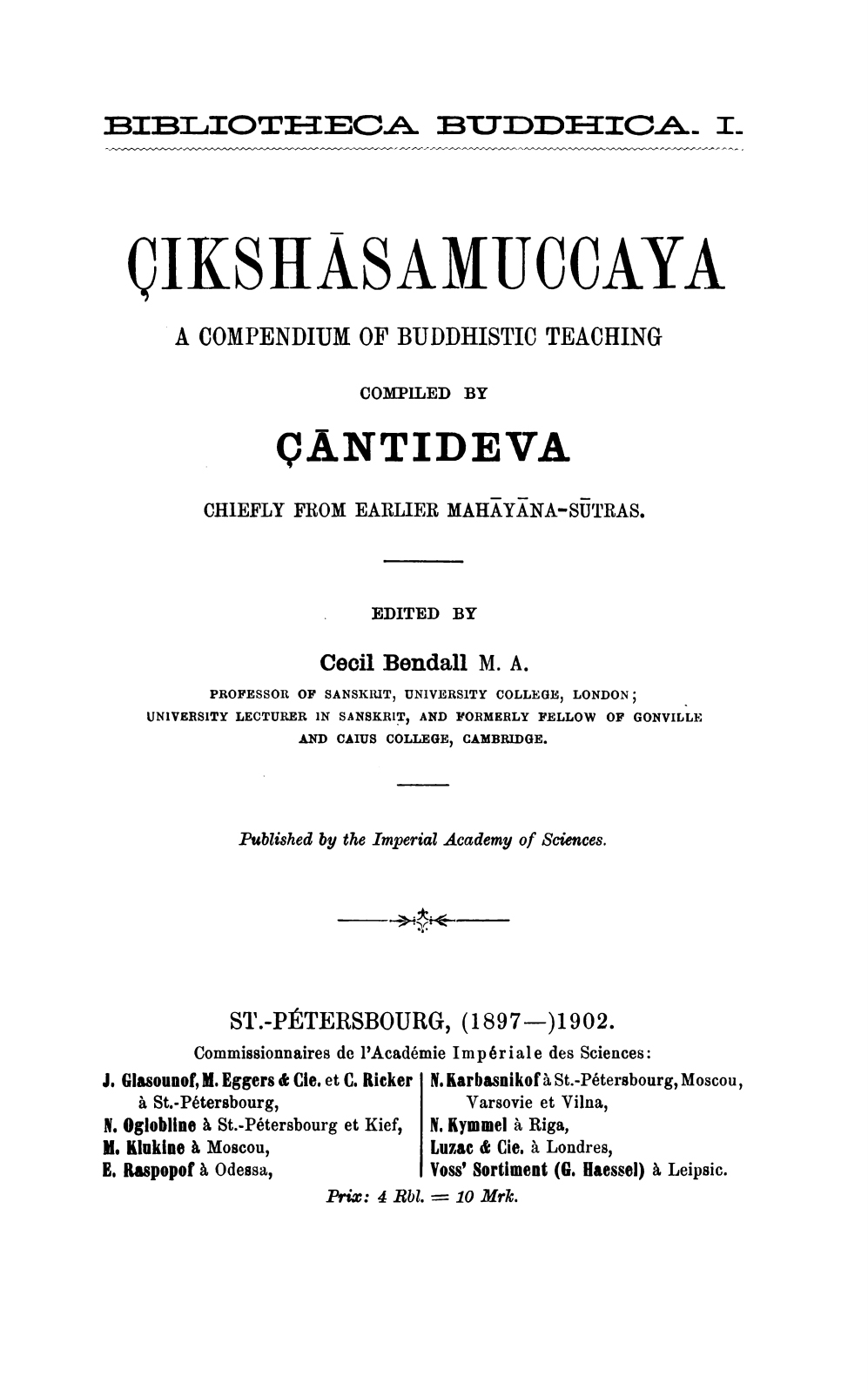
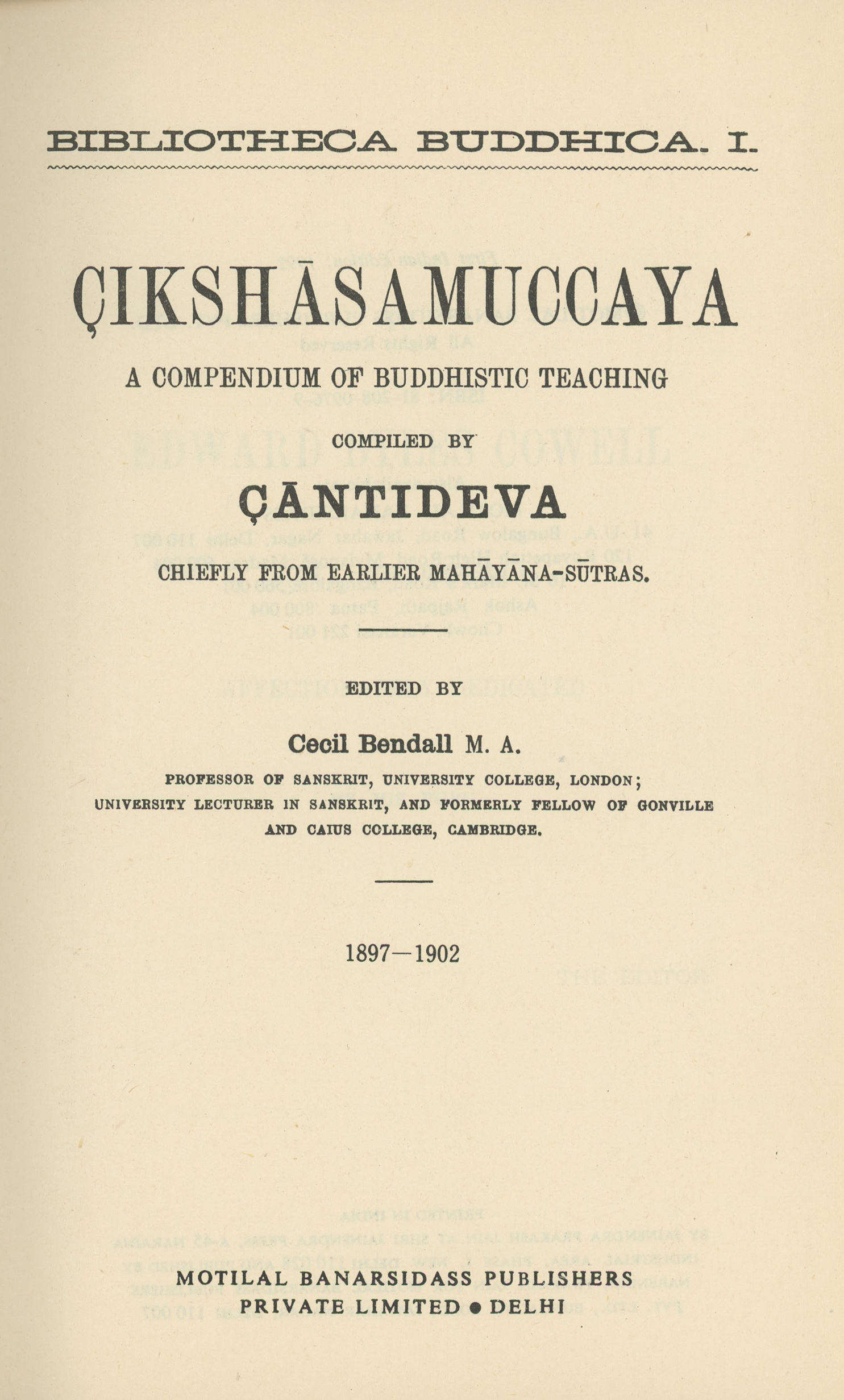
- Çikshāsamuccaya: A Compendium of Buddhistic Teaching (1897–1902)
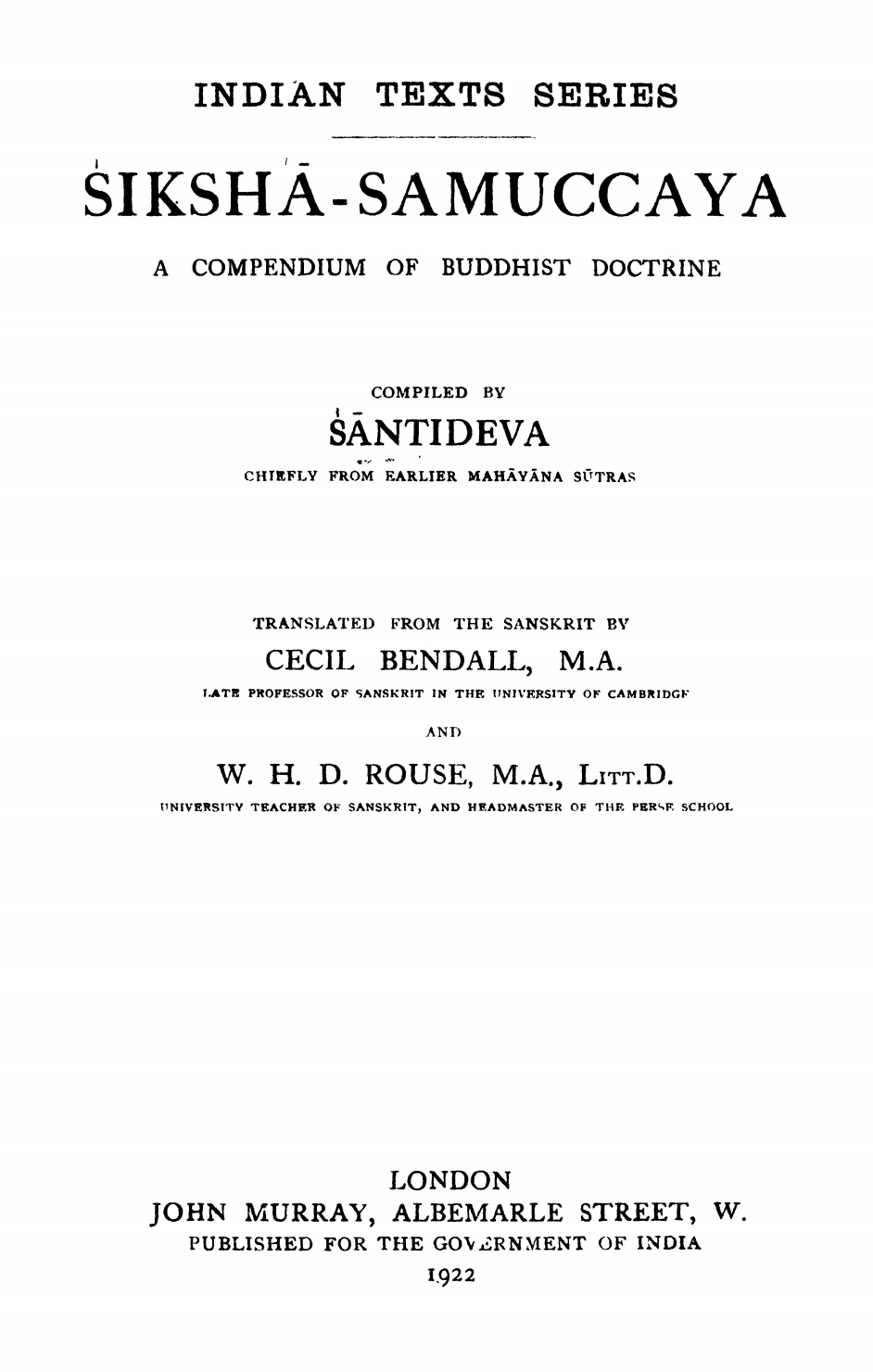
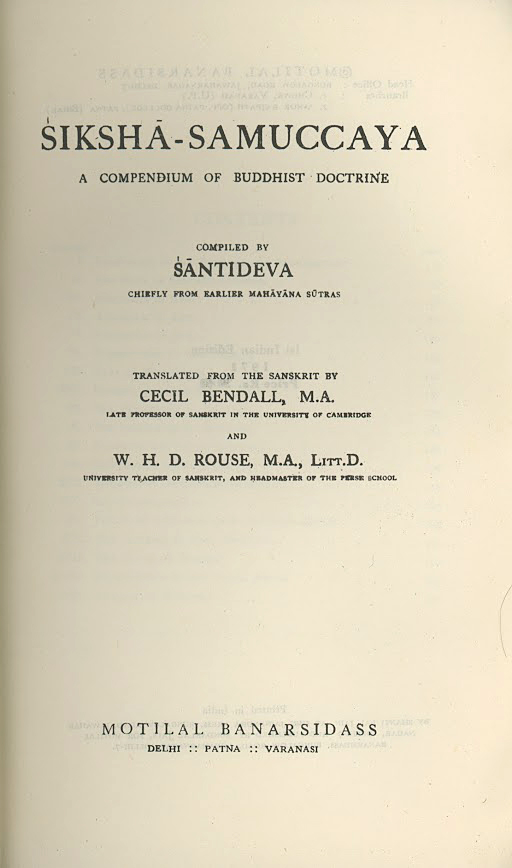
- Śikshā-samuccaya: A Compendium of Buddhist Doctrine (1922)
- Śāntideva's Śikṣāsamuccaya-kārikās
Please note that many items in our library are simply pages that represent a detailed library catalog entry and citation of someone else's work, presentation, or performance. Read our General Disclaimer for more information.

Description
Chandrakirti laid the foundations and initiated the Prasangika Madhyamika school of Buddhist thought, but Shantideva provided it with mystic vision and ecstatic fervour. Born in the eighth century, he was a son of the ruler of Saurashtra, a small kingdom in modern Gujarat. While still a child, he was vouchsafed a vision of Manjushri, the Bodhisattva of wisdom, and the vision was repeated near the time for his accession to the throne. Manjushr I declared that he was Shantideva’s kalyanamitra, spiritual friend, and warned him not to take the throne of Saurashtra. At about the same time, Shantideva had a dream in which Tara, the feminine aspect and counterpart of Avalokiteshvara, appeared to him in the guise of his mother and consecrated him. In an act reflecting the renunciation of Buddha, he fled the kingdom and wandered in a forest for twenty-one days. He came upon a woman who offered him sweet water and led him to a yogin who initiated him into Buddhist doctrine and meditation. He soon attained samadhi and recognized the woman and the yogin as Tara and Manjushri. From that moment, the vision of Manjushri remained with him throughout his life. While at Nalanda, Shantideva composed the Shikshasamuccaya, a “Compendium of Buddhist Doctrines”, which drew together citations from a vast number of sutras and texts. It emphasizes the moral dimension of the Bodhisattva Path, whilst the Bodhicaryavatara focusses on the Path from the stand point of consciousness. The book is translated from the Sanskrit by Cecil Bendall, Late Professor of Sanskrit in the University of Cambridge and W.H.D. Rouse, Late University teacher of Sanskrit. (Source Accessed Jan 6, 2022)
Citation
Bendall, Cecil, and William Henry Denham Rouse, trans. Śikshā-Samuccaya: A Compendium of Buddhist Doctrine. Compiled by Śāntideva. Indian Texts Series. London: John Murray, 1922. https://archive.org/details/in.ernet.dli.2015.203828/page/n5/mode/2up.
Table of contents
- CHAPTERPAGE
- I. SALUTATION TO ALL BUDDHAS AND BODHISATVAS !1
- II. THE DUTY OF SELF-PRESERVATION37
- III. AVOIDANCE OF EVIL46
- IV. AVOIDANCE OF EVIL61
- V. AVOIDANCE OF EVIL100
- VI. PRESERVATION OF THE PERSON117
- VII. CARE OF ENJOYMENTS142
- VIII. PURIFICATION FROM SIN157
- IX. THE PERFECTION OF PATIENCE175
- X. THE PERFECTION OF STRENGTH184
- XI. PRAISE OF THE FOREST SECLUSION188
- XII. PREPARATION OF THE THOUGHT196
- XIII. SUBJECTS OF INTENT CONTEMPLATION216
- XIV. SELF-PURIFICATION225
- XV. PURITY IN ENJOYMENT AND RELIGIOUS ACTION245
- XVI. THE INCREASE OF GOOD CONDUCT251
- XVII. THE PRAISE OF WORSHIP270
- XVIII. RECOLLECTION OF THE THREE JEWELS283
- XIX. INCREASE OF HOLINESS307
Interconnections
2 Full translation of

Śikṣāsamuccaya (T. Bslab pa kun las btus pa; C. Dasheng ji pusa xue lun; J. Daijōjū bosatsugakuron; K. Taesǔng chip posal hak non 大乘集菩薩學論). In Sanskrit, "Compendium of Training," a work by the eighth-century Indian Mahāyāna master Śāntideva. It consists of twenty-seven stanzas on the motivation and practice of the bodhisattva, including bodhicitta, the six perfections (pāramitā), the worship of buddhas and bodhisattvas, the benefits of renunciation, and the peace derived from the knowledge of emptiness (śūnyatā). The topic of each of the stanzas receives elaboration in the form of a prose commentary by the author as well as in illustrative passages, often quite extensive, drawn from a wide variety of Mahāyāna sūtras. Some ninety-seven texts are cited in all, many of which have been lost in their original Sanskrit, making the Śikṣāsamuccaya an especially important source for the textual history of Indian Buddhism. These citations also offer a window into which sūtras were known to a Mahāyāna author in eighth-century India. The digest of passages that Śāntideva provides was repeatedly drawn upon by Tibetan authors in their citations of sūtras. Although Śāntideva's Bodhicaryāvatāra and Śikṣāsamuccaya both deal with similar topics, the precise relation between the two texts is unclear. Several of the author's verses appear in both texts and some of the sūtra passages from the Śikṣāsamuccaya also appear in the Bodhicaryāvatāra. One passage in the Bodhicaryāvatāra also refers readers to the Śikṣāsamuccaya, but this line does not occur in the Dunhuang manuscript of the text and may be a later interpolation. (Source: "Śikṣāsamuccaya." In The Princeton Dictionary of Buddhism, 821. Princeton University Press, 2014. http://www.jstor.org/stable/j.ctt46n41q.27.)
These are the root verses of Śāntideva's Compendium of Spiritual Disciplines (Śikṣāsamuccaya).
3 Other editions

A critical Sanskrit edition of the Śikṣāsamuccaya, edited by Cecil Bendall, with an introduction, summary, kārikās in Sanskrit, Tibetan, and English, and indexes.

The first Indian edition of the critical Sanskrit edition of the Śikṣāsamuccaya, originally edited by Cecil Bendall in 1897–1902. Published by Motilal Banarsidass, 1992.

This is the first Indian edition of the English translation of Siksasamuccaya- a Mahayana Buddhist treatise edited by Dr. Bendall from a single Nepalese manuscript for the Russian Bibliotheca Buddhica.
The book is a compendium of Buddhist doctrine preserved in the schools of the great Vehicle-Mahayana. It presents as its subject matter the code of righteous conduct for the enlightenment of the aspirant.
The translation is authentic and authoritative. The book is interesting and instructive. There is also an alphabetical index of quoted works and a general index. (Source: Motilal Banarsidass)