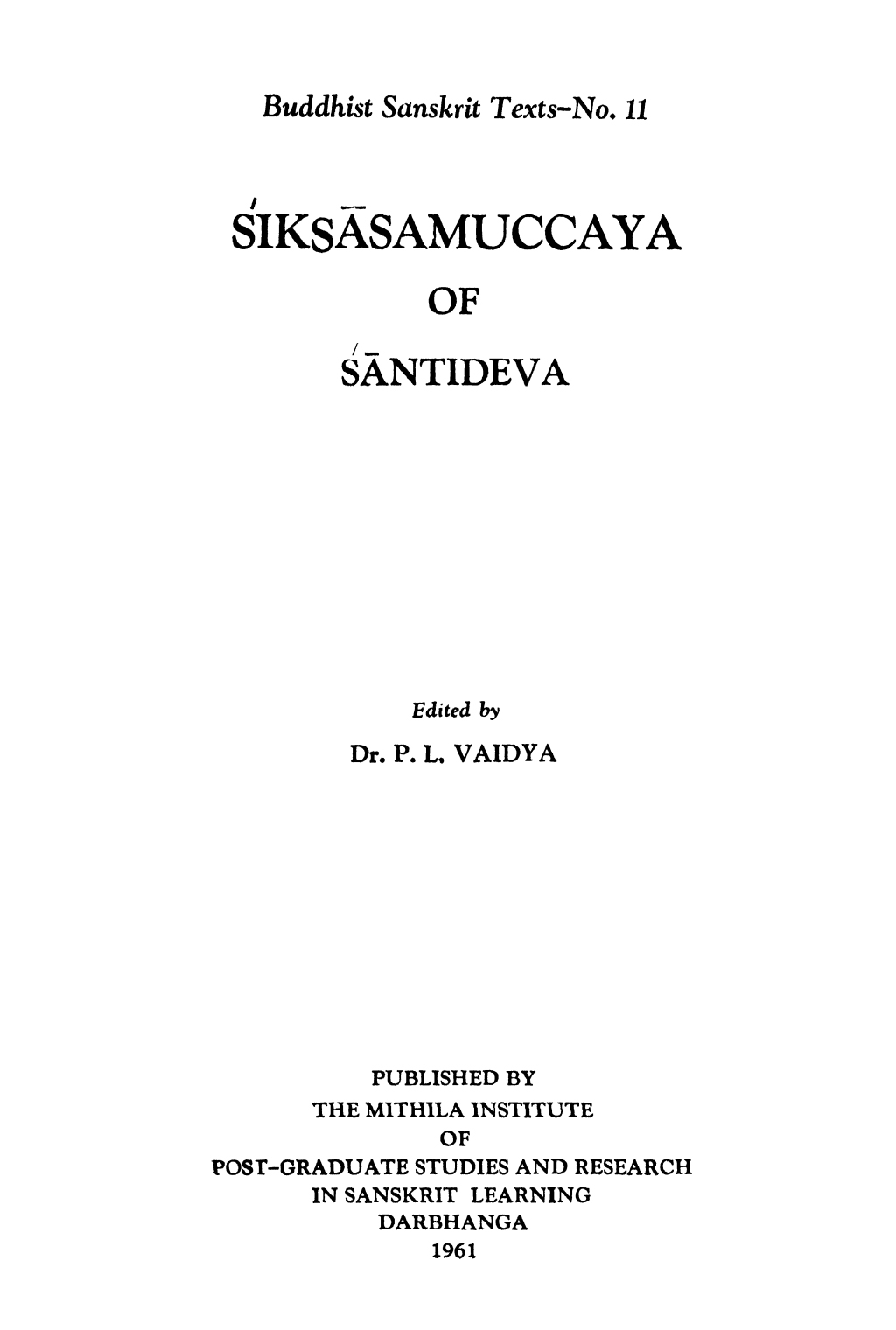
Śikṣāsamuccaya of Śāntideva (Vaidya)
From Bodhicitta
< Books(Redirected from Śikṣāsamuccaya of Śāntideva (Vaidya))
Books/Śikṣāsamuccaya of Śāntideva (Vaidya)
Books/Śikṣāsamuccaya of Śāntideva (Vaidya)
| 🤓 Admin Zone 🛠️ hidden to non-admins | |
Śikṣāsamuccaya of Śāntideva
Book
- A Reliable Witness? On the Tibetan Translation of the Śikṣāsamuccaya
- Contributions to the Study of the Śikṣāsamuccaya Derived from Chinese Sources
- Einige textkritische und exegetische Bemerkungen zu Śāntidevas Śikṣāsamuccaya (Kapitel XII und XIII)
- Verses by Śāntideva in the Śikṣāsamuccaya: A New English Translation
- Çikshāsamuccaya: A Compendium of Buddhistic Teaching (1992)
- Śikṣāsamuccaya of Śāntideva
- Śikṣāsamuccaya of Śāntideva (Vaidya)
- Śāntideva's Śikṣāsamuccaya-kārikās
Please note that many items in our library are simply pages that represent a detailed library catalog entry and citation of someone else's work, presentation, or performance. Read our General Disclaimer for more information.

Description
A critical Sanskrit edition of the Śikṣāsamuccaya by Śāntideva. Edited by P. L. Vaidya.
Citation
Vaidya, P. L., ed. Śikṣāsamuccaya of Śāntideva. Buddhist Sanskrit Texts 11. Darbhanga, Bihar, India: Mithila Institute of Post-Graduate Studies and Research in Sanskrit Learning, 1961. https://archive.org/details/siksasamuccayaofsantidevashikshavaidyap.l.mithilainstitutedarbhanga_400_c/page/n3/mode/2up.
Table of contents
- Introduction in English and HindiVII
- AbbreviationsXV
- शिक्षासमुच्चयकारिकाः१
- १ दानपारमता३
- २ सद्धर्मपरिग्रहः२३
- ३ धर्ममाणकादिरक्षा२५
- ४ अनर्थवर्जनम्३७
- ५ शीलपारमितायामनर्थवर्जनम्५८
- ६ आत्मभावरक्षा६७
- ७ भोगपुण्यरक्षा८०
- ८ पापशोधनम्८९
- ९ क्षान्तिपारमिता११२
- १० वीर्यपारमिता१०५
- ११ अरण्यसंवर्णनम्१०७
- १२ चित्तपरिकर्म११२
- १३ स्मृत्युपस्थानम्१२४
- १४ आत्मभावपरिशुद्धिः१३०
- १५ भोगपुण्यशुद्धिः१४३
- १६ भद्रचर्याविधिः१४६
- १७ वन्दनानुशंसा१५६
- १८ रत्नत्रयानुस्मृतिः१६८
- १९ पुण्यवृद्धि१८६
- प्रथमं परिशिष्टम् – सूत्रोद्धरणसूची२०७
Interconnections
1 Recension of

Śikṣāsamuccaya (T. Bslab pa kun las btus pa; C. Dasheng ji pusa xue lun; J. Daijōjū bosatsugakuron; K. Taesǔng chip posal hak non 大乘集菩薩學論). In Sanskrit, "Compendium of Training," a work by the eighth-century Indian Mahāyāna master Śāntideva. It consists of twenty-seven stanzas on the motivation and practice of the bodhisattva, including bodhicitta, the six perfections (pāramitā), the worship of buddhas and bodhisattvas, the benefits of renunciation, and the peace derived from the knowledge of emptiness (śūnyatā). The topic of each of the stanzas receives elaboration in the form of a prose commentary by the author as well as in illustrative passages, often quite extensive, drawn from a wide variety of Mahāyāna sūtras. Some ninety-seven texts are cited in all, many of which have been lost in their original Sanskrit, making the Śikṣāsamuccaya an especially important source for the textual history of Indian Buddhism. These citations also offer a window into which sūtras were known to a Mahāyāna author in eighth-century India. The digest of passages that Śāntideva provides was repeatedly drawn upon by Tibetan authors in their citations of sūtras. Although Śāntideva's Bodhicaryāvatāra and Śikṣāsamuccaya both deal with similar topics, the precise relation between the two texts is unclear. Several of the author's verses appear in both texts and some of the sūtra passages from the Śikṣāsamuccaya also appear in the Bodhicaryāvatāra. One passage in the Bodhicaryāvatāra also refers readers to the Śikṣāsamuccaya, but this line does not occur in the Dunhuang manuscript of the text and may be a later interpolation. (Source: "Śikṣāsamuccaya." In The Princeton Dictionary of Buddhism, 821. Princeton University Press, 2014. http://www.jstor.org/stable/j.ctt46n41q.27.)
1 Scholarship on
Śikṣāsamuccaya (T. Bslab pa kun las btus pa; C. Dasheng ji pusa xue lun; J. Daijōjū bosatsugakuron; K. Taesǔng chip posal hak non 大乘集菩薩學論). In Sanskrit, "Compendium of Training," a work by the eighth-century Indian Mahāyāna master Śāntideva. It consists of twenty-seven stanzas on the motivation and practice of the bodhisattva, including bodhicitta, the six perfections (pāramitā), the worship of buddhas and bodhisattvas, the benefits of renunciation, and the peace derived from the knowledge of emptiness (śūnyatā). The topic of each of the stanzas receives elaboration in the form of a prose commentary by the author as well as in illustrative passages, often quite extensive, drawn from a wide variety of Mahāyāna sūtras. Some ninety-seven texts are cited in all, many of which have been lost in their original Sanskrit, making the Śikṣāsamuccaya an especially important source for the textual history of Indian Buddhism. These citations also offer a window into which sūtras were known to a Mahāyāna author in eighth-century India. The digest of passages that Śāntideva provides was repeatedly drawn upon by Tibetan authors in their citations of sūtras. Although Śāntideva's Bodhicaryāvatāra and Śikṣāsamuccaya both deal with similar topics, the precise relation between the two texts is unclear. Several of the author's verses appear in both texts and some of the sūtra passages from the Śikṣāsamuccaya also appear in the Bodhicaryāvatāra. One passage in the Bodhicaryāvatāra also refers readers to the Śikṣāsamuccaya, but this line does not occur in the Dunhuang manuscript of the text and may be a later interpolation. (Source: "Śikṣāsamuccaya." In The Princeton Dictionary of Buddhism, 821. Princeton University Press, 2014. http://www.jstor.org/stable/j.ctt46n41q.27.)