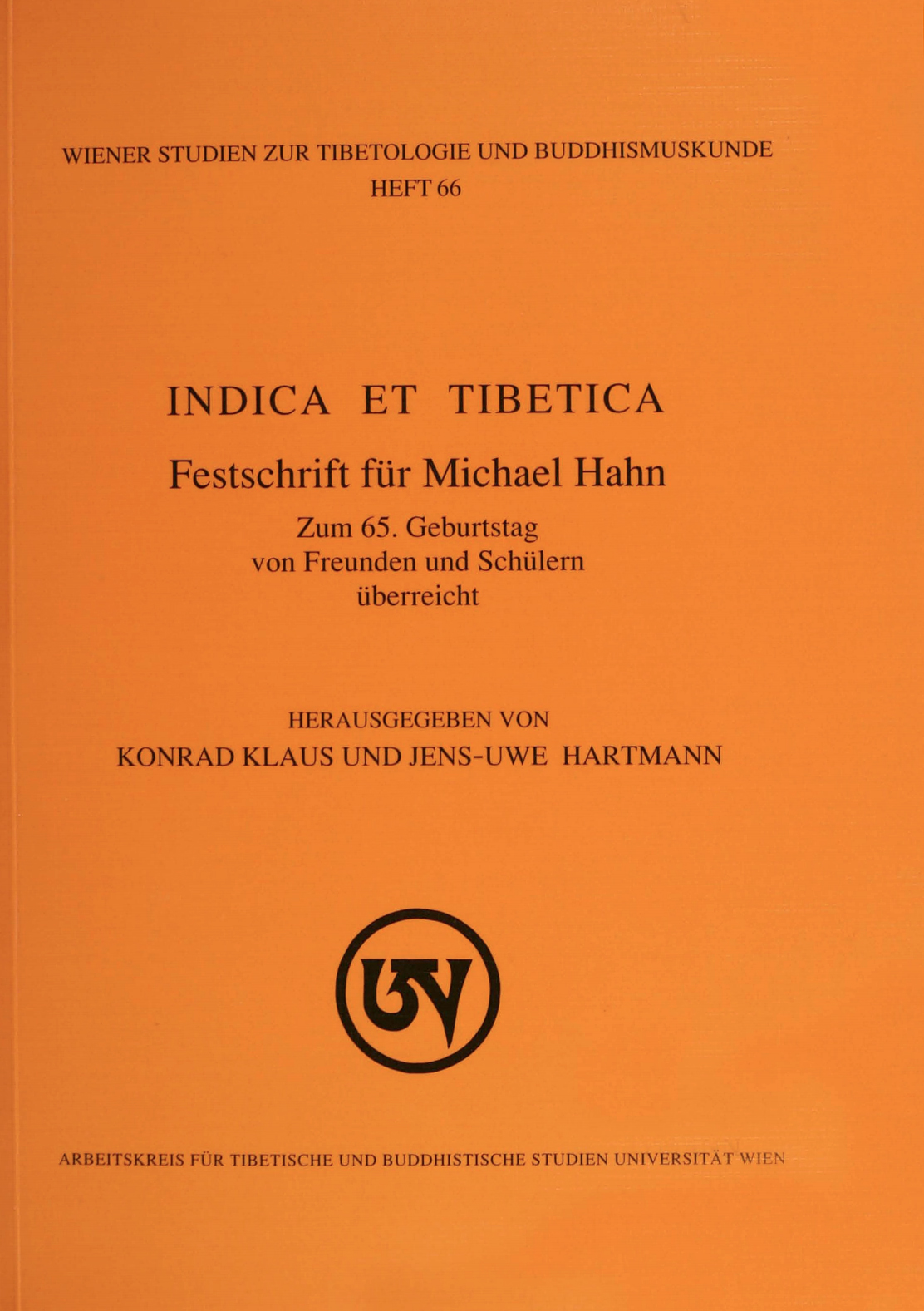
The Case of the Vanishing Poet: New Light on Śāntideva and the Śikṣā-samuccaya
Articles/The Case of the Vanishing Poet: New Light on Śāntideva and the Śikṣā-samuccaya
| 🤓 Admin Zone 🛠️ hidden to non-admins | |
- A Critical Study of Ācārya Śāntideva's Bodhicaryāvatāra
- A Critical Study of Ācārya Śāntideva's Bodhicaryāvatāra (diss)
- A Flash of Lightning in the Dark of Night
- A Short Presentation of Śāntideva's Bodhicaryāvatāra
- A Study of the Ṡikṣasamuccaya of Āchārya Shāntideva
- Akṣayamati's Bodhisattvacaryāvatāra as Found in the Tibetan Manuscripts from Dūn-huáng
- An Inquiry into the Relationship between the Śikṣāsamuccaya and the Bodhi(sattva)caryāvatāra
- Aspekte der Schulung in der Laufbahn eines Bodhisattva
- Aspekte der Schulung in der Laufbahn eines Bodhisattva-Review by de Jong
- Bhadracaryāvidhi in the Śikṣāsamuccaya Chapt. 16
- Bodhi(sattva)caryāvatāra and Śikṣāsamuccaya
- Bodhicaryāvatāra (Weeraratne)
- Bodhicaryāvatāra and Bodhicaryāvatāra-Pañjikā (Malalasekera)
- Bodhisattvacaryāvatāra: Exposition de la pratique des bodhisattvas
- Buddha Mind - Christ Mind
- Camino al Despertar
- Die "Vollkommenheiten" im BCA und seinen tibetischen Kommentaren
- Drops of Nectar: Khenpo Kunpal's Commentary on Shantideva's Entering the Conduct of the Bodhisattvas
- Epitome of the Bodhicaryāvatāra with Its Pañjikā, Chap. IX
- Ethical Revaluation in the Thought of Śāntideva
- Ethics in the Śikṣāsamuccaya: A Study in Mahāyāna Morality
- Facts or Fictions: Reconsidering Śāntideva's Names, Life, and Works
- Features of Śraddhā in the Śikṣāsamuccaya
- General Introduction: Śāntideva and His World
- Gleichheit und Mitgefühl: Prajñākaramatis Kommentar zu Bodhicaryāvatāra VIII. 89-108
- La légende de Śāntideva
- MindFulness in Santideva's Siksasamuccaya
- Moral Theory in Śāntideva's Śikṣāsamuccaya
- Moral Theory in Śāntideva's Śikṣāsamuccaya-Review by Osto
- Moral Theory in Śāntideva's Śikṣāsamuccaya: Cultivating the Fruits of Virtue-Review by Goodman
- Notes on the Deśanā-ritual in the Bodhicaryāvatāra: Evidence of Its Revision
- Notes on the Interpretation of Bodhi(sattva)caryāvatāra V.104–106
- Of the Progresse of the Bodhisattva
- Of the Progresse of the Bodhisattva: The Bodhisattvamārga in the Śikṣāsamuccaya
- On Akṣayamati's Bodhisattvacaryāvatāra
- On Another Sūtrasamuccaya
- On the Pariṇāmanā Chapter of the Bodhicaryāvatāra
- Prolegomena to an English Translation of the Sūtrasamuccaya
- Readings of Śāntideva's Guide to Bodhisattva Practice
- Readings of Śāntideva's Guide to Bodhisattva Practice-Review by Harris
- Reason and Knowledge on the Path: A Protreptic Reading of the Guide
- Reason, Irrationality and Akrasia (Weakness of the Will) in Buddhism: Reflections upon Śāntideva's Arguments with Himself
- Relocation of the Verses on "The Equality of Self and Others" in the Bodhicaryāvatāra
- Remarks on an Instance of Intertextuality in the Eleventh Chapter of the Śikṣāsamuccaya and the Phrase Tṛṇagulmauṣadhivanaspati in Buddhist Sūtra Literature
- Santideva (Indian Antiquary, Vol. 42, 1913)
- Santideva's Bodhicaryāvatāra
- Santideva, un mistico del Buddhismo
- Seven Important Points (Marmasthāna) in the Śikṣāsamuccaya
- Shantideva (Nariman)
- The Bodhi-caryâvatāra and Its Monastic Aspects: On the Problem of Representation
- The Bodhicaryāvatāra: A Buddhist Treatise Translated into Western Languages
- The Bodhisattva Path: Śāntideva's Bodhicaryāvatāra
- The Case of the Vanishing Poet: New Light on Śāntideva and the Śikṣā-samuccaya
- The Changing Way of the Bodhisattva: Superheroes, Saints, and Social Workers
- The Contrasts between the Bodhisattvayāna and the Śrāvakayāna in the Śikṣāsamuccaya's Theory of Bodhicitta
- The Literature of the Madhyamaka School of Philosophy in India
- The Masters and Poets of the Mahāyāna
- The Meaning of Sugata in the Bodhicaryāvatārapañjikā
- The Path of the Bodhisattva
- The Relationship between Morality and the Body in Monastic Training according to the Śikṣāsamuccaya
- The Training Anthology of Śāntideva
- The Transmission of the Bodhicaryāvatāra: The History, Diffusion, and Influence of a Mahāyāna Buddhist Text
- The Triskandha, Practice in Three Parts: Study of an Early Mahāyāna Buddhist Ritual
- The Way of the Bodhisattva: An Introduction and Commentary to Shantideva's The Way of Life of the Bodhisattva
- The Way of the Translators: Three Recent Translations of Śāntideva's Bodhicaryāvatāra
- Verses by Śāntideva in the Śikṣāsamuccaya: A New English Translation
- Virtuous Bodies
- Śikṣāsamuccaya (Anthology of Instruction)
- Śikṣāsamuccaya et Sūtrasamuccaya
- Śāntideva (Internet Encyclopedia of Philosophy)
- Śāntideva (Potter, Kalupahana, and Sweet)
- Śāntideva (Stanford Encyclopedia of Philosophy)
- Śāntideva and Bodhicaryāvatāra
- Śāntideva and the Mādhyamika: The Prajñāpāramitā-Pariccheda of the Bodhicaryāvatāra
- Śāntideva as a Mantracarin
- Śāntideva on Developing the Thought of Awakening
- Śāntideva's Bodhicaryāvatāra in Translation: A Century of Interpretation of a Sanskrit Mahāyāna Text
- Śāntideva's Statement about Confession
- Śāntideva, il Bodhicaryāvatāra e le kārikā del Śikṣāsamuccaya
- Śāntideva, il Bodhicaryāvatāra e le kārikā del Śikṣāsamuccaya-Review by Pāsādika
- Śāntideva: Mystique Bouddhiste des VIIe et VIIIe siècles
- Śāntideva: Mystique Bouddhiste des VIIe et VIIIe siècles-Review by Cabezón
- Śāntideva: The Author and His Project
- Śāntidevas Bodhicaryāvatāra: Das Weiterwirken des Werkes dargestellt anhand der Überlieferungsgeschichte des Textes und seiner Kommentare
Description
One cannot deny the importance and usefulness of the works of Śāntideva as summary statements of Mahāyāna Buddhism in its fully developed 7th- or 8th-century form.[2] His Bodhicaryāvatāra (or Bodhisattvacaryāvatara) is especially well known, having exerted a strong influence on Tibetan formulations of the bodhisattva path, and has remained a favourite source of inspiration and instruction for followers of the Mahāyāna to this day. Not surprisingly, it spawned many commentaries — one survives in Sanskrit, 10 in Tibetan translation — and has continued to do so into the modem period, in which it has also been frequently translated.[3] Śāntideva's Śikṣā-samuccaya, on the other hand, has generated a much smaller literature. As one might expect, there are translations into Tibetan[4] and Chinese,[5] but virtually nothing in the way of commentaries.[6] While the Sanskrit text is well served by C. Bendall's editio princeps (Bendall 1897- 1902), the work tends to be accessed by most readers through the English translation made by Bendall himself with the help of W. H. D. Rouse, published in 1922.[7] Although excerpts from the Śikṣā-samuccaya (hereafter Śikṣ) translated by others appear in various anthologies,[8] the Bendall and Rouse version remains the only complete translation into a Western language. Yet this translation is frequently problematic, presumably due to Rouse's inability to finish the work to an appropriate standard after the death of Bendall in 1906, an "insufficiency for the task" which he frankly confesses in the preface. Mindful of the inadequacies of the Bendall and Rouse translation, and convinced that the riches of Śāntideva's anthology deserve to be displayed to better effect, J.-U. Hartmann and I have recently embarked on a new English version of the Śikṣ, which we have set about by attacking the work in different places. The present paper grows out of an attempt on my part to produce a draft translation of Chap. XIX, the final chapter, and records the unexpected consequences of an almost random decision to start at the end of the text rather than the beginning. (Harrison, "The Case of the Vanishing Poet," 215–216)
Notes
- Note #1 is from the title. It reads: The research findings discussed in this article were first presented in public as part of a paper with a somewhat wider scope read at a conference held in Oxford in September 2004 to mark the retirement of R. Gombrich. This article, however, is the first publication in print of a discovery relating specifically to the verse portions of Śāntideva's Śikṣā-samuccaya. I wish to thank my colleagues A. Saitō and J.-U. Hartmann for their critical comments on an earlier draft, and A. Saitō in particular for generously sharing his research on the work of Śāntideva with me and for sending me inter alia an unpublished transcription of Chap. IX of the Dunhuang mss of the Bodhisattvacaryāvatāra in Tibetan translation. Naturally, all errors, omissions and wild surmises remain my own responsibility. It is my pleasure to be able to dedicate this paper to M. Hahn, as a token of friendship and in recognition of his many contributions to the study of Buddhist verse.
- The date of Śāntideva is given variously as 7th or 8th cent. Saitō (1993: 13) , for example, puts him at ca. 650-700, but revises this in Saitō 2001: 1 to ca. 690-750. Pezzali (1968: 38-40) reasons that the productive period of his life must have fallen in the years 685-763. In his critical review of Pezzali's work, De Jong (1975: 179 f.) expresses reservations about the arguments used to arrive at this conclusion.
- See especially Crosby & Skilton 1996, and Wallace & Wallace 1997. For details of other versions and a comparative study of the merits of some of them, see Gómez 1999, which contains a useful bibliography.
- bSlab pa kun las btus pa (Tōhoku 3940), translated in the early 9th cent. by Jinamitra, Dānaśīla and Ye shes sde. Hereafter referred to as ŚikṣTib. The version used is that of the Derge edition.
- T. 1636, Dasheng ji pusa xue lun 大聲疾菩薩學論, a title that could perhaps be turned into Sanskrit as *Mahāyāna-bodhisattva-Śikṣāsamuccaya-sūstra. The work is ascribed to Facheng 法藏 (= Dharmakīrti?), and the translation was made by Fahu 法護 (= Dharmapāla?) et al. in the first half of the 11th cent. Hereafter referred to as ŚikṣChin.
- See Bendall 1897-1902: viii-xiii for references.
- Cecil Bendall & W. H. D. Rouse, tr., Śikṣā-samuccaya: A Compendium of Buddhist Doctrine. London 1922. Referred to in this paper as BR.
- For details see Pfandt 1986: 94 f., 140f.

In jener Zeit in Nepal haben wir den Jubilar als äußerst kenntnisreichen und anregenden Gelehrten kennengelemt, der nicht müde wurde, uns Jüngeren, noch ganz am Anfang Stehenden etwas von der Faszination zu vermitteln, die ihm aus der Beschäftigung mit seinen Forschungsgegenständen erwuchs. Gleichzeitig verstand er es, durch seine offene und aufgeschlossene, Alters- und Wissensunterschiede ignorierende Art die Wurzeln für eine dauerhafte Freundschaft zu legen. Dafür und für all das, was wir seither an Anregung und Förderung von ihm erfahren haben, sind wir dankbar, und wir freuen uns, ihm mit dem vorliegenden Band wenigstens einen kleinen Teil jener Dankesschuld abstatten zu können.
Wir haben davon abgesehen, den Band in einen engeren thematischen Rahmen zu stellen, etwa durch die Forderung nach einem Bezug zu Nepal oder die Beschränkung auf Beiträge zu den engeren Forschungsgebieten des Jubilars. Michael Hahn ist mit Kollegen aus vie len Bereichen unseres Faches in alter Welt verbunden, und selbst die Arbeiten seiner Schüler umfassen ein so weites Spektrum, daß uns eine thematische Öffnung sinnvoll und notwendig erschien, um niemanden seiner zahlreichen Freunde und Schüler von vomherein von der Mitwirkung an dem Band auszuschließen.
Unser besonderer Dank gilt Herrn Dr. Helmut Eimer für sein sorgfaltiges Korrekturlesen. Herrn Peter Wyzlic, M. A., haben wir dafür zu danken, daß er stets mit Rat und Tat zur Seite stand, wenn es um die Lösung von Font-Problemen ging, insbesondere von solchen mit chinesischen und griechischen Zeichensätzen. Herr Prof. Dr. Ernst Steinkellner schlug uns vor, als seinen Beitrag zu der Festschrift den Band in die renommierte Reihe der Wiener Studien zur Tibetologie und Buddhismuskunde aufzunehmen, und diesem Vorschlag sind wir sehr gerne gefolgt. So danken wir ihm und den jetzigen Herausgebern, Frau Dr. Birgit Kellner, Herrn PD Dr. Helmut Krasser und Herrn Prof. Dr. Helmut Tauscher, fur die Veröffentlichung des Bandes in ihrer Reihe. (Die Herausgeber, preface, 7–8)