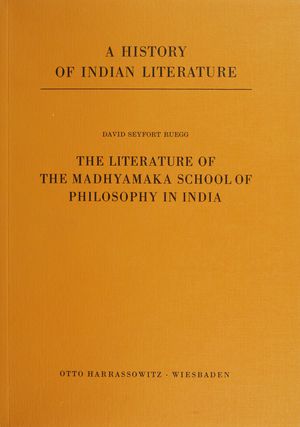
The Literature of the Madhyamaka School of Philosophy in India
| 🤓 Admin Zone 🛠️ hidden to non-admins | |
- A Critical Study of Ācārya Śāntideva's Bodhicaryāvatāra
- A Critical Study of Ācārya Śāntideva's Bodhicaryāvatāra (diss)
- A Short Presentation of Śāntideva's Bodhicaryāvatāra
- A Study of Akṣayamati (Śāntideva)'s Bodhisattvacaryāvatāra as Found in the Tibetan Manuscripts From Tun-huang
- A Study of the Wisdom Chapter (Prajñāpāramitā Pariccheda) of the Bodhicaryāvatārapañjikā of Prajñākaramati
- A Study of the Ṡikṣasamuccaya of Āchārya Shāntideva
- Account of the Period of the Kings Cala, Pañcamasiṃha and Others
- Akṣayamati and Śāntideva
- Akṣayamati's Bodhisattvacaryāvatāra as Found in the Tibetan Manuscripts from Dūn-huáng
- An Argument for Cittamātra: Reflections on Bodhicaryāvatāra 9:28 (Tib. 27) cd
- An Inquiry into the Relationship between the Śikṣāsamuccaya and the Bodhi(sattva)caryāvatāra
- Atiśa's Introduction to the Two Truths, and Its Sources
- Bodhi(sattva)caryāvatāra als Lehrschrift und Vorhaben: Zum Thema Ritual, Religion, Philosophie und Mystik im Buddhismus
- Bodhi(sattva)caryāvatāra and Śikṣāsamuccaya
- Bodhicaryāvatāra (Weeraratne)
- Bodhicaryāvatāra 9:2 as a Focus for Tibetan Interpretations of the Two Truths in the Prāsangika Mādhyamika
- Bodhicaryāvatāra and Bodhicaryāvatāra-Pañjikā (Malalasekera)
- Bodhicaryāvatāra and Tibetan Mind Training (Lojong)
- Bodhicaryāvatāra no kihon seikaku: Ichininshō no imi suru mono
- Bodhicharyavatara (Rigpa Shedra Wiki)
- Bodhisattvacaryāvatāra: Exposition de la pratique des bodhisattvas
- Bodhisattvas of the Forest and the Formation of the Mahayana
- Bu ston and the Bodhisattvacaryāvatāravyākhyāna (-pañjikā)
- Bu ston on the sPyod 'jug (Bodhisattvacaryāvatāra)
- Buddha Mind - Christ Mind
- Buddha's Lions
- Buddhist Texts Through the Ages
- Camino al Despertar
- Characteristics of the Buddhist Mongolian Texts: The Lineage of the Bodhicaryāvatāra
- Commentaries on Śāntideva's Bodhicaryāvatāra (Ejima 1966)
- Die "Vollkommenheiten" im BCA und seinen tibetischen Kommentaren
- Die Lehre von Satyadvaya in 'Ju Mi phams Nor bu ke ta ka
- Drops of Nectar: Khenpo Kunpal's Commentary on Shantideva's Entering the Conduct of the Bodhisattvas
- Dīpaṃkaraśrījñāna's Commentary on the Bodhicaryāvatāra
- Emptiness and Moral Perfection
- Enlightened Vagabond
- Entering the Path of Enlightenment
- Entering the Path of Enlightenment-Review by Cook
- Entering the Path of Enlightenment-Review by Seyfort Ruegg
- Epitome of the Bodhicaryāvatāra with Its Pañjikā, Chap. IX
- Ethical Revaluation in the Thought of Śāntideva
- Ethics in the Śikṣāsamuccaya: A Study in Mahāyāna Morality
- Facts or Fictions: Reconsidering Śāntideva's Names, Life, and Works
- Fierce Devotion to all Beings: The Role of Emotions in Śāntideva’s Introduction to the Way of the Bodhisattva (Bodhicaryāvatāra)
- General Introduction: Śāntideva and His World
- Gleichheit und Mitgefühl: Prajñākaramatis Kommentar zu Bodhicaryāvatāra VIII. 89-108
- Gser gling pa's Bodhisattvacaryāvatārapiṇḍārtha and Its Thought
- How to Be a Bodhisattva: Introduction to the Practice of the Bodhisattva Path (The Bodhicaryāvatāra)
- Identifying the Object of Negation: On Bodhicaryāvatāra 9:140 (Tib. 139)
- Introduction to Gzhan gyis brtsad pa'i lan mdor bsdus pa rigs lam rab gsal de nyid snang byed: An Answer to Blo-bzang-rab-gsal's Refutation of the Author's 'Sher le nor bu ke ta ka' and Its Defence, the Brgal lan nyin byed snang ba
- Jitāri, Śāntideva and Prabhākarakīrti
- La légende de Śāntideva
- Le commentaire de Mi-pham au chapitre IX du Bodhicaryāvatāra de Śāntideva: Échos modernes d'une controverse du XVème siècle
- Mahasiddhas: La vie de 84 sages de l'Inde
- Making and Remaking the Ultimate in Early Tibetan Readings of Śāntideva
- Masters of Mahāmudrā
- Mental Purification (Blo sbyong): A Native Tibetan Genre of Religious Literature
- Mi pham and the Philosophical Controversies of the Nineteenth Century
- Moral Theory in Śāntideva's Śikṣāsamuccaya
- Moral Theory in Śāntideva's Śikṣāsamuccaya-Review by Osto
- Moral Theory in Śāntideva's Śikṣāsamuccaya: Cultivating the Fruits of Virtue-Review by Goodman
- Nachlese zum Mongolischen Turfanfragment des Bodhicaryāvatāra
- Nichtselbst, Leerheit und Altruistische Ethik im Bodhicaryāvatāra (Lecture Transcript)
- Nichtselbst, Leerheit und Altruistische Ethik im Bodhicaryāvatāra (Official Publication)
- Notes on the Deśanā-ritual in the Bodhicaryāvatāra: Evidence of Its Revision
- Notes on the Interpretation of Bodhi(sattva)caryāvatāra V.104–106
- Nyubosatsugyō-ron kaisetsu saisho no Shyāntidēva rikai
- Of the Progresse of the Bodhisattva: The Bodhisattvamārga in the Śikṣāsamuccaya
- On Agama and Yukti in Bu ston's Byang chub sems dpa'i spyod pa la 'jug pa'i 'grel pa
- On Akṣayamati's Bodhisattvacaryāvatāra
- On Another Sūtrasamuccaya
- On Prakṛtinirvāṇa-Prakṛtinirvṛta in the Bodhicaryāvatāra: A Study in the Indo-Tibetan Commentarial Tradition
- On the Pariṇāmanā Chapter of the Bodhicaryāvatāra
- On the Role of Vairocanarakṣita in the Later Transmission Period: A Cross-section of the "Bodhisattva theory" Tradition
- On the Sanskrit Manuscript of the Śikṣāsamuccaya
- On the Textual Problems of Śāntideva's Bodhi(sattva)caryāvatāra: With Special Reference to Chapter 9 Entitled "Perfection of Wisdom (Prajñāpāramitā)"
- On Śāntideva's Position in the History of Mādhyamika Philosophy
- One Aspect of the Acceptance of the Bodhisattva-śīla in Tibet
- Polemics in Indo-Tibetan Scholasticism - A Late 19th-Century Debate Between 'Ju Mi pham and Dpa' ris Rab gsal
- Prolegomena to an English Translation of the Sūtrasamuccaya
- Proof of the Authenticity of the Mahāyāna in Akṣayamati's Bodhi(sattva)caryāvatāra
- Readings of Śāntideva's Guide to Bodhisattva Practice
- Readings of Śāntideva's Guide to Bodhisattva Practice-Review by Harris
- Reason and Knowledge on the Path: A Protreptic Reading of the Guide
- Reason, Irrationality and Akrasia (Weakness of the Will) in Buddhism: Reflections upon Śāntideva's Arguments with Himself
- Regional Characteristics of Mongolian Buddhism: A Study on the Basis of the Bodhicaryāvatāra
- Relocation of the Verses on "The Equality of Self and Others" in the Bodhicaryāvatāra
- Remarks on Akṣayamati (Blo gros mi zad pa), Being the Author of the Earlier Version of the Bodhisattvacaryāvatāra
- Remarks on an Instance of Intertextuality in the Eleventh Chapter of the Śikṣāsamuccaya and the Phrase Tṛṇagulmauṣadhivanaspati in Buddhist Sūtra Literature
- Remarks on the Philosophical Standpoint of the Anonymous Commentary, Bodhisattvacaryāvatāravyākhyāna(-pañjikā)
- Remarks on the Tabo Manuscript of the Bodhisattvacaryāvatāra
- Santideva (Indian Antiquary, Vol. 42, 1913)
- Santideva's Bodhicaryāvatāra
- Santideva, un mistico del Buddhismo
- Seven Important Points (Marmasthāna) in the Śikṣāsamuccaya
- Shantideva (From Butön's History of Buddhism in India and Its Spread to Tibet, Translated by Lisa Stein and Ngawang Zangpo)
- Shantideva (Nariman)
- Shantideva's Bodhicaryavatara: An Internal Pilgrimage to Universal Peace and Compassion
- Shantideva's Teaching
- Shāntideva (Tib. Shi-wa-lha)
- Some New Remarks on the Bodhicaryāvatāra Chapter V
- Stotra, Psychological Conditioning, and the Bodhicaryāvatāra: Together with a Translation of the Bodhicittānuśaṃsapariccheda
- Suffering Made Sufferable: Śāntideva, Dzongkaba, and Modern Therapeutic Approaches to Suffering's Silver Lining
- Suvarṇadvīpa's "Commentaries" on the Bodhicaryāvatāra
- Taming Śāntideva: Tsongkhapa's Use of the Bodhicaryāvatāra
- Tangut Texts of the Five Early Translations and the Texts on the Awakening of the Bodhicitta
- Textcritical Notes on Sanskrit Texts: I. Bodhi(sattva)caryāvatāra
- The Bodhi-caryâvatāra and Its Monastic Aspects: On the Problem of Representation
- The Bodhicittotpādasamādanāvidhi by Jitari
- The Bodhisattva Doctrine in Buddhist Sanskrit Literature
- The Bodhisattva Path: Śāntideva's Bodhicaryāvatāra
- The Bodistw-a Čari-a Awatar-un Tayilbur of 1312 by Čosgi Odsir
- The Buddhist Roots of Secular Compassion Training: A Comparative Study of Compassion Cultivation in Indian and Tibetan Mahāyāna Sources with the Contemporary Secular Program of Compassion Cultivation Training (CCT)
- The Case of 'Ju Mi pham (1846–1912) and Dpa' ris Rab gsal (1840–1912): A Study in Dgag lan Debate
- The Case of the Vanishing Poet: New Light on Śāntideva and the Śikṣā-samuccaya
- The Center of the Sunlit Sky
- The Changing Way of the Bodhisattva: Superheroes, Saints, and Social Workers
- The Circle of Compassion: An Interpretive Study of Karuṇā in Indian Buddhist Literature
- The Concept of Bodhicitta in Śāntideva's Bodhicaryāvatāra (Diss)
- The Ethics of Śaṅkara and Śāntideva
- The Ethics of Śaṅkara and Śāntideva-Review by Abramson
- The Ethics of Śaṅkara and Śāntideva-Review by Javanaud
- The Ethics of Śaṅkara and Śāntideva-Review by O'Leary
- The Literature of the Madhyamaka School of Philosophy in India
- The Mahāsiddha Bhusuku (Śāntideva), The Idle Monk
- The Masters and Poets of the Mahāyāna
- The Meaning of Sugata in the Bodhicaryāvatārapañjikā
- The Middle Way of the Bodhisattva
- The Original Bodhicaryāvatāra
- The Path of the Bodhisattva
- The Perfection of Wisdom (Schopen)
- The Reflexive Nature of Awareness (1998)
- The Relationship between Morality and the Body in Monastic Training according to the Śikṣāsamuccaya
- The Resolve to Become a Buddha
- The Tanjur Bodhicaryāvatāra Auxiliaries: A Few Collected Bibliographical Pointers
- The Training Anthology of Śāntideva
- The Transmission of the Bodhicaryāvatāra: The History, Diffusion, and Influence of a Mahāyāna Buddhist Text
- The Triskandha, Practice in Three Parts: Study of an Early Mahāyāna Buddhist Ritual
- The Way of the Bodhisattva: An Introduction and Commentary to Shantideva's The Way of Life of the Bodhisattva
- The Way of the Translators: Three Recent Translations of Śāntideva's Bodhicaryāvatāra
- Two Kinds of Saṃvṛtis in the Bodhicaryāvatārapañjikā IX 3-8
- Verses by Śāntideva in the Śikṣāsamuccaya: A New English Translation
- Virtuous Bodies
- Zu einer zentralen philosophischen Kontroverse mit den "orthodoxen" Philosophen
- Zum Bodhisattvacāryāvatārabhāṣya des Dīpaṃkaraśrījñāna
- Śikṣāsamuccaya (Anthology of Instruction)
- Śikṣāsamuccaya et Sūtrasamuccaya
- Śāntideva (Internet Encyclopedia of Philosophy)
- Śāntideva (Potter, Kalupahana, and Sweet)
- Śāntideva (Stanford Encyclopedia of Philosophy)
- Śāntideva and Bodhicaryāvatāra
- Śāntideva and the Mādhyamika: The Prajñāpāramitā-Pariccheda of the Bodhicaryāvatāra
- Śāntideva as a Mantracarin
- Śāntideva in the History of Mādhyamika Philosophy
- Śāntideva on Developing the Thought of Awakening
- Śāntideva's Critique of 'I' or Self in the Early and Later Recensions of the Bodhi(sattva)caryāvatāra
- Śāntideva's Philosophy as Expressed in the Early Version of His Bodhisattvacaryāvatāra, Chapter 8
- Śāntideva, A Mystic of Buddhism
- Śāntideva, il Bodhicaryāvatāra e le kārikā del Śikṣāsamuccaya
- Śāntideva, il Bodhicaryāvatāra e le kārikā del Śikṣāsamuccaya-Review by Pāsādika
- Śāntideva: Mystique Bouddhiste des VIIe et VIIIe siècles
- Śāntideva: Mystique Bouddhiste des VIIe et VIIIe siècles-Review by Cabezón
- Śāntideva: The Author and His Project
- Śāntidevas Bodhicaryāvatāra: Das Weiterwirken des Werkes dargestellt anhand der Überlieferungsgeschichte des Textes und seiner Kommentare

Description
we possess few good modern editions of the surviving Sanskrit texts and the very nature of our translated sources inevitably raise important philological and exegetical problems which it has not always been possible to pursue in the space available.
Limitations of space have moreover allowed the inclusion of short and hence selective summaries of only some of the most fundamental texts from the 1000-year history of the Indian Madhyamaka. The majority of the works from this vast literature have had to be mentioned simply by title, with brief indications being given as to the contents of some of the more important ones. A comprehensive historical treatment and systematic analysis of the Madhyamaka in its entirety will thus have to await much larger publications. Here an attempt has of course been made to determine the relative—and whenever possible also the absolute—chronology of the Mādhyamikas; but the same name has not infrequently been borne by more than one person, and in a number of cases the attribution of a work to an author as well as even its precise Sanskrit title remain doubtful and will have to be the subject of future investigation. Because of the paucity of reliable historical materials and disagreements between some of our sources many questions may remain open indefinitely; furthermore, the fact that most of our texts are now available only in translations into Chinese and Tibetan makes certain essential kinds of historical, literary and sometimes even philosophical analysis exceedingly precarious if not quite impossible. Since relatively few texts and masters of the Madhyamaka school have hitherto been the subject of monographic study, the present work will in many cases be a preliminary exploration in well-nigh uncharted territory.
Further research will also be needed in order to establish the relation of the Madhyamaka with other schools of Indian thought, non-Buddhist as well as Buddhist. If this has not been done extensively in the present book (on earlier connexions with non-Buddhist schools see nevertheless p. 6 note 11), this is because of the complex historical and methodological questions posed by such an investigation and the lack of space to pursue such problems; it is not because we would subscribe to the view that the schools of Indian philosophy are to be kept apart according to the particular religion of their representatives: Buddhist (and Jain) philosophers are surely as much part of the history of Indian philosophy as 'orthodox' Hindu philosophers. It can at least be pointed out here, however, that in his Khaṇḍanakhaṇḍakhādya the twelfth-century Vedantin Śrīharṣa—who admits the vitaṇḍā procedure (see § 168; cf. §§ 14—16)—has throughout regularly employed a method of reasoning based on what he terms khaṇḍanayukti, which is very close to the Mādhyamika's form of argument in the prasaṅga-type of reasoning. At a much earlier period of the Vedanta also the links between the Gauḍapādīya- or Māṇḍūkya-Kārikās (c. 500 ?) and Buddhist thought are well-known. Moreover, the continuous debates carried on between Brahmanical, Buddhist and Jain thinkers led not only to a sharpening of minds and a refinement of argument on all sides but also to commonly recognized methods in philosophical discussion; but the precise history of these developments still remains to be traced in detail.
In writing a work of this kind there arises the question of the extent to which the secondary literature in Asiatic languages can be included by a single writer and in a limited space. Scholars from East and Central Asia in particular have in fact devoted themselves over the centuries to translating, commenting on and explaining the Madhyamaka literature. (In Tibet for example there has existed for over a millennium a tradition of study of a very considerable portion of Indian literature, including even works that are not specifically Buddhist; and with a view to both translation and exegesis Tibetan scholars developed remarkable philological and interpretative methods that could well justify us in regarding them as Indologists avant la lettre.) The sheer bulk of the secondary literature in Chinese, Japanese, Tibetan, and Mongolian relating to the Madhyamaka is, however, so great that it will have to be the subject of separate publications.[1]
The above-mentioned considerations of a philological, bibliographical and material nature will explain why the present work differs in certain respects from many of the other volumes appearing in the same series. Some attempt at a connected account treating this body of literature, however tentative, is clearly a desideratum at the present time. (Ruegg, preface, vii-ix)
Notes
- Although the Tibetan secondary literature to which it has been possible to refer in this book cannot pretend to be representative of all schools, the works used are all of the highest interest. Among historical sources these are mainly the rGya gar chos 'byuń by Tāranātha (born in 1575) edited by A. SCHIEFNER (St. Petersburg, 1868), the well-known Chos 'byun by Bu ston (1290–1364) in the Žol edition reprinted by LOKESH CHANDRA (New Delhi, 1971) with page references also to E. OBERMILLLER'S incomplete English translation (2 parts, Heidelberg, 1931–32), and the Deb ther sṅon po by 'Gos gŽon nu dpal (1392–1481) in the Kun bde gliṅ edition reprinted by LOKESH CHANDRA (New Delhi, 1976) with page references also to G. N. ROERICH'S English translation (The Blue Annals, 2 volumes, Calcutta, 1949–53); hagiographies of several Madhyamaka masters are also to be found collected together in the Byaṅ chub lam gyi rim pa'i bla ma brgyud pa'i rnam par thar pa by Ye šes rgyal mchan (1713–93) reprinted by NGAWANG GELEK DEMO (New Delhi, 1970). From the rich mine of Tibetan exegetical and doctrinal literature reference has been made principally to the Legs bšad sñiṅ po (in the lHa sa edition of the gSuṅ 'bum) and the Lam rim chen mo (in the old bKra šis lhun po edition, reprinted by NGAWANG GELEK DEMO, New Delhi, 1977) by Ćoṅ kha pa (1357–1419); to the sToṅ thun chen mo (in the lHa sa edition of the gSuṅ 'bum) and the rGyud sde spyi rnam (in the edition by F. D. LESSING and A. WAYMAN, Fundamentals of the Buddhist Tantras, The Hague, 1968) by mKhas grub dGe legs dpal bzaṅ (1385—1438); and to the invaluable doxographical works (Grub mtha') by 'Jam dbyaṅs bžad pa Ṅag dbaṅ brćon 'grus (1648–1722) reprinted by NGAWANG GELEK DEMO (New Delhi, 1973), and by lCaṅ skya Rol pa'i rdo rje (1717–86) reprinted by LOKESH CHANDRA (New Delhi, 1977).
As for the extensive and important modern secondary literature from Japan, references have had to be limited mainly to one of the few generally available Japanese publications, the Indogaku bukkyōgaku kenkyū (Journal of Indian and Buddhist studies, abbreviated IBK). Useful bibliographical surveys of this literature are to be found in the publications listed on p. 4 note 9.
People Mentioned
- Introduction1
- The early period: the formation of the Madhyamaka school4
- Nāgārjuna4
- Commentaries on Nāgārjuna's works47
- Āryadeva50
- Rāhulabhadra54
- 'Nāga'56
- The middle period: the systematization of the Madhyamaka school58
- Buddhapālita60
- Bhāvaviveka61
- Later Svātantrikas67
- Śrīgupta67
- Jñānagarbha68
- Candrakīrti71
- Śāntideva82
- The Yogācāra-Madhyamaka synthesis87
- Śāntarakṣita88
- Kamalaśīla93
- Later Yogācāra-Mādhyamikas99
- The Madhyamaka-Prajñāpāramitā synthesis101
- Madhyamaka and Vajrayāna104
- The last period of the Indian Madhyamaka school109
- Bodhibhadra, Dharmakīrti and Dīpaṃkaraśrījñāna109
- Jayānanda113
- Abhayākaragupta114
- Other later Madhyamikas115
- Appendix I: Works on practice ascribed to Aśvaghoṣa, Ārya-Śūra, Dharma Subhūti(ghoṣa), and Mātṛceta119
- Appendix II: Ratnākaraśānti's 'Vijñapti-Madhyamaka' 122
- Modern editions of the Sanskrit texts of the Madhyamaka school125
- Modern editions of the Tibetan versions of works of the Madhyamaka school129
- Abbreviations132
- Indices
- I. Titles133
- II. Names139
- III. Sanskrit key-words141
- IV. Tibetan terms146