Taming Śāntideva: Tsongkhapa's Use of the Bodhicaryāvatāra
| 🤓 Admin Zone 🛠️ hidden to non-admins | |
- A Study of Akṣayamati (Śāntideva)'s Bodhisattvacaryāvatāra as Found in the Tibetan Manuscripts From Tun-huang
- A Study of the Wisdom Chapter (Prajñāpāramitā Pariccheda) of the Bodhicaryāvatārapañjikā of Prajñākaramati
- An Argument for Cittamātra: Reflections on Bodhicaryāvatāra 9:28 (Tib. 27) cd
- Atiśa's Introduction to the Two Truths, and Its Sources
- Bodhi(sattva)caryāvatāra als Lehrschrift und Vorhaben: Zum Thema Ritual, Religion, Philosophie und Mystik im Buddhismus
- Bodhicaryāvatāra 9:2 as a Focus for Tibetan Interpretations of the Two Truths in the Prāsangika Mādhyamika
- Bodhicaryāvatāra and Bodhicaryāvatāra-Pañjikā (Malalasekera)
- Bodhicaryāvatāra and Tibetan Mind Training (Lojong)
- Bodhicaryāvatāra no kihon seikaku: Ichininshō no imi suru mono
- Bodhicharyavatara (Rigpa Shedra Wiki)
- Bodhisattvacaryāvatāra: Exposition de la pratique des bodhisattvas
- Bu ston and the Bodhisattvacaryāvatāravyākhyāna (-pañjikā)
- Byang chub sems dpa'i spyod pa la 'jug pa rtsa ba dang 'grel pa (si khron mi rigs dpe skrun khang)
- Byang chub sems dpa'i spyod pa la 'jug pa'i zin bris mtshungs med bla ma'i zhal rgyun (Vajra Vidya Library)
- Byang chub spyod pa'i gzhung 'grel gsal ba'i me long (Tsoknyi Gechak Ling)
- Characteristics of the Buddhist Mongolian Texts: The Lineage of the Bodhicaryāvatāra
- Commentaries on Śāntideva's Bodhicaryāvatāra (Ejima 1966)
- Die "Vollkommenheiten" im BCA und seinen tibetischen Kommentaren
- Die Lehre von Satyadvaya in 'Ju Mi phams Nor bu ke ta ka
- Drops of Nectar: Khenpo Kunpal's Commentary on Shantideva's Entering the Conduct of the Bodhisattvas
- Dīpaṃkaraśrījñāna's Commentary on the Bodhicaryāvatāra
- Emptiness and Moral Perfection
- Enlightened Vagabond
- Epitome of the Bodhicaryāvatāra with Its Pañjikā, Chap. IX
- General Introduction: Śāntideva and His World
- Gser gling pa's Bodhisattvacaryāvatārapiṇḍārtha and Its Thought
- Identifying the Object of Negation: On Bodhicaryāvatāra 9:140 (Tib. 139)
- Introduction to Gzhan gyis brtsad pa'i lan mdor bsdus pa rigs lam rab gsal de nyid snang byed: An Answer to Blo-bzang-rab-gsal's Refutation of the Author's 'Sher le nor bu ke ta ka' and Its Defence, the Brgal lan nyin byed snang ba
- Jitāri, Śāntideva and Prabhākarakīrti
- Le commentaire de Mi-pham au chapitre IX du Bodhicaryāvatāra de Śāntideva: Échos modernes d'une controverse du XVème siècle
- Making and Remaking the Ultimate in Early Tibetan Readings of Śāntideva
- Mi pham and the Philosophical Controversies of the Nineteenth Century
- Nachlese zum Mongolischen Turfanfragment des Bodhicaryāvatāra
- Nichtselbst, Leerheit und Altruistische Ethik im Bodhicaryāvatāra (Lecture Transcript)
- Nichtselbst, Leerheit und Altruistische Ethik im Bodhicaryāvatāra (Official Publication)
- Notes on the Deśanā-ritual in the Bodhicaryāvatāra: Evidence of Its Revision
- Nyubosatsugyō-ron kaisetsu saisho no Shyāntidēva rikai
- On Agama and Yukti in Bu ston's Byang chub sems dpa'i spyod pa la 'jug pa'i 'grel pa
- On Prakṛtinirvāṇa-Prakṛtinirvṛta in the Bodhicaryāvatāra: A Study in the Indo-Tibetan Commentarial Tradition
- On the Role of Vairocanarakṣita in the Later Transmission Period: A Cross-section of the "Bodhisattva theory" Tradition
- On the Sanskrit Manuscript of the Śikṣāsamuccaya
- On the Textual Problems of Śāntideva's Bodhi(sattva)caryāvatāra: With Special Reference to Chapter 9 Entitled "Perfection of Wisdom (Prajñāpāramitā)"
- On Śāntideva's Position in the History of Mādhyamika Philosophy
- One Aspect of the Acceptance of the Bodhisattva-śīla in Tibet
- Performing Text as Practice: Rdza Dpal sprul's Practice Manual on the Bodhi(sattva)caryāvatāra
- Polemics in Indo-Tibetan Scholasticism - A Late 19th-Century Debate Between 'Ju Mi pham and Dpa' ris Rab gsal
- Proof of the Authenticity of the Mahāyāna in Akṣayamati's Bodhi(sattva)caryāvatāra
- Readings of Śāntideva's Guide to Bodhisattva Practice
- Readings of Śāntideva's Guide to Bodhisattva Practice-Review by Harris
- Regional Characteristics of Mongolian Buddhism: A Study on the Basis of the Bodhicaryāvatāra
- Remarks on Akṣayamati (Blo gros mi zad pa), Being the Author of the Earlier Version of the Bodhisattvacaryāvatāra
- Remarks on an Instance of Intertextuality in the Eleventh Chapter of the Śikṣāsamuccaya and the Phrase Tṛṇagulmauṣadhivanaspati in Buddhist Sūtra Literature
- Remarks on the Philosophical Standpoint of the Anonymous Commentary, Bodhisattvacaryāvatāravyākhyāna(-pañjikā)
- Remarks on the Tabo Manuscript of the Bodhisattvacaryāvatāra
- Some New Remarks on the Bodhicaryāvatāra Chapter V
- Suffering Made Sufferable: Śāntideva, Dzongkaba, and Modern Therapeutic Approaches to Suffering's Silver Lining
- Suvarṇadvīpa's "Commentaries" on the Bodhicaryāvatāra
- Taming Śāntideva: Tsongkhapa's Use of the Bodhicaryāvatāra
- Tangut Texts of the Five Early Translations and the Texts on the Awakening of the Bodhicitta
- Textcritical Notes on Sanskrit Texts: I. Bodhi(sattva)caryāvatāra
- The Bodhicittotpādasamādanāvidhi by Jitari
- The Bodistw-a Čari-a Awatar-un Tayilbur of 1312 by Čosgi Odsir
- The Buddhist Roots of Secular Compassion Training: A Comparative Study of Compassion Cultivation in Indian and Tibetan Mahāyāna Sources with the Contemporary Secular Program of Compassion Cultivation Training (CCT)
- The Case of 'Ju Mi pham (1846–1912) and Dpa' ris Rab gsal (1840–1912): A Study in Dgag lan Debate
- The Center of the Sunlit Sky
- The Circle of Compassion: An Interpretive Study of Karuṇā in Indian Buddhist Literature
- The Concept of Bodhicitta in Śāntideva's Bodhicaryāvatāra (Diss)
- The Literature of the Madhyamaka School of Philosophy in India
- The Meaning of Sugata in the Bodhicaryāvatārapañjikā
- The Middle Way of the Bodhisattva
- The Original Bodhicaryāvatāra
- The Reflexive Nature of Awareness (1998)
- The Tanjur Bodhicaryāvatāra Auxiliaries: A Few Collected Bibliographical Pointers
- The Transmission of the Bodhicaryāvatāra: The History, Diffusion, and Influence of a Mahāyāna Buddhist Text
- Two Kinds of Saṃvṛtis in the Bodhicaryāvatārapañjikā IX 3-8
- Zu einer zentralen philosophischen Kontroverse mit den "orthodoxen" Philosophen
- Zum Bodhisattvacāryāvatārabhāṣya des Dīpaṃkaraśrījñāna
- Śāntideva (Internet Encyclopedia of Philosophy)
- Śāntideva and Bodhicaryāvatāra
- Śāntideva in the History of Mādhyamika Philosophy
- Śāntideva's Critique of 'I' or Self in the Early and Later Recensions of the Bodhi(sattva)caryāvatāra
- Śāntideva's Philosophy as Expressed in the Early Version of His Bodhisattvacaryāvatāra, Chapter 8
- Śāntidevas Bodhicaryāvatāra: Das Weiterwirken des Werkes dargestellt anhand der Überlieferungsgeschichte des Textes und seiner Kommentare
Description
As Jonathan Gold points out in his introduction to this volume, Śāntideva's Guide is a "classic," a text that speaks so deeply to common human concerns that it can resonate with people born into cultures far removed in time and space from that of the author. A classic is, in short, "universal"—or nearly so. For all our human commonalities and interconnections, however, even in the twenty-first century we live in a profoundly plural world, so to be truly meaningful in a wide variety of settings, hence fulfill the definition of a "classic," a text must not only achieve excellence of form and content and touch on "timeless" questions but also be, in the language of theologian David Tracy, plural and ambiguous.[1] That is, it must overflow with possible meanings and uses, while avoiding any straightforward statement as to which of these meanings and uses is definitive or final. It is safe to say that religious texts such as the Bible, the Qur'ān, and the Bhagavad Gītā, or the literary works of Dante, Shakespeare, and Rumi, would never have become classics had they been open only to a single interpretation; it is precisely because they are plural and ambiguous that they could appeal to people in various times and places. Put another way, a classic is a "wild" text, resistant to domestication, impossible to fully subdue or contain. Yet to be human is to seek to tame the wild, whether encountered as natural forces, our fellow creatures,or the intractable meanings we seek to wrest from the world.
As a classic, the Guide is plural, ambiguous—and "wild." It is plural because it may be read as a ritual manual, a guide to meditation, an inquiry into ethics, a treatise on metaphysics, a psychological self-interrogation, a great devotional poem—or all of the above. It is ambiguous because its precise meaning, especially in its philosophical passages, was debated for centuries in India, for a millennium (and counting) among Tibetans, and now is contested by academics and Buddhist practitioners in the West. And it is, uncontestably, wild. Granted, it is systematic to a degree, more or less following the course of a bodhisattva's training as crystallized in the six perfections (pāramitā). Just as often, however, it is marked by Śāntideva's improvisational approach to the topics that interest him, as shown, for instance, in the way he will proffer one set of meditative reflections, then suggest a different tack, and another—not in an attempt
to establish a rigid contemplative sequence but to provide himself and the reader with a set of possibilities, at least one of which is bound to be effective. In this way, the Guide is resistant to highly ramified commentary—yet that is precisely the treatment it has received from scholastic traditions, especially in Tibet, where for a thousand years or more it has shaped understanding of what it means to be a bodhisattva, working toward full awakening for the sake of all beings. Despite the Guide's occasional unruliness, its sheer poetic, philosophical, and psychological brilliance—not to mention its influence in India—made it impossible to ignore, so scholastics within the developing monastic orders of second-millennium Tibet set out to "tame" it, to routinize its charisma, by bringing it under their intellectual and institutional control.[2]
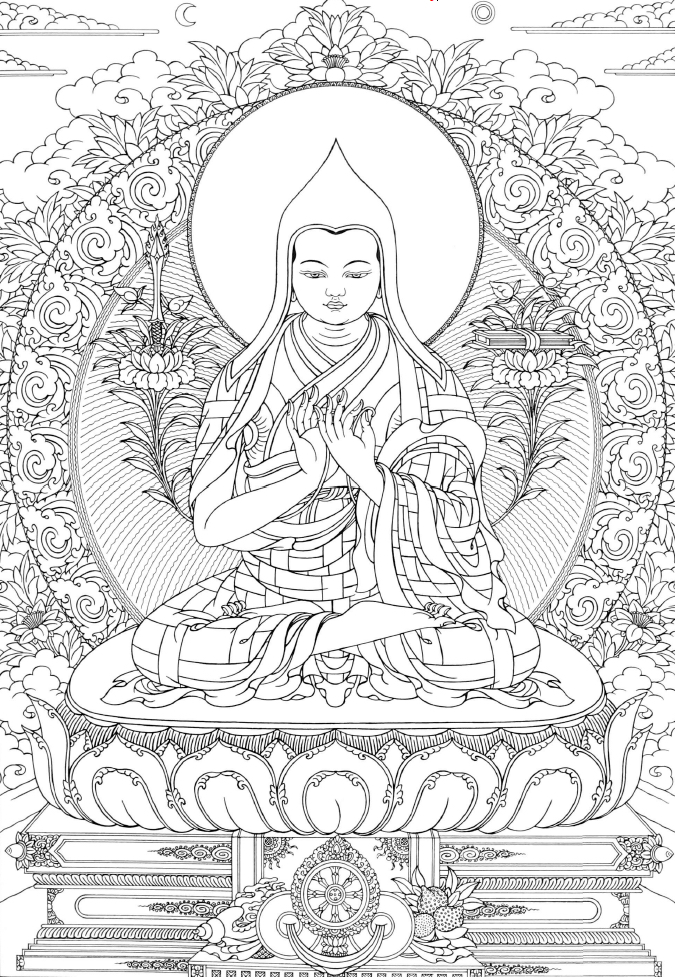
This chapter will examine one such attempt to tame the Guide, that of Tsongkhapa Losang Drakpa (Tsong kha pa Blo bzang grags pa, 1357-1417), the forefather of the Geluk (dge lugs) order of Tibetan Buddhism, the monastic lineage that would give Tibet the institution of the Dalai Lamas and dominate Tibetan politics from the mid-seventeenth to the mid-twentieth century. Tsongkhapa was one of the most influential figures in Tibetan Buddhist history, at once a visionary mystic, a brilliant and controversial philosopher, a dogged monastic reformer, and a founder of religious institutions that have lasted down to the present day. Our primary focus will be on Tsongkhapa's treatment of the Guide in his 1402 magnum opus, The Great Treatise on the Stages of the Path to Awakening (Byang chub lam rim chen mo),[3] but we also will cast a backward glance at Indian and Tibetan thinkers preceding him and touch on developments in Geluk tradition after his time. (Jackson, preliminary remarks, 162–63)
Notes
- See Tracy, Plurality and Ambiguity.
- For a thoughtful collection of reflections on the theory and practice of scholasticism, see Cabezon, ed., Scholasticism, of special note are Cabezon's introduction (1-17) and the essay by Paul Griffiths ("Scholasticism: The Possible Recovery of an Intellectual Practice," 201-235).
- Tibetan edition: Tsong kha pa, sKyes bu gsum gyi rnyams su blang ba'i rim pa thams cad tshang bar ston pa'i byang chub lam gyi rim pa/ Byang chub lam rim che ba; English translation: Tsong-kha-pa, The Great Treatise on the Stages of the Path to Enlightenment, trans. Lamrim Chenmo Translation Committee. For a helpful gloss on the Great Treatise, see Yangsi Rinpoche, Practicing the Path. For background on the stages of the path, see David Seyfort Ruegg's introduction to Tsong-kha-pa, Great Treatise, vol. 1, 17-32.


.jpg)