Suvarṇadvīpa's "Commentaries" on the Bodhicaryāvatāra
| 🤓 Admin Zone 🛠️ hidden to non-admins | |
- A Study of Akṣayamati (Śāntideva)'s Bodhisattvacaryāvatāra as Found in the Tibetan Manuscripts From Tun-huang
- A Study of the Wisdom Chapter (Prajñāpāramitā Pariccheda) of the Bodhicaryāvatārapañjikā of Prajñākaramati
- An Argument for Cittamātra: Reflections on Bodhicaryāvatāra 9:28 (Tib. 27) cd
- Atiśa's Introduction to the Two Truths, and Its Sources
- Bodhi(sattva)caryāvatāra als Lehrschrift und Vorhaben: Zum Thema Ritual, Religion, Philosophie und Mystik im Buddhismus
- Bodhicaryāvatāra 9:2 as a Focus for Tibetan Interpretations of the Two Truths in the Prāsangika Mādhyamika
- Bodhicaryāvatāra and Bodhicaryāvatāra-Pañjikā (Malalasekera)
- Bodhicaryāvatāra and Tibetan Mind Training (Lojong)
- Bodhicaryāvatāra no kihon seikaku: Ichininshō no imi suru mono
- Bodhicharyavatara (Rigpa Shedra Wiki)
- Bodhisattvacaryāvatāra: Exposition de la pratique des bodhisattvas
- Bu ston and the Bodhisattvacaryāvatāravyākhyāna (-pañjikā)
- Characteristics of the Buddhist Mongolian Texts: The Lineage of the Bodhicaryāvatāra
- Commentaries on Śāntideva's Bodhicaryāvatāra (Ejima 1966)
- Die "Vollkommenheiten" im BCA und seinen tibetischen Kommentaren
- Die Lehre von Satyadvaya in 'Ju Mi phams Nor bu ke ta ka
- Drops of Nectar: Khenpo Kunpal's Commentary on Shantideva's Entering the Conduct of the Bodhisattvas
- Dīpaṃkaraśrījñāna's Commentary on the Bodhicaryāvatāra
- Emptiness and Moral Perfection
- Enlightened Vagabond
- Epitome of the Bodhicaryāvatāra with Its Pañjikā, Chap. IX
- General Introduction: Śāntideva and His World
- Gser gling pa's Bodhisattvacaryāvatārapiṇḍārtha and Its Thought
- Identifying the Object of Negation: On Bodhicaryāvatāra 9:140 (Tib. 139)
- Introduction to Gzhan gyis brtsad pa'i lan mdor bsdus pa rigs lam rab gsal de nyid snang byed: An Answer to Blo-bzang-rab-gsal's Refutation of the Author's 'Sher le nor bu ke ta ka' and Its Defence, the Brgal lan nyin byed snang ba
- Jitāri, Śāntideva and Prabhākarakīrti
- Le commentaire de Mi-pham au chapitre IX du Bodhicaryāvatāra de Śāntideva: Échos modernes d'une controverse du XVème siècle
- Making and Remaking the Ultimate in Early Tibetan Readings of Śāntideva
- Mi pham and the Philosophical Controversies of the Nineteenth Century
- Nachlese zum Mongolischen Turfanfragment des Bodhicaryāvatāra
- Nichtselbst, Leerheit und Altruistische Ethik im Bodhicaryāvatāra (Lecture Transcript)
- Nichtselbst, Leerheit und Altruistische Ethik im Bodhicaryāvatāra (Official Publication)
- Notes on the Deśanā-ritual in the Bodhicaryāvatāra: Evidence of Its Revision
- Nyubosatsugyō-ron kaisetsu saisho no Shyāntidēva rikai
- On Agama and Yukti in Bu ston's Byang chub sems dpa'i spyod pa la 'jug pa'i 'grel pa
- On Prakṛtinirvāṇa-Prakṛtinirvṛta in the Bodhicaryāvatāra: A Study in the Indo-Tibetan Commentarial Tradition
- On the Role of Vairocanarakṣita in the Later Transmission Period: A Cross-section of the "Bodhisattva theory" Tradition
- On the Sanskrit Manuscript of the Śikṣāsamuccaya
- On the Textual Problems of Śāntideva's Bodhi(sattva)caryāvatāra: With Special Reference to Chapter 9 Entitled "Perfection of Wisdom (Prajñāpāramitā)"
- On Śāntideva's Position in the History of Mādhyamika Philosophy
- One Aspect of the Acceptance of the Bodhisattva-śīla in Tibet
- Polemics in Indo-Tibetan Scholasticism - A Late 19th-Century Debate Between 'Ju Mi pham and Dpa' ris Rab gsal
- Proof of the Authenticity of the Mahāyāna in Akṣayamati's Bodhi(sattva)caryāvatāra
- Readings of Śāntideva's Guide to Bodhisattva Practice
- Readings of Śāntideva's Guide to Bodhisattva Practice-Review by Harris
- Regional Characteristics of Mongolian Buddhism: A Study on the Basis of the Bodhicaryāvatāra
- Remarks on Akṣayamati (Blo gros mi zad pa), Being the Author of the Earlier Version of the Bodhisattvacaryāvatāra
- Remarks on an Instance of Intertextuality in the Eleventh Chapter of the Śikṣāsamuccaya and the Phrase Tṛṇagulmauṣadhivanaspati in Buddhist Sūtra Literature
- Remarks on the Philosophical Standpoint of the Anonymous Commentary, Bodhisattvacaryāvatāravyākhyāna(-pañjikā)
- Remarks on the Tabo Manuscript of the Bodhisattvacaryāvatāra
- Some New Remarks on the Bodhicaryāvatāra Chapter V
- Suffering Made Sufferable: Śāntideva, Dzongkaba, and Modern Therapeutic Approaches to Suffering's Silver Lining
- Suvarṇadvīpa's "Commentaries" on the Bodhicaryāvatāra
- Taming Śāntideva: Tsongkhapa's Use of the Bodhicaryāvatāra
- Tangut Texts of the Five Early Translations and the Texts on the Awakening of the Bodhicitta
- Textcritical Notes on Sanskrit Texts: I. Bodhi(sattva)caryāvatāra
- The Bodhicittotpādasamādanāvidhi by Jitari
- The Bodistw-a Čari-a Awatar-un Tayilbur of 1312 by Čosgi Odsir
- The Buddhist Roots of Secular Compassion Training: A Comparative Study of Compassion Cultivation in Indian and Tibetan Mahāyāna Sources with the Contemporary Secular Program of Compassion Cultivation Training (CCT)
- The Case of 'Ju Mi pham (1846–1912) and Dpa' ris Rab gsal (1840–1912): A Study in Dgag lan Debate
- The Center of the Sunlit Sky
- The Circle of Compassion: An Interpretive Study of Karuṇā in Indian Buddhist Literature
- The Concept of Bodhicitta in Śāntideva's Bodhicaryāvatāra (Diss)
- The Literature of the Madhyamaka School of Philosophy in India
- The Meaning of Sugata in the Bodhicaryāvatārapañjikā
- The Middle Way of the Bodhisattva
- The Original Bodhicaryāvatāra
- The Reflexive Nature of Awareness (1998)
- The Tanjur Bodhicaryāvatāra Auxiliaries: A Few Collected Bibliographical Pointers
- The Transmission of the Bodhicaryāvatāra: The History, Diffusion, and Influence of a Mahāyāna Buddhist Text
- Two Kinds of Saṃvṛtis in the Bodhicaryāvatārapañjikā IX 3-8
- Zu einer zentralen philosophischen Kontroverse mit den "orthodoxen" Philosophen
- Zum Bodhisattvacāryāvatārabhāṣya des Dīpaṃkaraśrījñāna
- Śāntideva (Internet Encyclopedia of Philosophy)
- Śāntideva and Bodhicaryāvatāra
- Śāntideva in the History of Mādhyamika Philosophy
- Śāntideva's Critique of 'I' or Self in the Early and Later Recensions of the Bodhi(sattva)caryāvatāra
- Śāntideva's Philosophy as Expressed in the Early Version of His Bodhisattvacaryāvatāra, Chapter 8
- Śāntidevas Bodhicaryāvatāra: Das Weiterwirken des Werkes dargestellt anhand der Überlieferungsgeschichte des Textes und seiner Kommentare
Description
The list of commentaries on the Bodhicaryāvatāra preserved in Tibetan translations[1] as given by Amalia Pezzali contains besides the Bodhicaryāvatārapañjikā of Prajñākaramati the titles of ten works[2]. Four of them exceed in length Śāntideva's poem; from this we may deduce that they are really commentaries: The Bodhisattvacaryāvatārasaṃskāra (Tibetan Byaṅ chub sems dpa'i spyod pa la 'jug pa'i legs par sbyar ba )[3], the Bodhisattvacaryāvatārapañjkā (Tibetan Byaṅ chub sems dpa'i spyod pa la 'jug pa'i dka' 'grel)[4], and the Bodhicaryāvatāratātparyapañjikāviśeṣadyotanī (Tibetan Byaṅ chub kyi spyod pa la 'jug pa'i dgoṅs pa'i 'grel pa khyad par gsal byed)[5], like the Bodhicaryāvatāra, each comprise ten chapters. The Bodhisattvacaryāvatāravivṛttipañjikā (Tibetan Byaṅ chub sems dpa'i spyod pa la 'jug pa'i rnam par bsad pa'i bka'i [recte: dka' 'grel)[6] is divided into nine chapters, this could indicate that — as in the Bodhicaryāvatārapañjikā — the Pariṇāmanāpariccheda [7] is not commented upon. Two smaller works deal with parts of the Bodhicaryāvatāra only: the Prajñāparicchedapañjikā[8] gives interpretations on the ninth and the
Bodhisattvacaryāvatāravivṛtti (Tibetan Byaṅ chub sems dpa'i spyod pa la 'jug pa'i rnam par bsad pa)[9] on the ninth and tenth chapters. Of the four remaining short texts only the Bodhisattvacaryāvatāraduravabodha[pāda]nirṇayanāmagrantha (Tibetan Byaṅ chub sems dpa'i spyod pa la 'jug pa'i rtogs par dka' ba 'i gnas gtan la dbab pa žes bya ba'i gžuṅ)[10] is a true commentary, for it deals with some passages difficult to understand. The Bodhisattvacaryāsutrikṛtāvavāda (Tibetan Byaṅ chub sems dpa'i spyod pa mdo tsam gdams hag tu byas pa)[11] composed by Dīpaṃkaraśrījñāna, commonly known by his title Atiśa, does not explain the Bodhicaryāvatāra; it is an "instruction about the [right] course of conduct of a Bodhisattva given in short".
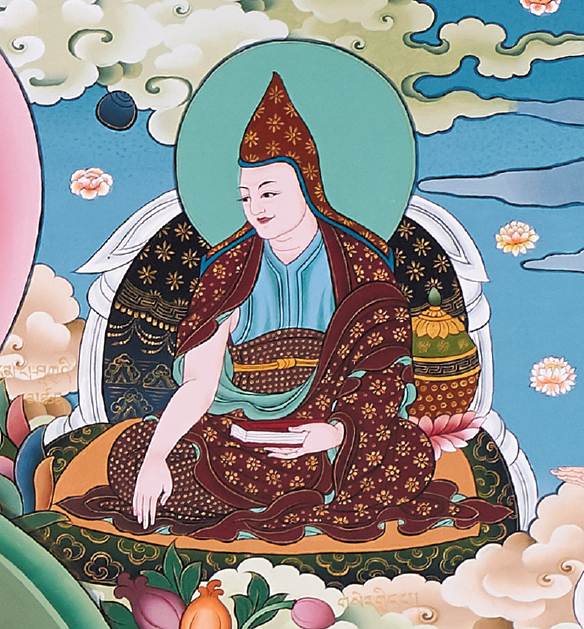
The two not yet mentioned texts from the list of commentaries, the Bodhisattvacaryāvatāraṣaṭtriṃśatpiṇḍārtha (hereafter: BcaSP; Tibetan Byaṅ chub sems dpa'i spyod pa la 'jug pa'i don sum cu rtsa drug bsdus pa)[12] and the Bodhisattvacaryāvatārapiṇḍārtha (hereafter: BcaP; Tibetan Byaṅ chub sems dpa'i spyod pa la 'jug pa'i don bsdus pa)[13] , were written by Dharmapāla, in Tibetan Gser gliṅ gi bla ma Chos skyoṅ. This Buddhist teacher came from Suvarṇadvīpa, nowadays Sumatra; he was an important guru of Dīpaṃkaraśrījñāna, from whose biography the data of his life can be seen[14]. The boy who was to become the teacher Gser gliṅ pa was born into the royal family, his name is given in a gloss inserted later into the account as Senasena (Tibetan: si na si na)[15]. This prince is said to have found a statue of Śākyamuni and thereupon to have become a Buddhist. For religious studies he travelled to India where he met his main teacher Mahaśrīratna. After having miraculous dreams he received the instruction asked for and was given the name Gser gliṅ pa Chos kyi grags pa. This is the name used throughout the biographical tradition concerning Atiśa; we may render it as Suvarṇadvīpa[16] Dharmakīrti. In the Tibetan Buddhist Canons we find the personal name as Dharmapāla; the difference in the second parts of these names cannot be explained. According to the legendary account available Suvarṇadvīpa became famous for his erudition after returning to his country so that many pupils - including Atiśa - travelled there. But it might be possible that Dharmapāla/-kīrti stayed in Northern India and worked as a teacher of Buddhism there, for in Tibet, in Reting Monastery, relics of
Gser gliṅ pa [17] — presumably brought there by Dīpaṃkaraśrījñāna — are preserved [18].
The titles of the above two works of Suvarṇadvīpa indicate their literary category with the word piṇḍārtha, which is not to be found in the modern dictionaries of classical Sanskrit [19]. It appears as an entry in the Buddhist Hybrid Sanskrit Dictionary with the explanation "meaning of the sum or whole mass, summary meaning"[20], and in The Pali Text Society's Pali-English Dictionary the compound piṇḍāttha is translated as "condensed meaning, resume"[21]. The fact that the BcaSP and the BcaP consist only of stanzas quoted from the Bodhicaryāvatāra has been pointed out in an article published in 1966 by Yasunori Ejima[22] • Louis de la Vallée Poussin knew already that these two works are not commentaries proper, since he speaks of "un sommaire de notre traite (Bodhicaryāvatārapiṇḍārtha) d'un certain Dharmapāla ( ou ºrakṣita)"[23] . In the preface to his edition of the Bodhicaryāvatāra and the commentary of Prajñākaramati P. L. Vaidya seems to refer to the same fact: "An abridgement of the BCA, called Piṇḍārtha in thirtysix verses is prepared by Kamalaśīla and is found translated in Tanjur by Dīpaṃkaraśrījñāna"[24] . This statement should be corrected in at least two points: The name Kamalaśīla stands for Kamalarakṣita[25] , and instead of one work comprising 36 stanzas one has to reckon with one of about 30 verses and another of about 80 verses.
The present paper aims at presenting identifications of the stanzas quoted from the Bodhicaryāvatāra in the BcaSP and in the BcaP. Through this it is also possible to understand the relation between these two abstracts composed by Suvarṇadvīpa which is indicated by the identical words in both the titles.
Notes
- The many commentaries on the Bodhicaryāvatāra composed in Tibetan cannot be considered in this paper.
- Amalia Pezzali, Śāntideva, mystique bouddhiste des VIIe et VIIIe sièles. Firenze 1968 (Testi e ricerche dei Scienze religiose. 3.), 59-61; a list presenting the same titles appeared already in P. L. Vaidya. Études sur Āryadeva et son Catuḥśataka. Chapitres VIII-XVI. Paris 1923, 56-57.
- Available in Daisetz T. Suzuki (ed.). The Tibetan Tripitika. Peking Edition. Reprinted under the Supervision of the Otani University, Kyoto. Tokyo 1955-1961 (hereafter: TT), as No. 5275, covering about 106 folios. The titles of works preserved in Tibetan translations only have been taken from TT (with changed transliteration for the Tibetan).
- Available in TT, No. 5277, covering about 74 folios.
- Available in TT, No. 5282, covering about 114 folios.
- Available in TT, No. 5274, covering about 71 folios.
- This is the title of the tenth chapter (in the Tibetan colophon: bsṅo ba žes bya ba'i le'u bcu pa). The authenticity of this chapter was questioned, since the Bodhicaryāvatārapañjikā of Prajñākaramati does not give explanations to it.
- Tibetan Šes rab le'u'i dka' 'grel; available in TT, No. 5278, covering about 24 folios.
- Available in TT, No. 5 279, covering about 13 folios.
- Available in TT, No. 5276, covering about 6 folios.
- Available in TT, No. 5342, 5348 and 5385, covering about 3 pages. If one would take the titles beginning with Bodhi(sattva)caryā- or Byaṅ chub (sems dpa'i) spyod pa- as those of commentaries on the Bodhicaryāvatāra, TT, No. 5332 Bodhisattvacaryā[saṃgraha]pradīparatnamālā, could be included into the list; but this text does not comment upon Śāntideva's poem.
- This is the title given at the beginning of the text; TT, No. 5280, covering about 4 folios.
- This is the title given at the beginning of the text; TT, No. 5 281, covering about 3 pages.
- Jo bo rje dpal ldan mar me mdzad ye šes kyi rnam thar rgyas pa, fol. 10b2-12b3 and 28b4-30a4, as now published in Helmut Eimer. Rnam thar rgyas pa. Materialien zu einer Biographie des Atiśa (Dīpaṃkaraśrījñāna). Wiesbaden 1979. (Asiatische Forschungen. 67), part 2, pages 34-41 and 95-100.
- See Eimer, op. cit., part 1, page 92.
- This form is derived from the transliteration given in the Bodhimārgadipapañjikā, TT, No. 5344: vol. 103, page 22, 4, 3.
- See Alfonsa Ferrari t. Mk'yen brtse's Guide to the Holy Places of Central Tibet. Roma 1958. (Serie Orientale Roma. XVI.), 38 and 78 note 6.
- Some further considerations on this topic are given by Eimer, op. cit., part 1, page 116.
- This includes the dictionaries by Otto Boehtlingk, Monier Monier-Williams and Vaman Shivram Apte as well as the Nachträge zum Wörterbuch ... von Otto Boehtlingk by Richard Schmidt.
- Franklin Edgerton, BHSD, 345a.
- T. W. Rhys Davids and William Stede, PTSD, 458b.
- Yasunori Ejima. ,Nyubo daigyōron no chūshaku bunken ni tsuite'. lndogaku Bukkyōgaku Kenkyū XIV (1966), 64 7-648. I extend my thanks to Dr. Akira Yuyama, Tokyo, for a copy of this paper and to Dr. Sigmara Sato-Diesner, Bonn, for the translation of the passage needed.
- Louis de la Vallée Poussin. Bodhicaryāvatāra, Introduction à la pratique des futurs Bouddhas. Poème de Çāntideva, Traduit du sanscrit et annoté. Paris 1907, 143.
- P. L. Vaidya (ed.). Bodhicaryāvatāra of Śāntideva, with the Commentary Pañjkā of Prajñākaramati. Darbhanga 1960. (Buddhist Sanskrit Texts. 12.), X.
- In the colophons to the BcaSP and the BcaP he is named together with Dīpaṃkaraśrījñāna as having asked Suvarṇadvīpa to compose the two summaries.