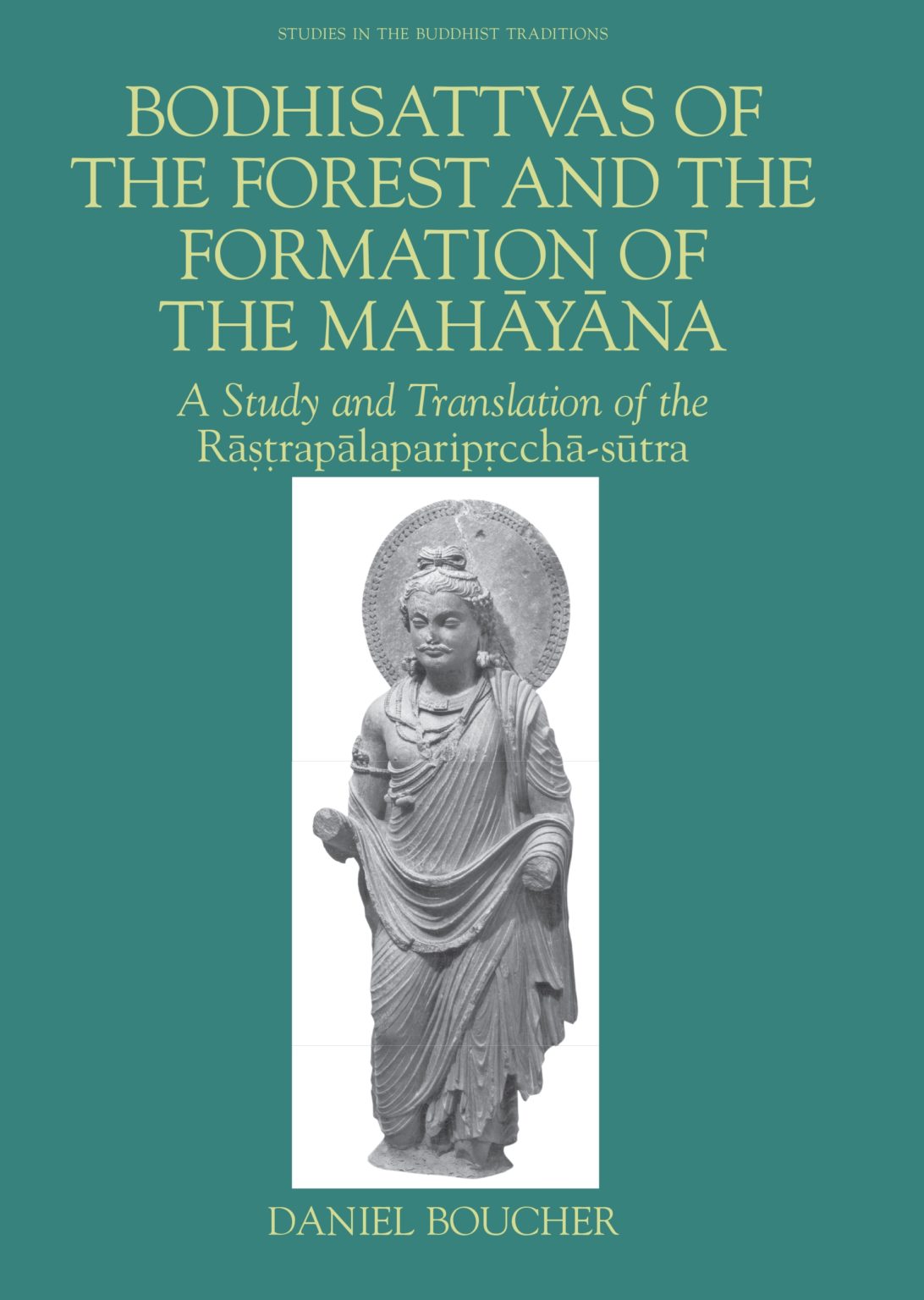
Bodhisattvas of the Forest and the Formation of the Mahayana
| 🤓 Admin Zone 🛠️ hidden to non-admins | |
- 'phags pa dri ma med par grags pas bstan pa zhes bya ba theg pa chen po'i mdo (Jeweled Lotus Publishing, 2015)
- A Buddha Within: The Tathāgatagarbhasūtra
- A Few Good Men
- A Short Presentation of Śāntideva's Bodhicaryāvatāra
- A Study of Akṣayamati (Śāntideva)'s Bodhisattvacaryāvatāra as Found in the Tibetan Manuscripts From Tun-huang
- Account of the Period of the Kings Cala, Pañcamasiṃha and Others
- Akṣayamati and Śāntideva
- Akṣayamatinirdeśasūtra, Vol. 1 (Braarvig, J.)
- Akṣayamatinirdeśasūtra, Vol. 2 (Braarvig, J.)
- Bodhi(sattva)caryāvatāra als Lehrschrift und Vorhaben: Zum Thema Ritual, Religion, Philosophie und Mystik im Buddhismus
- Bodhisattvas of the Forest and the Formation of the Mahayana
- Bodhisatvapiṭaka (Bibliotheca Polyglotta)
- Bu ston on the sPyod 'jug (Bodhisattvacaryāvatāra)
- Buddha Mind - Christ Mind
- Buddha's Lions
- Buddhist Texts Through the Ages
- Die Überlieferung vom Lebensende des Buddha, Part 1
- Drops of Nectar: Khenpo Kunpal's Commentary on Shantideva's Entering the Conduct of the Bodhisattvas
- Entering the Path of Enlightenment
- Entering the Path of Enlightenment-Review by Cook
- Entering the Path of Enlightenment-Review by Seyfort Ruegg
- Ethical Revaluation in the Thought of Śāntideva
- Ethics in the Śikṣāsamuccaya: A Study in Mahāyāna Morality
- Facts or Fictions: Reconsidering Śāntideva's Names, Life, and Works
- Fierce Devotion to all Beings: The Role of Emotions in Śāntideva’s Introduction to the Way of the Bodhisattva (Bodhicaryāvatāra)
- General Introduction: Śāntideva and His World
- Gleichheit und Mitgefühl: Prajñākaramatis Kommentar zu Bodhicaryāvatāra VIII. 89-108
- How to Be a Bodhisattva: Introduction to the Practice of the Bodhisattva Path (The Bodhicaryāvatāra)
- La légende de Śāntideva
- Mahasiddhas: La vie de 84 sages de l'Inde
- Masters of Mahāmudrā
- Mental Purification (Blo sbyong): A Native Tibetan Genre of Religious Literature
- Moral Theory in Śāntideva's Śikṣāsamuccaya
- Moral Theory in Śāntideva's Śikṣāsamuccaya-Review by Osto
- Moral Theory in Śāntideva's Śikṣāsamuccaya: Cultivating the Fruits of Virtue-Review by Goodman
- Narayanapariprccha: Sanskrit and Tibetan Texts
- On Akṣayamati's Bodhisattvacaryāvatāra
- Proof of the Authenticity of the Mahāyāna in Akṣayamati's Bodhi(sattva)caryāvatāra
- Readings of Śāntideva's Guide to Bodhisattva Practice
- Readings of Śāntideva's Guide to Bodhisattva Practice-Review by Harris
- Reason, Irrationality and Akrasia (Weakness of the Will) in Buddhism: Reflections upon Śāntideva's Arguments with Himself
- Remarks on Akṣayamati (Blo gros mi zad pa), Being the Author of the Earlier Version of the Bodhisattvacaryāvatāra
- Samantabhadracaryā-praṇidhānarāja (Devi)
- Santideva's Bodhicaryāvatāra
- Santideva, un mistico del Buddhismo
- Saṃgharakṣitāvadāna (Bibliotheca Polyglotta)
- Shantideva (From Butön's History of Buddhism in India and Its Spread to Tibet, Translated by Lisa Stein and Ngawang Zangpo)
- Shantideva (Nariman)
- Shantideva's Bodhicaryavatara: An Internal Pilgrimage to Universal Peace and Compassion
- Shantideva's Teaching
- Shāntideva (Tib. Shi-wa-lha)
- Stotra, Psychological Conditioning, and the Bodhicaryāvatāra: Together with a Translation of the Bodhicittānuśaṃsapariccheda
- Sūtra of Aṅgulimālika
- The Acceptance of Evil Acts in the Śīla-paṭala of the Yogācārabhūmi
- The Bhaiṣajyaguru-Sūtra and the Buddhism of Gilgit
- The Bodhi-caryâvatāra and Its Monastic Aspects: On the Problem of Representation
- The Bodhisattva Doctrine in Buddhist Sanskrit Literature
- The Center of the Sunlit Sky
- The Concept of Bodhicitta in Śāntideva's Bodhicaryāvatāra (Diss)
- The Ethics of Śaṅkara and Śāntideva
- The Ethics of Śaṅkara and Śāntideva-Review by Abramson
- The Ethics of Śaṅkara and Śāntideva-Review by Javanaud
- The Ethics of Śaṅkara and Śāntideva-Review by O'Leary
- The Literature of the Madhyamaka School of Philosophy in India
- The Mahāsiddha Bhusuku (Śāntideva), The Idle Monk
- The Masters and Poets of the Mahāyāna
- The Origins and Early History of the Mahāratnakūṭa Tradition of Mahāyāna Buddhism with a Study of the Ratnarāśisūtra and Related Materials
- The Perfection of Wisdom (Schopen)
- The Range of the Bodhisattva: A Study of an Early Mahāyānasūtra - Āryasatyakaparivarta
- The Resolve to Become a Buddha
- The Story of Saṅgharakṣita (Stories 23–25)
- The Training Anthology of Śāntideva
- The Triskandha, Practice in Three Parts: Study of an Early Mahāyāna Buddhist Ritual
- The Ugraparipṛcchā, the Mahāratnakūṭasūtra and Early Mahāyāna Buddhism
- The Vajradhvajapariṇāmanā: An Edition and Translation of the Tibetan Version
- The Śālistamba Sūtra
- The Śālistamba Sūtra and Its Indian Commentaries, Volume II
- Vimalakīrtinirdeśa: Transliterated Sanskrit Text Collated with Tibetan and Chinese Translations
- Śāntideva (Internet Encyclopedia of Philosophy)
- Śāntideva (Potter, Kalupahana, and Sweet)
- Śāntideva (Stanford Encyclopedia of Philosophy)
- Śāntideva and Bodhicaryāvatāra
- Śāntideva and the Mādhyamika: The Prajñāpāramitā-Pariccheda of the Bodhicaryāvatāra
- Śāntideva as a Mantracarin
- Śāntideva in the History of Mādhyamika Philosophy
- Śāntideva, A Mystic of Buddhism
- Śāntideva, il Bodhicaryāvatāra e le kārikā del Śikṣāsamuccaya
- Śāntideva, il Bodhicaryāvatāra e le kārikā del Śikṣāsamuccaya-Review by Pāsādika
- Śāntideva: Mystique Bouddhiste des VIIe et VIIIe siècles
- Śāntideva: Mystique Bouddhiste des VIIe et VIIIe siècles-Review by Cabezón
- Śāntideva: The Author and His Project
- Śāntidevas Bodhicaryāvatāra: Das Weiterwirken des Werkes dargestellt anhand der Überlieferungsgeschichte des Textes und seiner Kommentare

Description
The first part of the study looks at the relationship between the bodily glorification of the Buddha and the ascetic career—spanning thousands of lifetimes—that produced it within the socioeconomic world of early medieval Buddhist monasticism. The authors of the Rastrapala sharply criticize their monastic contemporaries for rejecting the rigorous lifestyle of the first Buddhist communities, an ideal that, for the sutra’s authors, self-consciously imitates the disciplines and sacrifices of the Buddha’s own bodhisattva career, the very career that led to his acquisition of bodily perfection. Thus, Boucher reveals the ways in which the authors of the Rastrapala co-opted this topos concerning the bodily perfection of the Buddha from the Mainstream tradition to subvert their co-religionists whose behavior they regarded as representing a degenerate version of that tradition.
In Part 2 Boucher focuses on the third-century Chinese translation of the sutra attributed to Dharmaraksa and traces the changes in the translation to the late tenth century. The significance of this translation, Boucher explains, is to be found in the ways it differs from all other witnesses. These differences, which are significant, almost certainly reveal an earlier shape of the sutra before later editors were inspired to alter dramatically the text’s tone and rhetoric. The early Chinese translations, though invaluable in revealing developments in the Indian milieu that led to changes in the text, present particular challenges to the interpreter. It takes an understanding of not only their abstruse idiom, but also the process by which they were rendered from an undetermined Indian language into a Chinese cultural product. One of the signal contributions of this study is Boucher’s skill at identifying the traces left by the process and ability to uncover clues about the nature of the source text as well as the world of the principal recipients.
Bodhisattvas of the Forest concludes with an annotated translation of the Rastrapalapariprccha-sutra based on a new reading of its earliest extant Sanskrit manuscript. The translation takes note of important variants in Chinese and Tibetan versions to correct the many corruptions of the Sanskrit manuscript. (Source: University of Hawai'i Press)
- Acknowledgmentsvii
- Abbreviationsix
- Introductionxi
The Indian Text of the Rāṣṭrapālaparipṛcchā-sūtra
- Chapter One: The Physiognomy of Virtue3
- Chapter Two: Former Life Narratives and the Bodhisattva Career20
- Chapter Three: Wilderness Dwelling and the Ascetic Disciplines40
- Chapter Four: "Profit and Honor”: A Critique of Sedentary Monasticism64
Dharmarakṣa's Translation of the Rāṣṭrapālaparipṛcchā-sūtra
- Chapter Five: The Role of Translation in Reconstructing the Early Mahāyāna87
- Chapter Six: Mistranslation and Missed Translation101
- One: Prologue113
- Two: The Story of Puṇyaraśmi142
- Notes171
- Bibliography251
- Index283