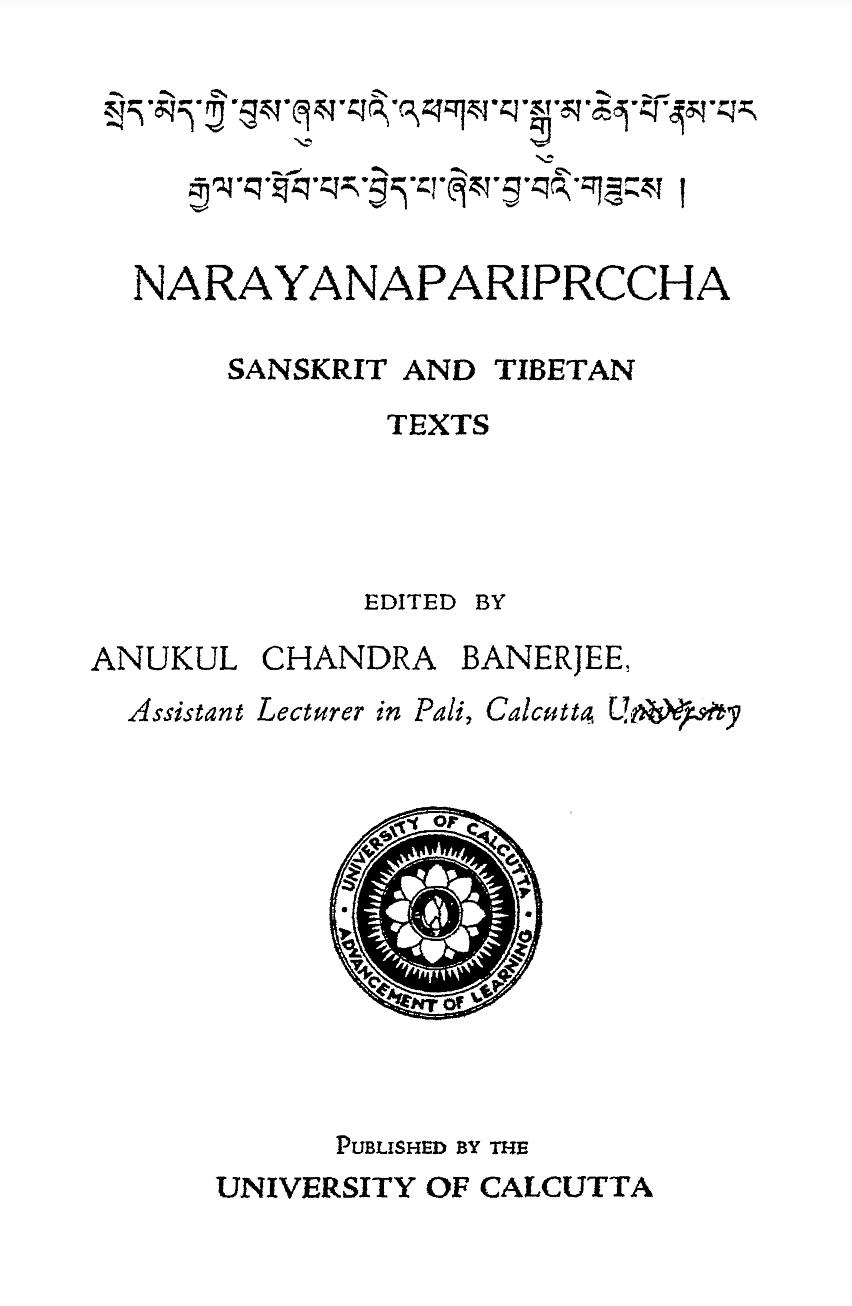
Narayanapariprccha: Sanskrit and Tibetan Texts
| 🤓 Admin Zone 🛠️ hidden to non-admins | |
- 'phags pa dri ma med par grags pas bstan pa zhes bya ba theg pa chen po'i mdo (Jeweled Lotus Publishing, 2015)
- A Buddha Within: The Tathāgatagarbhasūtra
- A Few Good Men
- A Revised Edition of the Laṅkāvatāra-Sūtra, Kṣaṇika-Parivarta
- A Revised Edition of the Laṅkāvatāra-sūtra, "Kṣaṇika-parivarta" (in Collected Papers)
- Akṣayamatinirdeśasūtra, Vol. 1 (Braarvig, J.)
- Akṣayamatinirdeśasūtra, Vol. 2 (Braarvig, J.)
- Amida Dhāraṇī Sūtra and Jñānagarbha's Commentary
- Ashṭasāhasrikā: A Collection of Discourses on the Metaphysics of the Mahāyāna School of the Buddhists
- Aṣṭa-sāhasrikā prajñāparamitā: A Sanskrit Manuscript from Nepal
- Aṣṭasāhasrikā Prajñāpāramitā, with Haribhadra's Commentary called Ālokā
- Bhaisajya-guru-sutra: Original Sanskrit Text with Introduction and Commentary
- Bhaiṣajyaguruvaidūryaprabharājasūtram (Dutt, N.)
- Bhaiṣajyaguruvaidūryaprabharājasūtram (Vaidya, P. L.)
- Bhaiṣajyaguruvaiḍūryaprabharājasūtra (Vira and Chandra)
- Bodhisattvas of the Forest and the Formation of the Mahayana
- Bodhisatvapiṭaka (Bibliotheca Polyglotta)
- Bouddhisme: Notes et Bibliographie
- Buddhist Wisdom Books Containing the Diamond Sutra and the Heart Sutra (1972)
- Catalogue of Buddhist Sanskrit Manuscripts in the Possession of the Royal Asiatic Society (Hodgson Collection)
- Caturdharmikasūtra (Tseng, V.)
- Cuṇḍīdevīdhāraṇī (Zieme, P.)
- Das Gilgit-Fragment Or. 11878A im Britischen Museum zu London
- Daśabhūmikasūtra (Rahder, J.)
- Daśabhūmikasūtra et Bodhisattvabhūmi
- Daśabhūmikasūtram
- Daśabhūmīśvaro nāma Mahāyānasūtraṃ
- Dharma-Samuccaya: Compendium de la Loi, Vol. 1
- Dharma-Samuccaya: Compendium de la Loi, Vol. 2
- Dharma-Samuccaya: Compendium de la Loi, Vol. 3
- Die Bhadracari, eine probe buddhistisch-religiöser lyrik
- Die Überlieferung vom Lebensende des Buddha, Part 1
- Gaṇḍavyūhasūtra (Vaidya, P. L.)
- Gilgit Manuscripts, Vol. 2 (Part 1)
- Gilgit Manuscripts, Vol. 2 (Part 2)
- Gilgit Manuscripts, Vol. 2 (Part 3)
- Lalita Vistara: Leben und Lehre des Çâkya-Buddha, Erster Teil: Text
- Lalita-Vistara (Vaidya, P. L.)
- Lankavatara-Sutra (Das, Sarat Chandra)
- Laṅkāvatāra-sūtra: Sanskrit Manuscript from Nepal
- Mahā-megha-sūtra
- Mārīcīdhāraṇī (Zieme, P.)
- Narayanapariprccha: Sanskrit and Tibetan Texts
- Rāṣṭrapālaparipṛcchā (Vaidya, P. L.)
- Rāṣṭrapālaparipṛcchā: Sūtra du Mahāyāna (1901)
- Saddharma-Puṇḍarīka-Sūtra: Kashgar Manuscript
- Saddharmalankavatarasutram (Vaidya, P. L.)
- Saddharmapuṇḍarīka (1908)
- Saddharmapuṇḍarīka-sūtram (Wogihara and Tsuchida)
- Saddharmapuṇḍarīkanāmamahāyānasūtram (Kawaguchi and Ikeda)
- Saddharmapuṇḍarīkasūtra (Vaidya, P. L.)
- Saddharmapuṇḍarīkasūtram (Dutt, N.)
- Samantabhadracaryā-praṇidhānarāja (Devi)
- Samādhirāja-Sūtram (Das, Sarat)
- Samādhirājasūtra (Vaidya, P. L.)
- Samādhirājasūtra (Vira and Chandra)
- Sarvadharmāpravṛttinirdeśa (Braarvig, J.)
- Saṃgharakshita (Cowell and Neil)
- Saṃgharakṣitāvadāna (Bibliotheca Polyglotta)
- Saṃgharakṣitāvadānam (Vaidya, P. L.)
- Siṃhaparipṛcchāsūtra (Tseng, V.)
- Studies in the Divyāvadāna: I. Sūkarikāvadāna
- Studies in the Literature of the Great Vehicle
- Suvarna Prabhā
- Suvarṇaprabhāsasūtram (Bagchi, S.)
- Suvarṇaprabhāsottamasūtra: Das Goldglanz-Sūtra (Nobel 1937)
- Sūkarikāvadāna (Cowell and Neil)
- Sūkarikāvadānam (Vaidya, P. L.)
- Sūtra of Aṅgulimālika
- The Acceptance of Evil Acts in the Śīla-paṭala of the Yogācārabhūmi
- The Bhaiṣajyaguru-Sūtra and the Buddhism of Gilgit
- The Final Leaves of the Pravrajyāvastu Portion of the Vinayavastu Manuscript Found Near Gilgit: Part 1 Saṃgharakṣitāvadāna
- The Gandavyuha Sutra (1949)
- The Gilgit Text of the Vajracchedikā
- The Gāthās of the Daśabhūmika-Sūtra (1–5)
- The Gāthās of the Daśabhūmika-Sūtra (6–10)
- The Hymn of the Life and Vows of Samantabhadra
- The Khotanese Bhadracaryādeśanā
- The Khotanese Śūraṅgamasamādhisūtra
- The Lalita-Vistara, or Memoirs of the Early Life of Śákya Siñha (Sanskrit)
- The Laṅkāvatāra Sūtra (Bunyu)
- The Laṅkāvatāra-ratna-sūtram: Sarva-buddha-pravacana-hṛdayam
- The Manuscript of the Vajracchedikā Found at Gilgit
- The Origins and Early History of the Mahāratnakūṭa Tradition of Mahāyāna Buddhism with a Study of the Ratnarāśisūtra and Related Materials
- The Perfection of Wisdom (Schopen)
- The Range of the Bodhisattva: A Study of an Early Mahāyānasūtra - Āryasatyakaparivarta
- The Ratnarāśisūtra Quoted in the Śikṣāsamuccaya
- The Saddharma Laṅkāvatārasūtra (Vaipulya Sūtra)
- The Samādhi Lists of the Akṣayamatinirdeśasūtra and the Mahāvyutpatti
- The Story of Saṅgharakṣita (Stories 23–25)
- The Suvarṇaprabhāsa Sūtra (Nanjio and Idzumi)
- The Suvarṇaprabhāsa Sūtra: A Mahayana Text called "The Golden Splendour"
- The Tathāgatagarbha Sūtra
- The Ugraparipṛcchā, the Mahāratnakūṭasūtra and Early Mahāyāna Buddhism
- The Vajradhvajapariṇāmanā: An Edition and Translation of the Tibetan Version
- The Śālistamba Sūtra
- The Śālistamba Sūtra and Its Indian Commentaries, Volume II
- Two Sanskrit Manuscripts of the Daśabhūmikasūtra
- Unique Sanskrit Fragments of the "Sūtra of the Golden Light" in the Manuscript Collection of the St. Petersburg Branch of the Institute of Oriental Studies (Russian Academy of Sciences)
- Vajracchedikā Prajñāpāramitā (Conze)
- Vajracchedikā Prajñāpāramitā (Dutt)
- Vajracchedikā Prajñāpāramitā (Sanskrit)
- Vajracchedikā Prajñāpāramitāsūtra (Joshi, L.)
- Vajracchedikā in the Original Sanskrit
- Vajracchedikā nāma Triśatikā Prajñāpāramitā
- Vimalakīrtinirdeśa: A Sanskrit Edition Based upon the Manuscript Newly Found at the Potala Palace
- Vimalakīrtinirdeśa: Transliterated Sanskrit Text Collated with Tibetan and Chinese Translations
- Vimalakīrtinirdeśasūtra (Joshi and Prāsādika)
- Vinayaviniścaya Upāliparipṛcchā (Dutt, N.)
- Çatasāhasrikā-Prajñā-Pāramitā: A Theological and Philosophical Discourse of Buddha with His Disciples (in a Hundred-Thousand Stanzas), Vol. 1
- Çatasāhasrikā-Prajñā-Pāramitā: A Theological and Philosophical Discourse of Buddha with His Disciples (in a Hundred-Thousand Stanzas), Vol. 2
- Ārya Śrīaṣṭasāhasrikāprajñāpāramitāsūtram (Vajrācārya, H.)
- Ārya Śālistamba Sūtra (Sastri, N.)
- Āryaśrīdaśabhūmikasūtram (Herākājī Vajrācārya)

Description
Summary by Anukul Chandra Banerjee, Narayanapariprccha: Sanskrit and Tibetan Texts, 1941:
The present text is a mantra dhāraṇī, the efficacies of which are described as follows:
(i) Security against the action of enemies, evil spirits and thieves,
(ii) gaining happiness and fortune in life, and
(iii) gaining the pawer of recollection of previous births. . . .
It is said that once the Exalted Buddha was living in the house of Vaiśravaṇa on the summit of the golden mountain. He delivered there a discourse called Dharmālokamukha, 'an Introduction to the light of the Element of Existence', eulogised alike by the gods, the Garuḍas, Kiṇṇaras, Yakṣas and the rest. Once Nārāyaṇa, having been overpowered by the demons, approached the Buddha and said, "Oh Lord, take pity on me and kindly give me that charm whereby men, gods, demi-gods, etc., would be free from all evils and gain victory in battle." At this the Lord said to him, "Oh Nārāyaṇa, you know many deceptive artifices and possess sufficient power. Why are you asking me for this?" Then Nārāyaṇa said to Him, "Oh Lord, I have been vanquished by the lord of the demons through his stratagem in battle. Some of the gods died instantly in the battle-field while others fled away in fear of death. So, Lord, kindly teach me that charm out of compassion for me, so that all beings would be victorious in the battle and the pride of the demons also humbled down." The Lord said to him, "Oh Nārāyaṇa, there was, in days of yore, a king named Ratnaśrī in the hill called Rohita in Magadha. Then there was born at that time a Tathāgata named Sarveśvara who was all-enlightened, endowed with supreme knowledge, and a leader of gods and men. I have learnt this charm from that Tathāgata and have explained this to others elaborately. Again, Oh Nārāyaṇa, through the influence of this charm one can have no fear from enemies and thieves, and one gains mastery over all evils and this king too reigned for many hundred years in righteousness through its efficacy. Afterwards he was born as a Bodhisattva called Māndhāṭr and became a monarch in his next birth. He gave away for the good of all beings all his riches due to his perfection in charity in his previous births and the gods, the demi-gods, the Nāgas, men, etc., carried out his orders at his very bidding. After spending sixty four thousand kalpas (aeons) thus, he became a Buddha 'fully enlightened,' unparallel in the world and the teacher of gods in one of his births and was like the king of serpents freed from the fear of the king of birds (Garuḍa). Hence, Oh Nārāyaṇa, learn this charm called Mahāmāyāvijayavāhinīdhāraṇī which commences with the words namo 'stvadhvānugatapratiṣṭhitebhyaḥ sarvabuddhabodhisattvebhyaḥ and closes with the words phaṭ phaṭ svāhā (vide the text, pp. 3-4). Having learnt this charm, Oh Nārāyaṇa, kindly explain this to others in full. Now this charm being put in five wheels kept in five models of chariots is to be placed in five places of the battle-field. There one is to think of the 'Queen of Secret Sciences' (Vidyārājñī) called Mahāvijayavāhinī, possessing many hundred thousand forms and hands, three eyes, black-red colour and four bright faces devouring the enemies while staying in this chariot placed in front of the enemy. The king himself is to make a wheel and write this charm in saffron on this in the mid-day and thus he conquers his enemy with his prowess. Such is the efficacy, Oh Nārāyaṇa, of this charm. This charm could be worn by the pure as well as by the impure and even by one observing fast or not. If a man recites this charm thrice daily, he becomes free from five heinous offences, attains happiness and can also recollect his previous births. He devotes all his life for the cause of the good religion and the happiness of the beings and never falls a prey to evils. And moreover, Oh Nārāyaṇa, a noble son, a noble daughter, a monk, a nun, a lay man, a lay woman, a king, a prince or a Brahmin who wears this charm can recollect his or her previous births."
At this Nārāyaṇa got up from his seat and saluted Him with a smiling face saying, "Thou art the Lord of the gods and men and so thou explaineth the true doctrine. I bow down to Thee." Nārāyaṇa again saluted Him saying, "Oh Lord, thou art my Lord," and so saying he went away with this charm. (Banerjee, Narayanapariprccha: Sanskrit and Tibetan Texts, xiii–xvii)
- Prefacev
- Introductionxi
- Nārāyaṇaparipṛcchā
- Sanskrit Text1
- Tibetan Text7

The present text is a mantra dhāraṇī, the efficacies of which are described as follows:
(i) Security against the action of enemies, evil spirits and thieves,
(ii) gaining happiness and fortune in life, and
(iii) gaining the pawer of recollection of previous births. . . .
At this Nārāyaṇa got up from his seat and saluted Him with a smiling face saying, "Thou art the Lord of the gods and men and so thou explaineth the true doctrine. I bow down to Thee." Nārāyaṇa again saluted Him saying, "Oh Lord, thou art my Lord," and so saying he went away with this charm. (Banerjee, Narayanapariprccha: Sanskrit and Tibetan Texts, xiii–xvii)
The present text is a mantra dhāraṇī, the efficacies of which are described as follows:
(i) Security against the action of enemies, evil spirits and thieves,
(ii) gaining happiness and fortune in life, and
(iii) gaining the pawer of recollection of previous births. . . .
At this Nārāyaṇa got up from his seat and saluted Him with a smiling face saying, "Thou art the Lord of the gods and men and so thou explaineth the true doctrine. I bow down to Thee." Nārāyaṇa again saluted Him saying, "Oh Lord, thou art my Lord," and so saying he went away with this charm. (Banerjee, Narayanapariprccha: Sanskrit and Tibetan Texts, xiii–xvii)