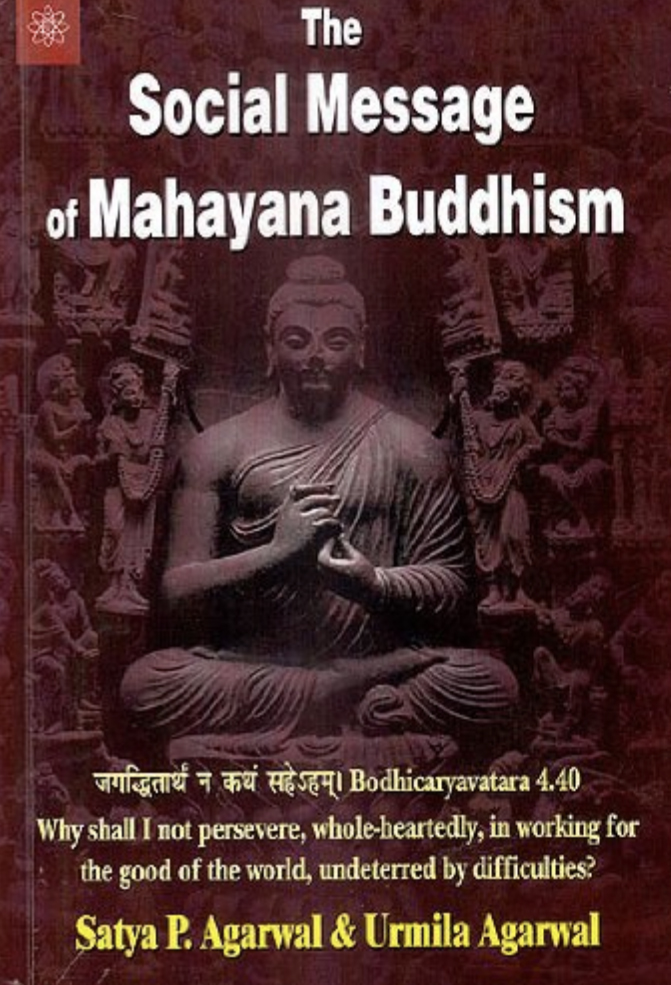
The Social Message of Mahayana Buddhism
From Bodhicitta
< BooksBooks/The Social Message of Mahayana Buddhism
| 🤓 Admin Zone 🛠️ hidden to non-admins | |
The Social Message of Mahayana Buddhism
Book
- A Buddhist 'good life' Theory: Śāntideva's Bodhicaryāvatāra
- A Buddhist Carol
- A Fearless Heart
- A Mirror Is for Reflection
- Altruism as Antidote to Demagoguery: Shantideva’s Bodhicharyavatara Chapter 3 as Method for Countering Identity Divisions
- An Introduction to Buddhist Ethics
- Becoming Bodhisattvas
- Bodhicaryāvatāra and Tibetan Mind Training (Lojong)
- Bodies and Embodiment in the Bodhicaryāvatāra
- Buddhist Ethics and Globalization on the Basis of Bodhicaryavatara
- Buddhist Ethics in the Context of Conventional Truth: Path and Transformation
- Built on Emptiness: Śūnyatā as a Basis for Mahāyāna Ethics, With References to Śāntideva’s Bodhicaryāvatāra
- Can We Kill Illusory People? Some Philosophical Reflections on Bodhi(sattva)caryāvatāra 9:11-13ab
- Compassion in Our Day: Learning from Shantideva
- Consequences of Compassion
- Consequences of Compassion: An Interpretation and Defense of Buddhist Ethics-Review by Meyers
- Demandingness, Self-Interest and Benevolence in Santideva's Introduction to the Practice of Awakening (Bodhicaryavatara)
- Does "Buddhist Ethics" Exist?
- Does Anātman Rationally Entail Altruism? On Bodhicaryāvatāra 8:101-103
- Emptiness and Moral Perfection
- Enlightenment to Go
- Ethics (Garfield)
- Ethics in Indian and Tibetan Buddhism
- Ethics without Self, Dharma without Atman
- Extreme Giving: The Vessantara Jātaka and Shantideva's A Guide to the Bodhisattva Way of Life
- From Madhyamaka to Consequentialism: A Road Map
- Guidance for the Spiritual Caregiver from the Bodhicaryavatara by Shantideva
- Healing Anger
- Healing Anger: The Power of Patience from a Buddhist Perspective-Review by Naga
- Innate Human Connectivity and Śāntideva's Cultivation of Compassion
- Madhyamaka Ethics
- Mapping the Bodhicaryāvatāra
- Moonpaths: Ethics and Emptiness
- Moral Pluralism, Skillful Means, and Environmental Ethics
- Moral Theory in Śāntideva's Śikṣāsamuccaya
- Moral Theory in Śāntideva's Śikṣāsamuccaya-Review by Osto
- Moral Theory in Śāntideva's Śikṣāsamuccaya: Cultivating the Fruits of Virtue-Review by Goodman
- On Altruism and Rebirth: Philosophical Comments on Bodhicaryāvatāra 8: 97-8
- On Learning to Overhear the "Vanishing Poet"
- On the Classification of Śāntideva's Ethics in the Bodhicaryāvatāra
- Patience and Perspective
- Plant Seed, Pull Weed
- Puṇya and Pāp in Public Health: Everyday Religion, Material Culture, and Avenues of Buddhist Activism in Urban Kathmandu
- Readings of Śāntideva's Guide to Bodhisattva Practice
- Readings of Śāntideva's Guide to Bodhisattva Practice-Review by Harris
- René Girard, Śāntideva, and the Emptiness of Desire
- Resentment and Reality: Buddhism on Moral Responsibility
- Shantideva: How to Wake Up a Hero
- Stoics and Bodhisattvas: Spiritual Exercise and Faith in Two Philosophical Traditions
- The Bodhi-caryâvatāra and Its Monastic Aspects: On the Problem of Representation
- The Changing Way of the Bodhisattva: Superheroes, Saints, and Social Workers
- The Compassionate Gift of Vice: Śāntideva on Gifts, Altruism, and Poverty
- The Self and the Suffering Other: Levinas and Śāntideva on the Ethics of Compassion
- The Social Message of Mahayana Buddhism
- The Training Anthology of Śāntideva
- Why War? Why Not Peace? Santideva's Answer to Einstein's Famous Question to Freud
- Śāntideva and an Ethic of Radical Compassion
- Śāntideva on Roots and Resolutions of Violence
- Śāntideva's Impartialist Ethics
Please note that many items in our library are simply pages that represent a detailed library catalog entry and citation of someone else's work, presentation, or performance. Read our General Disclaimer for more information.

Description
"Engaged Buddhists" have attracted world-wide attention in the 21st century. They are carrying on non-violent struggles in different regions of the world, for promoting democracy, justice and human rights. Research scholars are interviewing them to elicit their views on questions related to the scope of their work as also the methods that they are employing to enhance the effectiveness of their struggles. This book provides answers to such questions that have been extracted from two of the main scriptures of Mahayana Buddhism viz. The Lotus Sutra and Shantideva's Bodhicaryavatara, which have inspired most of the "engaged Buddhists". Relevant portions of the Sanskrit—texts have been identified, and are reproduced here, along with their simple meaning in English. The pattern of presentation is similar to the authors' earlier book "The Social Role of the Gita: How and Why", which has won the hearts of Gandhian scholars. This presentation provides ample proof of similarity between the social message of Bhagavad Gita and of the two Mahayana-texts. (Source Accessed Jan 19, 2022)
Citation
Agarwal, Satya P., and Urmila Agarwal. The Social Message of Mahayana Buddhism. New Delhi: New Age Books, 2012.
Table of contents
- PrefaceIX
- AcknowledgementsXI
- 1. The Purpose and Plan of the Book1
- 2. Two Main Sources of the Social Message5
- 3. Spiritual as well as Secular Aspects of the Message13
- 4. Five Methods of Implementing the Message61
- 5. Adaptation of the Message to Conditions in China129
- 6. Nurturing and Development of the Message towards Success in Japan147
- 7. Challenges followed by Undaunted Work in Korea, Vietnam, and Taiwan163
- 8. Mahayana Intermingled with other Doctrines in Nepal and Tibet177
- 9. Summary of the Book and Concluding Remarks183
- Select Bibliography187
- Index18
Interconnections
2 Scholarship on

An "Introduction to Bodhisattva Practice," the Bodhisattvacaryāvatāra is a poem about the path of a bodhisattva, in ten chapters, written by the Indian Buddhist Śāntideva (fl. c. 685–763). One of the masterpieces of world literature, it is a core text of Mahāyāna Buddhism and continues to be taught, studied, and commented upon in many languages and by many traditions around the world. The main subject of the text is bodhicitta, the altruistic aspiration for enlightenment, and the path and practices of the bodhisattva, the six perfections (pāramitās). The text forms the basis of many contemporary discussions of Buddhist ethics and philosophy.

The White Lotus of the Good Dharma, popularly known as the Lotus Sūtra, is taught by Buddha Śākyamuni on Vulture Peak to an audience that includes bodhisattvas from countless realms, as well as bodhisattvas who emerge from under the ground, from the space below this world. Buddha Prabhūtaratna, who has long since passed into nirvāṇa, appears within a floating stūpa to hear the sūtra, and Śākyamuni enters the stūpa and sits beside him. The Lotus Sūtra is celebrated, particularly in East Asia, for its presentation of crucial elements of the Mahāyāna tradition, such as the doctrine that there is only one yāna, or "vehicle"; the distinction between expedient and definite teachings; and the notion that the Buddha's life, enlightenment, and parinirvāṇa were simply manifestations of his transcendent buddhahood, while he continues to teach eternally. A recurring theme in the sūtra is its own significance in teaching these points during past and future eons, with many passages in which the Buddha and bodhisattvas such as Samantabhadra describe the great benefits that come from devotion to it, the history of its past devotees, and how it is the Buddha's ultimate teaching, supreme over all other sūtras. (Source: 84000)