Vajracchedikāprajñāpāramitāsūtra

From Bodhicitta
Texts/Vajracchedikāprajñāpāramitāsūtra

🤓 Admin Zone 🛠️ hidden to non-admins
वज्रच्छेदिकाप्रज्ञापारमितासूत्र
Vajracchedikāprajñāpāramitāsūtra
འཕགས་པ་ཤེས་རབ་ཀྱི་ཕ་རོལ་ཏུ་ཕྱིན་པ་རྡོ་རྗེ་གཅོད་པ་ཞེས་བྱ་བ་ཐེག་པ་ཆེན་པོའི་མདོ།
'phags pa shes rab kyi pha rol tu phyin pa rdo rje gcod pa zhes bya ba theg pa chen po'i mdo
The Sūtra on the Perfection of Wisdom "The Diamond Cutter" (84000)
Text


Please note that many items in our library are simply pages that represent a detailed library catalog entry and citation of someone else's work, presentation, or performance. Read our General Disclaimer for more information.

Description

One of the most revered and recited scriptures of the perfection of wisdom genre (prajñāpāramitāsūtras), perhaps second only to the Heart Sūtra, both of which became especially popular in the East Asian Buddhist traditions. It is a crucial source for Mahāyāna tenets of selflessness and the emptiness of phenomena, and its discourse is framed as an explanation of how to enter into the vehicle of the bodhisattvas by developing and sustaining their enlightened perspective.
Quoted in the aligned translations
Reference
Vajracchedikāprajñāpāramitāsūtra [वज्रच्छेदिकाप्रज्ञापारमितासूत्र]. 'phags pa shes rab kyi pha rol tu phyin pa rdo rje gcod pa zhes bya ba theg pa chen po'i mdo [འཕགས་པ་ཤེས་རབ་ཀྱི་ཕ་རོལ་ཏུ་ཕྱིན་པ་རྡོ་རྗེ་གཅོད་པ་ཞེས་བྱ་བ་ཐེག་པ་ཆེན་པོའི་མདོ།]. [The Sūtra on the Perfection of Wisdom "The Diamond Cutter" (84000)]. Translated by Bodhiruci, Śīlendrabodhi, Ye shes sde, Kumārajīva, Paramārtha, Dharmagupta, Yijing, Xuanzang. Kangyur, RKTSK 16 http://www.rkts.org/cat.php?id=16&typ=1.
Interconnections
All 137Books 85Articles 43Classical Works 7Multimedia 2
13 Recensions
Books1881–84About this item
Critical Sanskrit editions of the Vajracchedikāprajñāpāramitāsūtra, the Sukhāvatīvyūha, the Bhagavatīprajñāpāramitāhṛdaya, and the (Āryasarvadurgatipariśodhani) - Uṣṇiṣavijayanāmadhāraṇī. One volume with three parts.
Books1956About this item
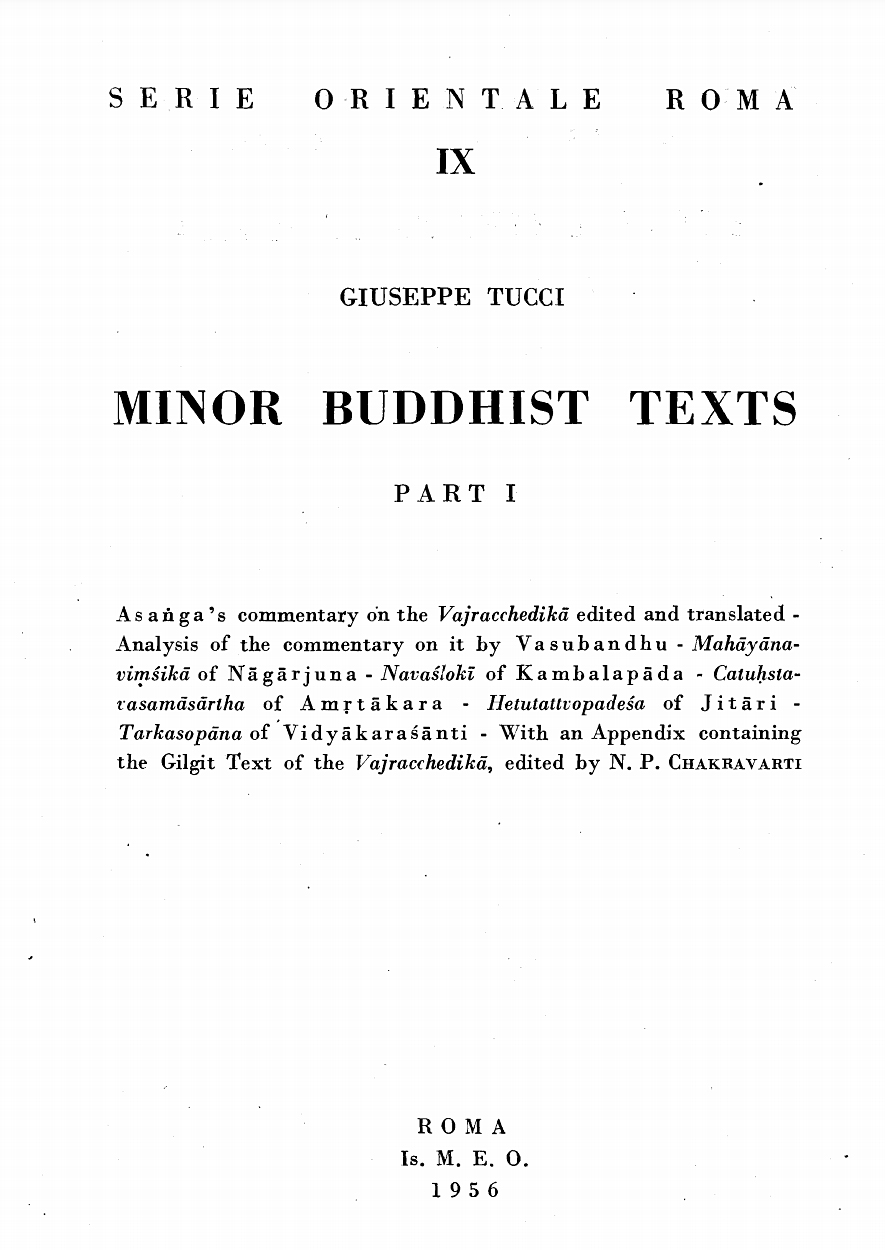
Contents of pt. 1 includes: Triśatikāyāḥ prajñāpāramitāyāḥ kārikāsaptatiḥ / Asaṅga--Mahāyānaviṁśikā / Nāgārjuna--Navaślokī / Kambalapāda--Catuḥstavasamāsārtha / Amr̥tākara--Hetutattvopadeśa / Jitāri--Tarkasopāna / Vidyākaraśānti / Vajracchedikā (Gilgit text).
Books1986About this item
Asaṅga's commentary on the Vajracchedikā edited and translated—Analysis of the commentary on it by Vasubandhu—Mahāyānaviṃśikā of Nāgārjuna—Navaślokī of Kambalapāda—Catuḥstavasamāsārtha of Amṛtākara—Hetutattvopadeśa of Jitāri—Tarkasopāna of Vidyākaraśānti—With an Appendix containing the Gilgit Text of the Vajracchedikā, edited by N. P. Chakravarti. First Bhāvanākrama of Kamalaśīla, Sanskrit and Tibetan Texts with Introduction and English Summary.
Books1971About this item
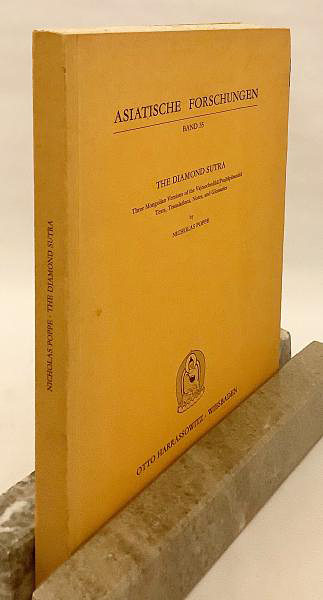
Contains the texts of three Mongolian versions of the Vajracchedikāprajñāpāramitāsūtra and their respective translations into English by Nicholas Poppe.
Articles1956About this item
A critical Sanskrit edition (Roman) of the Vajracchedikāprajñāpāramitāsūtra, edited by N. P. Chakravarti in Minor Buddhist Texts, Part 1. Edited by Giuseppe Tucci, 1956.
Articles1881About this item
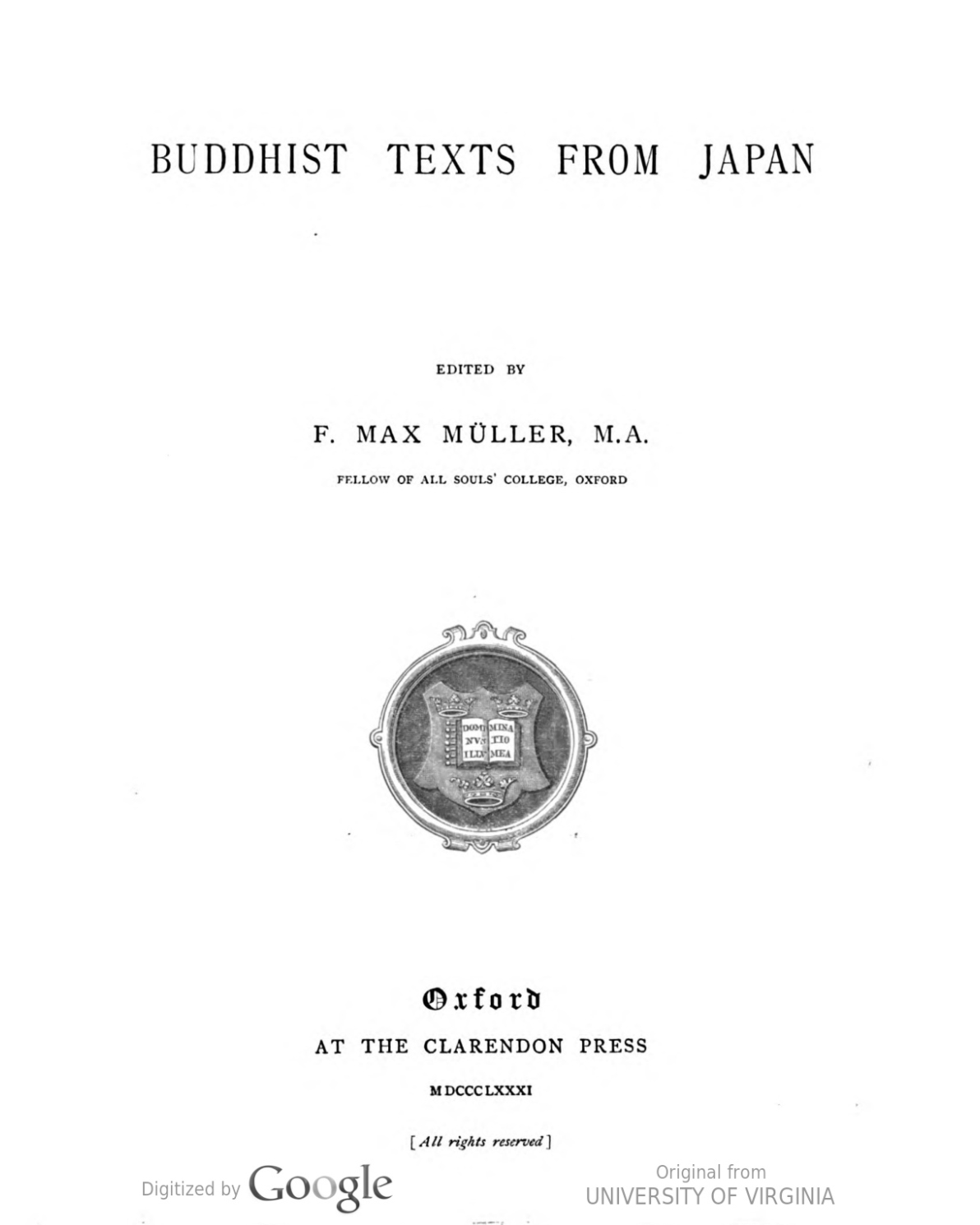
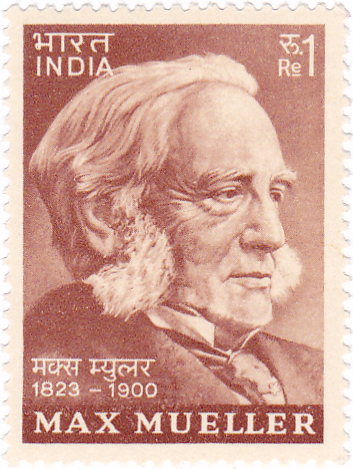
Critical Sanskrit edition of the Vajracchedikāprajñāpāramitāsūtra, edited by Max Müller 1881. Published as part 1 of 3 in the volume Buddhist Texts from Japan.
Books1974About this item
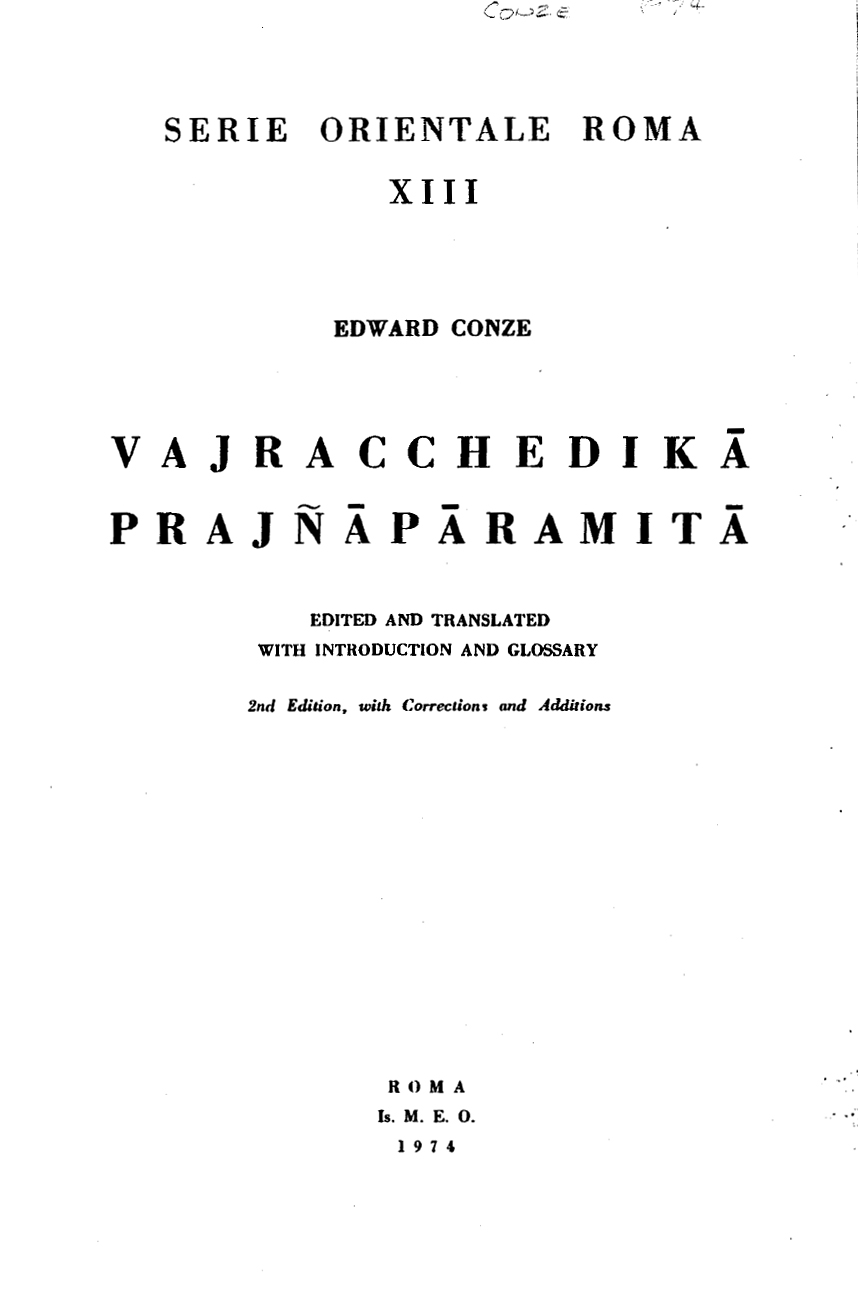
A critical Sanskrit edition and English translation of the Vajracchedikāprajñāpāramitāsūtra based on Max Müller's edition. English and Sanskrit; introd. in English.
Articles1959About this item
A critical Sanskrit edition of the Vajracchedikāprajñāpāramitāsūtra, edited by Nalinaksha Dutt, with the assistance of D. M. Bhattacharya and Shiv Nath Sharma, 1959.
Articles2006About this item
Among the MS remains of Mahāyāna texts in the Schøyen Collection a manuscript of the Vajracchedikā has been discovered comprising roughly three-fourths of the complete text which significantly adds to our knowledge of the Sanskrit text of this famous discourse. In "Vajracchedikā Prajñāpāramitā" (pp. 89–132) Paul Harrison and Shōgo Watanabe present an informative bibliographical survey, a description of the MS (date: ca. 6th–7th century) and of its relationship with other extant Vajracchedikā MSS, discuss its linguistic characteristics, then transliterate the text and finally reconstruct it. (Source: Bhikkhu Pāsādika, Review of Buddhist Manuscripts in the Schøyen Collection, Vol. III, Indo-Iranian Journal 52 (2009): 85)
Books1978About this item
A critical Sanskrit edition of the Vajracchedikāprajñāpāramitāsūtra, edited by Lal Mani Joshi and published by The Central Institute of Higher Tibetan Studies, 1978.
Articles1916About this item
A manuscript of the Vajracchedikāprajñāpāramitāsūtra edited by F. E. Pargiter, in A. F. Hoernle's Manuscript Remains of Buddhist Literature Found in Eastern Turkestan. .
Articles1840About this item
One of the earliest Western academic treatments of Mahāyāna Buddhist doctrine, by the German-Baltic orientalist and Mongolist Isaac Jacob Schmidt (1779–1847), based on his work with Tibetan and Mongolian Buddhist sources at the Imperial Academy of Sciences in St. Petersburg. The essay introduces the Mahāyāna as a doctrinal category and the Prajñāpāramitā teaching of emptiness (śūnyatā), which Schmidt renders into German as Leere ("emptiness") rather than Nichts ("nothingness")—an unusually careful interpretive choice for its time, later cited approvingly by Arthur Schopenhauer as a valuable early introduction to Buddhist thought. Schmidt then singles out the Vajracchedikā Prajñāpāramitā Sūtra (Diamond Sūtra)—Tibetan Rdo rje gcod pa—as a Mahāyāna sūtra devoted exclusively to the Prajñāpāramitā teaching, and, owing to its brevity, well suited to introducing the doctrine to a wider audience. He accordingly presents the Tibetan text of the sūtra in full alongside his own German translation, making this one of the earliest translations of the Diamond Sūtra into a European language directly from Tibetan. The translation opens with the sūtra's frame narrative—the Buddha's alms round in Śrāvastī before the assembled saṅgha and bodhisattvas—and proceeds through the philosophical dialogue with Subhūti at the heart of the text.
38 Full translations
Books1938About this item
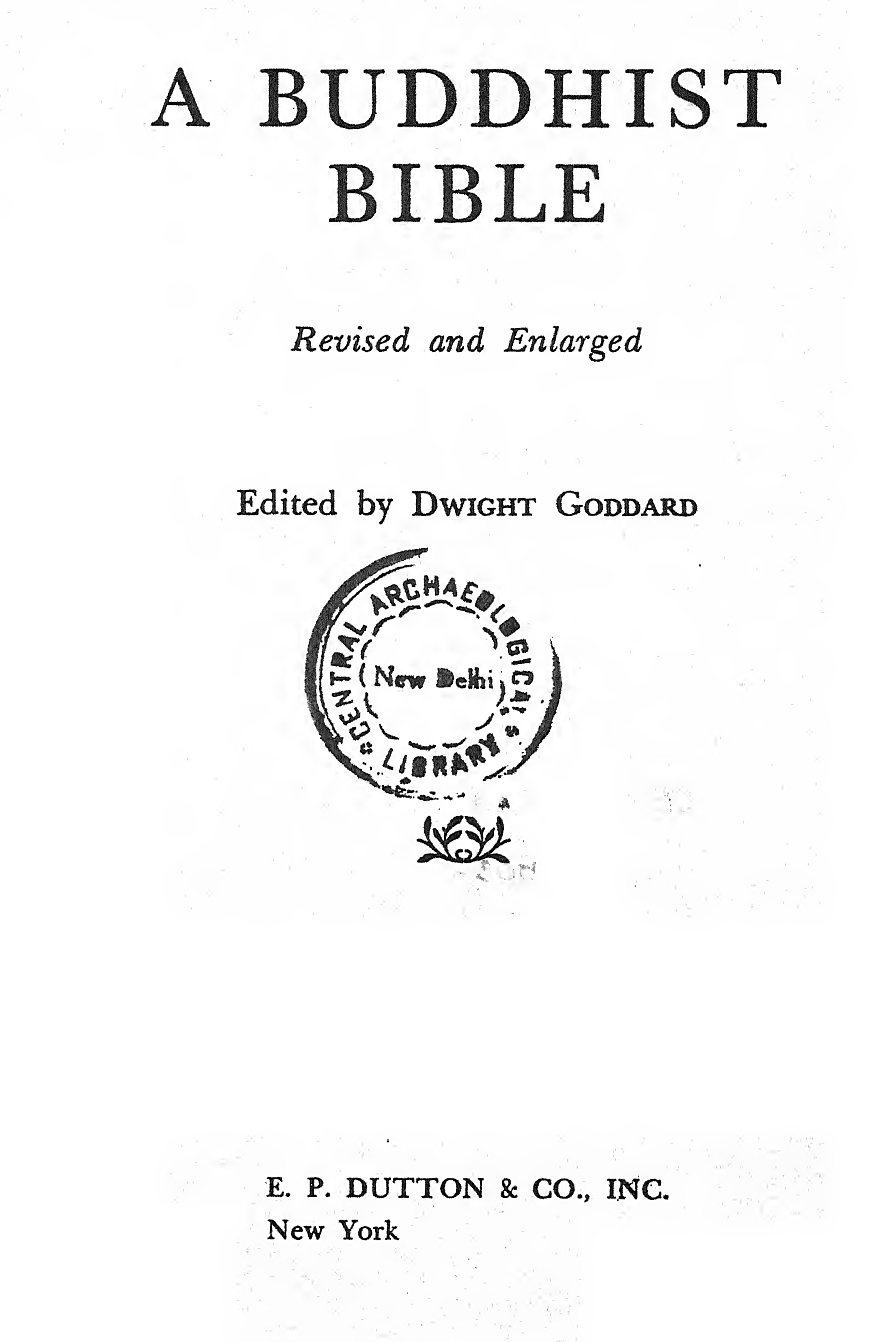
This early Western publication on Buddhism includes mention of the concept of buddha-nature 19 times. Thus this work would have been one of the few English publications at the time to mention buddha-nature by name. What follows is Goddard's preface to the book.

The first edition of this Buddhist Bible was published in 1932. When the need of a new edition became evident, it was decided to enlarge it so as to include other Scriptures of like importance so as to make it more comprehensive. This involved making a number of new translations for which we are indebted to Bhikshu Wai-tao. We are also indebted and are very grateful to a number of other Buddhist Scholars for permission to use their translations, as noted in the Appendix.
      The compiling of a Buddhist Bible is a very different matter from compiling the Christian Bible. In the first place, there is no Hierarchy or Ecclesiastic Council to pass upon the authenticity of different scriptures, and as to their canonicity. In the second place, Christian Scriptures are a closed system of doctrines and dogmas that have been inspired by the Holy Spirit and are to be accepted in faith. Buddhism, on the contrary, is looked upon as a growing organism whose scriptures are of many kinds as the organism has developed under different racial, temporal and cultural conditions. As disciples follow the Buddha's Noble Path and practice dhyana concentration and intuitive meditation they have an unfolding experience of spiritual insight and grace which any one of them may describe and elucidate. Some of these expediences are of highest value, some of less value. Some are concerned with the Dharma, some have to do with the rules of the Brotherhoods, some are philosophical, some psychological, some are commentaries and some are commentaries on commentaries. In the third place, there is the difference of quantity. In the Christian Bible there are sixty-six titles; Buddhist scriptures number over ten thousand, only a fraction of which have thus far been translated. In the Sung Dynasty about 972 AD a Chinese version of these scriptures was published consisting of 1521 works, in more than 5000 volumes, covering 130,000 pages.
      The nearest approach to canonicity is the Pali Tripitika. That was the earliest collection and was supposed to be limited to the words of Buddha. Southern Buddhists are passionately devoted to these Pali Scriptures and are inclined to disparage and dispute the more philosophical scriptures of the Northern School that developed later after Buddhism had come in contact with other world religions in Persia, Palestine, Egypt and Greece. Under these conditions there developed in Northern India, and Kashgar, a succession of very able minds, Ashvaghosha, Nargajuna, Vasobandhu and his brother Asangha from whose writings and teachings there developed various important schools of philosophical thought that profoundly changed the understanding of Buddha's Dharma.
      Later on as Buddhism spread into China and came under the influence of its immemorial culture and practical good sense, it took on forms of Taoist naturalism and kindly humanism, and there developed forms of "salvation by faith in Amitabha's mercy" and rebirth in his Pure Land. While in Tibet, coming in contact with its ancient Bon religion, and under the climatic conditions of its high altitudes, it took on forms of strenuousness and magic and tantric conceptions. Later on in Japan owing to political and social conditions incident to the presence of a limited but powerful noble class dominating a suppressed peasantry, which had developed extremes of loyalty and obedience and self-control, it took on forms of concentrative meditation known as Zen, and a still more widely divergent type of the True Pure Land Sect.
      Naturally among these diverse conditions Buddhist scriptures vary widely, and the quantity of them being so enormous, they have become segregated into different groups as they are favored by different schools of thought and practice. The Tien-tai favor the more philosophical scriptures, the Shingon, the more esoteric, the Ch’an (Zen), the more intellectual, and the Pure Land, the more emotional. The present editor has been guided in his selection of scriptures for this Buddhist Bible by a sincere purpose to make the selection as comprehensive as possible within its limits and to represent as truly as possible the original teachings of the Blessed One both as understood by the Southern and more primitive school and by the Northern and more philosophical interpreters. He has also humbly tried to have the choice vouched for by his own spiritual experience in his practice of the Noble Path and especially during its Eighth Stage of intuitive Dhyana.
      It follows, therefore, that the scriptures thus selected are the generally accepted scriptures of the Dhyana Sects—Ch’an in China, Zen in Japan and Kargyupta in Tibet. Of course among so enormous a collection of scriptures there are others that are favorites also, notably the Saddharma-pundarika (Lotus of the Perfect Law), and the Avatamsaka, said to be the grandest religious document ever written, but these are very large books in themselves. The late W. E. Soothil of London left a very careful translation of the Lotus that still waits a publisher. Dr. Suzuki of Kyoto has made a translation of the Gandhavyuha sections of the Avatamsaka that is now in process of being published. The inclusion of Laotzu’s Tao-teh-king is open to question as it is not strictly a Buddhist text, but its teaching has such a close affinity to Buddhist teaching and nearly all early Chinese Masters of Buddhism were Taoist scholars who, upon becoming Buddhists, did not give up their Taoist conceptions and terms, and because the Laotzuan teaching in the Tao-teh-king has had such a wholesome influence on the development of Chinese Buddhism, and, in later years, wherever the Tao-teh-king is held in reverence, it has tended to restrain individual pride of egoism, religious ceremonial, ecclesiasticism, priestcraft and insincerity generally, we make no apology for including it. In fact, it is our earnest wish that the Tao-teh-king may become one of the foundation stones of American and European Buddhism.
      Further introductory notes are reserved for the Appendix under the heads of the individual Scriptures, as are also -grateful appreciation to those who have contributed to the preparation and publication of this Bible, especially to those Buddhist scholars who have courteously granted the Editor permission to use their translations for this purpose
      Just a closing word as to the rules that have guided the Editor in his choice and handling of textual material. He has always kept in mind the spiritual needs of his readers. This Buddhist Bible is not intended to be a source book for critical literary and historical study. It is only intended to be a source of spiritual inspiration designed to awaken faith and to develop faith into aspiration and full realization. The original texts having for centuries been carried in memory and transcribed by hand by scribes who were often more loyal to their Master than to historical exactness, are often overloaded with interpolations and extensions, and in places are confused and obscure. To carry out the design of the Editor, he has omitted a great deal of matter not bearing directly upon the theme of the particular Scripture, and has interpreted occasionally where it seemed necessary and advisable, in order to provide an easier and more inspiring reading. The need for this course will become apparent to every earnest minded disciple.
      In these days when Western civilization and culture is buffeted as never before by foreboding waves of materialism and selfish aggrandisement both individual and national, Buddhism seems to hold out teachings of highest promise. For two thousand years Dhyana Buddhism has powerfully conditioned the cultural, ethical and spiritual life of the great Oriental nations. It well may be the salvation of Western civilization. Its rationality, its discipline, its emphasis on simplicity and sincerity, its thoughtfulness, its cheerful industry not for profit but for service, its love for all animate life, its restraint of desire in all its subtle forms, its actual foretastes of enlightenment and blissful peace, its patient acceptance of karma and rebirth, all mark it out as being competent to meet the problems of this excitement loving, materialistic, acquisitive and thoughtless age.
      Its basic principle of an eternal process based on unchanging law and operating in eternal recurrence, leading to mind-control, to highest cognition, to purest conceptions of love and compassion, to ever clearing insight, to highest perfect wisdom, to the self-giving of Bodhisattvas, and Buddhas, to blissful peace, is worthy of confidence; and its Noble Path worthy of

trial.
      The theme of this Buddhist Bible is designed to show the unreality of all conceptions of a personal ego. Its purpose is to awaken faith in Buddhahood as being one’s true self-nature; to kindle aspiration to realize one’s true Buddha-nature; to energize effort to follow the Noble Path, to become Buddha. The true response to the appeal of this Buddhist Bible is not in outward activities, but in self-yielding, becoming a clear channel for Buddhahood's indrawing compassion, that all sentient beings may become emancipated, enlightened and brought to Buddhahood. (Goddard, preface, v–viii)
Books1965About this item
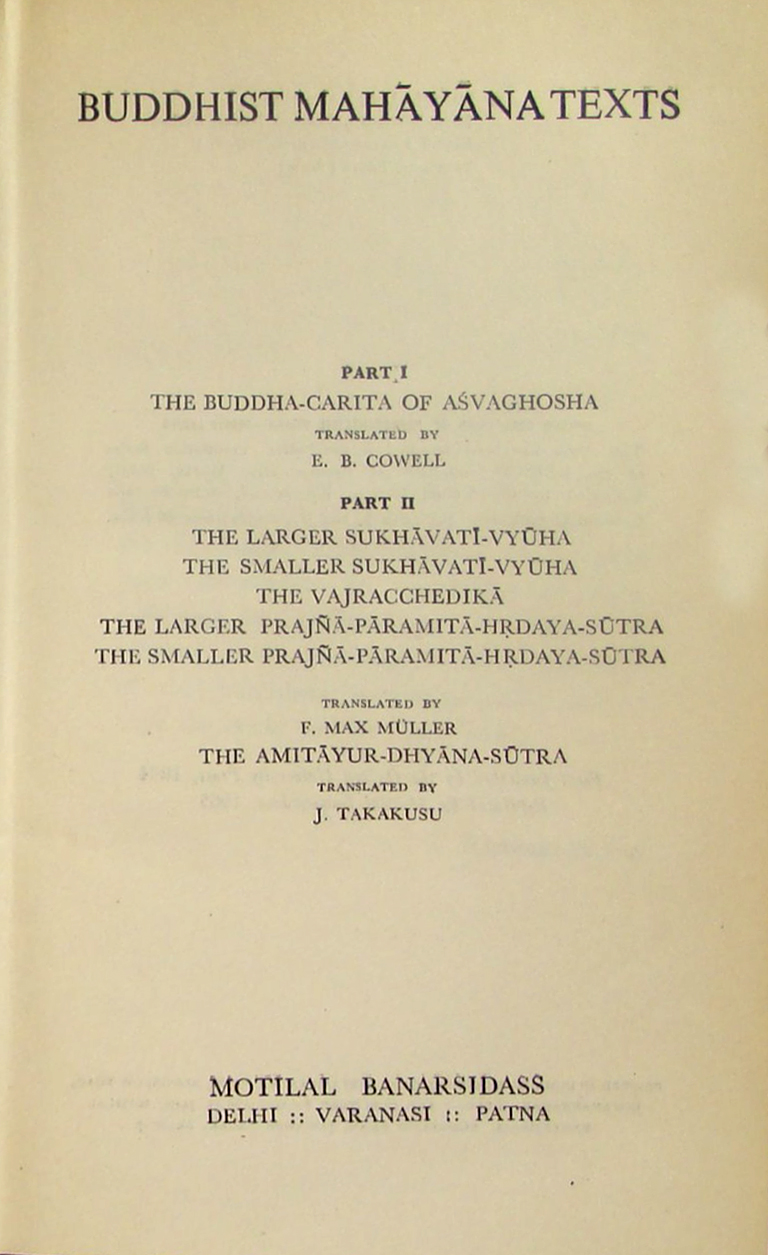
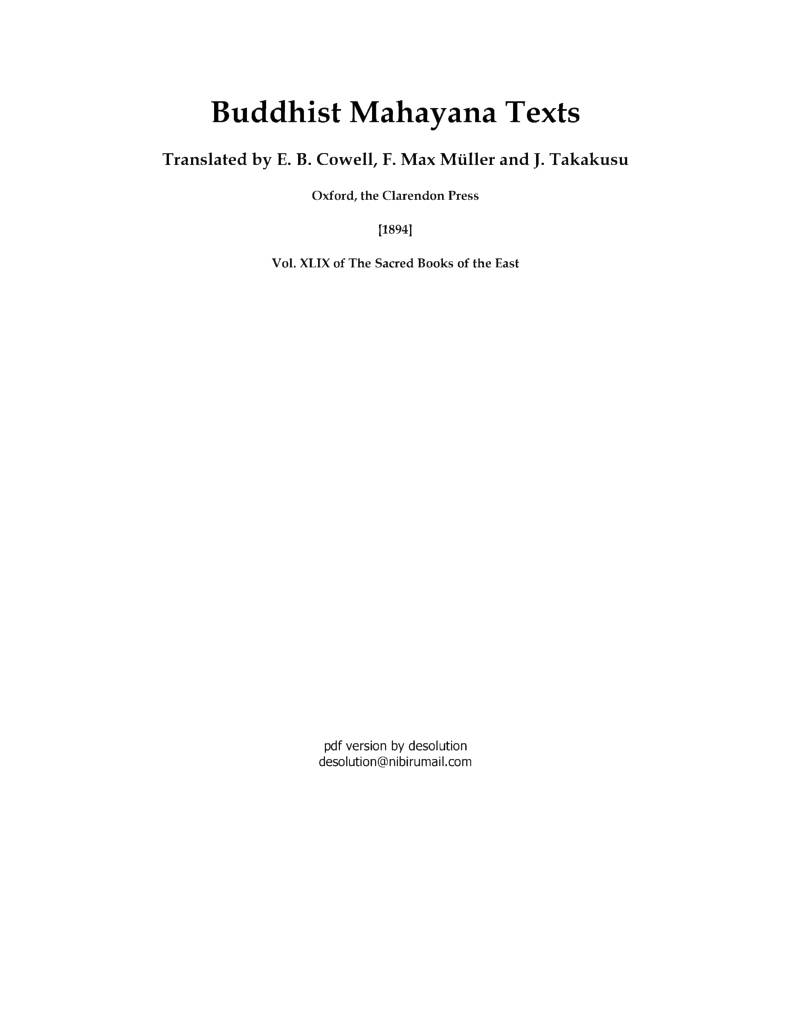
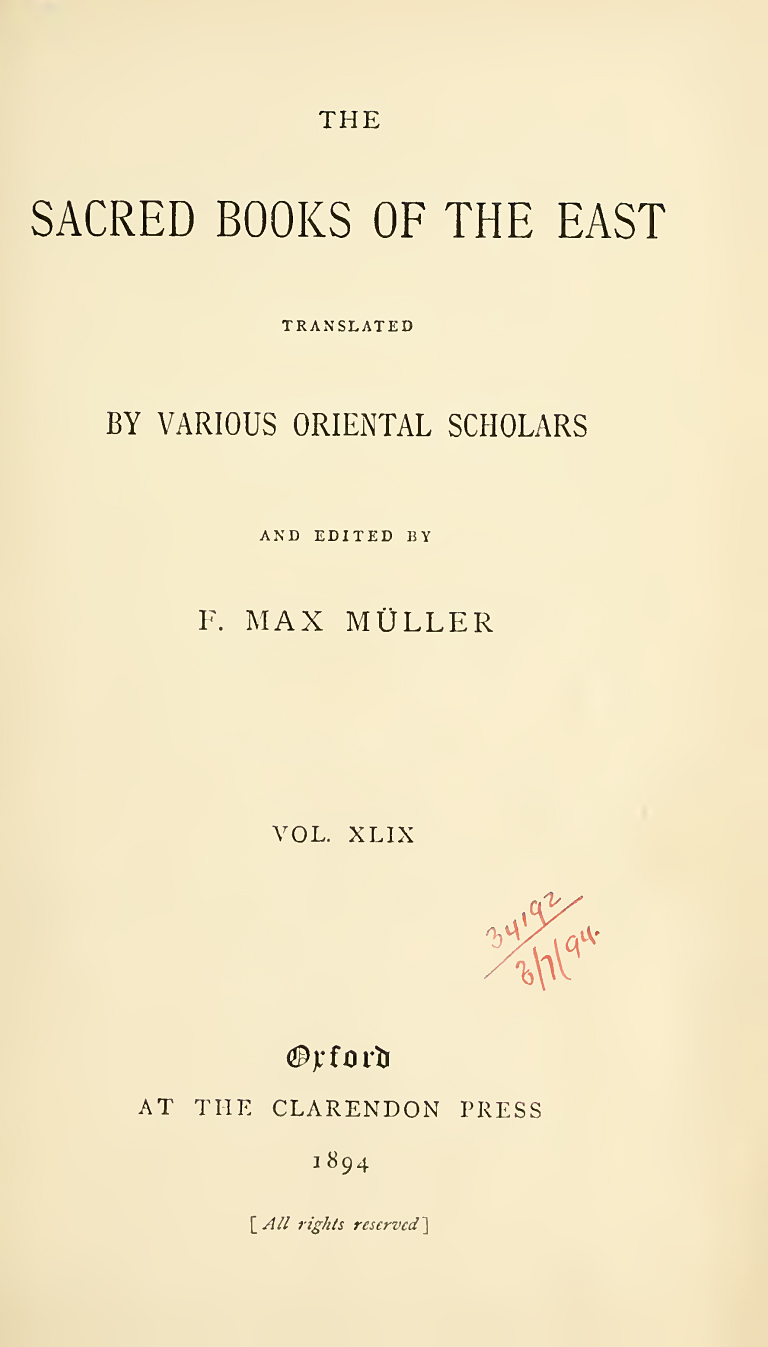
Buddhist Mahayana Texts, edited and translated by E.B. Cowell, F. Max Müller, and J. Takakusu, is Volume 49 of the Sacred Books of the East series. Originally published in 1894 by Clarendon Press, it includes foundational early English translations of key Sanskrit and Chinese Mahayana scriptures.
BooksndAbout this item
Buddhist Mahayana Texts, edited and translated by E.B. Cowell, F. Max Müller, and J. Takakusu, is Volume 49 of the Sacred Books of the East series. Originally published in 1894 by Clarendon Press, it includes foundational early English translations of key Sanskrit and Chinese Mahayana scriptures.
Books1894About this item
Two Volumes in One:

Part. I, (1-207) The Buddha-karita of Asvaghosha, translated from the Sanskrit by E.B. Cowell.

Part. II, (1-203) The larger Sukhâvatî-vyûha, the smaller Sukhâvatî-vyûha, the Vagrakkhedikâ, the larger Pragñâ-pâra-mitâ-hridaya-sûtra, the smaller Pragñâ-pâramitâ-hridaya-sûtra, translated by F. Max Müller. The Amitâyur-dhyâna-sûtra, translated by J. Takakusu.

The texts of Part. II are translated from the Sanskrit, except the Amitâyur-dhyâna-sûtra, which is from a Chinese translation. (Source Accessed Aug 16, 2021)
Books1972About this item
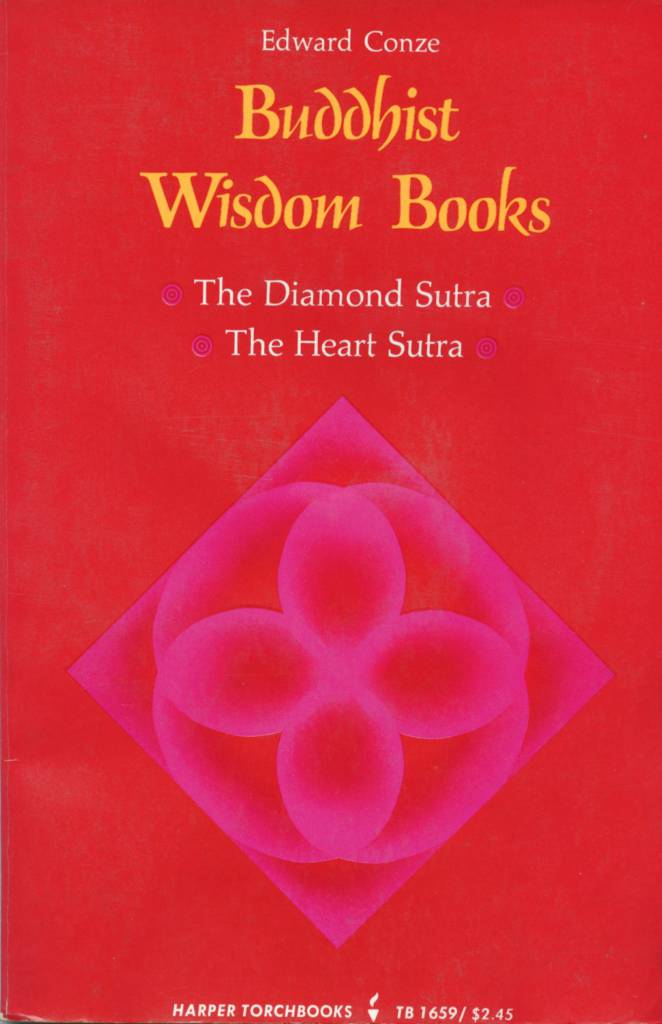
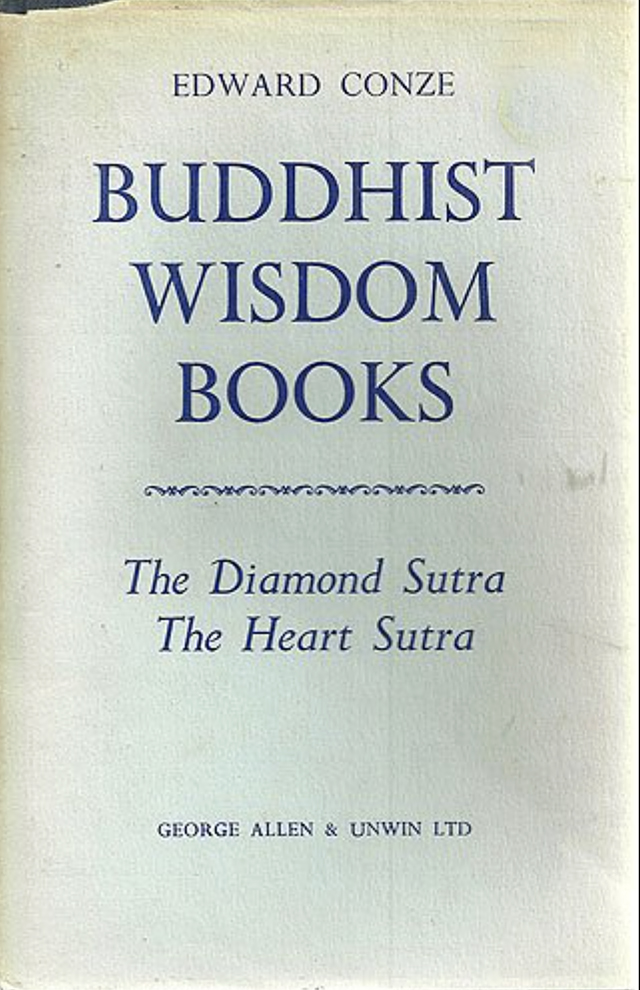
A landmark publication which offers Western readers a unique combination of what Buddhists worldwide consider the holiest of holy texts, The Diamond Sūtra and The Heart Sūtra
Books1958About this item
A landmark publication which offers Western readers a unique combination of what Buddhists worldwide consider the holiest of holy texts The Diamond Sutra and The Heart Sutra, two sutras, or scriptures, ascribed to the early centuries of the first millennium.

The Diamond Sutra, or the Perfection of Wisdom, which cuts like a thunderbolt, is one of the cornerstone texts of Mahayana Buddhism and provides a summary of the core concepts of the Buddha. The Heart Sutra, perhaps the most important of all Buddhist texts, sets out to formulate the very heart, or essence of perfect wisdom and is studied with special reverence in Zen monasteries and the Tibetan Buddhist lamaseries.

Edward Conze, who was until his death in 1979 a powerful force for introducing Buddhism and its sacred texts to the West, has provided these translated key texts with an extensive commentary for the easiest possible appreciation phrase by phrase. (Source Accessed Aug 16, 2021)
Books1970About this item
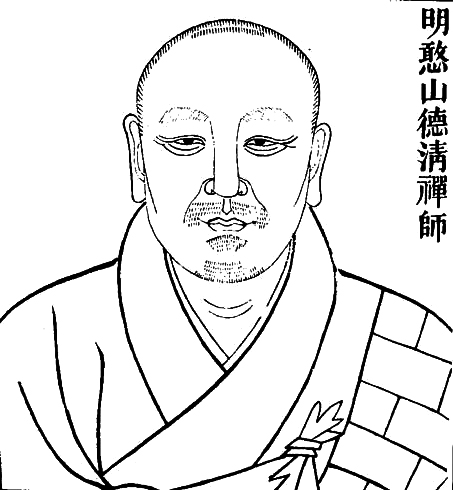
The first volume contains - The practice as taught by the Venerable Hsu Yun, the best-known modern Ch'an Master. It elaborates upon the technique known as hua t'ou which is taught in Japanese zendos; six representative stories (kung-ans) of Ch'an Masters are translated from the Imperial Selection of Ch'an Sayings. Each kung-an is fully explained so that it makes sense to the uninitiated; a translation of the Diamond and Heart Sutras with the Commentary of Ch'an Master Han Shan. (Source Accessed Apr 19, 2022)
Books1993About this item
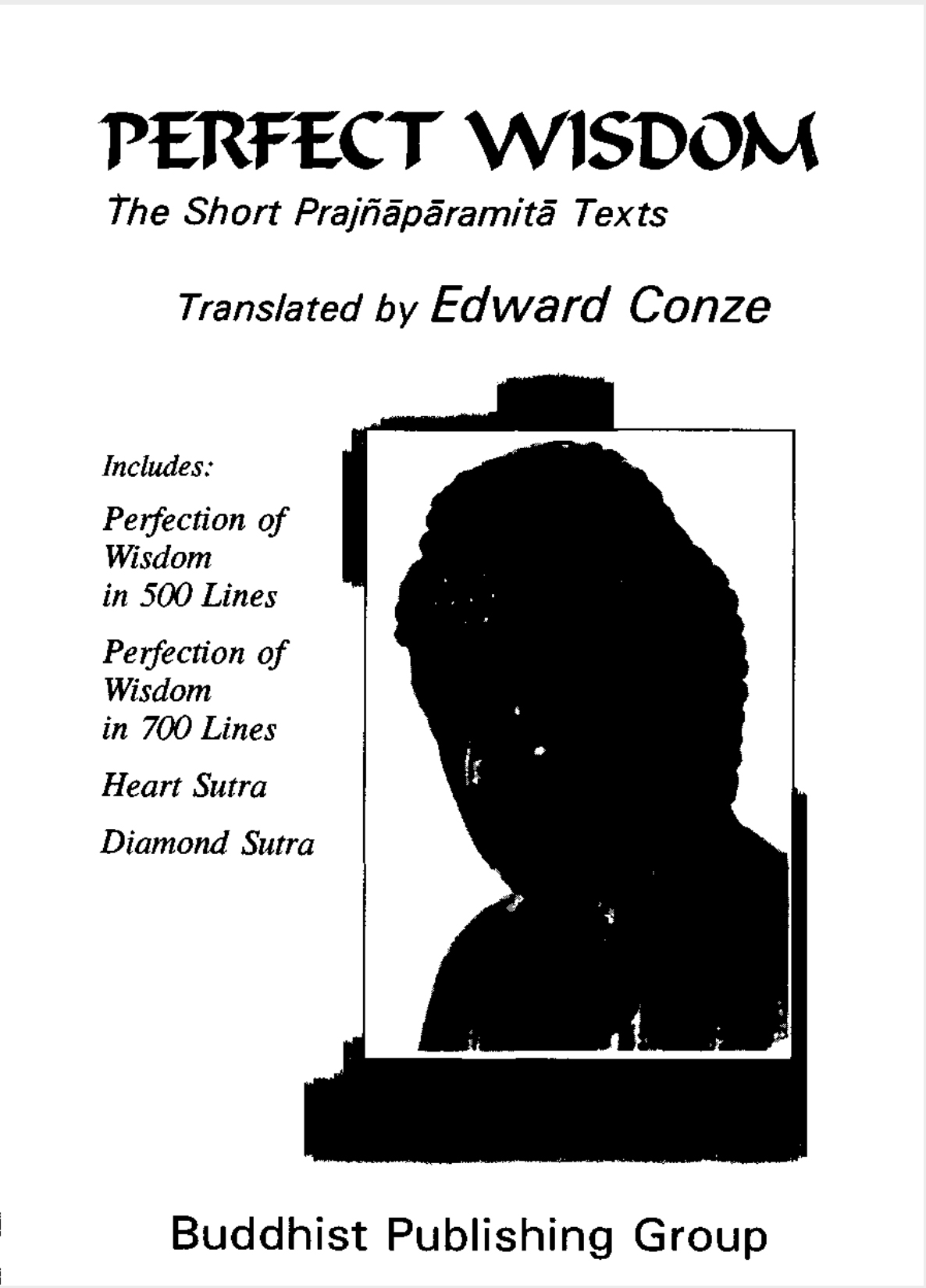
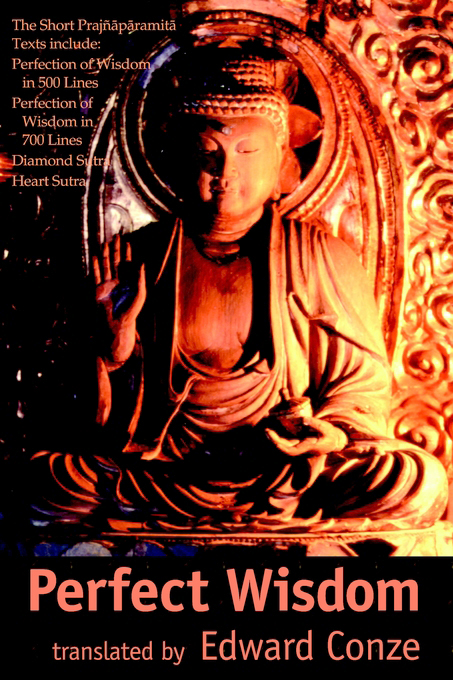
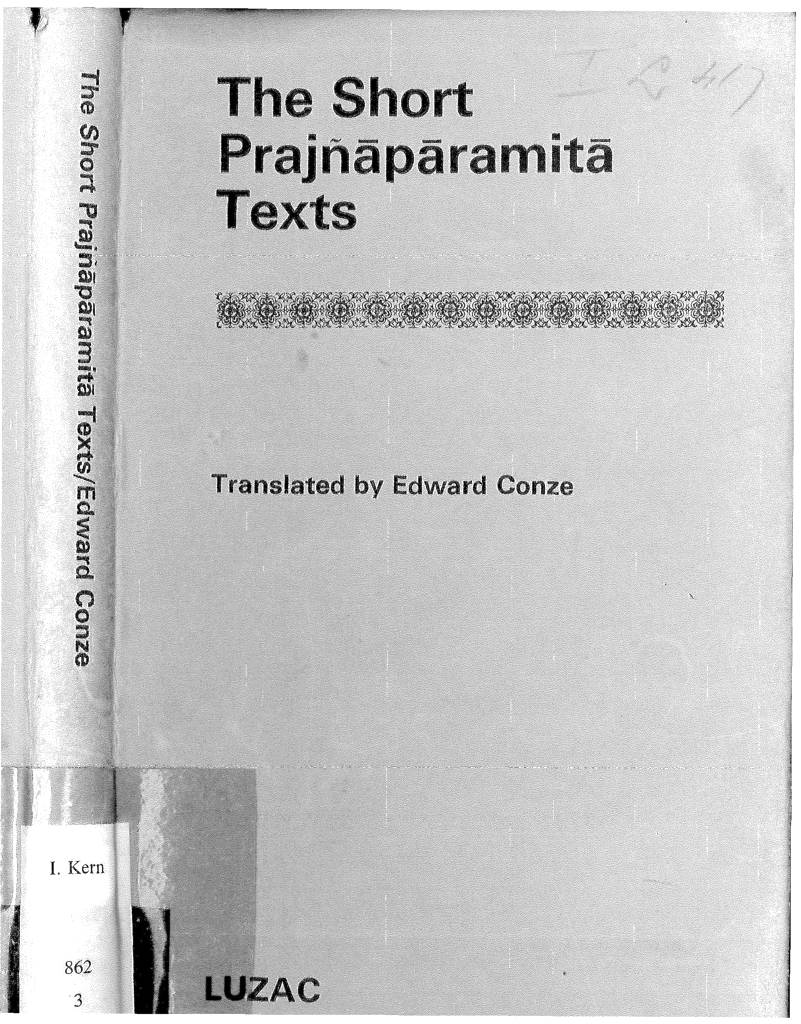
The prajñāpāramitā texts were composed in India between approximately 100 BC and AD 600. Those contained within this volume, of about forty texts, are among the shorter ones; they are also some of the most well known such as The Heart Sutra, Perfection of Wisdom in 500 lines, The Diamond Sutra, The Questions of Suvikràntavikràmin, and Perfection of Wisdom in 700 lines. (Buddhist Publishing Group)
Books2002About this item
The prajñāpāramitā texts were composed in India between approximately 100 BC and AD 600. Those contained within this volume, of about forty texts, are among the shorter ones; they are also some of the most well known such as The Heart Sutra, Perfection of Wisdom in 500 Lines, The Diamond Sutra, The Questions of Suvikrantavikramin, and Perfection of Wisdom in 700 Lines. (Buddhist Publishing Group)
Books2001About this item
A French translation of the Diamond Sūtra and other Mahāyāna sūtras by Philippe Cornu and Patrick Carré.
Books1983About this item
A compilation of fourteen Sanskrit Buddhist texts translated into Italian, including the Bodhicaryāvatāra. Edited by Raniero Gnoli.
Books2020About this item
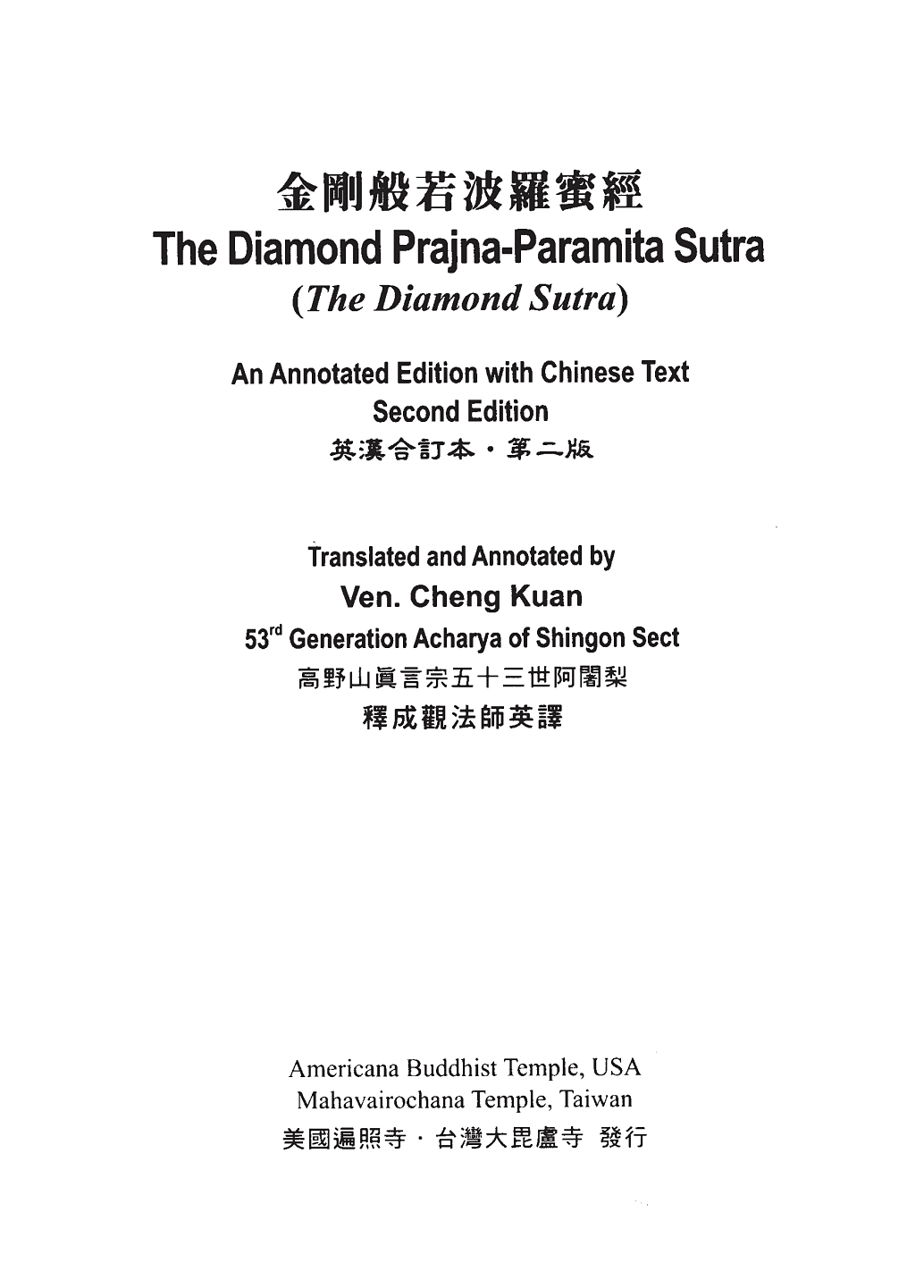
An English translation of the Vajracchedikāprajñāpāramitāsūtra by the Chung Tai Translation Committee from the Chinese edition of Kumārajīva, T235.
Books1912About this item
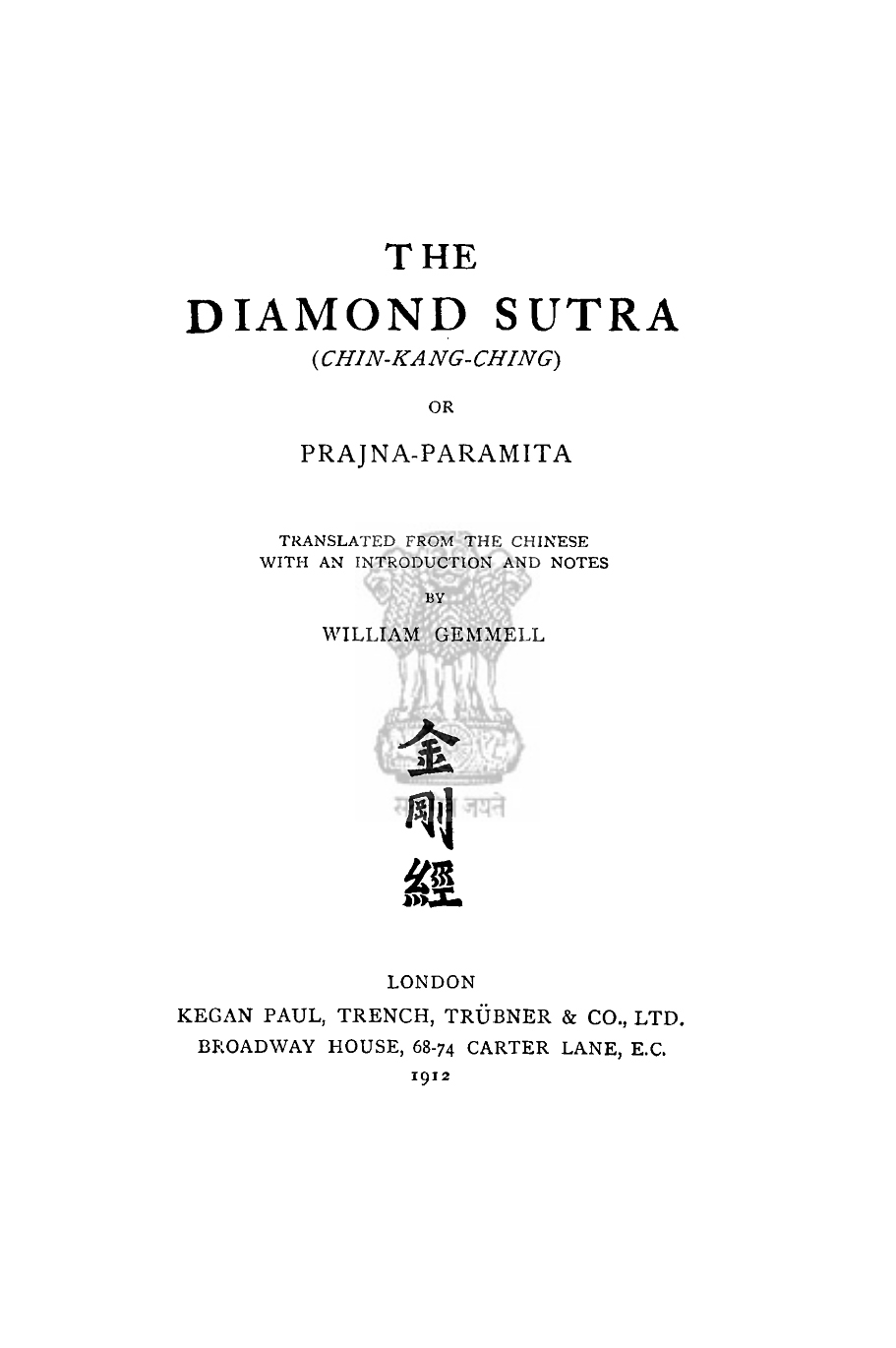
An English translation of the Diamond Sutra, translated from the Chinese text of Kumārajīva, by William Gemmell.
Articles1973About this item
This is an English translation of the Vajracchedikāprajñāpāramitāsūtra by Edward Conze, a reprint of his second translation made in 1973.
Books1974About this item
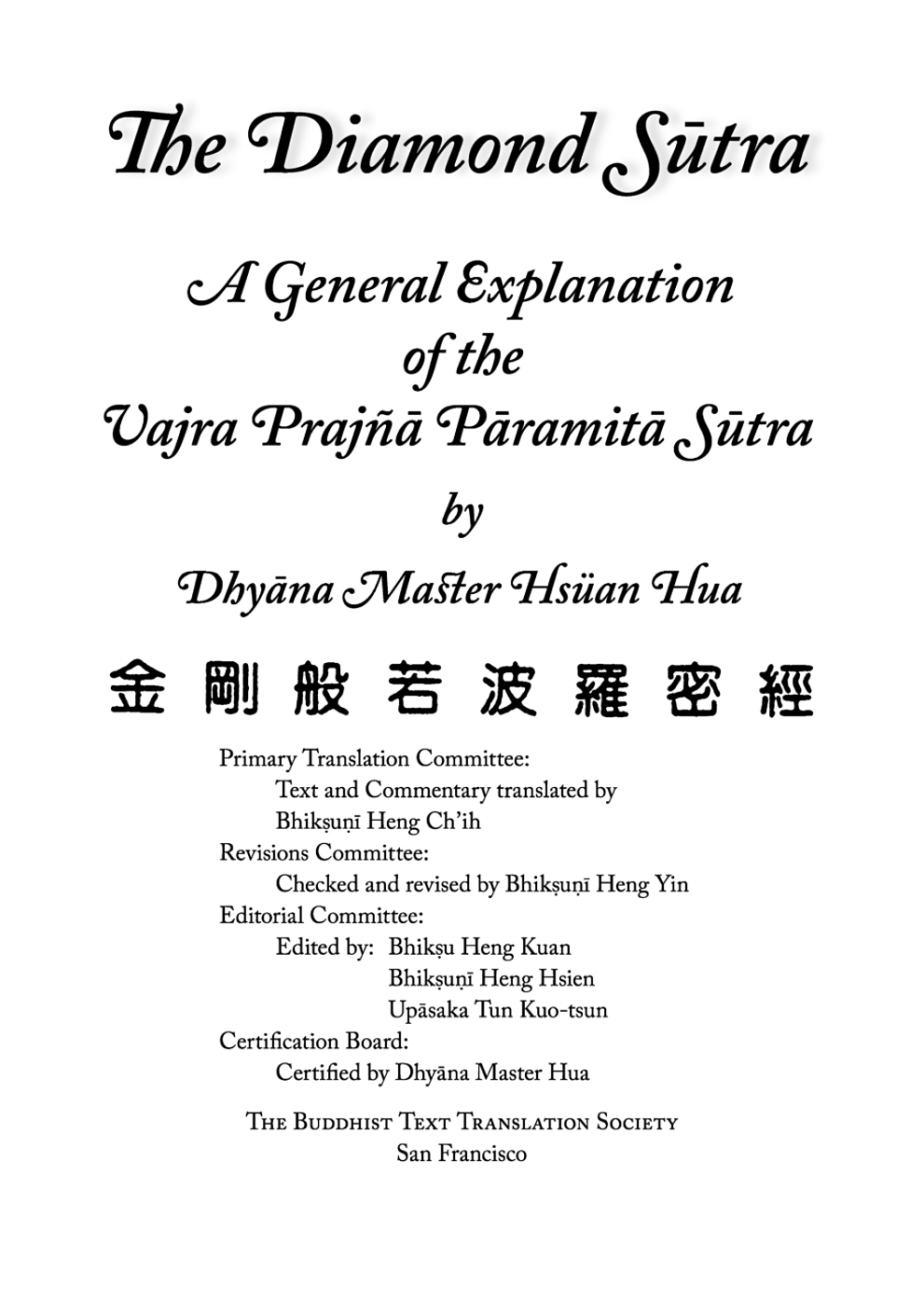
This is an English translation and general explanation of the Diamond Sūtra by Master Hsüan Hua, translated by Bhikṣuṇī Heng Ch'ih of the Buddhist Text Translation Society.
Books1971About this item
Contains the texts of three Mongolian versions of the Vajracchedikāprajñāpāramitāsūtra and their respective translations into English by Nicholas Poppe.
Articles1938About this item
An English translation of the Vajracchedikāprajñāpāramitāsūtra made by Bhikshu Wai-tao and Dwight Goddard in 1935 from Kumārajīva's Chinese translation.
Books1973About this item
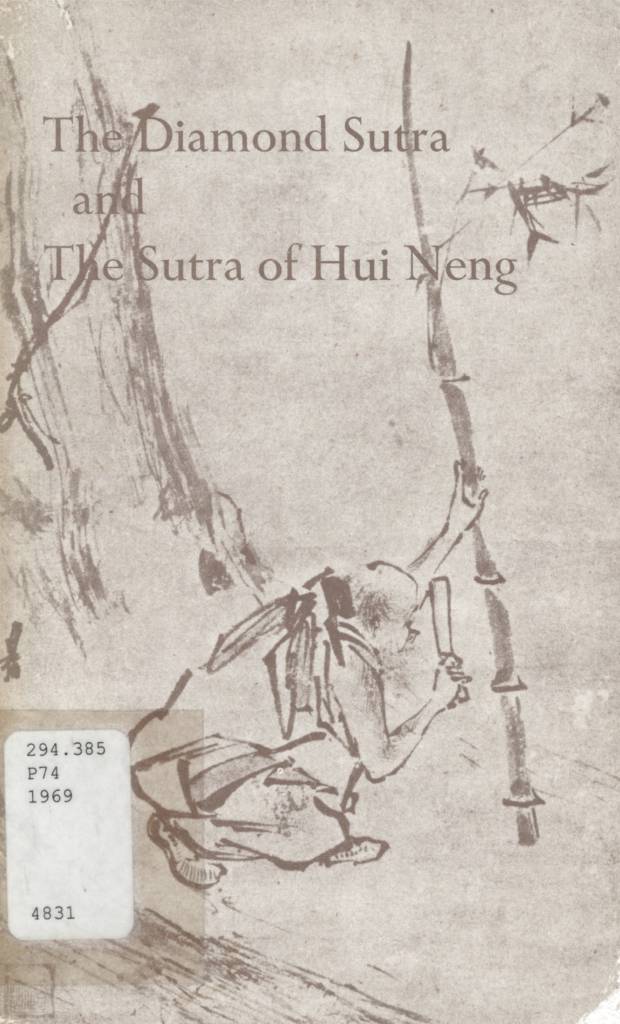
An English translation of the Diamond Sūtra together with the Sūtra of Hui-neng, also known as the Platform Sūtra, by A. F. Price and Wong Mou-Lam.
Books2001About this item
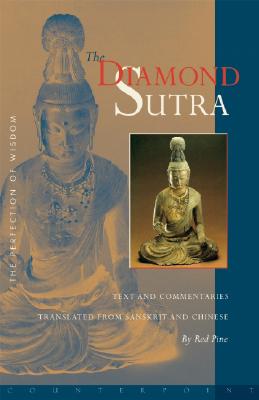
Red Pine's English translation of the Diamond Sūtra based on six extant Chinese translations of the text and in consultation with two Sanskrit editions by Conze and Müller.
Books2000About this item
In this translation and commentary on the Diamond Sutra, Mu Soeng integrates this ancient wisdom teaching with current scientific and psychological thought.
Books2010About this item
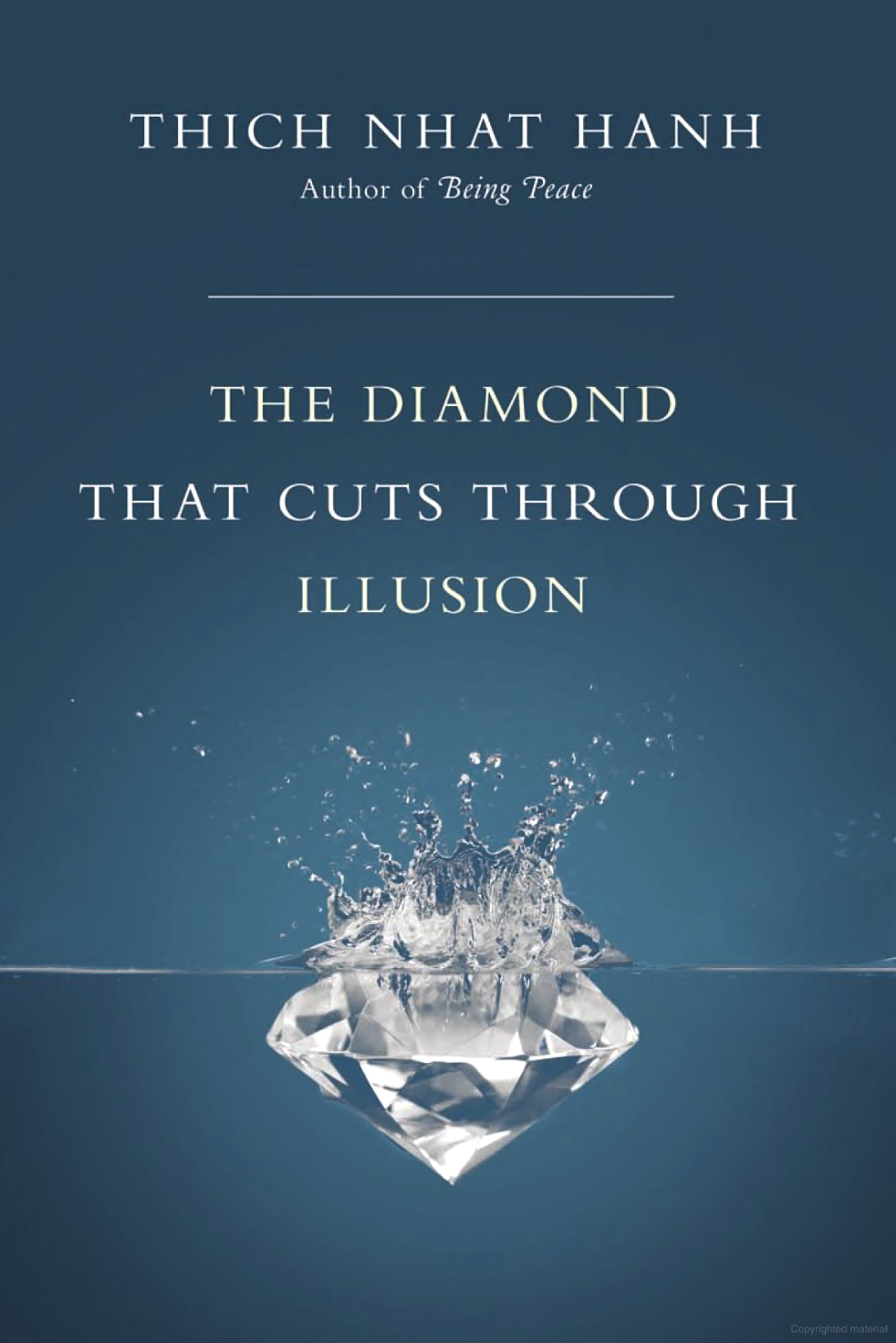
This revised edition includes Thich Nhat Hanh's translation of the Diamond Sutra from the Chinese and new work on its environmental implications.
Articles2004About this item
A translation of the Diamond Sūtra by Gregory Schopen from the mauscript found at Gilgit, reprinted as "The Perfection of Wisdom" in Buddhist Scriptures, edited by Donald S. Lopez, Jr.
Books1973About this item
The prajñāpāramitā texts were composed in India between approximately 100 BC and AD 600. Those contained within this volume, of about forty texts, are among the shorter ones; they are also some of the most well known such as The Heart Sutra, Perfection of Wisdom in 500 lines, The Diamond Sutra, The Questions of Suvikràntavikràmin, and Perfection of Wisdom in 700 lines. (Source: Buddhist Publishing Group)
Articles1894About this item
No abstract given. Here are the first relevant paragraphs:

In order to make this collection of Mahâyâna works more complete and useful to students in Japan I have added a translation of the Vajrakkhedikâ, which is much studied in Japan, and the Sanskrit text of which was published by me in an editio princeps—in the Anecdota Oxoniensia, 1881.
      The Vajrakkhedikâ, or the Diamond-cutter, is one of the most widely read and most highly valued metaphysical treatises in Buddhist literature. In Japan the Vajrakkhedikâ and the Pragñâpâramitâhṛdaya are read chiefly by the followers of the Shin-gon sect, founded by Kô-Bô, the great disciple of the famous Hiouen-thsang, in 816 A. D. The temples of this sect in Japan amount to 12,943. Written originally in Sanskrit, it has been translated into Chinese, Tibetan, Mongol, and Mandshu. Its full title is Vajrakkhedikâ Pragñâ-pâramitâ, i.e. the Diamond-cutter, the perfection of wisdom, or, as it has sometimes been rendered, 'the Transcendent Wisdom.' Mr. Bunyiu Nanjio in his Catalogue of the Tripiṭaka, p. I, has shown that it forms the ninth section of the Mahapragñâ-pâramitâ-sûtra, and that it agrees with the Tibetan translation of the text in 300 ślokas.
      An account of the Tibetan translation was given as far back as 1836 by Csoma Körösi in his Analysis of the Sherchiu, the second division of the Kanjur, published in the Asiatic Researches, vol. xx, p. 393 seq. Our text is there described as the Diamond-cutter or the Sutra of wonderful effects, in which Sâkya in a colloquial manner instructs Subhûti, one of his principal disciples, in the true meaning of the Pragñâ-pâramitâ. The Tibetans., we are told, pay great respect to this Sûtra, and copies of it are found in consequence in great abundance[1].
      The first Chinese translation[2] is ascribed to Kumâragîva of the latter Tsin dynasty (A.D. 384-417). An English translation of this Chinese translation was published by the Rev. S. Beal in the Journal of the Royal Asiatic Society, 1864-5.
      There are several more Chinese translations, one by Bodhiruki (A. D. 509), one by Paramârtha (A. D. 562), one by Hiouen-thsang (A. D. 648), one by I-tsing (A. D. 703), one by Dharmagupta of the Sui dynasty (A. D. 589-618).
      The text and German translation of the Tibetan translation were published in 1837 by M. Schmidt in the Mémoires de I'Académie de St. Petersbourg, tom. iv, p. 186.
       The Mongolian translation was presented by the Baron Schiling de Canstadt to the Library of the Institut de France.
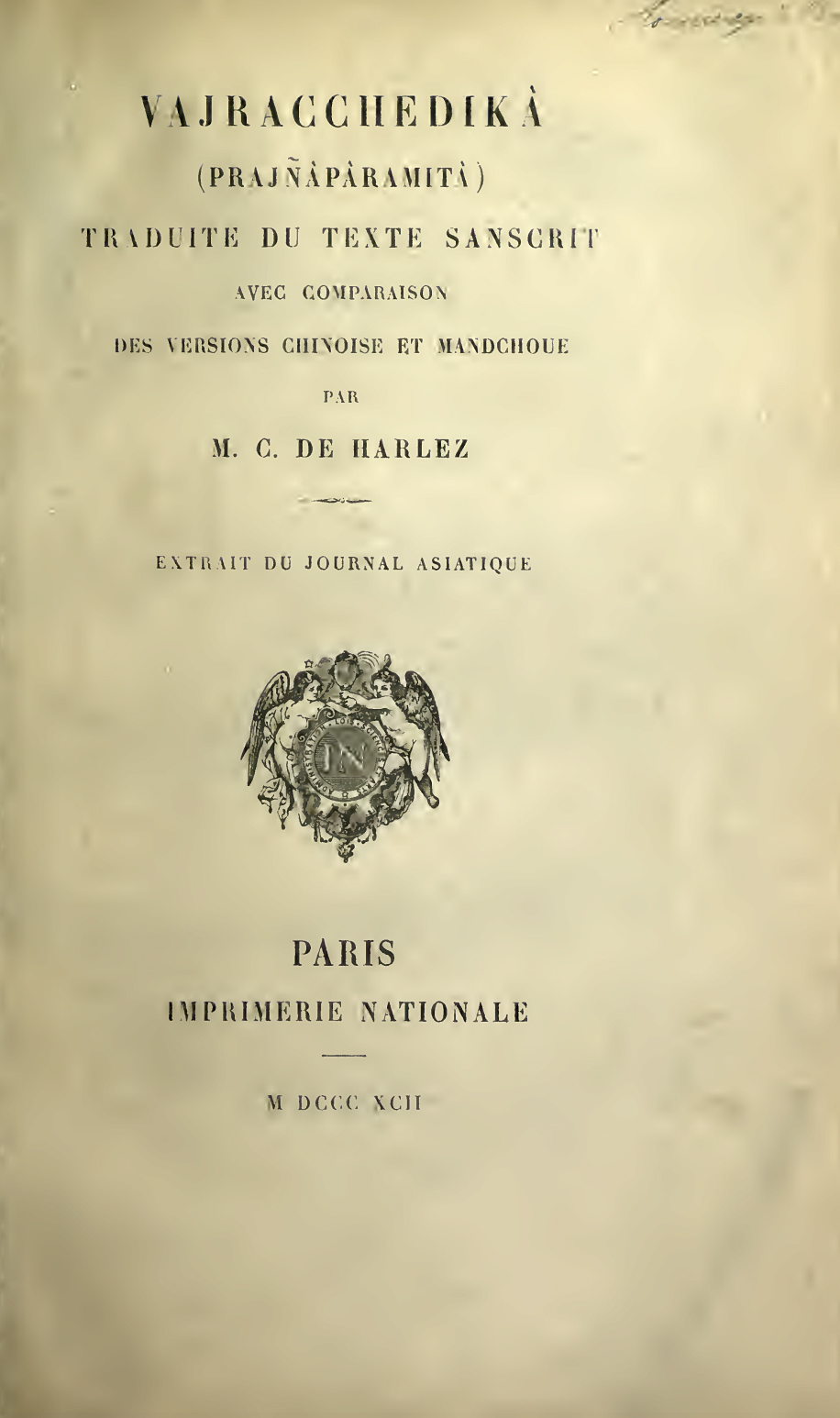
      The Mandshu translation is in the possession of M, de Harlez, who with the help of the Tibetan, Mandshu, and Chinese versions has published a valuable French translation of the Sanskrit text of the Vagrakkhedikâ in the Journal Asiatique, 1893. (Müller, introduction to the Vagrakkhedikâ, xii–xiii)

Notes
  1. See also L. Feer in Annales du Musée Guimet, vol. ii, p. 201.
  2. See preface to my edition of the Vagrakkhedikâ, Anecd. Oxon., 1881.
Articles1865About this item
This is Samuel Beal's English translation of the Vajracchedikāprajñāpāramitāsūtra from the Chinese edition of Kumārajīva, T235.
Books1892About this item
A French translation of the Vajracchedikāprajñāpāramitāsūtra from the Chinese of Kumārajīva, T235. Published in Journal Asiatique in 1891 and as a monograph in 1892.
Books1974About this item
A critical Sanskrit edition and English translation of the Vajracchedikāprajñāpāramitāsūtra based on Max Müller's edition. English and Sanskrit; introd. in English.
Books1978About this item
A critical Sanskrit edition of the Vajracchedikāprajñāpāramitāsūtra, edited by Lal Mani Joshi and published by The Central Institute of Higher Tibetan Studies, 1978.
Articles1840About this item
One of the earliest Western academic treatments of Mahāyāna Buddhist doctrine, by the German-Baltic orientalist and Mongolist Isaac Jacob Schmidt (1779–1847), based on his work with Tibetan and Mongolian Buddhist sources at the Imperial Academy of Sciences in St. Petersburg. The essay introduces the Mahāyāna as a doctrinal category and the Prajñāpāramitā teaching of emptiness (śūnyatā), which Schmidt renders into German as Leere ("emptiness") rather than Nichts ("nothingness")—an unusually careful interpretive choice for its time, later cited approvingly by Arthur Schopenhauer as a valuable early introduction to Buddhist thought. Schmidt then singles out the Vajracchedikā Prajñāpāramitā Sūtra (Diamond Sūtra)—Tibetan Rdo rje gcod pa—as a Mahāyāna sūtra devoted exclusively to the Prajñāpāramitā teaching, and, owing to its brevity, well suited to introducing the doctrine to a wider audience. He accordingly presents the Tibetan text of the sūtra in full alongside his own German translation, making this one of the earliest translations of the Diamond Sūtra into a European language directly from Tibetan. The translation opens with the sūtra's frame narrative—the Buddha's alms round in Śrāvastī before the assembled saṅgha and bodhisattvas—and proceeds through the philosophical dialogue with Subhūti at the heart of the text.
3 Classical commentaries
Classical WorksAbout this item
This is a two-layer commentarial work on the Vajracchedikāprajñāpāramitāsūtra (the "Diamond Cutter" sūtra), combining root verses by Asaṅga with prose explanation by his half-brother Vasubandhu. In the Sanskrit tradition, Asaṅga's verses are known as the Triśatikāyāḥ Prajñāpāramitāyāḥ Kārikāsaptatiḥ ("Seventy Verses on the Perfection of Wisdom in Three Hundred [Lines]," so named for the sūtra's approximate length), and survive independently in Sanskrit as critically edited by Giuseppe Tucci (Minor Buddhist Texts, part I, Rome, 1956). The same verse-and-commentary combination is also preserved in two separate Chinese translations (Taishō 1511 and 1513). This Tengyur text represents the Tibetan transmission of the same commentarial tradition. Together with Vasubandhu's independently authored Saptārthaṭīkā (RKTST 3161) and Kamalaśīla's explicitly Madhyamaka-framed Vajracchedikāṭīkā (RKTST 3162), this text forms part of a substantial cluster of Indian commentarial literature on the Vajracchedikā preserved in the Tengyur, reflecting sustained scholarly engagement with the sūtra across differing structural approaches and philosophical framings.
Classical WorksAbout this item
This is Vasubandhu's commentary on the Vajracchedikāprajñāpāramitā (the "Diamond Cutter" Perfection of Wisdom Sūtra), organized around a structuring scheme of seven topics or subjects (saptārtha), from which the text takes its title. It is preserved in the Tibetan Tengyur and represents one of the major early Indian commentarial approaches to the sūtra, alongside the closely associated tradition of verse summaries attributed to Asaṅga with prose commentary by Vasubandhu, which survives independently in two Chinese translations (Taishō 1511 and 1513). Vasubandhu (fl. 4th–5th century CE) was a foundational figure in Indian Buddhist philosophy and, with his half-brother Asaṅga, a principal founder of the Yogācāra school.
Classical WorksAbout this item
This is Kamalaśīla's commentary on the Vajracchedikāprajñāpāramitāsūtra (the "Diamond Cutter" Perfection of Wisdom sūtra), preserved in the Tibetan Tengyur. Notably, its own colophon gives a fuller title than the standard catalog heading—'phags pa rdo rje gcod pa dbu ma'i tshul du rgya cher 'grel pa, "An Extensive Commentary on the Diamond Cutter in the Manner of Madhyamaka"—explicitly signaling its Madhyamaka interpretive framework from within the text itself. Kamalaśīla (d. 795 CE) was a major Indian Madhyamaka scholar and student of Śāntarakṣita, renowned above all for his role in the Samye debate against the Chinese Chan teacher Moheyan and for his three-part Bhāvanākrama ("Stages of Meditation"), composed at the request of the Tibetan emperor. His engagement with the Vajracchedikā fits within this broader context: the sūtra was a text of real importance in the doctrinal controversies of late eighth-century Tibet, cited by both Kamalaśīla and Moheyan in support of their respective positions, alongside works like the Laṅkāvatārasūtra. This commentary stands alongside the commentary by Vasubandhu as one of the major Indian exegetical treatments of the sūtra to survive in Tibetan translation. The Tibetan translation is credited to the Indian preceptors Mañjuśrī and Jinamitra, together with the editor-translator Yeshe De.
3 Partial translations
Books2007About this item
Contains translations of The Diamond Cutter Sūtra: The Exalted Mahāyāna Sūtra on the Wisdom Gone Beyond Called The Vajra Cutter translated by George Churinoff and Seventy Verses on Emptiness by Nagarjuna, translated by Gareth Sparham.
Books1974About this item
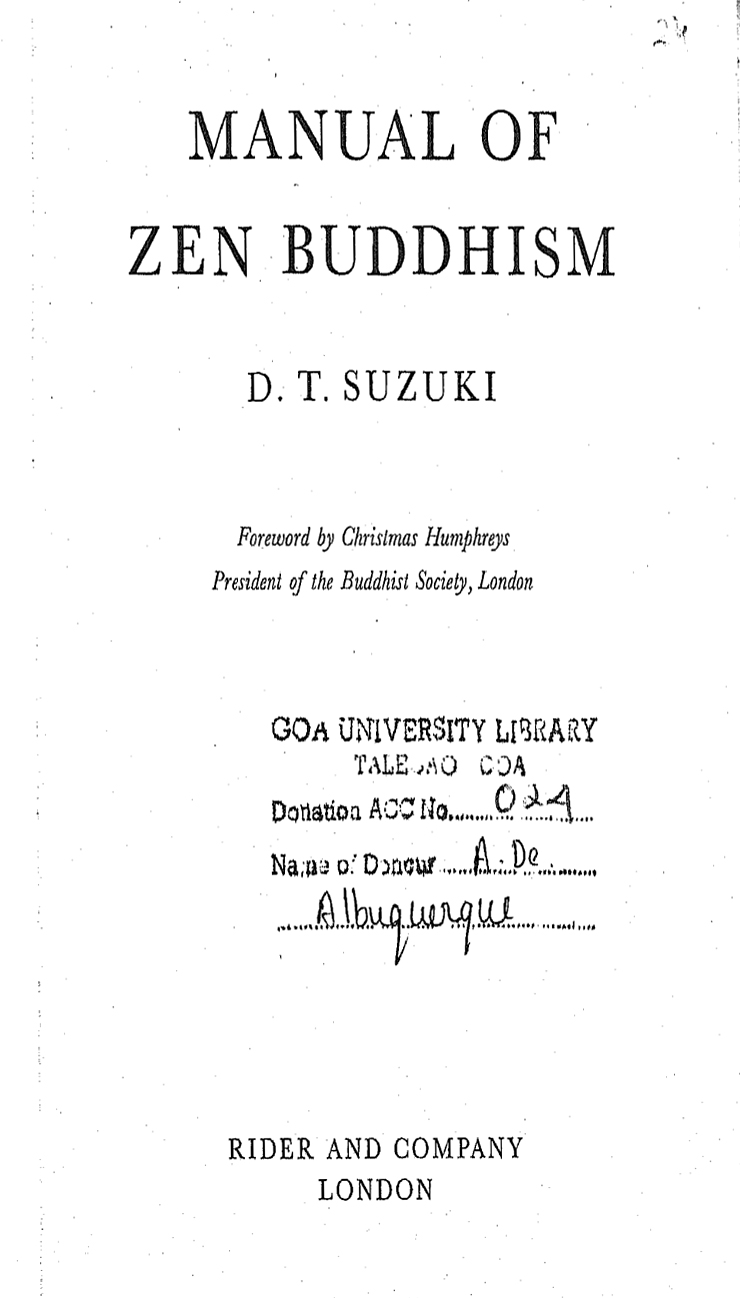
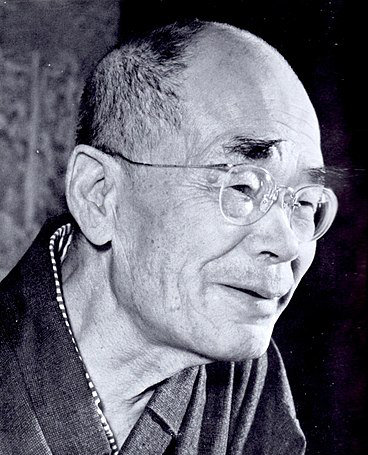
In my Introduction to Zen Buddhism (published 1934), an outline of Zen teaching is sketched, and in The Training of the Zen Monk (1934) a description of the Meditation Hall and its life is given. To complete a triptych the present Manual has been compiled. The object is to inform the reader of the various literary materials relating to the monastery life. Foreign students often express their desire to know about what the Zen monk reads before the Buddha in his daily service, where his thoughts move in his leisure hours, and what objects of worship he has in the different quarters of his institution. This work will partly, it is hoped, satisfy their desire. Those who find my Essays too bulky or too elaborate may prefer these smaller works on Zen. (Suzuki, preface to the first edition (1935), 11)
Articles1974About this item
An partial English translation of the Vajracchedikāprajñāpāramitāsūtra from the Chinese edition of Kumārajīva (the first half and extracts from the second half).
1 Teachings
MultimediaAbout this item
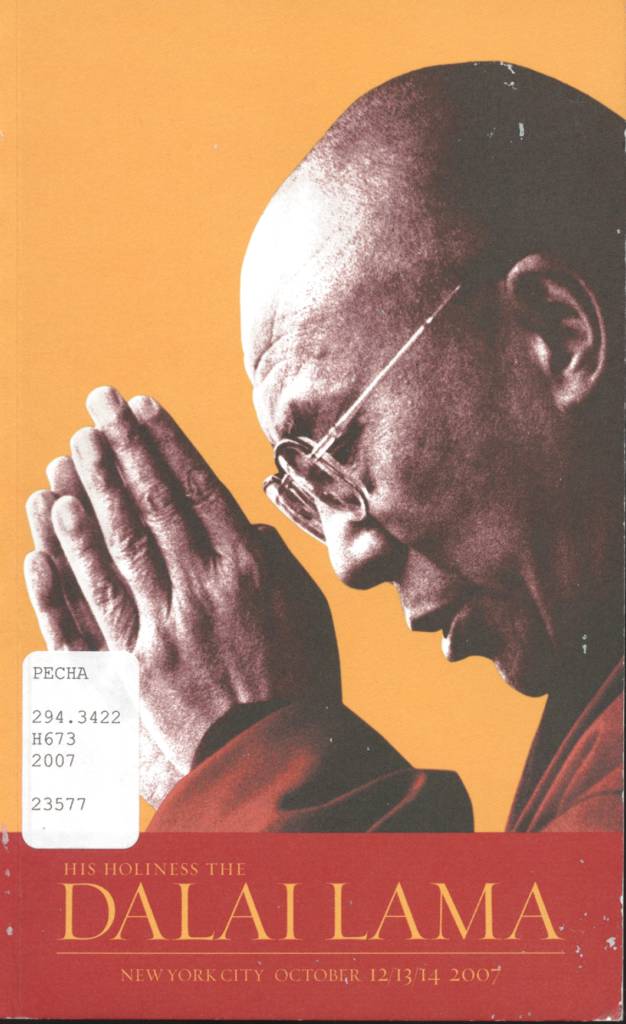
His Holiness the Dalai Lama's teaching on the Diamond Sūtra at the request of a group of Korean Buddhists. The teaching was held at the Main Tibetan Temple in Dharamsala, India, on August 28-29, 2010. His Holiness is teaching in Tibetan followed by the English translation.(www.dalailama.com)
2 Works containing teachings
Books2012About this item
This book is a compilation of talks on emptiness given by Khensur Rinpoche at Land of Medicine Buddha in Soquel, California, from October 2006 to December 2007.
Books2010About this item
This revised edition includes Thich Nhat Hanh's translation of the Diamond Sutra from the Chinese and new work on its environmental implications.
13 Scholarship
Books2014About this item
In this book, an international team of fourteen scholars investigates the Chinese reception of Indian Buddhist ideas, especially in the sixth and seventh centuries. Topics include Buddhist logic and epistemology (pramāṇa, yinming); commentaries on Indian Buddhist texts; Chinese readings of systems as diverse as Madhyamaka, Yogācāra and tathāgatagarbha; the working out of Indian concepts and problematics in new Chinese works; and previously under-studied Chinese evidence for developments in India. The authors aim to consider the ways that these Chinese materials might furnish evidence of broader Buddhist trends, thereby problematizing a prevalent notion of “sinification”, which has led scholars to consider such materials predominantly in terms of trends ostensibly distinctive to China. The volume also tries to go beyond seeing sixth- and seventh-century China primarily as the age of the formation and establishment of the Chinese Buddhist “schools”. The authors attempt to view the ideas under study on their own terms, as valid Buddhist ideas engendered in a rich, “liminal” space of interchange between two large traditions. (Source: Hamburg University Press)
Books1972About this item
A landmark publication which offers Western readers a unique combination of what Buddhists worldwide consider the holiest of holy texts, The Diamond Sūtra and The Heart Sūtra
Books1958About this item
A landmark publication which offers Western readers a unique combination of what Buddhists worldwide consider the holiest of holy texts The Diamond Sutra and The Heart Sutra, two sutras, or scriptures, ascribed to the early centuries of the first millennium.

The Diamond Sutra, or the Perfection of Wisdom, which cuts like a thunderbolt, is one of the cornerstone texts of Mahayana Buddhism and provides a summary of the core concepts of the Buddha. The Heart Sutra, perhaps the most important of all Buddhist texts, sets out to formulate the very heart, or essence of perfect wisdom and is studied with special reverence in Zen monasteries and the Tibetan Buddhist lamaseries.

Edward Conze, who was until his death in 1979 a powerful force for introducing Buddhism and its sacred texts to the West, has provided these translated key texts with an extensive commentary for the easiest possible appreciation phrase by phrase. (Source Accessed Aug 16, 2021)
Books1916About this item
Manuscript Remains of Buddhist Literature Found in Eastern Turkestan: Facsimiles with Transcripts, Translations and Notes, Volume I (Oxford: Clarendon Press, 1916), edited by A. F. Rudolf Hoernle (1841–1918) "in conjunction with other scholars," presents facsimiles, transcriptions, translations, and scholarly notes for Buddhist manuscript fragments recovered from Central Asian sites—chiefly through Sir Aurel Stein's expeditions, alongside material from Hoernle's own and George Macartney's collections—in Sanskrit, Khotanese, Kuchean, Tibetan, and Chinese. Compiled as a genuinely international collaboration, its contributors included Lionel D. Barnett, Édouard Chavannes, Sten Konow, Sylvain Lévi, Heinrich Lüders, F. E. Pargiter, and F. W. Thomas, each responsible for the material in their specialty. Hoernle's lengthy General Introduction argues, based on the newly recovered Khotanese material, that the Tibetan alphabet derived not directly from India but specifically from the script of Khotan. Though conceived as the first volume of an ongoing series, no further volumes were published. The Sanskrit material includes newly discovered fragments of hymns by the celebrated poet Mātṛceṭa, among other canonical and noncanonical texts.
Books1977About this item
In this volume scholars from around the world honor Dr. Edward Conze, one of the most important figures in Buddhist Studies in this century. His contribution has been mainly centered around the family of texts known as the Prajnaparamita. These articles deal with this literature and the systems of thought related to it.
Books2005About this item
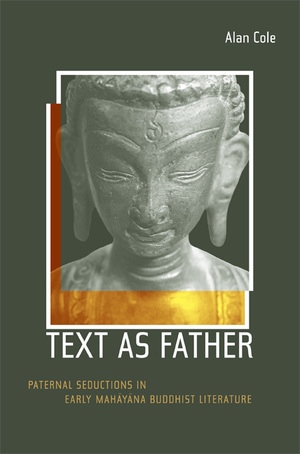
This beautifully written work sheds new light on the origins and nature of Mahayana Buddhism with close readings of four well-known texts—the Lotus Sutra, Diamond Sutra, Tathagatagarbha Sutra, and Vimalakirtinirdesa. Treating these sutras as literary works rather than as straightforward philosophic or doctrinal treatises, Alan Cole argues that these writings were carefully sculpted to undermine traditional monastic Buddhism and to gain legitimacy and authority for Mahayana Buddhism as it was veering away from Buddhism’s older oral and institutional forms. His sophisticated and sustained analysis of the narrative structures and seductive literary strategies used in these sutras suggests that they were specifically written to encourage devotion to the written word instead of other forms of authority, be they human, institutional, or iconic. (Source: University of California Press)
Books1971About this item
Contains the texts of three Mongolian versions of the Vajracchedikāprajñāpāramitāsūtra and their respective translations into English by Nicholas Poppe.
Articles2000About this item
Based on the study of two Indian commentaries extant in Tibetan on the Vajracchedikā Prajñāpāramitā Sūtra, the paper investigates the significance of the title of this exceedingly popular Mahāyāna scripture. Tracing back the symbolism of the vajra to its origin in Vedic myth, it proceeds to show the survival of its imagery in the Buddhist idea of the vajropama-samādhi. This is followed by an analysis of Kamalaśīla's explanation of the meaning of the term "Diamond-Cutter", which relates it to a threefold path-structure inherent in the text itself. Then the central topic of the sūtra, the support of abhisamaya is analysed and found to be allied in meaning to vajropama-samādhi and āśraya-parāvṛtti, the "conversion of support". The next part of the paper seeks to extend this symbolism to the rest of the āśraya constituting the text, utilising Vasubandhu's explanation of the meaning of "non-corruption" (mi nyams-pa). Finally, the essential meaning of "vajra-cutting" is found to be encapsulated in the seemingly paradoxical threefold logical pattern repeatedly employed by the sūtra: X is (spoken of as) no-X; therefore it is (called or spoken of as) X.
Articles2000About this item
Based on the study of two Indian commentaries extant in Tibetan on the Vajracchedikā Prajñāpāramitā Sūtra, the paper investigates the significance of the title of this exceedingly popular Mahāyāna scripture. Tracing back the symbolism of the vajra to its origin in Vedic myth, it proceeds to show the survival of its imagery in the Buddhist idea of the vajropama-samādhi. This is followed by an analysis of Kamalaśīla's explanation of the meaning of the term "Diamond-Cutter", which relates it to a threefold path-structure inherent in the text itself. Then the central topic of the sūtra, the support of abhisamaya is analysed and found to be allied in meaning to vajropama-samādhi and āśraya-parāvṛtti, the "conversion of support". The next part of the paper seeks to extend this symbolism to the rest of the āśraya constituting the text, utilising Vasubandhu's explanation of the meaning of "non-corruption" (mi nyams-pa). Finally, the essential meaning of "vajra-cutting" is found to be encapsulated in the seemingly paradoxical threefold logical pattern repeatedly employed by the sūtra: X is (spoken of as) no-X; therefore it is (called or spoken of as) X.
Books2000About this item
The literature of Prajñāpāramitā is vast, deep, and vital to an understanding of the Mahayana. It has so far been neglected by the European scholars. With the aim of facilitating the study, the author has set out a certain amount of information about it. Thus this handbook [was created] for the use of scholars [to record] the very limited knowledge acquired during the last century. (Adapted from Source Nov 28, 2023)
Books1978About this item
A critical Sanskrit edition of the Vajracchedikāprajñāpāramitāsūtra, edited by Lal Mani Joshi and published by The Central Institute of Higher Tibetan Studies, 1978.
Articles1916About this item
A manuscript of the Vajracchedikāprajñāpāramitāsūtra edited by F. E. Pargiter, in A. F. Hoernle's Manuscript Remains of Buddhist Literature Found in Eastern Turkestan. .
2 Related
Classical WorksAbout this item
The Perfection of Wisdom in Eight Thousand Lines, like other sūtras on the Perfection of Wisdom, deals with the topic of emptiness and the understanding of the ultimate truth or the way things are. Modern scholars date the sūtra roughly to the 2nd and 1st century BC and consider it to be the earliest sūtra on which other Perfection of Wisdom sūtras are based. Its adherents claim the sūtra to be a part of the words of the Buddha. It is believed to have been taken to the subterranean world and brought back to the human world by Nāgārjuna. It is sometimes known as the Condensed Mother (ཡུམ་བསྡུས་པ་), the term Mother referring to the Perfection of Wisdom which gives rise to all buddhas and bodhisattvas. It is said to be the condensed version of the long version in one hundred thousand lines and the middle version in twenty-five thousand lines. Having spread across Asia and beyond and having been translated into many languages, it is one of the most common books to be found in the Buddhist Himalayas. The sūtra takes the form of a series of dialogues between the Buddha Śākyamuni, Subhūti, Śāriputra, and others, such as Indra, the king of gods, and a goddess of the Ganges. In the final chapters, the sūtra contains the inspirational narratives of Sadāprarudita and his quest for the teachings on the Perfection of Wisdom from the Bodhisattva Dharmodgata. The sūtra is also one of the earliest Mahāyāna sources proclaiming the luminous nature of the mind.
Books2012About this item
This book consists of revised selections from the 1975 edition of Edward Conze's The Large Sutra on Perfect Wisdom and his 1973 edition of The Perfection of Wisdom.
62 A topic of
MultimediaAbout this item
His Holiness the Dalai Lama's teaching on the Diamond Sūtra at the request of a group of Korean Buddhists. The teaching was held at the Main Tibetan Temple in Dharamsala, India, on August 28-29, 2010. His Holiness is teaching in Tibetan followed by the English translation.(www.dalailama.com)
Books1938About this item
This early Western publication on Buddhism includes mention of the concept of buddha-nature 19 times. Thus this work would have been one of the few English publications at the time to mention buddha-nature by name. What follows is Goddard's preface to the book.

The first edition of this Buddhist Bible was published in 1932. When the need of a new edition became evident, it was decided to enlarge it so as to include other Scriptures of like importance so as to make it more comprehensive. This involved making a number of new translations for which we are indebted to Bhikshu Wai-tao. We are also indebted and are very grateful to a number of other Buddhist Scholars for permission to use their translations, as noted in the Appendix.
      The compiling of a Buddhist Bible is a very different matter from compiling the Christian Bible. In the first place, there is no Hierarchy or Ecclesiastic Council to pass upon the authenticity of different scriptures, and as to their canonicity. In the second place, Christian Scriptures are a closed system of doctrines and dogmas that have been inspired by the Holy Spirit and are to be accepted in faith. Buddhism, on the contrary, is looked upon as a growing organism whose scriptures are of many kinds as the organism has developed under different racial, temporal and cultural conditions. As disciples follow the Buddha's Noble Path and practice dhyana concentration and intuitive meditation they have an unfolding experience of spiritual insight and grace which any one of them may describe and elucidate. Some of these expediences are of highest value, some of less value. Some are concerned with the Dharma, some have to do with the rules of the Brotherhoods, some are philosophical, some psychological, some are commentaries and some are commentaries on commentaries. In the third place, there is the difference of quantity. In the Christian Bible there are sixty-six titles; Buddhist scriptures number over ten thousand, only a fraction of which have thus far been translated. In the Sung Dynasty about 972 AD a Chinese version of these scriptures was published consisting of 1521 works, in more than 5000 volumes, covering 130,000 pages.
      The nearest approach to canonicity is the Pali Tripitika. That was the earliest collection and was supposed to be limited to the words of Buddha. Southern Buddhists are passionately devoted to these Pali Scriptures and are inclined to disparage and dispute the more philosophical scriptures of the Northern School that developed later after Buddhism had come in contact with other world religions in Persia, Palestine, Egypt and Greece. Under these conditions there developed in Northern India, and Kashgar, a succession of very able minds, Ashvaghosha, Nargajuna, Vasobandhu and his brother Asangha from whose writings and teachings there developed various important schools of philosophical thought that profoundly changed the understanding of Buddha's Dharma.
      Later on as Buddhism spread into China and came under the influence of its immemorial culture and practical good sense, it took on forms of Taoist naturalism and kindly humanism, and there developed forms of "salvation by faith in Amitabha's mercy" and rebirth in his Pure Land. While in Tibet, coming in contact with its ancient Bon religion, and under the climatic conditions of its high altitudes, it took on forms of strenuousness and magic and tantric conceptions. Later on in Japan owing to political and social conditions incident to the presence of a limited but powerful noble class dominating a suppressed peasantry, which had developed extremes of loyalty and obedience and self-control, it took on forms of concentrative meditation known as Zen, and a still more widely divergent type of the True Pure Land Sect.
      Naturally among these diverse conditions Buddhist scriptures vary widely, and the quantity of them being so enormous, they have become segregated into different groups as they are favored by different schools of thought and practice. The Tien-tai favor the more philosophical scriptures, the Shingon, the more esoteric, the Ch’an (Zen), the more intellectual, and the Pure Land, the more emotional. The present editor has been guided in his selection of scriptures for this Buddhist Bible by a sincere purpose to make the selection as comprehensive as possible within its limits and to represent as truly as possible the original teachings of the Blessed One both as understood by the Southern and more primitive school and by the Northern and more philosophical interpreters. He has also humbly tried to have the choice vouched for by his own spiritual experience in his practice of the Noble Path and especially during its Eighth Stage of intuitive Dhyana.
      It follows, therefore, that the scriptures thus selected are the generally accepted scriptures of the Dhyana Sects—Ch’an in China, Zen in Japan and Kargyupta in Tibet. Of course among so enormous a collection of scriptures there are others that are favorites also, notably the Saddharma-pundarika (Lotus of the Perfect Law), and the Avatamsaka, said to be the grandest religious document ever written, but these are very large books in themselves. The late W. E. Soothil of London left a very careful translation of the Lotus that still waits a publisher. Dr. Suzuki of Kyoto has made a translation of the Gandhavyuha sections of the Avatamsaka that is now in process of being published. The inclusion of Laotzu’s Tao-teh-king is open to question as it is not strictly a Buddhist text, but its teaching has such a close affinity to Buddhist teaching and nearly all early Chinese Masters of Buddhism were Taoist scholars who, upon becoming Buddhists, did not give up their Taoist conceptions and terms, and because the Laotzuan teaching in the Tao-teh-king has had such a wholesome influence on the development of Chinese Buddhism, and, in later years, wherever the Tao-teh-king is held in reverence, it has tended to restrain individual pride of egoism, religious ceremonial, ecclesiasticism, priestcraft and insincerity generally, we make no apology for including it. In fact, it is our earnest wish that the Tao-teh-king may become one of the foundation stones of American and European Buddhism.
      Further introductory notes are reserved for the Appendix under the heads of the individual Scriptures, as are also -grateful appreciation to those who have contributed to the preparation and publication of this Bible, especially to those Buddhist scholars who have courteously granted the Editor permission to use their translations for this purpose
      Just a closing word as to the rules that have guided the Editor in his choice and handling of textual material. He has always kept in mind the spiritual needs of his readers. This Buddhist Bible is not intended to be a source book for critical literary and historical study. It is only intended to be a source of spiritual inspiration designed to awaken faith and to develop faith into aspiration and full realization. The original texts having for centuries been carried in memory and transcribed by hand by scribes who were often more loyal to their Master than to historical exactness, are often overloaded with interpolations and extensions, and in places are confused and obscure. To carry out the design of the Editor, he has omitted a great deal of matter not bearing directly upon the theme of the particular Scripture, and has interpreted occasionally where it seemed necessary and advisable, in order to provide an easier and more inspiring reading. The need for this course will become apparent to every earnest minded disciple.
      In these days when Western civilization and culture is buffeted as never before by foreboding waves of materialism and selfish aggrandisement both individual and national, Buddhism seems to hold out teachings of highest promise. For two thousand years Dhyana Buddhism has powerfully conditioned the cultural, ethical and spiritual life of the great Oriental nations. It well may be the salvation of Western civilization. Its rationality, its discipline, its emphasis on simplicity and sincerity, its thoughtfulness, its cheerful industry not for profit but for service, its love for all animate life, its restraint of desire in all its subtle forms, its actual foretastes of enlightenment and blissful peace, its patient acceptance of karma and rebirth, all mark it out as being competent to meet the problems of this excitement loving, materialistic, acquisitive and thoughtless age.
      Its basic principle of an eternal process based on unchanging law and operating in eternal recurrence, leading to mind-control, to highest cognition, to purest conceptions of love and compassion, to ever clearing insight, to highest perfect wisdom, to the self-giving of Bodhisattvas, and Buddhas, to blissful peace, is worthy of confidence; and its Noble Path worthy of

trial.
      The theme of this Buddhist Bible is designed to show the unreality of all conceptions of a personal ego. Its purpose is to awaken faith in Buddhahood as being one’s true self-nature; to kindle aspiration to realize one’s true Buddha-nature; to energize effort to follow the Noble Path, to become Buddha. The true response to the appeal of this Buddhist Bible is not in outward activities, but in self-yielding, becoming a clear channel for Buddhahood's indrawing compassion, that all sentient beings may become emancipated, enlightened and brought to Buddhahood. (Goddard, preface, v–viii)
Books2014About this item
In this book, an international team of fourteen scholars investigates the Chinese reception of Indian Buddhist ideas, especially in the sixth and seventh centuries. Topics include Buddhist logic and epistemology (pramāṇa, yinming); commentaries on Indian Buddhist texts; Chinese readings of systems as diverse as Madhyamaka, Yogācāra and tathāgatagarbha; the working out of Indian concepts and problematics in new Chinese works; and previously under-studied Chinese evidence for developments in India. The authors aim to consider the ways that these Chinese materials might furnish evidence of broader Buddhist trends, thereby problematizing a prevalent notion of “sinification”, which has led scholars to consider such materials predominantly in terms of trends ostensibly distinctive to China. The volume also tries to go beyond seeing sixth- and seventh-century China primarily as the age of the formation and establishment of the Chinese Buddhist “schools”. The authors attempt to view the ideas under study on their own terms, as valid Buddhist ideas engendered in a rich, “liminal” space of interchange between two large traditions. (Source: Hamburg University Press)
Books1965About this item
Buddhist Mahayana Texts, edited and translated by E.B. Cowell, F. Max Müller, and J. Takakusu, is Volume 49 of the Sacred Books of the East series. Originally published in 1894 by Clarendon Press, it includes foundational early English translations of key Sanskrit and Chinese Mahayana scriptures.
BooksndAbout this item
Buddhist Mahayana Texts, edited and translated by E.B. Cowell, F. Max Müller, and J. Takakusu, is Volume 49 of the Sacred Books of the East series. Originally published in 1894 by Clarendon Press, it includes foundational early English translations of key Sanskrit and Chinese Mahayana scriptures.
Books1894About this item
Two Volumes in One:

Part. I, (1-207) The Buddha-karita of Asvaghosha, translated from the Sanskrit by E.B. Cowell.

Part. II, (1-203) The larger Sukhâvatî-vyûha, the smaller Sukhâvatî-vyûha, the Vagrakkhedikâ, the larger Pragñâ-pâra-mitâ-hridaya-sûtra, the smaller Pragñâ-pâramitâ-hridaya-sûtra, translated by F. Max Müller. The Amitâyur-dhyâna-sûtra, translated by J. Takakusu.

The texts of Part. II are translated from the Sanskrit, except the Amitâyur-dhyâna-sûtra, which is from a Chinese translation. (Source Accessed Aug 16, 2021)
Books1881–84About this item
Critical Sanskrit editions of the Vajracchedikāprajñāpāramitāsūtra, the Sukhāvatīvyūha, the Bhagavatīprajñāpāramitāhṛdaya, and the (Āryasarvadurgatipariśodhani) - Uṣṇiṣavijayanāmadhāraṇī. One volume with three parts.
Books1972About this item
A landmark publication which offers Western readers a unique combination of what Buddhists worldwide consider the holiest of holy texts, The Diamond Sūtra and The Heart Sūtra
Books1958About this item
A landmark publication which offers Western readers a unique combination of what Buddhists worldwide consider the holiest of holy texts The Diamond Sutra and The Heart Sutra, two sutras, or scriptures, ascribed to the early centuries of the first millennium.

The Diamond Sutra, or the Perfection of Wisdom, which cuts like a thunderbolt, is one of the cornerstone texts of Mahayana Buddhism and provides a summary of the core concepts of the Buddha. The Heart Sutra, perhaps the most important of all Buddhist texts, sets out to formulate the very heart, or essence of perfect wisdom and is studied with special reverence in Zen monasteries and the Tibetan Buddhist lamaseries.

Edward Conze, who was until his death in 1979 a powerful force for introducing Buddhism and its sacred texts to the West, has provided these translated key texts with an extensive commentary for the easiest possible appreciation phrase by phrase. (Source Accessed Aug 16, 2021)
Books1970About this item
The first volume contains - The practice as taught by the Venerable Hsu Yun, the best-known modern Ch'an Master. It elaborates upon the technique known as hua t'ou which is taught in Japanese zendos; six representative stories (kung-ans) of Ch'an Masters are translated from the Imperial Selection of Ch'an Sayings. Each kung-an is fully explained so that it makes sense to the uninitiated; a translation of the Diamond and Heart Sutras with the Commentary of Ch'an Master Han Shan. (Source Accessed Apr 19, 2022)
Books2007About this item
Contains translations of The Diamond Cutter Sūtra: The Exalted Mahāyāna Sūtra on the Wisdom Gone Beyond Called The Vajra Cutter translated by George Churinoff and Seventy Verses on Emptiness by Nagarjuna, translated by Gareth Sparham.
Books2012About this item
This book is a compilation of talks on emptiness given by Khensur Rinpoche at Land of Medicine Buddha in Soquel, California, from October 2006 to December 2007.
Books1974About this item
In my Introduction to Zen Buddhism (published 1934), an outline of Zen teaching is sketched, and in The Training of the Zen Monk (1934) a description of the Meditation Hall and its life is given. To complete a triptych the present Manual has been compiled. The object is to inform the reader of the various literary materials relating to the monastery life. Foreign students often express their desire to know about what the Zen monk reads before the Buddha in his daily service, where his thoughts move in his leisure hours, and what objects of worship he has in the different quarters of his institution. This work will partly, it is hoped, satisfy their desire. Those who find my Essays too bulky or too elaborate may prefer these smaller works on Zen. (Suzuki, preface to the first edition (1935), 11)
Books1916About this item
Manuscript Remains of Buddhist Literature Found in Eastern Turkestan: Facsimiles with Transcripts, Translations and Notes, Volume I (Oxford: Clarendon Press, 1916), edited by A. F. Rudolf Hoernle (1841–1918) "in conjunction with other scholars," presents facsimiles, transcriptions, translations, and scholarly notes for Buddhist manuscript fragments recovered from Central Asian sites—chiefly through Sir Aurel Stein's expeditions, alongside material from Hoernle's own and George Macartney's collections—in Sanskrit, Khotanese, Kuchean, Tibetan, and Chinese. Compiled as a genuinely international collaboration, its contributors included Lionel D. Barnett, Édouard Chavannes, Sten Konow, Sylvain Lévi, Heinrich Lüders, F. E. Pargiter, and F. W. Thomas, each responsible for the material in their specialty. Hoernle's lengthy General Introduction argues, based on the newly recovered Khotanese material, that the Tibetan alphabet derived not directly from India but specifically from the script of Khotan. Though conceived as the first volume of an ongoing series, no further volumes were published. The Sanskrit material includes newly discovered fragments of hymns by the celebrated poet Mātṛceṭa, among other canonical and noncanonical texts.
Books1956About this item
Contents of pt. 1 includes: Triśatikāyāḥ prajñāpāramitāyāḥ kārikāsaptatiḥ / Asaṅga--Mahāyānaviṁśikā / Nāgārjuna--Navaślokī / Kambalapāda--Catuḥstavasamāsārtha / Amr̥tākara--Hetutattvopadeśa / Jitāri--Tarkasopāna / Vidyākaraśānti / Vajracchedikā (Gilgit text).
Books1993About this item
The prajñāpāramitā texts were composed in India between approximately 100 BC and AD 600. Those contained within this volume, of about forty texts, are among the shorter ones; they are also some of the most well known such as The Heart Sutra, Perfection of Wisdom in 500 lines, The Diamond Sutra, The Questions of Suvikràntavikràmin, and Perfection of Wisdom in 700 lines. (Buddhist Publishing Group)
Books2002About this item
The prajñāpāramitā texts were composed in India between approximately 100 BC and AD 600. Those contained within this volume, of about forty texts, are among the shorter ones; they are also some of the most well known such as The Heart Sutra, Perfection of Wisdom in 500 Lines, The Diamond Sutra, The Questions of Suvikrantavikramin, and Perfection of Wisdom in 700 Lines. (Buddhist Publishing Group)
Books1977About this item
In this volume scholars from around the world honor Dr. Edward Conze, one of the most important figures in Buddhist Studies in this century. His contribution has been mainly centered around the family of texts known as the Prajnaparamita. These articles deal with this literature and the systems of thought related to it.
Books2001About this item
A French translation of the Diamond Sūtra and other Mahāyāna sūtras by Philippe Cornu and Patrick Carré.
Books1983About this item
A compilation of fourteen Sanskrit Buddhist texts translated into Italian, including the Bodhicaryāvatāra. Edited by Raniero Gnoli.
Books2005About this item
This beautifully written work sheds new light on the origins and nature of Mahayana Buddhism with close readings of four well-known texts—the Lotus Sutra, Diamond Sutra, Tathagatagarbha Sutra, and Vimalakirtinirdesa. Treating these sutras as literary works rather than as straightforward philosophic or doctrinal treatises, Alan Cole argues that these writings were carefully sculpted to undermine traditional monastic Buddhism and to gain legitimacy and authority for Mahayana Buddhism as it was veering away from Buddhism’s older oral and institutional forms. His sophisticated and sustained analysis of the narrative structures and seductive literary strategies used in these sutras suggests that they were specifically written to encourage devotion to the written word instead of other forms of authority, be they human, institutional, or iconic. (Source: University of California Press)
Books2020About this item
An English translation of the Vajracchedikāprajñāpāramitāsūtra by the Chung Tai Translation Committee from the Chinese edition of Kumārajīva, T235.
Books1912About this item
An English translation of the Diamond Sutra, translated from the Chinese text of Kumārajīva, by William Gemmell.
Articles1973About this item
This is an English translation of the Vajracchedikāprajñāpāramitāsūtra by Edward Conze, a reprint of his second translation made in 1973.
Books1974About this item
This is an English translation and general explanation of the Diamond Sūtra by Master Hsüan Hua, translated by Bhikṣuṇī Heng Ch'ih of the Buddhist Text Translation Society.
Books1971About this item
Contains the texts of three Mongolian versions of the Vajracchedikāprajñāpāramitāsūtra and their respective translations into English by Nicholas Poppe.
Articles1938About this item
An English translation of the Vajracchedikāprajñāpāramitāsūtra made by Bhikshu Wai-tao and Dwight Goddard in 1935 from Kumārajīva's Chinese translation.
Books1973About this item
An English translation of the Diamond Sūtra together with the Sūtra of Hui-neng, also known as the Platform Sūtra, by A. F. Price and Wong Mou-Lam.
Books2001About this item
Red Pine's English translation of the Diamond Sūtra based on six extant Chinese translations of the text and in consultation with two Sanskrit editions by Conze and Müller.
Books2000About this item
In this translation and commentary on the Diamond Sutra, Mu Soeng integrates this ancient wisdom teaching with current scientific and psychological thought.
Books2010About this item
This revised edition includes Thich Nhat Hanh's translation of the Diamond Sutra from the Chinese and new work on its environmental implications.
Articles2000About this item
Based on the study of two Indian commentaries extant in Tibetan on the Vajracchedikā Prajñāpāramitā Sūtra, the paper investigates the significance of the title of this exceedingly popular Mahāyāna scripture. Tracing back the symbolism of the vajra to its origin in Vedic myth, it proceeds to show the survival of its imagery in the Buddhist idea of the vajropama-samādhi. This is followed by an analysis of Kamalaśīla's explanation of the meaning of the term "Diamond-Cutter", which relates it to a threefold path-structure inherent in the text itself. Then the central topic of the sūtra, the support of abhisamaya is analysed and found to be allied in meaning to vajropama-samādhi and āśraya-parāvṛtti, the "conversion of support". The next part of the paper seeks to extend this symbolism to the rest of the āśraya constituting the text, utilising Vasubandhu's explanation of the meaning of "non-corruption" (mi nyams-pa). Finally, the essential meaning of "vajra-cutting" is found to be encapsulated in the seemingly paradoxical threefold logical pattern repeatedly employed by the sūtra: X is (spoken of as) no-X; therefore it is (called or spoken of as) X.
Articles1956About this item
A critical Sanskrit edition (Roman) of the Vajracchedikāprajñāpāramitāsūtra, edited by N. P. Chakravarti in Minor Buddhist Texts, Part 1. Edited by Giuseppe Tucci, 1956.
Books2012About this item
This book consists of revised selections from the 1975 edition of Edward Conze's The Large Sutra on Perfect Wisdom and his 1973 edition of The Perfection of Wisdom.
Articles1974About this item
An partial English translation of the Vajracchedikāprajñāpāramitāsūtra from the Chinese edition of Kumārajīva (the first half and extracts from the second half).
Articles2025About this item
Bodhicitta, the "mind of awakening," constitutes the foundational principle of Mahāyāna Buddhism. This essay traces the concept's historical and doctrinal genesis from its pre-Mahāyāna antecedents to its full articulation in the Indian and Tibetan traditions. It explores the main scriptural and scholastic sources in India, the two great Indian lineages of practice—the "Profound View" of Nāgārjuna and the "Vast Conduct" of Asaṅga—and the pivotal role of Atiśa Dīpaṃkara Śrījñāna in transmitting and systematizing these teachings in Tibet. The article further details how Atiśa's Kadam school and its core mind training (lojong) teachings influenced the subsequent development of bodhicitta cultivation in the Nyingma, Kagyu, Sakya, and Geluk schools. Bodhicitta is not a static concept but a dynamic, multifaceted principle that functions as the soteriological core of the Mahāyāna path, embodying the indivisible union of universal compassion and the profound wisdom that realizes emptiness.
Articles2004About this item
A translation of the Diamond Sūtra by Gregory Schopen from the mauscript found at Gilgit, reprinted as "The Perfection of Wisdom" in Buddhist Scriptures, edited by Donald S. Lopez, Jr.
Books2000About this item
The literature of Prajñāpāramitā is vast, deep, and vital to an understanding of the Mahayana. It has so far been neglected by the European scholars. With the aim of facilitating the study, the author has set out a certain amount of information about it. Thus this handbook [was created] for the use of scholars [to record] the very limited knowledge acquired during the last century. (Adapted from Source Nov 28, 2023)
Books1973About this item
The prajñāpāramitā texts were composed in India between approximately 100 BC and AD 600. Those contained within this volume, of about forty texts, are among the shorter ones; they are also some of the most well known such as The Heart Sutra, Perfection of Wisdom in 500 lines, The Diamond Sutra, The Questions of Suvikràntavikràmin, and Perfection of Wisdom in 700 lines. (Source: Buddhist Publishing Group)
Articles1894About this item
No abstract given. Here are the first relevant paragraphs:

In order to make this collection of Mahâyâna works more complete and useful to students in Japan I have added a translation of the Vajrakkhedikâ, which is much studied in Japan, and the Sanskrit text of which was published by me in an editio princeps—in the Anecdota Oxoniensia, 1881.
      The Vajrakkhedikâ, or the Diamond-cutter, is one of the most widely read and most highly valued metaphysical treatises in Buddhist literature. In Japan the Vajrakkhedikâ and the Pragñâpâramitâhṛdaya are read chiefly by the followers of the Shin-gon sect, founded by Kô-Bô, the great disciple of the famous Hiouen-thsang, in 816 A. D. The temples of this sect in Japan amount to 12,943. Written originally in Sanskrit, it has been translated into Chinese, Tibetan, Mongol, and Mandshu. Its full title is Vajrakkhedikâ Pragñâ-pâramitâ, i.e. the Diamond-cutter, the perfection of wisdom, or, as it has sometimes been rendered, 'the Transcendent Wisdom.' Mr. Bunyiu Nanjio in his Catalogue of the Tripiṭaka, p. I, has shown that it forms the ninth section of the Mahapragñâ-pâramitâ-sûtra, and that it agrees with the Tibetan translation of the text in 300 ślokas.
      An account of the Tibetan translation was given as far back as 1836 by Csoma Körösi in his Analysis of the Sherchiu, the second division of the Kanjur, published in the Asiatic Researches, vol. xx, p. 393 seq. Our text is there described as the Diamond-cutter or the Sutra of wonderful effects, in which Sâkya in a colloquial manner instructs Subhûti, one of his principal disciples, in the true meaning of the Pragñâ-pâramitâ. The Tibetans., we are told, pay great respect to this Sûtra, and copies of it are found in consequence in great abundance[1].
      The first Chinese translation[2] is ascribed to Kumâragîva of the latter Tsin dynasty (A.D. 384-417). An English translation of this Chinese translation was published by the Rev. S. Beal in the Journal of the Royal Asiatic Society, 1864-5.
      There are several more Chinese translations, one by Bodhiruki (A. D. 509), one by Paramârtha (A. D. 562), one by Hiouen-thsang (A. D. 648), one by I-tsing (A. D. 703), one by Dharmagupta of the Sui dynasty (A. D. 589-618).
      The text and German translation of the Tibetan translation were published in 1837 by M. Schmidt in the Mémoires de I'Académie de St. Petersbourg, tom. iv, p. 186.
       The Mongolian translation was presented by the Baron Schiling de Canstadt to the Library of the Institut de France.
      The Mandshu translation is in the possession of M, de Harlez, who with the help of the Tibetan, Mandshu, and Chinese versions has published a valuable French translation of the Sanskrit text of the Vagrakkhedikâ in the Journal Asiatique, 1893. (Müller, introduction to the Vagrakkhedikâ, xii–xiii)

Notes
  1. See also L. Feer in Annales du Musée Guimet, vol. ii, p. 201.
  2. See preface to my edition of the Vagrakkhedikâ, Anecd. Oxon., 1881.
Articles1881About this item
Critical Sanskrit edition of the Vajracchedikāprajñāpāramitāsūtra, edited by Max Müller 1881. Published as part 1 of 3 in the volume Buddhist Texts from Japan.
Articles1865About this item
This is Samuel Beal's English translation of the Vajracchedikāprajñāpāramitāsūtra from the Chinese edition of Kumārajīva, T235.
Books1892About this item
A French translation of the Vajracchedikāprajñāpāramitāsūtra from the Chinese of Kumārajīva, T235. Published in Journal Asiatique in 1891 and as a monograph in 1892.
Books1974About this item
A critical Sanskrit edition and English translation of the Vajracchedikāprajñāpāramitāsūtra based on Max Müller's edition. English and Sanskrit; introd. in English.
Articles1959About this item
A critical Sanskrit edition of the Vajracchedikāprajñāpāramitāsūtra, edited by Nalinaksha Dutt, with the assistance of D. M. Bhattacharya and Shiv Nath Sharma, 1959.
Articles2006About this item
Among the MS remains of Mahāyāna texts in the Schøyen Collection a manuscript of the Vajracchedikā has been discovered comprising roughly three-fourths of the complete text which significantly adds to our knowledge of the Sanskrit text of this famous discourse. In "Vajracchedikā Prajñāpāramitā" (pp. 89–132) Paul Harrison and Shōgo Watanabe present an informative bibliographical survey, a description of the MS (date: ca. 6th–7th century) and of its relationship with other extant Vajracchedikā MSS, discuss its linguistic characteristics, then transliterate the text and finally reconstruct it. (Source: Bhikkhu Pāsādika, Review of Buddhist Manuscripts in the Schøyen Collection, Vol. III, Indo-Iranian Journal 52 (2009): 85)
Books1978About this item
A critical Sanskrit edition of the Vajracchedikāprajñāpāramitāsūtra, edited by Lal Mani Joshi and published by The Central Institute of Higher Tibetan Studies, 1978.
Articles1916About this item
A manuscript of the Vajracchedikāprajñāpāramitāsūtra edited by F. E. Pargiter, in A. F. Hoernle's Manuscript Remains of Buddhist Literature Found in Eastern Turkestan. .
Classical WorksAbout this item
This is a two-layer commentarial work on the Vajracchedikāprajñāpāramitāsūtra (the "Diamond Cutter" sūtra), combining root verses by Asaṅga with prose explanation by his half-brother Vasubandhu. In the Sanskrit tradition, Asaṅga's verses are known as the Triśatikāyāḥ Prajñāpāramitāyāḥ Kārikāsaptatiḥ ("Seventy Verses on the Perfection of Wisdom in Three Hundred [Lines]," so named for the sūtra's approximate length), and survive independently in Sanskrit as critically edited by Giuseppe Tucci (Minor Buddhist Texts, part I, Rome, 1956). The same verse-and-commentary combination is also preserved in two separate Chinese translations (Taishō 1511 and 1513). This Tengyur text represents the Tibetan transmission of the same commentarial tradition. Together with Vasubandhu's independently authored Saptārthaṭīkā (RKTST 3161) and Kamalaśīla's explicitly Madhyamaka-framed Vajracchedikāṭīkā (RKTST 3162), this text forms part of a substantial cluster of Indian commentarial literature on the Vajracchedikā preserved in the Tengyur, reflecting sustained scholarly engagement with the sūtra across differing structural approaches and philosophical framings.
Articles1840About this item
One of the earliest Western academic treatments of Mahāyāna Buddhist doctrine, by the German-Baltic orientalist and Mongolist Isaac Jacob Schmidt (1779–1847), based on his work with Tibetan and Mongolian Buddhist sources at the Imperial Academy of Sciences in St. Petersburg. The essay introduces the Mahāyāna as a doctrinal category and the Prajñāpāramitā teaching of emptiness (śūnyatā), which Schmidt renders into German as Leere ("emptiness") rather than Nichts ("nothingness")—an unusually careful interpretive choice for its time, later cited approvingly by Arthur Schopenhauer as a valuable early introduction to Buddhist thought. Schmidt then singles out the Vajracchedikā Prajñāpāramitā Sūtra (Diamond Sūtra)—Tibetan Rdo rje gcod pa—as a Mahāyāna sūtra devoted exclusively to the Prajñāpāramitā teaching, and, owing to its brevity, well suited to introducing the doctrine to a wider audience. He accordingly presents the Tibetan text of the sūtra in full alongside his own German translation, making this one of the earliest translations of the Diamond Sūtra into a European language directly from Tibetan. The translation opens with the sūtra's frame narrative—the Buddha's alms round in Śrāvastī before the assembled saṅgha and bodhisattvas—and proceeds through the philosophical dialogue with Subhūti at the heart of the text.
Classical WorksAbout this item
This is Vasubandhu's commentary on the Vajracchedikāprajñāpāramitā (the "Diamond Cutter" Perfection of Wisdom Sūtra), organized around a structuring scheme of seven topics or subjects (saptārtha), from which the text takes its title. It is preserved in the Tibetan Tengyur and represents one of the major early Indian commentarial approaches to the sūtra, alongside the closely associated tradition of verse summaries attributed to Asaṅga with prose commentary by Vasubandhu, which survives independently in two Chinese translations (Taishō 1511 and 1513). Vasubandhu (fl. 4th–5th century CE) was a foundational figure in Indian Buddhist philosophy and, with his half-brother Asaṅga, a principal founder of the Yogācāra school.
Classical WorksAbout this item
This is Kamalaśīla's commentary on the Vajracchedikāprajñāpāramitāsūtra (the "Diamond Cutter" Perfection of Wisdom sūtra), preserved in the Tibetan Tengyur. Notably, its own colophon gives a fuller title than the standard catalog heading—'phags pa rdo rje gcod pa dbu ma'i tshul du rgya cher 'grel pa, "An Extensive Commentary on the Diamond Cutter in the Manner of Madhyamaka"—explicitly signaling its Madhyamaka interpretive framework from within the text itself. Kamalaśīla (d. 795 CE) was a major Indian Madhyamaka scholar and student of Śāntarakṣita, renowned above all for his role in the Samye debate against the Chinese Chan teacher Moheyan and for his three-part Bhāvanākrama ("Stages of Meditation"), composed at the request of the Tibetan emperor. His engagement with the Vajracchedikā fits within this broader context: the sūtra was a text of real importance in the doctrinal controversies of late eighth-century Tibet, cited by both Kamalaśīla and Moheyan in support of their respective positions, alongside works like the Laṅkāvatārasūtra. This commentary stands alongside the commentary by Vasubandhu as one of the major Indian exegetical treatments of the sūtra to survive in Tibetan translation. The Tibetan translation is credited to the Indian preceptors Mañjuśrī and Jinamitra, together with the editor-translator Yeshe De.