The Diamond Sutra (Chin-Kang-Ching), or Prajna-Paramita
From Bodhicitta
< BooksBooks/The Diamond Sutra (Chin-Kang-Ching), or Prajna-Paramita
| 🤓 Admin Zone 🛠️ hidden to non-admins | |
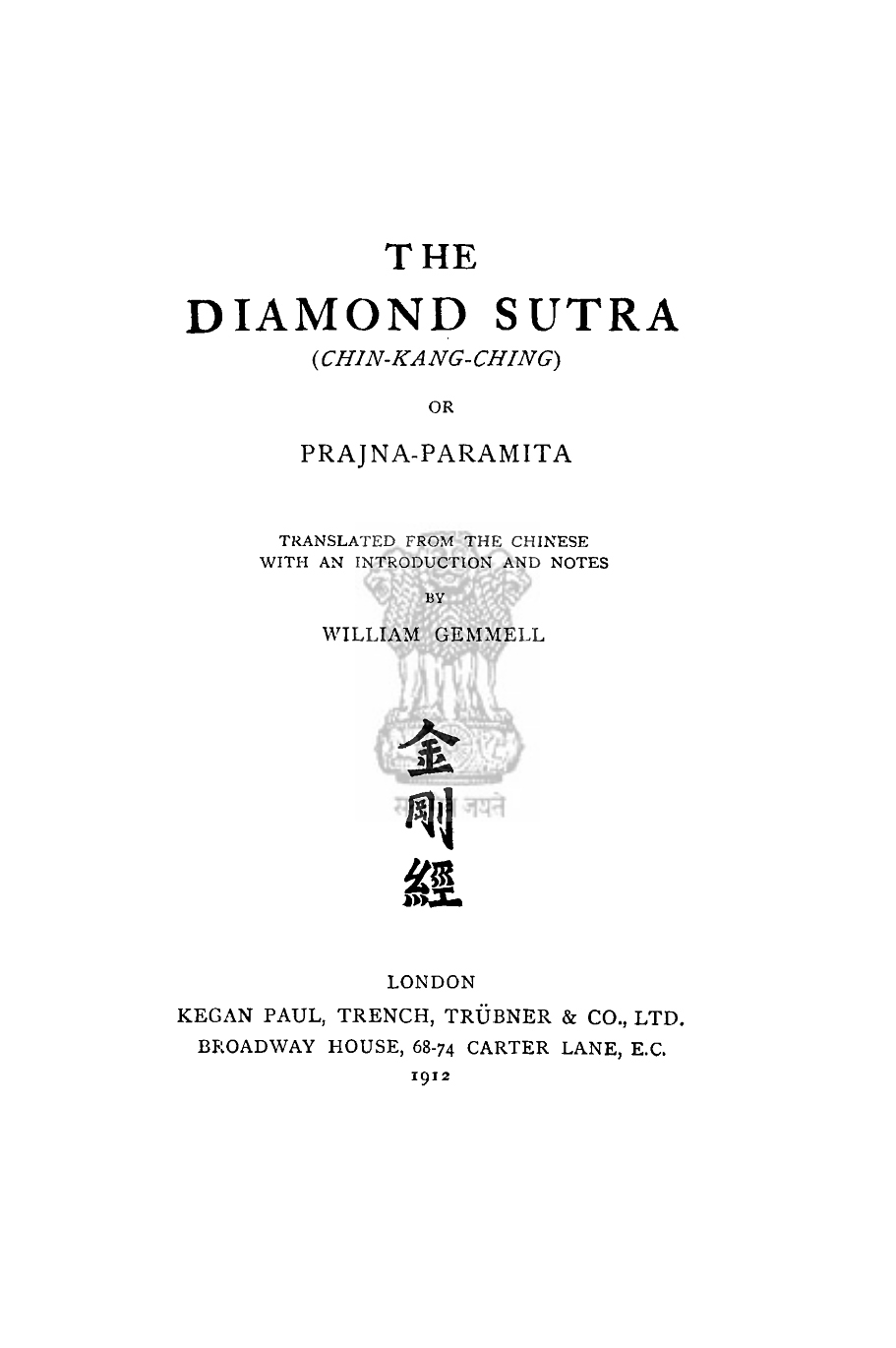
The Diamond Sutra (Chin-Kang-Ching), or Prajna-Paramita
Book
- A Few Good Men
- A Treasury of Mahāyāna Sūtras
- Abiding in Good and Noble Deportment
- Appendix to the New Edition of the Bodhicaryāvatāra
- Buddha Pronounces the Sūtra of the Great Cundī Dhāraṇī
- Chapter on Entering the Inconceivable Liberated State of Samantabhadra's Practices and Vows
- Dialogue With Bodhisattva Infinite Wisdom
- Mahāvaipulya Sūtra of the Tathāgata Store
- Myōhō-renge-kyō
- On Entering into the Inconceivable State of Emancipation by the Practice and Vows of the Bodhisattva Samantabhadra of the Mahavaipulya Buddha Avatamsaka Sutra
- On the Pāramitā of Ingenuity
- Scripture of the Lotus Blossom of the Fine Dharma
- The Buddhist Feminine Ideal
- The Definitive Vinaya
- The Dhâranî of Tchundi
- The Diamond Cutter of Doubts: A Commentary on The Diamond Sūtra (Vajracchedikā-prajñā-pāramitā Sūtra) By Ch'an Master Han Shan
- The Diamond Prajna Paramita Sutra
- The Diamond Prajna-Paramita Sutra
- The Diamond Sutra (Chin-Kang-Ching), or Prajna-Paramita
- The Diamond Sutra (Hsüan Hua)
- The Diamond Sutra (Wai-tao and Goddard)
- The Diamond Sutra and The Sutra of Hui Neng
- The Diamond Sutra: The Perfection of Wisdom
- The Diamond Sutra: Translated from Kumarajiva's Chinese Version
- The Diamond That Cuts Through Illusion
- The Essentials of the Dharma Blossom Sutra
- The Flower Ornament Scripture: A Translation of The Avatamsaka Sutra
- The Giving Rise of the Ten Kinds of Mind of the Bodhisattva
- The Great Vows of Samantabhadra
- The Healing Buddha (1979)
- The Healing Buddha (1989)
- The Lankavatara Sutra: A Zen Text
- The Lion's Roar of Queen Śrīmālā
- The Lotus Sutra (2016) (BDK)
- The Lotus Sutra (Watson)
- The Lotus Sutra: A Contemporary Translation of a Buddhist Classic
- The Lotus Sutra: The Sutra of the Lotus Flower of the Wonderful Dharma
- The Lotus of the Wonderful Law or The Lotus Gospel (2005)
- The Mahayana Mahaparinirvana-sutra (3 vols.)
- The Pratyutpanna Samādhi Sutra: The Śūraṅgama Samādhi Sutra
- The Prediction of Mañjuśrī's Attainment of Buddhahood
- The Scripture of Master of Medicine, Beryl Radiance Tathāgata and The Sutra of the Girl Candrottarā
- The Shurangama Sutra - Volume Eight
- The Shurangama Sutra - Volume Five
- The Shurangama Sutra - Volume Four
- The Shurangama Sutra - Volume One
- The Shurangama Sutra - Volume Seven
- The Shurangama Sutra - Volume Six
- The Shurangama Sutra - Volume Three
- The Shurangama Sutra - Volume Two
- The Shurangama Sutra: Sutra Text and Supplements
- The Skill in Means (Upāyakauśalya) Sūtra
- The Sky as a Mahāyāna Symbol of Emptiness and Generous Fullness: A Study and Translation of the Gaganagañjaparipṛcchā: Volume 2: Edition and Translation
- The Sutra of Queen Śrīmālā of the Lion's Roar and the Vimalakīrti Sutra
- The Sutra of the Lord of Healing
- The Sutra of the Master of Healing
- The Tale of King Udayana of Vatsa
- The Threefold Lotus Sūtra
- The True Lion's Roar of Queen Śrīmālā
- The Vimalakirti Nirdesa Sutra
- The Vimalakīrti Sūtra (Watson)
- The Vow to Live the Life of Samanta-bhadra
- The Vows of Bodhisattva Samantabhadra Sutra
- The Śūraṅgama Sūtra: A New Translation
- Vaipulya Sūtra of Śrīmālā's Lion's Roar That Reveals the Great Skillful Means of the One Vehicle
- Vajra-chhedika, the "Kin Kong King," or Diamond Sutra
- Vimalakīrti's Discourse on Emancipation
- Vimalakīrti-Nirdeśa-Sūtra: Translated from the Chinese
Please note that many items in our library are simply pages that represent a detailed library catalog entry and citation of someone else's work, presentation, or performance. Read our General Disclaimer for more information.

Description
This English version of the Diamond Sutra,[1] translated from the Chinese text of Kumarajiva, owes its inception to successive conversations with a friend, profoundly interested in the interpretation of oriental systems of philosophy. During those conversations renderings into English were made numerous passages from the works of Confucius, Mencius, and Lao-Tsz.
Having surveyed briefly those fertile fields of thought, we passed, by a natural transition, into the delectable Buddhist realm. Some passages for the Chinese Sutras, comprising texts and annotations, were consecutively examined, and variously considered. Eventually it was suggested that The Diamond Sutra, perhaps one of the most metaphysical of the works ascribed to Buddha, be conveniently rendered into the English language.
In order that the rather unfamiliar text might assume due intelligibility, parallel passages and numerous annotations were subjoined, as the pleasant work of translating proceeded. The idea of printing and publishing the text seemed to follow as a natural sequence.
Already there exist in the English language, renderings of The Diamond Sutra from the Sanscrit by Max Müller, and from the Chinese by Beal. This new version does not seek to enter into rivalry with those erudite works; and a possible apology which might readily be offered for the publication of this modest volume is, that the scholarly productions of Müller and Beal, in their present forms, are perhaps slightly inaccessible to the general English reader.
It would appear that the peculiar charm of the Buddhist philosophy, and the remarkable purity of the Buddhist faith, are becoming more generally appreciated in Europe. Should this imperfect rendering of The Diamond Sutra, even in the faintest degree, confirm this just sense of appreciation, or prove a gentle incentive to further enquiry, then its unexpected publication may prove to be not entirely unjustified.
In recording our many obligations to those scholars whose works were frequently consulted, we also give expression to a hope that nothing of importance is omitted which ought to be gratefully acknowledged.
It may also be permissible to express admiration of the piety, and appreciation of the friendship, of those learned monks in Central China, to whom we are everlastingly indebted for even a slight initiation into those inexhaustible truths, which are alike the heritage, and the glory, of the disciples of Buddha. Amongst those we should like to specify are Chang-Ming, the chief monk (Seng-Kwan) of Chen-Chou prefecture, Hu-Nan, and the aged and affectionate Chioh-Hsien. (Gemmell, preface, vii–viii)
Having surveyed briefly those fertile fields of thought, we passed, by a natural transition, into the delectable Buddhist realm. Some passages for the Chinese Sutras, comprising texts and annotations, were consecutively examined, and variously considered. Eventually it was suggested that The Diamond Sutra, perhaps one of the most metaphysical of the works ascribed to Buddha, be conveniently rendered into the English language.
In order that the rather unfamiliar text might assume due intelligibility, parallel passages and numerous annotations were subjoined, as the pleasant work of translating proceeded. The idea of printing and publishing the text seemed to follow as a natural sequence.
Already there exist in the English language, renderings of The Diamond Sutra from the Sanscrit by Max Müller, and from the Chinese by Beal. This new version does not seek to enter into rivalry with those erudite works; and a possible apology which might readily be offered for the publication of this modest volume is, that the scholarly productions of Müller and Beal, in their present forms, are perhaps slightly inaccessible to the general English reader.
It would appear that the peculiar charm of the Buddhist philosophy, and the remarkable purity of the Buddhist faith, are becoming more generally appreciated in Europe. Should this imperfect rendering of The Diamond Sutra, even in the faintest degree, confirm this just sense of appreciation, or prove a gentle incentive to further enquiry, then its unexpected publication may prove to be not entirely unjustified.
In recording our many obligations to those scholars whose works were frequently consulted, we also give expression to a hope that nothing of importance is omitted which ought to be gratefully acknowledged.
It may also be permissible to express admiration of the piety, and appreciation of the friendship, of those learned monks in Central China, to whom we are everlastingly indebted for even a slight initiation into those inexhaustible truths, which are alike the heritage, and the glory, of the disciples of Buddha. Amongst those we should like to specify are Chang-Ming, the chief monk (Seng-Kwan) of Chen-Chou prefecture, Hu-Nan, and the aged and affectionate Chioh-Hsien. (Gemmell, preface, vii–viii)
Notes
- A learned Chinese commentator thus explained the rather striking title: "As the diamond exceeds all other precious gems in brilliance and indestructibility; so, also, does the wisdom of The Diamond Sutra transcend, and shall outlive, all other knowledge known to Philosophy."
Citation
Gemmell, William, trans. The Diamond Sutra (Chin-Kang-Ching), or Prajna-Paramita. London: Kegan Paul, Trench, Trübner, 1912. https://archive.org/details/dli.csl.3882/page/n1/mode/2up.
Interconnections
1 Full translation of

One of the most revered and recited scriptures of the perfection of wisdom genre (prajñāpāramitāsūtras), perhaps second only to the Heart Sūtra, both of which became especially popular in the East Asian Buddhist traditions. It is a crucial source for Mahāyāna tenets of selflessness and the emptiness of phenomena, and its discourse is framed as an explanation of how to enter into the vehicle of the bodhisattvas by developing and sustaining their enlightened perspective.