| 🤓 Admin Zone 🛠️ hidden to non-admins | |
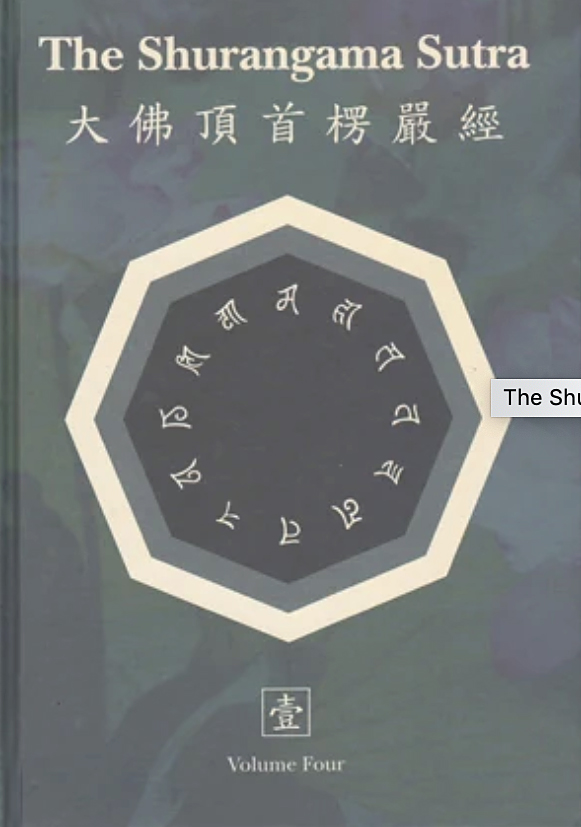
The Shurangama Sutra, Volume Four: A Simple Explanation by the Venerable Master Hsuan Hua
Book
- A Few Good Men
- A Treasury of Mahāyāna Sūtras
- Abiding in Good and Noble Deportment
- Appendix to the New Edition of the Bodhicaryāvatāra
- Buddha Pronounces the Sūtra of the Great Cundī Dhāraṇī
- Chapter on Entering the Inconceivable Liberated State of Samantabhadra's Practices and Vows
- Dialogue With Bodhisattva Infinite Wisdom
- Mahāvaipulya Sūtra of the Tathāgata Store
- Myōhō-renge-kyō
- On Entering into the Inconceivable State of Emancipation by the Practice and Vows of the Bodhisattva Samantabhadra of the Mahavaipulya Buddha Avatamsaka Sutra
- On the Pāramitā of Ingenuity
- Scripture of the Lotus Blossom of the Fine Dharma
- The Buddhist Feminine Ideal
- The Definitive Vinaya
- The Dhâranî of Tchundi
- The Diamond Cutter of Doubts: A Commentary on The Diamond Sūtra (Vajracchedikā-prajñā-pāramitā Sūtra) By Ch'an Master Han Shan
- The Diamond Prajna Paramita Sutra
- The Diamond Prajna-Paramita Sutra
- The Diamond Sutra (Chin-Kang-Ching), or Prajna-Paramita
- The Diamond Sutra (Hsüan Hua)
- The Diamond Sutra (Wai-tao and Goddard)
- The Diamond Sutra and The Sutra of Hui Neng
- The Diamond Sutra: The Perfection of Wisdom
- The Diamond Sutra: Translated from Kumarajiva's Chinese Version
- The Diamond That Cuts Through Illusion
- The Essentials of the Dharma Blossom Sutra
- The Flower Ornament Scripture: A Translation of The Avatamsaka Sutra
- The Giving Rise of the Ten Kinds of Mind of the Bodhisattva
- The Great Vows of Samantabhadra
- The Healing Buddha (1979)
- The Healing Buddha (1989)
- The Lankavatara Sutra: A Zen Text
- The Lion's Roar of Queen Śrīmālā
- The Lotus Sutra (2016) (BDK)
- The Lotus Sutra (Watson)
- The Lotus Sutra: A Contemporary Translation of a Buddhist Classic
- The Lotus Sutra: The Sutra of the Lotus Flower of the Wonderful Dharma
- The Lotus of the Wonderful Law or The Lotus Gospel (2005)
- The Mahayana Mahaparinirvana-sutra (3 vols.)
- The Pratyutpanna Samādhi Sutra: The Śūraṅgama Samādhi Sutra
- The Prediction of Mañjuśrī's Attainment of Buddhahood
- The Scripture of Master of Medicine, Beryl Radiance Tathāgata and The Sutra of the Girl Candrottarā
- The Shurangama Sutra - Volume Eight
- The Shurangama Sutra - Volume Five
- The Shurangama Sutra - Volume Four
- The Shurangama Sutra - Volume One
- The Shurangama Sutra - Volume Seven
- The Shurangama Sutra - Volume Six
- The Shurangama Sutra - Volume Three
- The Shurangama Sutra - Volume Two
- The Shurangama Sutra: Sutra Text and Supplements
- The Skill in Means (Upāyakauśalya) Sūtra
- The Sky as a Mahāyāna Symbol of Emptiness and Generous Fullness: A Study and Translation of the Gaganagañjaparipṛcchā: Volume 2: Edition and Translation
- The Sutra of Queen Śrīmālā of the Lion's Roar and the Vimalakīrti Sutra
- The Sutra of the Lord of Healing
- The Sutra of the Master of Healing
- The Tale of King Udayana of Vatsa
- The Threefold Lotus Sūtra
- The True Lion's Roar of Queen Śrīmālā
- The Vimalakirti Nirdesa Sutra
- The Vimalakīrti Sūtra (Watson)
- The Vow to Live the Life of Samanta-bhadra
- The Vows of Bodhisattva Samantabhadra Sutra
- The Śūraṅgama Sūtra: A New Translation
- Vaipulya Sūtra of Śrīmālā's Lion's Roar That Reveals the Great Skillful Means of the One Vehicle
- Vajra-chhedika, the "Kin Kong King," or Diamond Sutra
- Vimalakīrti's Discourse on Emancipation
- Vimalakīrti-Nirdeśa-Sūtra: Translated from the Chinese
Please note that many items in our library are simply pages that represent a detailed library catalog entry and citation of someone else's work, presentation, or performance. Read our General Disclaimer for more information. You can find more information about this item on the publisher website.

Description
This is the fourth of eight volumes of the Shurangama Sutra, with commentaries from the Venerable Master Hsuan Hua.
The Buddha has just explained with clarity and eloquence the pervasiveness of the true mind with all of existence. But then, Purnamatreiyaniputra retraces the Buddha’s past teachings and brings up two doubts
In "The Reason for Continual Arisal" the Buddha explains why in the midst of fundamental purity existence (ignorance) suddenly arises.
In "The Reason for Perfect Penetration" the Buddha explains that the very question of the pervasiveness of the elements (water, fire, earth, wind, emptiness, seeing and consciousness) creating a chaotic and incompatible mix, is itself invalid.
Both doubts have false-thinking as the root.
In "Ananda Attaches to Causes and Conditions", Ananda still has residual fondness for causes & conditions. The Buddha reiterates that in the final true meaning, neither causes & conditions nor sponaneity will hold up. Again, Ananda’s doubt has falsethinking as the root.
Ananda, realizing that great learning that is unmatched with cultivation ultimately bears no fruit, knows that he is still outside the gates of Nirvana, and reverently asks for further instructions on how to progress towards perfect enlightenment.
In "The Two Decisive Doctrines", the Buddha explains just that. First, in "Purification of the Turbidities", the Buddha exhorts Ananda to purify the five turbidities of time, views, afflictions, living beings and lifespans. Second, in "Liberation of the Organs", the Buddha demonstrates how one detaches oneself from the six organs: eyes, ears, nose, tongue, body and mind.
Surprisingly again, Ananda erroneously asks that since everything is fundamentally false and non-existent, how can it be used to achieve Nirvana? In "Hearing is Not Sound", the Buddha upbraids Ananda for mistaking the false (sound) for the true (hearing).
Then Ananda, wishing to recognize his innate ignorance that causes him to revolve on the wheel of birth and death, asks for the location of the ‘knot’ of ignorance so that he and living beings of the future can untie it. In "The Source of the Knot", the Buddha again reiterates that the source of ignorance lies in the six sense organs: eyes, ears, nose, tongue, body and mind.
Finally, the Buddha reveals that the source of enlightenment also lies in these very six knots! (Buddhist Text Translation Society, introduction, vi–vii)
The Buddha has just explained with clarity and eloquence the pervasiveness of the true mind with all of existence. But then, Purnamatreiyaniputra retraces the Buddha’s past teachings and brings up two doubts
In "The Reason for Continual Arisal" the Buddha explains why in the midst of fundamental purity existence (ignorance) suddenly arises.
In "The Reason for Perfect Penetration" the Buddha explains that the very question of the pervasiveness of the elements (water, fire, earth, wind, emptiness, seeing and consciousness) creating a chaotic and incompatible mix, is itself invalid.
Both doubts have false-thinking as the root.
In "Ananda Attaches to Causes and Conditions", Ananda still has residual fondness for causes & conditions. The Buddha reiterates that in the final true meaning, neither causes & conditions nor sponaneity will hold up. Again, Ananda’s doubt has falsethinking as the root.
Ananda, realizing that great learning that is unmatched with cultivation ultimately bears no fruit, knows that he is still outside the gates of Nirvana, and reverently asks for further instructions on how to progress towards perfect enlightenment.
In "The Two Decisive Doctrines", the Buddha explains just that. First, in "Purification of the Turbidities", the Buddha exhorts Ananda to purify the five turbidities of time, views, afflictions, living beings and lifespans. Second, in "Liberation of the Organs", the Buddha demonstrates how one detaches oneself from the six organs: eyes, ears, nose, tongue, body and mind.
Surprisingly again, Ananda erroneously asks that since everything is fundamentally false and non-existent, how can it be used to achieve Nirvana? In "Hearing is Not Sound", the Buddha upbraids Ananda for mistaking the false (sound) for the true (hearing).
Then Ananda, wishing to recognize his innate ignorance that causes him to revolve on the wheel of birth and death, asks for the location of the ‘knot’ of ignorance so that he and living beings of the future can untie it. In "The Source of the Knot", the Buddha again reiterates that the source of ignorance lies in the six sense organs: eyes, ears, nose, tongue, body and mind.
Finally, the Buddha reveals that the source of enlightenment also lies in these very six knots! (Buddhist Text Translation Society, introduction, vi–vii)
Citation
Buddhist Text Translation Society, trans. The Shurangama Sutra, Volume Four: A Simple Explanation by the Venerable Master Hsuan Hua. 2nd ed. Burlingame, CA: Buddhist Text Translation Society, 2002. https://repstein.faculty.drbu.edu/Buddhism/Shurangama/ps.ss.02.v4.020526.screen.pdf.
Publisher Link
Table of contents
- Introductionvi
- User's Guideviii
- Exhortation to Protect and Propagateix
- The Eight Guidelinesxii
- Outlinexiii
- Chapter 1. The Reason for Continual Arisal1
- Chapter 2. The Reason for Perfect Penetration62
- Chapter 3. Ananda Attaches to Causes and Conditions115
- Chapter 4. The Two Decisive Doctrines142
- Purification of the Turbidities145
- Liberation of the Organs161
- Chapter 5. Hearing is Not Sound211
- Chapter 6. The Source of the Knot237
Interconnections
1 Full translation of

Śūraṃgamasūtra. (T. Dpa' bar 'gro ba'i mdo; C. Shoulengyan jing; J. Shuryōgongyō; K. Sunǔngǒm kyǒng 首楞嚴經). A Chinese indigenous scripture (see apocrypha), usually known in the West by its reconstructed Sanskrit title Śūraṃgamasūtra, meaning "Heroic March Sūtra." Its full title is Dafoding rulai miyin xiuzheng liaoyi zhu pusa wanxing Shoulengyan jing, in ten rolls. (This indigenous scripture should be distinguished from an early-fifth century Chinese translation of the Śūraṃgamasamādhsūtra, attributed by Kumārajīva, in two rolls, for which Sanskrit fragments are extant.) According to the account in the Chinese cataloguer Zhisheng's Xu gujin yijing tuji, the Śūraṃgamasūtra was brought to China by a śramaṇa named Pāramiti. Because the Śūraṃgamasūtra had been proclaimed a national treasure, the Indian king had forbidden anyone to take the sūtra out of the country. In order to transmit this scripture to China, Pāramiti wrote the sūtra out in minute letters on extremely fine silk, then he cut open his arm and hid the small scroll inside his flesh. With the sūtra safely hidden away, Pāramiti set out for China and eventually arrived in Guangdong province. There, he happened to meet the exiled Prime Minister Fangrong, who invited him to reside at the monastery of Zhizhisi, where he translated the sūtra in 705 CE. Apart from Pāramiti's putative connection to the Śūraṃgamasūtra, however, nothing more is known about him and he has no biography in the Gaoseng zhuan ("Biographies of Eminent Monks"). Zhisheng also has an entry on the Śūraṃgamasūtra in his Kaiyuan Shijiao lu, but there are contradictions in these two extant catalogue accounts of the sūtra's transmission and translation. The Kaiyuan Shijiao lu merely records that the śramaņa Huidi encountered an unnamed Western monk at Guangdong, who had with him a copy of the Sanskrit recension of this sūtra, and Huidi invited him to translate the scripture together. Since the names of this Western monk and his patron Fangrong are not mentioned, the authenticity of the scripture has been called into question. Although Zhisheng assumed the Śūraṃgamasūtra was a genuine Indian scripture, the fact that no Sanskrit manuscript of the text is known to exist, as well as the inconsistencies in the stories about its transmission to China, have led scholiasts for centuries to questions the scripture's authenticity. There is also internal evidence of the scripture's Chinese provenance, such as the presence of such indigenous Chinese philosophical concepts as yin-yang cosmology and the five elements (wuxing) theory, the stylistic beauty of the literary Chinese in which the text is written, etc. For these and other reasons, the Śūraṃgamasūtra is now generally recognized to be a Chinese apocryphal composition. The sūtra opens with one of the most celebrated stories in East Asian Buddhist literature: the Buddha's attendant Ānanda’s near seduction by the harlot Mātaṅgī. With Ānanda close to being in flagrante delicto, the Buddha sends the bodhisattva Mañjuśrī to save him from a pārājika offense, by employing the śūraṃgama dhāraṇī to thwart Mātaṅgī's seductive magic. The Buddha uses the experience to teach to Ānanda and the congregation the śūraṃgamasamādhi, which counters the false views about the aggregates (skandha) and consciousness (vijñāna) and reveals the tathāgatagarbha that is inherent in all sentient beings. This tathāgatagarbha, or buddha-nature, is made manifest through the śūraṃgamasamādhi, which constitutes the "heroic march" forward toward enlightenment. The Śūraṃgamasūtra was especially influential in the Chan school during the Song and Ming dynasties, which used the text as the scriptural justification for the school's distinctive teaching that Chan "points directly to the human mind" (zhizhi renxin), so that one may "see the nature and achieve buddhahood" (jianxing chengfo). Several noted figures within the Chan school achieved their own awakenings through the influence of the Śūraṃgamasūtra, including the Ming-dynasty master Hanshan Deqing (1546–1623), and the sūtra was particularly important in the writings of such Ming-dynasty Chan masters as Yunqi Zhuhong (1535-1615). The leading Chan monk of modern Chinese Buddhism, Xuyun (1840-1959), advocated the practice of the Śūraṃgamasūtra throughout his life, and it was the only scripture that he ever annotated. As a mark of the sūtra's influence in East Asian Buddhism, the Śūraṃgamasūtra is one of the few apocryphal scriptures that receives its own mention in another indigenous sūtra: the apocryphal Foshuo fa miejin jing ("The Sūtra on the Extinction of the Dharma") states that the first sūtra to disappear from the world during the dharma-ending age (mofa) will in fact be the Śūraṃgamasūtra. The Tibetan translation of this Chinese apocryphon was produced during the Qianlong era (1735-1796) of the Qing dynasty; the scripture was apparently so important in contemporary Chinese Buddhism that it was deemed essential for it to be represented in the Tibetan canon as well. (Source: "*Śūraṃgamasūtra." In The Princeton Dictionary of Buddhism, 873–74. Princeton University Press, 2014. http://www.jstor.org/stable/j.ctt46n41q.27.)
1 Teaching based on
Śūraṃgamasūtra. (T. Dpa' bar 'gro ba'i mdo; C. Shoulengyan jing; J. Shuryōgongyō; K. Sunǔngǒm kyǒng 首楞嚴經). A Chinese indigenous scripture (see apocrypha), usually known in the West by its reconstructed Sanskrit title Śūraṃgamasūtra, meaning "Heroic March Sūtra." Its full title is Dafoding rulai miyin xiuzheng liaoyi zhu pusa wanxing Shoulengyan jing, in ten rolls. (This indigenous scripture should be distinguished from an early-fifth century Chinese translation of the Śūraṃgamasamādhsūtra, attributed by Kumārajīva, in two rolls, for which Sanskrit fragments are extant.) According to the account in the Chinese cataloguer Zhisheng's Xu gujin yijing tuji, the Śūraṃgamasūtra was brought to China by a śramaṇa named Pāramiti. Because the Śūraṃgamasūtra had been proclaimed a national treasure, the Indian king had forbidden anyone to take the sūtra out of the country. In order to transmit this scripture to China, Pāramiti wrote the sūtra out in minute letters on extremely fine silk, then he cut open his arm and hid the small scroll inside his flesh. With the sūtra safely hidden away, Pāramiti set out for China and eventually arrived in Guangdong province. There, he happened to meet the exiled Prime Minister Fangrong, who invited him to reside at the monastery of Zhizhisi, where he translated the sūtra in 705 CE. Apart from Pāramiti's putative connection to the Śūraṃgamasūtra, however, nothing more is known about him and he has no biography in the Gaoseng zhuan ("Biographies of Eminent Monks"). Zhisheng also has an entry on the Śūraṃgamasūtra in his Kaiyuan Shijiao lu, but there are contradictions in these two extant catalogue accounts of the sūtra's transmission and translation. The Kaiyuan Shijiao lu merely records that the śramaņa Huidi encountered an unnamed Western monk at Guangdong, who had with him a copy of the Sanskrit recension of this sūtra, and Huidi invited him to translate the scripture together. Since the names of this Western monk and his patron Fangrong are not mentioned, the authenticity of the scripture has been called into question. Although Zhisheng assumed the Śūraṃgamasūtra was a genuine Indian scripture, the fact that no Sanskrit manuscript of the text is known to exist, as well as the inconsistencies in the stories about its transmission to China, have led scholiasts for centuries to questions the scripture's authenticity. There is also internal evidence of the scripture's Chinese provenance, such as the presence of such indigenous Chinese philosophical concepts as yin-yang cosmology and the five elements (wuxing) theory, the stylistic beauty of the literary Chinese in which the text is written, etc. For these and other reasons, the Śūraṃgamasūtra is now generally recognized to be a Chinese apocryphal composition. The sūtra opens with one of the most celebrated stories in East Asian Buddhist literature: the Buddha's attendant Ānanda’s near seduction by the harlot Mātaṅgī. With Ānanda close to being in flagrante delicto, the Buddha sends the bodhisattva Mañjuśrī to save him from a pārājika offense, by employing the śūraṃgama dhāraṇī to thwart Mātaṅgī's seductive magic. The Buddha uses the experience to teach to Ānanda and the congregation the śūraṃgamasamādhi, which counters the false views about the aggregates (skandha) and consciousness (vijñāna) and reveals the tathāgatagarbha that is inherent in all sentient beings. This tathāgatagarbha, or buddha-nature, is made manifest through the śūraṃgamasamādhi, which constitutes the "heroic march" forward toward enlightenment. The Śūraṃgamasūtra was especially influential in the Chan school during the Song and Ming dynasties, which used the text as the scriptural justification for the school's distinctive teaching that Chan "points directly to the human mind" (zhizhi renxin), so that one may "see the nature and achieve buddhahood" (jianxing chengfo). Several noted figures within the Chan school achieved their own awakenings through the influence of the Śūraṃgamasūtra, including the Ming-dynasty master Hanshan Deqing (1546–1623), and the sūtra was particularly important in the writings of such Ming-dynasty Chan masters as Yunqi Zhuhong (1535-1615). The leading Chan monk of modern Chinese Buddhism, Xuyun (1840-1959), advocated the practice of the Śūraṃgamasūtra throughout his life, and it was the only scripture that he ever annotated. As a mark of the sūtra's influence in East Asian Buddhism, the Śūraṃgamasūtra is one of the few apocryphal scriptures that receives its own mention in another indigenous sūtra: the apocryphal Foshuo fa miejin jing ("The Sūtra on the Extinction of the Dharma") states that the first sūtra to disappear from the world during the dharma-ending age (mofa) will in fact be the Śūraṃgamasūtra. The Tibetan translation of this Chinese apocryphon was produced during the Qianlong era (1735-1796) of the Qing dynasty; the scripture was apparently so important in contemporary Chinese Buddhism that it was deemed essential for it to be represented in the Tibetan canon as well. (Source: "*Śūraṃgamasūtra." In The Princeton Dictionary of Buddhism, 873–74. Princeton University Press, 2014. http://www.jstor.org/stable/j.ctt46n41q.27.)