Bhagavaduṣṇīṣamahā
| 🤓 Admin Zone 🛠️ hidden to non-admins | |


Description


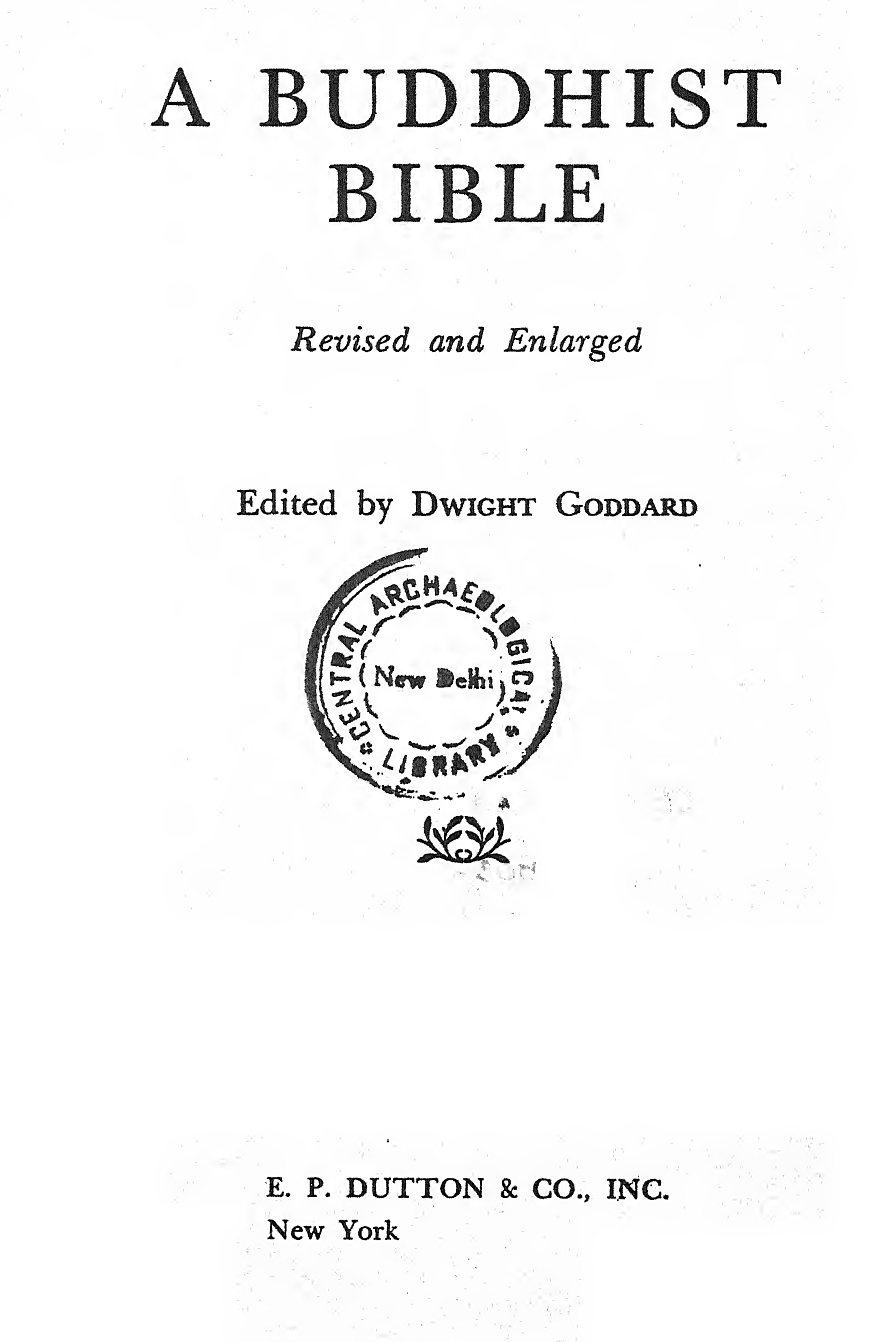
The first edition of this Buddhist Bible was published in 1932. When the need of a new edition became evident, it was decided to enlarge it so as to include other Scriptures of like importance so as to make it more comprehensive. This involved making a number of new translations for which we are indebted to Bhikshu Wai-tao. We are also indebted and are very grateful to a number of other Buddhist Scholars for permission to use their translations, as noted in the Appendix.
The compiling of a Buddhist Bible is a very different matter from compiling the Christian Bible. In the first place, there is no Hierarchy or Ecclesiastic Council to pass upon the authenticity of different scriptures, and as to their canonicity. In the second place, Christian Scriptures are a closed system of doctrines and dogmas that have been inspired by the Holy Spirit and are to be accepted in faith. Buddhism, on the contrary, is looked upon as a growing organism whose scriptures are of many kinds as the organism has developed under different racial, temporal and cultural conditions. As disciples follow the Buddha's Noble Path and practice dhyana concentration and intuitive meditation they have an unfolding experience of spiritual insight and grace which any one of them may describe and elucidate. Some of these expediences are of highest value, some of less value. Some are concerned with
the Dharma, some have to do with the rules of the Brotherhoods, some are philosophical, some psychological, some are commentaries and some are commentaries on commentaries. In the third place, there is the difference of quantity. In the Christian Bible there are sixty-six titles; Buddhist scriptures number over ten thousand, only a fraction of which have thus far been translated. In the Sung Dynasty about 972 AD a Chinese version of these scriptures was published consisting of 1521 works, in more than 5000 volumes, covering 130,000 pages.
The nearest approach to canonicity is the Pali Tripitika. That was the earliest collection and was supposed to be limited to the words of Buddha. Southern Buddhists are passionately devoted to these Pali Scriptures and are inclined to disparage and dispute the more philosophical scriptures of the Northern School that developed later after Buddhism had come in contact with other world religions in Persia, Palestine, Egypt and Greece. Under these conditions there developed in Northern India, and Kashgar, a succession of very able minds,
Ashvaghosha, Nargajuna, Vasobandhu and his brother Asangha from whose writings and teachings there developed various important schools of philosophical thought that profoundly changed the understanding of Buddha's Dharma.
Later on as Buddhism spread into China and came under the influence of its immemorial culture and practical good sense, it took on forms of Taoist naturalism and kindly humanism, and there developed forms of "salvation by faith in Amitabha's mercy" and rebirth in his Pure Land. While in Tibet, coming in contact with its ancient Bon religion, and
under the climatic conditions of its high altitudes, it took on forms of strenuousness and magic and tantric conceptions. Later on in Japan owing to political and social conditions incident to the presence of a limited but powerful noble class dominating a suppressed peasantry, which had developed extremes of loyalty and obedience and self-control, it took on forms of concentrative meditation known as Zen, and a still more widely divergent type of the True Pure Land Sect.
Naturally among these diverse conditions Buddhist scriptures vary widely, and the quantity of them being so enormous, they have become segregated into different groups as they are favored by different schools of thought and practice. The Tien-tai favor the more philosophical scriptures, the Shingon, the more esoteric, the Ch’an (Zen), the more intellectual, and the Pure Land, the more emotional. The present editor has been guided in his selection of scriptures for this Buddhist Bible by a sincere purpose to make the selection as comprehensive as possible within its limits and to represent as truly as possible the original teachings of the Blessed One both as understood by the Southern and more primitive school and by the Northern and more philosophical interpreters. He has also humbly tried to have the choice vouched for by his own spiritual experience in his practice of the Noble Path and especially during its Eighth Stage of intuitive Dhyana.
It follows, therefore, that the scriptures thus selected are the generally accepted scriptures of the Dhyana Sects—Ch’an in China, Zen in Japan and Kargyupta in Tibet. Of course among so enormous a collection of scriptures there are others that are favorites also, notably the Saddharma-pundarika (Lotus of the Perfect Law), and the Avatamsaka, said to be the grandest religious document ever written, but these are very large books in themselves. The late W. E. Soothil of London left a very careful translation of the Lotus that still waits a publisher. Dr. Suzuki of Kyoto has made a translation of the Gandhavyuha sections of the Avatamsaka that is now in process of being published. The inclusion of Laotzu’s Tao-teh-king is open to question as it is not strictly a Buddhist
text, but its teaching has such a close affinity to Buddhist teaching and nearly all early Chinese Masters of Buddhism were Taoist scholars who, upon becoming Buddhists, did not give up their Taoist conceptions and terms, and because the Laotzuan teaching in the Tao-teh-king has had such a wholesome
influence on the development of Chinese Buddhism, and, in later years, wherever the Tao-teh-king is held in reverence, it has tended to restrain individual pride of egoism, religious ceremonial, ecclesiasticism, priestcraft and insincerity generally, we make no apology for including it. In fact, it is our earnest wish that the Tao-teh-king may become one of the foundation stones of American and European Buddhism.
Further introductory notes are reserved for the Appendix
under the heads of the individual Scriptures, as are also -grateful appreciation to those who have contributed to the preparation and publication of this Bible, especially to those Buddhist scholars who have courteously granted the Editor permission to use their translations for this purpose
Just a closing word as to the rules that have guided the
Editor in his choice and handling of textual material. He has always kept in mind the spiritual needs of his readers. This Buddhist Bible is not intended to be a source book for critical literary and historical study. It is only intended to be a source of spiritual inspiration designed to awaken faith and to develop faith into aspiration and full realization. The original texts having for centuries been carried in memory and transcribed by hand by scribes who were often more loyal to their Master than to historical exactness, are often overloaded with interpolations and extensions, and in places are confused and obscure. To carry out the design of the Editor, he has omitted a great deal of matter not bearing directly upon the theme of
the particular Scripture, and has interpreted occasionally where it seemed necessary and advisable, in order to provide an easier and more inspiring reading. The need for this course will become apparent to every earnest minded disciple.
In these days when Western civilization and culture is buffeted as never before by foreboding waves of materialism and selfish aggrandisement both individual and national, Buddhism seems to hold out teachings of highest promise. For two thousand years Dhyana Buddhism has powerfully conditioned the cultural, ethical and spiritual life of the great Oriental nations. It well may be the salvation of Western civilization. Its rationality, its discipline, its emphasis on simplicity and sincerity, its thoughtfulness, its cheerful industry not for profit but for service, its love for all animate life, its restraint of desire in all its subtle forms, its actual foretastes of enlightenment and blissful peace, its patient acceptance of karma and rebirth, all mark it out as being competent to meet the problems of this excitement loving, materialistic, acquisitive and thoughtless age.
Its basic principle of an eternal process based on unchanging law and operating in eternal recurrence, leading to mind-control, to highest cognition, to purest conceptions of love and compassion, to ever clearing insight, to highest perfect wisdom, to the self-giving of Bodhisattvas, and Buddhas, to blissful peace, is worthy of confidence; and its Noble Path worthy of
The theme of this Buddhist Bible is designed to show the unreality of all conceptions of a personal ego. Its purpose is to awaken faith in Buddhahood as being one’s true self-nature; to kindle aspiration to realize one’s true Buddha-nature; to energize effort to follow the Noble Path, to become Buddha. The true response to the appeal of this Buddhist Bible is not in outward activities, but in self-yielding, becoming a clear channel for Buddhahood's indrawing compassion, that all sentient beings may become emancipated, enlightened and brought to Buddhahood. (Goddard, preface, v–viii)


The first edition of this Buddhist Bible was published in 1932. When the need of a new edition became evident, it was decided to enlarge it so as to include other Scriptures of like importance so as to make it more comprehensive. This involved making a number of new translations for which we are indebted to Bhikshu Wai-tao. We are also indebted and are very grateful to a number of other Buddhist Scholars for permission to use their translations, as noted in the Appendix.
The compiling of a Buddhist Bible is a very different matter from compiling the Christian Bible. In the first place, there is no Hierarchy or Ecclesiastic Council to pass upon the authenticity of different scriptures, and as to their canonicity. In the second place, Christian Scriptures are a closed system of doctrines and dogmas that have been inspired by the Holy Spirit and are to be accepted in faith. Buddhism, on the contrary, is looked upon as a growing organism whose scriptures are of many kinds as the organism has developed under different racial, temporal and cultural conditions. As disciples follow the Buddha's Noble Path and practice dhyana concentration and intuitive meditation they have an unfolding experience of spiritual insight and grace which any one of them may describe and elucidate. Some of these expediences are of highest value, some of less value. Some are concerned with
the Dharma, some have to do with the rules of the Brotherhoods, some are philosophical, some psychological, some are commentaries and some are commentaries on commentaries. In the third place, there is the difference of quantity. In the Christian Bible there are sixty-six titles; Buddhist scriptures number over ten thousand, only a fraction of which have thus far been translated. In the Sung Dynasty about 972 AD a Chinese version of these scriptures was published consisting of 1521 works, in more than 5000 volumes, covering 130,000 pages.
The nearest approach to canonicity is the Pali Tripitika. That was the earliest collection and was supposed to be limited to the words of Buddha. Southern Buddhists are passionately devoted to these Pali Scriptures and are inclined to disparage and dispute the more philosophical scriptures of the Northern School that developed later after Buddhism had come in contact with other world religions in Persia, Palestine, Egypt and Greece. Under these conditions there developed in Northern India, and Kashgar, a succession of very able minds,
Ashvaghosha, Nargajuna, Vasobandhu and his brother Asangha from whose writings and teachings there developed various important schools of philosophical thought that profoundly changed the understanding of Buddha's Dharma.
Later on as Buddhism spread into China and came under the influence of its immemorial culture and practical good sense, it took on forms of Taoist naturalism and kindly humanism, and there developed forms of "salvation by faith in Amitabha's mercy" and rebirth in his Pure Land. While in Tibet, coming in contact with its ancient Bon religion, and
under the climatic conditions of its high altitudes, it took on forms of strenuousness and magic and tantric conceptions. Later on in Japan owing to political and social conditions incident to the presence of a limited but powerful noble class dominating a suppressed peasantry, which had developed extremes of loyalty and obedience and self-control, it took on forms of concentrative meditation known as Zen, and a still more widely divergent type of the True Pure Land Sect.
Naturally among these diverse conditions Buddhist scriptures vary widely, and the quantity of them being so enormous, they have become segregated into different groups as they are favored by different schools of thought and practice. The Tien-tai favor the more philosophical scriptures, the Shingon, the more esoteric, the Ch’an (Zen), the more intellectual, and the Pure Land, the more emotional. The present editor has been guided in his selection of scriptures for this Buddhist Bible by a sincere purpose to make the selection as comprehensive as possible within its limits and to represent as truly as possible the original teachings of the Blessed One both as understood by the Southern and more primitive school and by the Northern and more philosophical interpreters. He has also humbly tried to have the choice vouched for by his own spiritual experience in his practice of the Noble Path and especially during its Eighth Stage of intuitive Dhyana.
It follows, therefore, that the scriptures thus selected are the generally accepted scriptures of the Dhyana Sects—Ch’an in China, Zen in Japan and Kargyupta in Tibet. Of course among so enormous a collection of scriptures there are others that are favorites also, notably the Saddharma-pundarika (Lotus of the Perfect Law), and the Avatamsaka, said to be the grandest religious document ever written, but these are very large books in themselves. The late W. E. Soothil of London left a very careful translation of the Lotus that still waits a publisher. Dr. Suzuki of Kyoto has made a translation of the Gandhavyuha sections of the Avatamsaka that is now in process of being published. The inclusion of Laotzu’s Tao-teh-king is open to question as it is not strictly a Buddhist
text, but its teaching has such a close affinity to Buddhist teaching and nearly all early Chinese Masters of Buddhism were Taoist scholars who, upon becoming Buddhists, did not give up their Taoist conceptions and terms, and because the Laotzuan teaching in the Tao-teh-king has had such a wholesome
influence on the development of Chinese Buddhism, and, in later years, wherever the Tao-teh-king is held in reverence, it has tended to restrain individual pride of egoism, religious ceremonial, ecclesiasticism, priestcraft and insincerity generally, we make no apology for including it. In fact, it is our earnest wish that the Tao-teh-king may become one of the foundation stones of American and European Buddhism.
Further introductory notes are reserved for the Appendix
under the heads of the individual Scriptures, as are also -grateful appreciation to those who have contributed to the preparation and publication of this Bible, especially to those Buddhist scholars who have courteously granted the Editor permission to use their translations for this purpose
Just a closing word as to the rules that have guided the
Editor in his choice and handling of textual material. He has always kept in mind the spiritual needs of his readers. This Buddhist Bible is not intended to be a source book for critical literary and historical study. It is only intended to be a source of spiritual inspiration designed to awaken faith and to develop faith into aspiration and full realization. The original texts having for centuries been carried in memory and transcribed by hand by scribes who were often more loyal to their Master than to historical exactness, are often overloaded with interpolations and extensions, and in places are confused and obscure. To carry out the design of the Editor, he has omitted a great deal of matter not bearing directly upon the theme of
the particular Scripture, and has interpreted occasionally where it seemed necessary and advisable, in order to provide an easier and more inspiring reading. The need for this course will become apparent to every earnest minded disciple.
In these days when Western civilization and culture is buffeted as never before by foreboding waves of materialism and selfish aggrandisement both individual and national, Buddhism seems to hold out teachings of highest promise. For two thousand years Dhyana Buddhism has powerfully conditioned the cultural, ethical and spiritual life of the great Oriental nations. It well may be the salvation of Western civilization. Its rationality, its discipline, its emphasis on simplicity and sincerity, its thoughtfulness, its cheerful industry not for profit but for service, its love for all animate life, its restraint of desire in all its subtle forms, its actual foretastes of enlightenment and blissful peace, its patient acceptance of karma and rebirth, all mark it out as being competent to meet the problems of this excitement loving, materialistic, acquisitive and thoughtless age.
Its basic principle of an eternal process based on unchanging law and operating in eternal recurrence, leading to mind-control, to highest cognition, to purest conceptions of love and compassion, to ever clearing insight, to highest perfect wisdom, to the self-giving of Bodhisattvas, and Buddhas, to blissful peace, is worthy of confidence; and its Noble Path worthy of
The theme of this Buddhist Bible is designed to show the unreality of all conceptions of a personal ego. Its purpose is to awaken faith in Buddhahood as being one’s true self-nature; to kindle aspiration to realize one’s true Buddha-nature; to energize effort to follow the Noble Path, to become Buddha. The true response to the appeal of this Buddhist Bible is not in outward activities, but in self-yielding, becoming a clear channel for Buddhahood's indrawing compassion, that all sentient beings may become emancipated, enlightened and brought to Buddhahood. (Goddard, preface, v–viii)
An error occurred during the storage process. Message reads Property "RktsAltTitles" (as page type) with input value "bcom ldan 'das kyi gtsug gtor chen po de bzhin gshegs pa'i gsang ba sgrub pa'i don mngon par thob pa'i rgyu byang chub sems dpa' thams cad kyi spyod pa dpa' bar 'gro ba'i mdo le'u stong phrag bcu pa las le'u bcu pa (A C Cz Dd Dk Gt L N Np Pj Pz Q R S Ty U V)" contains invalid characters or is incomplete and therefore can cause unexpected results during a query or annotation process.