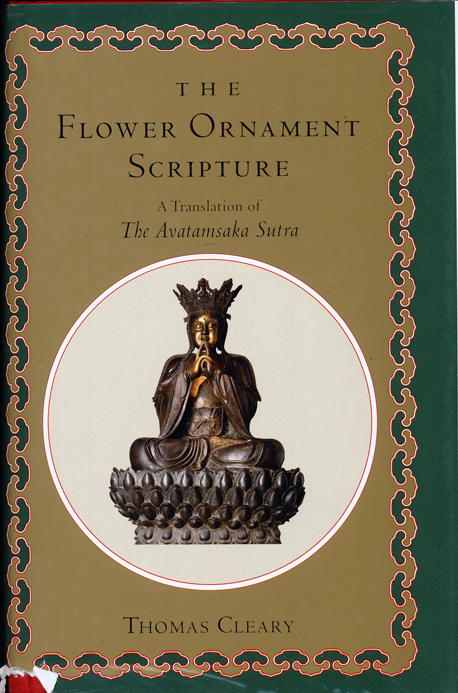
The Flower Ornament Scripture: A Translation of The Avatamsaka Sutra
From Bodhicitta
< BooksBooks/The Flower Ornament Scripture: A Translation of The Avatamsaka Sutra
| 🤓 Admin Zone 🛠️ hidden to non-admins | |
The Flower Ornament Scripture: A Translation of The Avatamsaka Sutra
Book
- A Few Good Men
- A Treasury of Mahāyāna Sūtras
- Abiding in Good and Noble Deportment
- Appendix to the New Edition of the Bodhicaryāvatāra
- Buddha Pronounces the Sūtra of the Great Cundī Dhāraṇī
- Chapter on Entering the Inconceivable Liberated State of Samantabhadra's Practices and Vows
- Dialogue With Bodhisattva Infinite Wisdom
- Mahāvaipulya Sūtra of the Tathāgata Store
- Myōhō-renge-kyō
- On Entering into the Inconceivable State of Emancipation by the Practice and Vows of the Bodhisattva Samantabhadra of the Mahavaipulya Buddha Avatamsaka Sutra
- On the Pāramitā of Ingenuity
- Scripture of the Lotus Blossom of the Fine Dharma
- The Buddhist Feminine Ideal
- The Definitive Vinaya
- The Dhâranî of Tchundi
- The Diamond Cutter of Doubts: A Commentary on The Diamond Sūtra (Vajracchedikā-prajñā-pāramitā Sūtra) By Ch'an Master Han Shan
- The Diamond Prajna Paramita Sutra
- The Diamond Prajna-Paramita Sutra
- The Diamond Sutra (Chin-Kang-Ching), or Prajna-Paramita
- The Diamond Sutra (Hsüan Hua)
- The Diamond Sutra (Wai-tao and Goddard)
- The Diamond Sutra and The Sutra of Hui Neng
- The Diamond Sutra: The Perfection of Wisdom
- The Diamond Sutra: Translated from Kumarajiva's Chinese Version
- The Diamond That Cuts Through Illusion
- The Essentials of the Dharma Blossom Sutra
- The Flower Ornament Scripture: A Translation of The Avatamsaka Sutra
- The Giving Rise of the Ten Kinds of Mind of the Bodhisattva
- The Great Vows of Samantabhadra
- The Healing Buddha (1979)
- The Healing Buddha (1989)
- The Lankavatara Sutra: A Zen Text
- The Lion's Roar of Queen Śrīmālā
- The Lotus Sutra (2016) (BDK)
- The Lotus Sutra (Watson)
- The Lotus Sutra: A Contemporary Translation of a Buddhist Classic
- The Lotus Sutra: The Sutra of the Lotus Flower of the Wonderful Dharma
- The Lotus of the Wonderful Law or The Lotus Gospel (2005)
- The Mahayana Mahaparinirvana-sutra (3 vols.)
- The Pratyutpanna Samādhi Sutra: The Śūraṅgama Samādhi Sutra
- The Prediction of Mañjuśrī's Attainment of Buddhahood
- The Scripture of Master of Medicine, Beryl Radiance Tathāgata and The Sutra of the Girl Candrottarā
- The Shurangama Sutra - Volume Eight
- The Shurangama Sutra - Volume Five
- The Shurangama Sutra - Volume Four
- The Shurangama Sutra - Volume One
- The Shurangama Sutra - Volume Seven
- The Shurangama Sutra - Volume Six
- The Shurangama Sutra - Volume Three
- The Shurangama Sutra - Volume Two
- The Shurangama Sutra: Sutra Text and Supplements
- The Skill in Means (Upāyakauśalya) Sūtra
- The Sky as a Mahāyāna Symbol of Emptiness and Generous Fullness: A Study and Translation of the Gaganagañjaparipṛcchā: Volume 2: Edition and Translation
- The Sutra of Queen Śrīmālā of the Lion's Roar and the Vimalakīrti Sutra
- The Sutra of the Lord of Healing
- The Sutra of the Master of Healing
- The Tale of King Udayana of Vatsa
- The Threefold Lotus Sūtra
- The True Lion's Roar of Queen Śrīmālā
- The Vimalakirti Nirdesa Sutra
- The Vimalakīrti Sūtra (Watson)
- The Vow to Live the Life of Samanta-bhadra
- The Vows of Bodhisattva Samantabhadra Sutra
- The Śūraṅgama Sūtra: A New Translation
- Vaipulya Sūtra of Śrīmālā's Lion's Roar That Reveals the Great Skillful Means of the One Vehicle
- Vajra-chhedika, the "Kin Kong King," or Diamond Sutra
- Vimalakīrti's Discourse on Emancipation
- Vimalakīrti-Nirdeśa-Sūtra: Translated from the Chinese
Please note that many items in our library are simply pages that represent a detailed library catalog entry and citation of someone else's work, presentation, or performance. Read our General Disclaimer for more information.

Description
Known in Chinese as Hua-yen and in Japanese as Kegon-kyo, the Avatamsaka Sutra, or Flower Ornament Scripture, is held in the highest regard and studied by Buddhists of all traditions. Through its structure and symbolism, as well as through its concisely stated principles, it conveys a vast range of Buddhist teachings.
This one-volume edition contains Thomas Cleary's definitive translation of all thirty-nine books of the sutra, along with an introduction, a glossary, and Cleary's translation of Li Tongxuan's seventh-century guide to the final book, the Gandavyuha, "Entry into the Realm of Reality." (Source: Shambhala Publications)
Citation
Cleary, Thomas, trans. The Flower Ornament Scripture: A Translation of The Avatamsaka Sutra. Boulder, CO: Shambhala Publications, 1993. https://archive.org/details/avatmaskasutratheflowerornamentscripturethomascleary_300_e.
Table of contents
- Introduction1
- 1. The Wonderful Adornments of the Leaders of the Worlds55
- 2. Appearance of the Buddha150
- 3. The Meditation of the Enlightening Being Universally Good176
- 4. The Formation of the Worlds182
- 5. The Flower Bank World202
- 6. Vairocana254
- 7. Names of the Buddha270
- 8. The Four Holy Truths276
- 9. Awakening by Light282
- 10. An Enlightening Being Asks for Clarification298
- 11. Purifying Practice312
- 12. Chief in Goodness330
- 13. Ascent to the Peak of Mount Sumeru368
- 14. Eulogies on Mount Sumeru371
- 15. Ten Abodes384
- 16. Religious Practice401
- 17. The Merit of the Initial Determination for Enlightenment404
- 18. Clarifying Method425
- 19. Ascent to the Palace of the Suyama Heaven438
- 20. Eulogies in the Palace of the Suyama Heaven441
- 21. Ten Practices454
- 22. Ten Inexhaustible Treasuries485
- 23. Ascent to the Palace of the Tushita Heaven497
- 24. Eulogies in the Tushita Palace516
- 25. Ten Dedications530
- 26. The Ten Stages695
- 27. The Ten Concentrations812
- 28. The Ten Superknowledges863
- 29. The Ten Acceptances870
- 30. The Incalculable889
- 31. Life Span905
- 32. Dwelling Places of Enlightening Beings906
- 33. Inconceivable Qualities of Buddhas908
- 34. The Ocean of Physical Marks of the Ten Bodies of Buddha933
- 35. The Qualities of the Buddha's Embellishments and Lights946
- 36. The Practice of Universal Good952
- 37. Manifestation of Buddha970
- 38. Detachment from the World1022
- 39. Entry into the Realm of Reality1135
- Appendix 1: Technical Terminology and Symbolism in The Flower Ornament Scripture1521
- Appendix 2: Amplifications of Book 391535
- Appendix 3: Commentary on Book 39 by Li Tongxuan1545
- Glossary1631
Interconnections
1 Full translation of

One of the longest works in the entire Buddhist canon, the Buddhāvataṃsakasūtra is widely considered to be a compilation of independent scriptures, which was expanded upon over the course of time. It was extremely influential in East Asia, where it was preserved in an eighty-scroll recension. The Tibetan translation of this work fills four volumes in the Derge Kangyur. Though only two sections—namely, the Gaṇḍavyūhasūtra and the Daśabhūmikasūtra—have survived in Sanskrit, both of which have also circulated as independent works.