The Vajracchedikā in the Old Khotanese Version of Eastern Turkestan
| 🤓 Admin Zone 🛠️ hidden to non-admins | |
Description
This edition of the Vajracchedikā is based on a complete manuscript which belongs to the treasures brought back by Sir Aurel Stein from the cave temples at the 'Halls of the Thousand Buddhas' to the south-east of Tunhuang.[1]
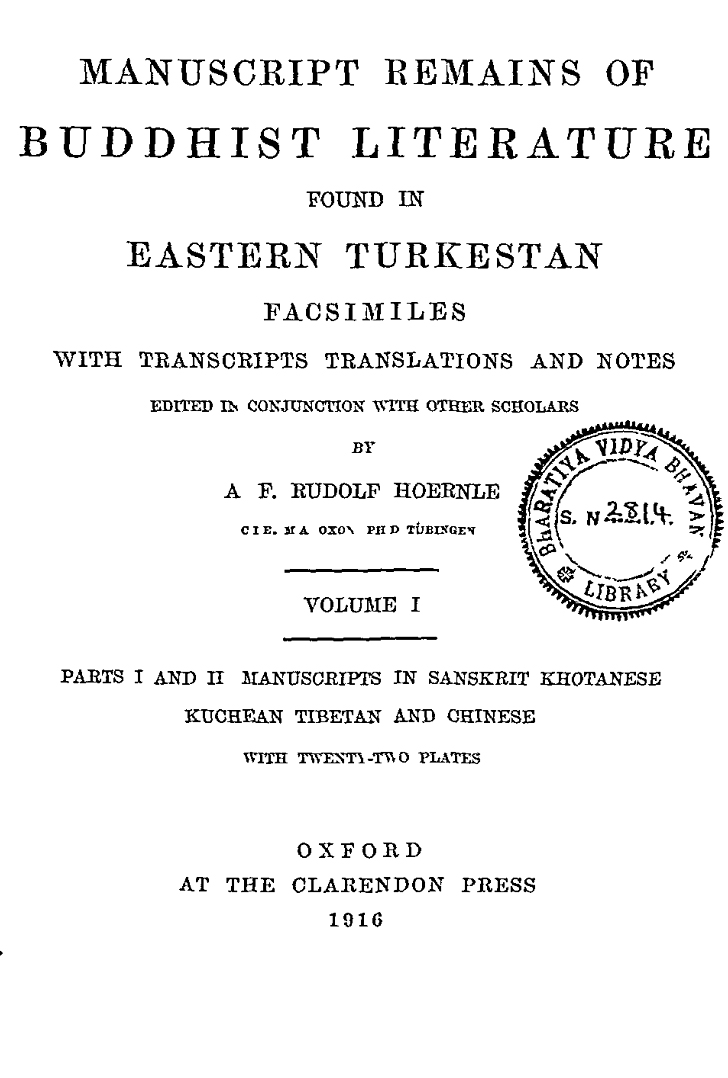
The manuscript was first brought to notice by Dr. Hoernle, who describes it as follows:[2]
- 'The manuscript of the Vajracchedikā consists of forty-four leaves, measuring about 26.0 x 7.3 cm. (or 10 x 2 7/8 inches), with four lines of large writing in the upright Gupta type of Eastern Turkestani characters. It is, however, not quite complete: only thirty-three leaves survive; fols. 11–14, 16–19, 39, 41 and 43, altogether eleven, are missing. The folio numbers are on the obverse sides. The text commences, on the reverse of the first folio, with a circlet in the upper right corner, followed by saddham. The centre of the page is occupied by a large figure of the seated Buddha within two concentric circles. The obverse of the first folio is filled with a disorderly mass of writing in cursive characters of varying sizes, among which the words Kalpa-rāja-sūtra and Vajara-chaidaki-prajñāpārā-saddham are legible. The reverse of the last folio has three lines, and in the centre another large figure of the seated Buddha within concentric circles. The first line gives the colophon haḍi Vajrrachedaka ttṛśayä Prajñāpārāṁma samāsye II . . . Then, after a broad intervening blank space, follow the other two lines, which read saddham Vajrrachidakyi hīya ttādi, &e.[1] The manuscript commences with a long introduction in the "unknown language", of which there is no Sanskrit equivalent in Max Müller's edition.[2] The text itself of the Vajracchedikā begins only with the second line of the reverse of the third folio, where its beginning is indicated by a circlet followed by saddham, exactly like that at the commencement of the whole manuscript.'
To this description I have only to add that fol. 38 is not in the same handwriting as the rest, and that the missing leaves, 11-14, 16-19, 39, 41 and 43 have subsequently turned up. After my edition of the text and my translation and vocabulary had been ready in proof for some time, I received from Dr. Hoernle eleven manuscript leaves, which had likewise been found in the Tunhuang caves, but not in the same place as the Vajracchedikā manuscript. Dr. Hoernle thought that they might belong to another manuscript of the same text. When examining them, however, I soon realized that they were the missing leaves of the old manuscript, and I am accordingly in a position to publish the first complete text in the old Iranian language of Eastern Turkestan. (Konow, introduction, 214–15) Read more here
Notes
- See M. Aurel Stein, Explorations in Central Asia, 1906-8. Reprinted from the Geographical Journal for July and September, 1909, pp. 39 and ff. Also, his Ruins of Desert Cathay, Vol. ii, pp. 24 and ff. It appears to have been found separated into two portions, which were placed by Sir Aurel Stein in two bundles, one marked Ch. 00275 and containing fols. 1-10, 15, 20-38, 40, 42, 44, the other marked Ch. xlvi. 0012 A, and comprising fol. 11-14, 16-19, 39, 1, 43. The fact that the two bundles contained portions of the same text was recognized by Dr. Hoernle only in the course of a lengthy examination of the manusripts recovered by Sir Aurel Stein. When this took place, the contents of the first bundle had already been reproduced in Plates V-XI. Consequently the folios of the second bundle could not be made to appear in their proper places, but are shown in Plates XII-XIV.
- Journal of the Koyal Asiatic Society, 1910, pp. 836 and f. I have introduced my own reading of the text words.
- In the left-hand margin is another small seated Buddha within two concentric circles.
- Anecdota Oxoniensia. Aryan Series, Vol. i, Part 1. Buddhist Texts from Japan, edited by F. Max Muller, M.A., Oxford, 1881.