| 🤓 Admin Zone 🛠️ hidden to non-admins | |
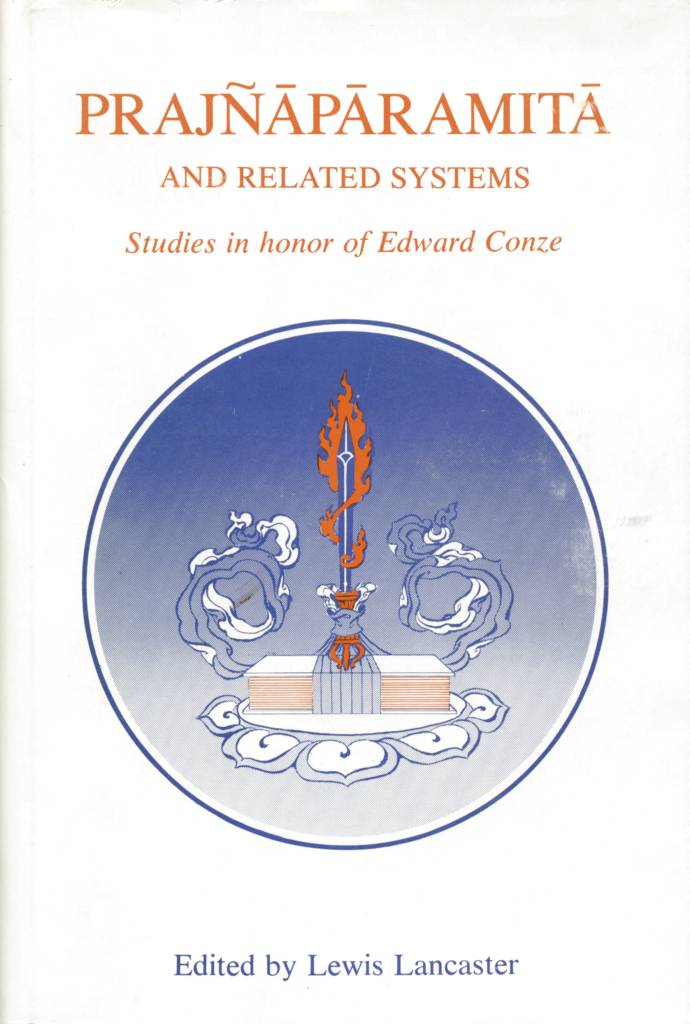
Prajñāpāramitā and Related Systems: Studies in Honor of Edward Conze
Book
Please note that many items in our library are simply pages that represent a detailed library catalog entry and citation of someone else's work, presentation, or performance. Read our General Disclaimer for more information.

Description
In this volume scholars from around the world honor Dr. Edward Conze, one of the most important figures in Buddhist Studies in this century. His contribution has been mainly centered around the family of texts known as the Prajnaparamita. These articles deal with this literature and the systems of thought related to it.
Citation
Lancaster, Lewis R., and Luis O. Gómez, eds. Prajñāpāramitā and Related Systems: Studies in Honor of Edward Conze. Berkeley Buddhist Studies Series 1. Institute of Buddhist Studies. Berkeley: University of California, 1977.
Table of contents
- Forwardix
- Abbreviationsxi
- List of Contributorsxv
- I Aṣṭasāhasrikā
- The Position of the Aṣṭasāhasrikā Prajñāpāramitā in the Development of Early Mahāyāna by Andrew Rawlinson 3
- Textgeschichtliche Beobachtungen zum 1. Kapitel der Aṣṭasāhasrikā Prajñāpāramitā by Lambert Schmithausen 35
- II Vajracchedikā
- The Concluding Verses of the Khotanese Vajracchedika. by R. E. Emmerick83
- "Thus Spoke the Blessed One ... " by Yuichi Kajiyama93
- III Hrdaya
- Hsuän-tsang (602-664) and the Heart Scripture by Leon Hurvitz103
- The Heart Sutra in Japanese Context by Michael Pye123
- Secret of the Heart Sutra by Alex Wayman135
- Mahāprajñāpāramitā-sūtra by H. W. Bailey153
- A Study of a Khotanese Prajñāpāramitā Text: After the Work of Sir Harold Bailey by L. Lancaster163
- IV Suvikrāntavikrāmipariprcchā
- Notes on Prajñāpāramitā texts: The Suvikrāntavikrāmipariprcchā by J. W. de Jong187
- V Prajñāpāramitāratnaguṇasaṃcayagāthā
- VI The Bodhisattva Tradition
- The Bodhisattva as Wonder-worker by Luis O. Gomez221
- The Bodhisattva Ideal in the Aṣṭa and Pañca Prajñāpāramitā Sūtras by Nancy R. Lethcoe263
- VII The Ekayāna Tradition
- The Gotra, Ekayāna and Tathāgatagarbha Theories of the Prajñāpāramitā according to Dharmamitra and Abhayākaragupta by D. Seyfort Ruegg 283
- Some Aspects of the Ekayāna by Arnold Kunst 313
- VIII The Mahāyāna Developments
- Notes on the Vision Quest in Early Mahayana Stephan Beyer329
- Another Look at the Mādhyamika versus Yogācāra Controversy Concerning Existence and Non-existence Jay Hirabayashi and Shotaro Iida341
- Mahayana Literature in Sri Lanka: The Early Phase Heinz Bechert361
- IX Related Systems
- A Note on Evil and its Conquest from Indra to Buddha by W. B. Bollee371
- Jñānaśrīmitra' s Sarvajñasiddhiḥ by Ernst Steinkellner383
- Mystery and Mysticism by Geoffrey Parrinder395
- Prajñā and dṛṣṭi in the Vaibhāṣika Abhidharma by Padmanabh S. Jaini403
- Plates
- The Works of Edward Conze
- Index
Interconnections
1 Contains chapter or part

No abstract given. Here are the first relevant paragraphs:
In the course of his monumental work on the Prajñāpāramitā Sūtras E. Conze has written: 'It is quite a problem how the Dharma-element which is common to all can be regarded as the source of a variety of "lineages" [gotra]'.[1] It has been the endeavour of the present writer in a series of publications starting in 1968 to shed light on this very fundamental and interesting question. An article in the Festschrift dedicated to the late E. Frauwallner was devoted to the interconnexion between the single, unique and undifferentiated dharmadhātu, the naturally existent spiritual element or germ (prakṛtisthaṃ gotram) and the variously conditioned psycho-spiritual categories (gotra)[2] recognized by the Buddhist texts as explained by Ārya Vimuktisena (ca. 500 ?) and his successor Bhadanta Vimuktisena in their commentaries on the Abhisamayālaṃkāra (i. 37-39), which they correlate with the topics of the Pañcaviṃśatisāhasrikā Prajñāpāramitā.[3] And shortly afterwards there followed a more detailed study of this question as it relates to the notion of the tathāgatagarbha or buddha-nature in La théorie du tathāgatagarbha et du gotra: Études sur ta sotériologie et la gnoséologie du bouddhisme (Paris, 1969) and Le traité du tathāgatagarbha de Bu ston Rin chen grub (Paris, 1973). In the last publications Haribhadra's commentaries on the Prajñāpāramitā were discussed, and the importance of the doctrine of the One Vehicle (ekayāna), was taken up at some length not only from the point of view of soteriology but also from that of gnoseology
Between the two Vimuktisenas and Haribhadra (fl. c. 750-800) on the one side and the Tibetan exegetes on the other there lived a number of important Indian commentators whose work could be only briefly touched on in the Théorie. Amongst the most important of these later Indian masters of the Prajñāpāramitā are Dharmamitra and Abhayākaragupta, both of whom have been reckoned by Buddhist doxographers as being, for certain systematic reasons, close to the Svātantrika-Mādhyamika school, and Ratnākaraśānti (first half of the 11th century), a Vijñānavādin (of the Alīkākāravāda branch) who appears to have undertaken a harmonization of the Vijñānavāda and the Madhyamaka in the manner of the synthesizing movements especially characteristic of later Buddhist thought in India.
One of Ratnākaraśānti's main works on the Prajñāpāramitā—the Sārottamā (or Sāratamā ?), a Pañjikā on the Aṣṭasāhasrikā, which until recently was known only by its Tibetan version in the Bstan 'gyur—has now been recovered in an incomplete Sanskrit manuscript. Since the promised publication of this text is awaited with keenest interest by students of this literature, his work must be left for another occasion.[4] The present paper will therefore consider the discussions by Dharmamitra and Abhayākaragupta of the relation between the gotra, the dharmadhātu, the ekayāna, and the tathāgatagarbha. (Ruegg, "The Gotra, Ekayāna and Tathāgatagarbha Theories of the Prajñāpāramitā," 283–284)
In the course of his monumental work on the Prajñāpāramitā Sūtras E. Conze has written: 'It is quite a problem how the Dharma-element which is common to all can be regarded as the source of a variety of "lineages" [gotra]'.[1] It has been the endeavour of the present writer in a series of publications starting in 1968 to shed light on this very fundamental and interesting question. An article in the Festschrift dedicated to the late E. Frauwallner was devoted to the interconnexion between the single, unique and undifferentiated dharmadhātu, the naturally existent spiritual element or germ (prakṛtisthaṃ gotram) and the variously conditioned psycho-spiritual categories (gotra)[2] recognized by the Buddhist texts as explained by Ārya Vimuktisena (ca. 500 ?) and his successor Bhadanta Vimuktisena in their commentaries on the Abhisamayālaṃkāra (i. 37-39), which they correlate with the topics of the Pañcaviṃśatisāhasrikā Prajñāpāramitā.[3] And shortly afterwards there followed a more detailed study of this question as it relates to the notion of the tathāgatagarbha or buddha-nature in La théorie du tathāgatagarbha et du gotra: Études sur ta sotériologie et la gnoséologie du bouddhisme (Paris, 1969) and Le traité du tathāgatagarbha de Bu ston Rin chen grub (Paris, 1973). In the last publications Haribhadra's commentaries on the Prajñāpāramitā were discussed, and the importance of the doctrine of the One Vehicle (ekayāna), was taken up at some length not only from the point of view of soteriology but also from that of gnoseology
Between the two Vimuktisenas and Haribhadra (fl. c. 750-800) on the one side and the Tibetan exegetes on the other there lived a number of important Indian commentators whose work could be only briefly touched on in the Théorie. Amongst the most important of these later Indian masters of the Prajñāpāramitā are Dharmamitra and Abhayākaragupta, both of whom have been reckoned by Buddhist doxographers as being, for certain systematic reasons, close to the Svātantrika-Mādhyamika school, and Ratnākaraśānti (first half of the 11th century), a Vijñānavādin (of the Alīkākāravāda branch) who appears to have undertaken a harmonization of the Vijñānavāda and the Madhyamaka in the manner of the synthesizing movements especially characteristic of later Buddhist thought in India.
One of Ratnākaraśānti's main works on the Prajñāpāramitā—the Sārottamā (or Sāratamā ?), a Pañjikā on the Aṣṭasāhasrikā, which until recently was known only by its Tibetan version in the Bstan 'gyur—has now been recovered in an incomplete Sanskrit manuscript. Since the promised publication of this text is awaited with keenest interest by students of this literature, his work must be left for another occasion.[4] The present paper will therefore consider the discussions by Dharmamitra and Abhayākaragupta of the relation between the gotra, the dharmadhātu, the ekayāna, and the tathāgatagarbha. (Ruegg, "The Gotra, Ekayāna and Tathāgatagarbha Theories of the Prajñāpāramitā," 283–284)
Notes
- E. Conze, The Large Sūtra on Perfect Wisdom (London 1961), p. 105 note 2. References hereunder to the folios of Tibetan translations of Indian texts contained in the Bstan 'gyur relate to the Peking edition as reproduced in the Japanese reprint published by the Tibetan Tripiṭaka Research Institute (Tokyo and Kyoto). Prints of other editions of the Bstan 'gyur were unfortunately unavailable during the writing of the present paper.
- On the meanings of the term gotra, and in particular on the two meanings '(spiritual) element, germ, capacity' and '(spiritual) lineage, class, category' which might be described respectively as the intensional and extensional meanings of the word when the gotra as germ determines the classification of persons possessing it in a gotra as category, see the present writer's article in BSOAS 39 (1976) p. 341sq.
- "Ārya and Bhadanta Vimuktisena on the gotra-theory of the Prajñāpāramitā," Beitriige zur Geistesgeschichte Indiens (Festschrift fur Erich Frauwallner), WZKSO 12-13 (1968/1969), pp. 303–317.
4. Ratnākaraśānti's other work on the subject, a commentary on the AA entitled Śuddhimatī, (or: Śuddhamatī) will be referred to below.
4 Scholarship on

The Perfection of Wisdom in Eight Thousand Lines, like other sūtras on the Perfection of Wisdom, deals with the topic of emptiness and the understanding of the ultimate truth or the way things are. Modern scholars date the sūtra roughly to the 2nd and 1st century BC and consider it to be the earliest sūtra on which other Perfection of Wisdom sūtras are based. Its adherents claim the sūtra to be a part of the words of the Buddha. It is believed to have been taken to the subterranean world and brought back to the human world by Nāgārjuna. It is sometimes known as the Condensed Mother (ཡུམ་བསྡུས་པ་), the term Mother referring to the Perfection of Wisdom which gives rise to all buddhas and bodhisattvas. It is said to be the condensed version of the long version in one hundred thousand lines and the middle version in twenty-five thousand lines. Having spread across Asia and beyond and having been translated into many languages, it is one of the most common books to be found in the Buddhist Himalayas.
The sūtra takes the form of a series of dialogues between the Buddha Śākyamuni, Subhūti, Śāriputra, and others, such as Indra, the king of gods, and a goddess of the Ganges. In the final chapters, the sūtra contains the inspirational narratives of Sadāprarudita and his quest for the teachings on the Perfection of Wisdom from the Bodhisattva Dharmodgata. The sūtra is also one of the earliest Mahāyāna sources proclaiming the luminous nature of the mind.
One of the most revered and recited scriptures of the perfection of wisdom genre (prajñāpāramitāsūtras), perhaps second only to the Heart Sūtra, both of which became especially popular in the East Asian Buddhist traditions. It is a crucial source for Mahāyāna tenets of selflessness and the emptiness of phenomena, and its discourse is framed as an explanation of how to enter into the vehicle of the bodhisattvas by developing and sustaining their enlightened perspective.

The Perfection of Wisdom in 25,000 Lines is the second longest of the six ‘mother’ Prajñāpāramitā texts (yum drug). It comprises three entire volumes of the Kangyur (vols. 26-28) and is divided into 76 chapters relating dialogues between the Buddha and senior disciples, notably Śāriputra, Subhūti and Ānanda.
With some exceptions, the text parallels the structure of the other Perfection of Wisdom sūtras, especially the Prajñāpāramitā in 10,000 Lines, yet it has traditionally been regarded as more influential, analyzing the bodhisattvas’ transcendent perfections in considerably greater detail, and showing how bodhisattvas should practise them without ever considering either their practice, or any other phenomena whatsoever, as truly existing.
An original Sanskrit version found in Gilgit exists, as well as four distinct Chinese translations. There is also an important recast Sanskrit manuscript, possibly of 5th century origin, which divides the text according to the eight sections of Asaṅga-Maitreya’s famous treatise, the Abhisamayālaṃkāra. The Tibetan text dates from the 9th century. There are several important commentaries on the text in the Tengyur, by Haribhadra, Smṛtijñānakīrti, Vimuktasena and others. (Source: 84000)
Rattnaguṇasaṃcayagāthā. (T. Yon tan rin po che sdud pa tshigs su bcad pa; C. Fomu baodezang bore boluomi jing; J. Butsumo hōtokuzō hannya haramitsukyō; K. Pulmo podǒkchang panya paramil kyǒng 佛母寶德藏般若波羅蜜經. In Sanskrit, "Verses on the Collection of Precious Qualities," the longer title is Prajñāpāramitāratnaguṇasaṃcayagāthā, or "Verses on the Collection of the Precious Qualities of the Perfection of Wisdom." The Ratnaguṇasaṃcayagāthā epitomizes the early Mahāyāna in its emphasis on the emptiness (śūnyatā) of the aggregates (skandha) and its praise of the path of the bodhisattva over that of the arhat. The text is considered to be of particular importance in the history of the Mahāyāna because many of its verses, particularly those that appear early in the text, may represent some of the earliest expressions of Mahāyāna philosophy and may date as far back as 100 BCE. Another indication of the text’s antiquity is that it was translated into Chinese as early as the second century CE. The only extant Sanskrit version is that edited in the eighth century by Haribhadra to conform to the structure of the Abhisamayālaṃkāra, making the precise order of the original verses difficult to determine. Many Mahāyāna sūtras are composed of alternating verse and prose. The verses of the Ratnaguṇasaṃcayagāthā are written in an ancient meter, suggesting to some that they constitute part of an original sūtra, with the Aṣṭasāhasrikāprajñāpāramitā ("Perfection of Wisdom in Eight Thousand Lines") supplying the prose section. However, because the verses that appear in the Ratnaguṇasaṃcayagāthā are not in all cases identical to those in the Aṣṭasāhasrikā, the Ratnaguṇasaṃcayagāthā may have originally been a separate work. It appears as the verse recapitulations in the Chinese translation of the Aṣṭasāhasrikā and as the eighty-fourth chapter of the Aṣṭadaśasāhasrikāprajñāpāramitā ("Perfection of Wisdom in Eighteen Thousand Lines") in its Tibetan translation. (Source: "Ratnaguṇasaṃcayagāthā." In The Princeton Dictionary of Buddhism, 702. Princeton University Press, 2014. http://www.jstor.org/stable/j.ctt46n41q.27.)
Categories:
- Library Items
- Books
- Lancaster, L.
- Gómez, L.
- Iida, S.
- Wayman, A.
- Beyer, S.
- Steinkellner, E.
- Ruegg, D.
- Bechert, H.
- Schmithausen, L.
- Yuyama, A.
- Kajiyama, Y.
- Rawlinson, A.
- Bailey, H.
- Bollée, W.
- De Jong, J. W.
- Emmerick, R.
- Hurvitz, L.
- Pye, M.
- Lethcoe, N.
- Kunst, A.
- Hirabayashi, J.
- Parrinder, G.
- Jaini, P.
- University of California Press
- Institute of Buddhist Studies
- Decade: 1970s