The Heart of Buddhist Wisdom (Jones 2012)
From Bodhicitta
< BooksBooks/The Heart of Buddhist Wisdom (Jones 2012)
| 🤓 Admin Zone 🛠️ hidden to non-admins | |
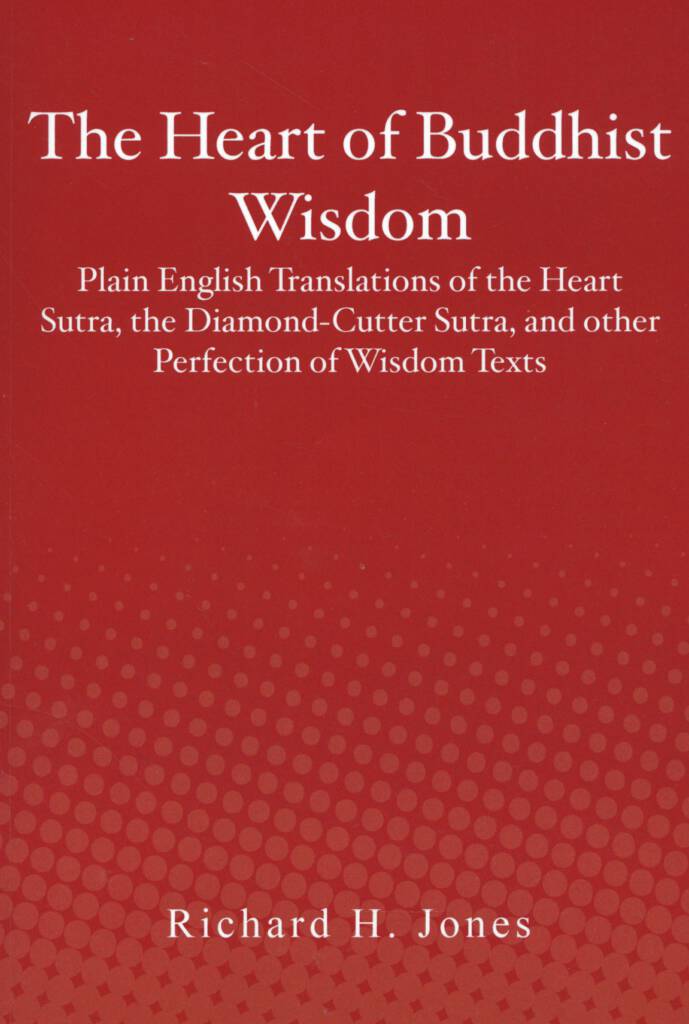
The Heart of Buddhist Wisdom: Plain English Translations of the Heart Sutra, the Diamond-Cutter Sutra, and other Perfection of Wisdom Texts
Book
Please note that many items in our library are simply pages that represent a detailed library catalog entry and citation of someone else's work, presentation, or performance. Read our General Disclaimer for more information.
-front.jpg)
Description
This book consists of revised selections from the 1975 edition of Edward Conze's The Large Sutra on Perfect Wisdom and his 1973 edition of The Perfection of Wisdom.
Citation
Jones, Richard H. The Heart of Buddhist Wisdom: Plain English Translations of the Heart Sutra, the Diamond-Cutter Sutra, and other Perfection of Wisdom Texts. New York: Jackson Square Books, 2012.
Table of contents
- Preface iv
- 1. Translations
- The Collection of the Highest Qualities 3
- Abridgment of the Perfection of Wisdom in 8,000 Lines 42
- Selections from The Large Sutra in the Perfection of Wisdom 105
- The Perfection of Wisdom in 700 Lines 137
- The Diamond-Cutter Sutra 172
- The Heart Sutra 197
- 2. Commentaries
- The Philosophy of the Perfection of Wisdom 207
- Logic and Paradox: An Excursion into Nonsense? 220
- The Heart Sutra: Form is Emptiness 224
- Key Terms for Understanding the Perfection of Wisdom 227
- References and Other Works 231
- Index 233
Interconnections
4 Related

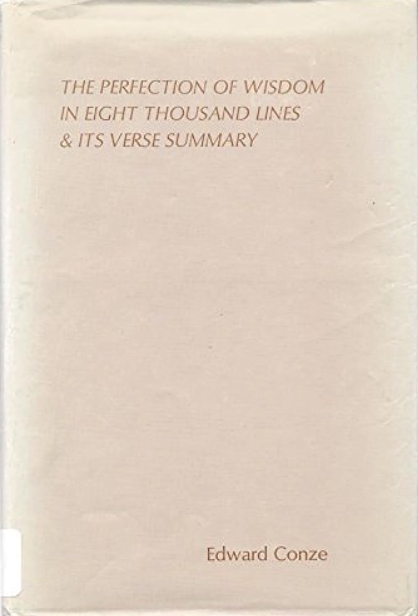
The Perfection of Wisdom in Eight Thousand Lines, like other sūtras on the Perfection of Wisdom, deals with the topic of emptiness and the understanding of the ultimate truth or the way things are. Modern scholars date the sūtra roughly to the 2nd and 1st century BC and consider it to be the earliest sūtra on which other Perfection of Wisdom sūtras are based. Its adherents claim the sūtra to be a part of the words of the Buddha. It is believed to have been taken to the subterranean world and brought back to the human world by Nāgārjuna. It is sometimes known as the Condensed Mother (ཡུམ་བསྡུས་པ་), the term Mother referring to the Perfection of Wisdom which gives rise to all buddhas and bodhisattvas. It is said to be the condensed version of the long version in one hundred thousand lines and the middle version in twenty-five thousand lines. Having spread across Asia and beyond and having been translated into many languages, it is one of the most common books to be found in the Buddhist Himalayas.
The sūtra takes the form of a series of dialogues between the Buddha Śākyamuni, Subhūti, Śāriputra, and others, such as Indra, the king of gods, and a goddess of the Ganges. In the final chapters, the sūtra contains the inspirational narratives of Sadāprarudita and his quest for the teachings on the Perfection of Wisdom from the Bodhisattva Dharmodgata. The sūtra is also one of the earliest Mahāyāna sources proclaiming the luminous nature of the mind.

Upāyakauśalyasūtra. (T. Thabs la mkhas pa'i mdo; C. Dasheng fangbian hui; J. Daijō hōben'e; K. Taesǔng pangp'yǒn hoe 大乘方便會). In Sanskrit, "Skillful Means Sūtra," an early Mahāyāna sūtra included in the Ratnakūṭasūtra collection, where it is also known as the Jñānottarabodhisattvaparipṛcchā. (In addition to the recension embedded in the 410 CE Chinese translation of the Ratnakūṭa, as transcribed above, there are also two other Chinese translations, one made in 285 CE, the other c. 980.) The first part of the sūtra extols the virtues of the practice of "skillful means" (upāyakauśalya), generally understood in this context to refer to the dedication of the merit from a virtuous deed, such as offerings made for the welfare and ultimate enlightenment of all beings. The sūtra goes on to explain how apparently nonvirtuous acts, such as sexual misconduct, become virtues when performed by a bodhisattva with skillful means, noting, "Something that sends other sentient beings to hell sends the bodhisattva who is skilled in means to rebirth in the world of Brahmā." Also recounted is the famous story of the Buddha's previous life as a ship captain, when he kills a potential murderer in order to save others' lives. In the second part of the sūtra, the Buddha recounts the events of his life (see Baxiang), from his entry into his mother's womb to his decision to teach the dharma as instances of his skillful means; none of these events are presented as the consequences of his own past nonvirtuous actions or indeed of any fault whatsoever on his part. For example, after his enlightenment, the Buddha has no hesitation to teach the dharma; nonetheless, he compels the god Brahmā to descend from his heaven to implore the Buddha to teach. He forces this act so that beings who worship Brahmā will have faith in the Buddha and so that the myriad forms of the god Brahmā will generate bodhicitta. The sūtra concludes with a discussion of ten cases in the life of the Buddha in which he apparently undergoes suffering (such as a headache, backache, and being pierced by a thorn) that had previously been ascribed to his nonvirtuous deeds in a past life; in each case, these are instead explained as being examples of the Buddha's skillful means. (Source: "Upāyakauśalyasūtra." In The Princeton Dictionary of Buddhism, 943. Princeton University Press, 2014. http://www.jstor.org/stable/j.ctt46n41q.27.)
One of the most revered and recited scriptures of the perfection of wisdom genre (prajñāpāramitāsūtras), perhaps second only to the Heart Sūtra, both of which became especially popular in the East Asian Buddhist traditions. It is a crucial source for Mahāyāna tenets of selflessness and the emptiness of phenomena, and its discourse is framed as an explanation of how to enter into the vehicle of the bodhisattvas by developing and sustaining their enlightened perspective.

After the Torah, the Koran and the Gospels, the Indian literature of the Perfection of Wisdom has had the greatest impact on the religious consciousness of mankind. Its composition extended for over seven hundred years, and here we offer the reader the first two works which were composed in South India between 100 B.C. and A.D. 100. These documents are not only indispensable to those who wish to understand the mentality of the East, they still carry a potent spiritual message; and those who desire to diminish their personal worries y the disciplined contemplation of spiritual; thought could make no better choice. (Source Accessed June 25, 2021)