| 🤓 Admin Zone 🛠️ hidden to non-admins | |
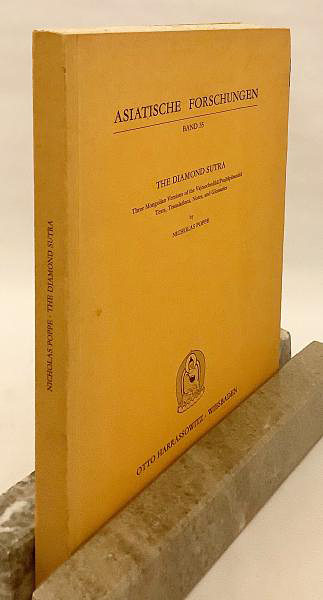
The Diamond Sutra: Three Mongolian Versions of the Vajracchedikā Prajñāpāramirā; Texts, Translations, Notes, and Glossaries
Book
Please note that many items in our library are simply pages that represent a detailed library catalog entry and citation of someone else's work, presentation, or performance. Read our General Disclaimer for more information.

Description
Present work contains the texts of three Mongolian versions of the Vajracchedikā prajñāpāramitā, their respective translations into English, notes, and two glossaries of Mongolian, Tibetan, and Sanskrit terms. The text editions are based on manuscripts and xylographs the microfilms of which were made available to the author of these lines by the following libraries: the Westdeutsche Bibliothek in Marburg an der Lahn; the library of the Seminar für Sprach- und Kulturwissenschaft Zentralasiens of the University of Bonn; the Royal Library in Copenhagen; the British Museum; and the Public Library of New South Wales in Sydney, Australia. The undersigned expresses his gratitude to the heads of the libraries mentioned for the helpfulness, namely to Dr. Wolfgagng Voigt, Head of the Oriental Division of the Westdeutsche Bibliothek; Dr. Erik Haarh, Head of the Oriental Division of the Royal Library in Copenhagen; to Mr. G. D. Richardson, M. A., Principal Librarian of the Public Library of New South Wales; and in particular to his friend, Professor Walther Heissig, Director of the Seminar für Sprach- und Kulturwissenschaft Zentralasiens, who generously supplied the author of this book with microfilms and other reproductions of numerous xylographs and manuscripts of the Mongolian Diamond Sūtra.
The xylograph of the translation made by Pandita Širegetü Güši Čorǰi is a rare edition. To give an idea of its outer appearance, three photographic reproductions are supplied. Plate I shows the picture on the inner side of the upper board. Plate II shows the picture on the inner side of the bottom board. Plate III shows the text on fol. 1a (a), and that on fol. 20b (b).
In the transcription of the Mongolian texts several special signs are used. The sign oo is Mongolian birya. The dot (.) is Mongolian čeg, the sign : renders the Mongolian dabqur čeg, and : : is the so-called dörbelǰin čeg. The sign — is used to separate letters and parts of words which are written separately in the original. There where a word is written together in the original but, for typographical reasons, had to be divided, the sign — is used. (Poppe, preface)
The xylograph of the translation made by Pandita Širegetü Güši Čorǰi is a rare edition. To give an idea of its outer appearance, three photographic reproductions are supplied. Plate I shows the picture on the inner side of the upper board. Plate II shows the picture on the inner side of the bottom board. Plate III shows the text on fol. 1a (a), and that on fol. 20b (b).
In the transcription of the Mongolian texts several special signs are used. The sign oo is Mongolian birya. The dot (.) is Mongolian čeg, the sign : renders the Mongolian dabqur čeg, and : : is the so-called dörbelǰin čeg. The sign — is used to separate letters and parts of words which are written separately in the original. There where a word is written together in the original but, for typographical reasons, had to be divided, the sign — is used. (Poppe, preface)
Citation
Poppe, Nicholas, trans. The Diamond Sutra: Three Mongolian Versions of the Vajracchedikā Prajñāpāramirā; Texts, Translations, Notes, and Glossaries. Asiatische Forschungen 35. Wiesbaden: Harrassowitz, 1971.
Table of contents
- Prefacevii
- Introduction1
- Works used and abbreviations9
- I. The Anonymous Translation11
- Text12
- Notes to the Text34
- Translation50
- Notes to the Translation71
- II. Pandit & Siregetii Giisi CorJi's Translation99
- Text100
- Notes to the Text122
- Translation127
- Notes to the Translation148
- III. Zaya Pandita's Translation159
- Text160
- Notes to the Text179
- Translation185
- Notes to the Translation205
- Mongolian-Tibetan-Sanskrit Glossary218
- Sanskrit-Mongolian Glossary225
Interconnections
1 Recension of

One of the most revered and recited scriptures of the perfection of wisdom genre (prajñāpāramitāsūtras), perhaps second only to the Heart Sūtra, both of which became especially popular in the East Asian Buddhist traditions. It is a crucial source for Mahāyāna tenets of selflessness and the emptiness of phenomena, and its discourse is framed as an explanation of how to enter into the vehicle of the bodhisattvas by developing and sustaining their enlightened perspective.
1 Full translation of
One of the most revered and recited scriptures of the perfection of wisdom genre (prajñāpāramitāsūtras), perhaps second only to the Heart Sūtra, both of which became especially popular in the East Asian Buddhist traditions. It is a crucial source for Mahāyāna tenets of selflessness and the emptiness of phenomena, and its discourse is framed as an explanation of how to enter into the vehicle of the bodhisattvas by developing and sustaining their enlightened perspective.
1 Scholarship on
One of the most revered and recited scriptures of the perfection of wisdom genre (prajñāpāramitāsūtras), perhaps second only to the Heart Sūtra, both of which became especially popular in the East Asian Buddhist traditions. It is a crucial source for Mahāyāna tenets of selflessness and the emptiness of phenomena, and its discourse is framed as an explanation of how to enter into the vehicle of the bodhisattvas by developing and sustaining their enlightened perspective.