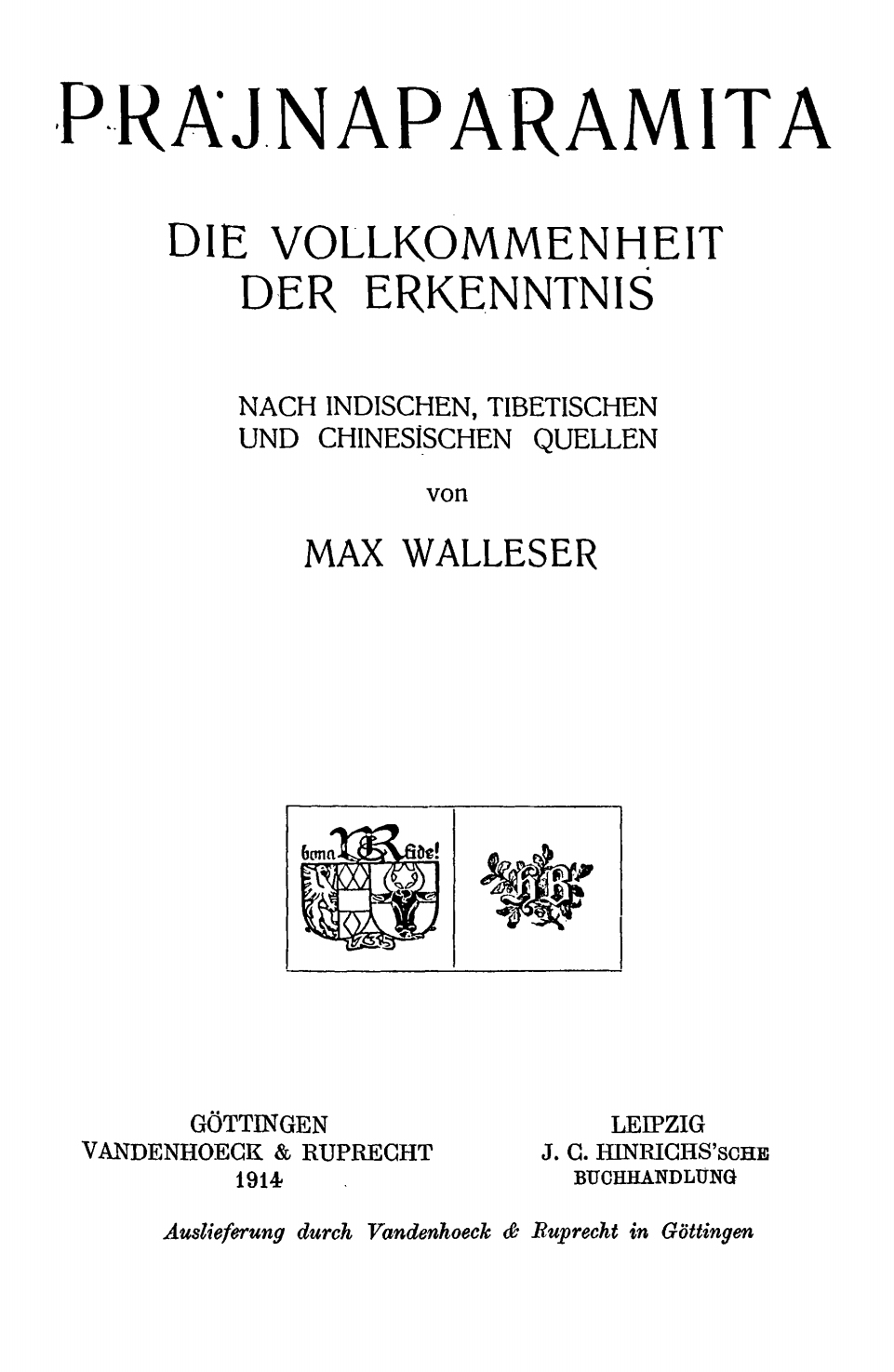
Prajnaparamita: Die Vollkommenheit der Erkenntnis
From Bodhicitta
< Books
Books/Prajnaparamita: Die Vollkommenheit der Erkenntnis| 🤓 Admin Zone 🛠️ hidden to non-admins | |
Prajnaparamita: Die Vollkommenheit der Erkenntnis; Nach Indischen, Tibetischen, und Chinesischen quellen
Book
Please note that many items in our library are simply pages that represent a detailed library catalog entry and citation of someone else's work, presentation, or performance. Read our General Disclaimer for more information.

Description
German translation of the Aṣṭasāhasrikā Prajñāpāramitā (p. 32-139) and the Vajracchedikā Prajñāpāramitā (p. 140-158). Originally intended as the 4th part of the author's Buddhistische philosophie in ihrer geschichtlichen entwicklung. (Source Accessed Jan 4, 2022)
Citation
Walleser, Max, trans. Prajnaparamita: Die Vollkommenheit der Erkenntnis; Nach Indischen, Tibetischen, und Chinesischen quellen. Quellen der Religions-Geschichte. Göttingen: Vandenhoeck & Ruprecht, 1914. https://archive.org/details/dli.granth.87981/page/n7/mode/2up.
Table of contents
- Erster Abschnitt. Zur Geschichte und Kritik1
- Zweiter Abschnitt. Bibliographie15
- Dritter Abschnitt. Aṣṭasāhasrikā Prajñāpāramitā32
- Vorbemerkung32
- 1. Das Buch des Wandels in der Allerkenntnis34
- 2. Das Buch des S'akra54
- 8. Das Buch der Reinheit66
- 9. Das Buch der Lobpreisung75
- 13. Das Buch des Undenkbaren81
- 15. Das Buch der Götter86
- 16. Das Buch der Soheit95
- 18. Das Buch der Leerheit106
- 19. Das Buch der Gangesgöttin Bhaginī112
- 22. Das Buch der wohlwollenden Freunde123
- 27. Das Buch des Kernes132
- Vierter Abschnitt. Vajracchedikā Prajñāpāramitā140
- Nachtrag159
- Sachregister161
- Bibliographisches Register163
Interconnections
2 Full translation of

The Perfection of Wisdom in Eight Thousand Lines, like other sūtras on the Perfection of Wisdom, deals with the topic of emptiness and the understanding of the ultimate truth or the way things are. Modern scholars date the sūtra roughly to the 2nd and 1st century BC and consider it to be the earliest sūtra on which other Perfection of Wisdom sūtras are based. Its adherents claim the sūtra to be a part of the words of the Buddha. It is believed to have been taken to the subterranean world and brought back to the human world by Nāgārjuna. It is sometimes known as the Condensed Mother (ཡུམ་བསྡུས་པ་), the term Mother referring to the Perfection of Wisdom which gives rise to all buddhas and bodhisattvas. It is said to be the condensed version of the long version in one hundred thousand lines and the middle version in twenty-five thousand lines. Having spread across Asia and beyond and having been translated into many languages, it is one of the most common books to be found in the Buddhist Himalayas.
The sūtra takes the form of a series of dialogues between the Buddha Śākyamuni, Subhūti, Śāriputra, and others, such as Indra, the king of gods, and a goddess of the Ganges. In the final chapters, the sūtra contains the inspirational narratives of Sadāprarudita and his quest for the teachings on the Perfection of Wisdom from the Bodhisattva Dharmodgata. The sūtra is also one of the earliest Mahāyāna sources proclaiming the luminous nature of the mind.
One of the most revered and recited scriptures of the perfection of wisdom genre (prajñāpāramitāsūtras), perhaps second only to the Heart Sūtra, both of which became especially popular in the East Asian Buddhist traditions. It is a crucial source for Mahāyāna tenets of selflessness and the emptiness of phenomena, and its discourse is framed as an explanation of how to enter into the vehicle of the bodhisattvas by developing and sustaining their enlightened perspective.