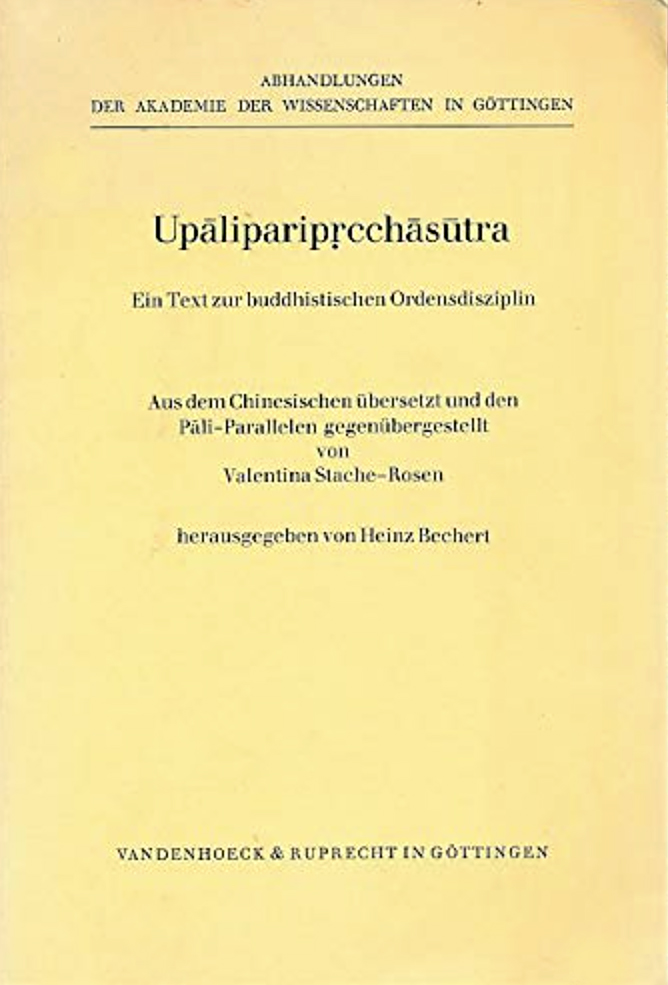
Upāliparipṛcchāsūtra: ein Text zur buddhistischen Ordensdisziplin
From Bodhicitta
< Books
Books/Upāliparipṛcchāsūtra: ein Text zur buddhistischen Ordensdisziplin| 🤓 Admin Zone 🛠️ hidden to non-admins | |
Upāliparipṛcchāsūtra: ein Text zur buddhistischen Ordensdisziplin
Book
- A Critical Edition of Lokakṣema's Translation of the Aṣṭasāhasrikā Prajñāpāramitā
- A Few Good Men
- A Prolegomena to the Śrīmālādevī Sūtra and the Tathāgatagarbha Theory: The Role of Women in Buddhism
- Bodhisatvapiṭaka (Bibliotheca Polyglotta)
- Das Akashagarbha Sutra
- Das Sūtra Vimalakīrti
- Discourse on Samantabhadra's Beneficence Aspirations
- Prajnaparamita: Die Vollkommenheit der Erkenntnis
- Samantabhadracaryā-praṇidhānarāja (Devi)
- Sūtra of Aṅgulimālika
- The Origins and Early History of the Mahāratnakūṭa Tradition of Mahāyāna Buddhism with a Study of the Ratnarāśisūtra and Related Materials
- The Scripture on the Production of Buddha Images
- The Story of Saṅgharakṣita (Stories 23–25)
- The Ugraparipṛcchā, the Mahāratnakūṭasūtra and Early Mahāyāna Buddhism
- The Vows of Samantabhadra
- The Śālistamba Sūtra
- Upāliparipṛcchāsūtra: ein Text zur buddhistischen Ordensdisziplin
- Vimalakīrtinirdeśa: Transliterated Sanskrit Text Collated with Tibetan and Chinese Translations
Please note that many items in our library are simply pages that represent a detailed library catalog entry and citation of someone else's work, presentation, or performance. Read our General Disclaimer for more information.

Description
German text of the Upāliparipṛcchāsūtra, with original Chinese text as an appendix. Fragments in Pāli (romanized) of the Suttavibhaṅga and Parivāra. "It is a section from the Upāliparipṛcchā, which forms part of the Daśādhyayavinaya of the Sarvāstivādin. This ten-section complete text of the Vinaya of the Sarvāstivāda school is divided into the two Vinayavibhaṅgas, Vinayavastu and 'Parivāra.,' The Upāliparipṛcchā ( Yu-po-li wen fo) forms part of this 'Parivāra'"--P. 10 (Source Accessed Sep 9, 2021)
Citation
Stache-Rosen, Valentina, trans. Upāliparipṛcchāsūtra: ein Text zur buddhistischen Ordensdisziplin. Edited by Heinz Bechert. Abhandlungen der Akademie der Wissenschaften in Göttingen, Philologisch-Historische Klasse, 3 Folge, Nr. 140. Göttingen: Vandenhoeck & Ruprecht, 1984.
Interconnections
1 Full translation of

Ascertaining the Vinaya: Upāli's Questions is a sūtra focused on the relationship between and integration of the prātimokṣa vows of monastic discipline and the conduct of a bodhisattva who follows the Mahāyāna tradition. The sūtra’s two main interlocuters, Śāriputra and Upāli, query the Buddha about the relationship between these two levels of commitments, eliciting a teaching on the different orientations held by the followers of different Buddhist vehicles and how their different views affect the application of their vows. Ascertaining the Vinaya is a particularly valuable sūtra for its inclusion of a unique form of the confessional "Three Sections" rite, making it one of the few extant canonical sources to describe it at length. (Source: 84000)