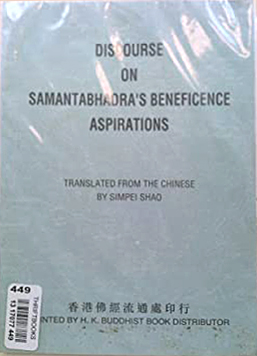
Discourse on Samantabhadra's Beneficence Aspirations
| 🤓 Admin Zone 🛠️ hidden to non-admins | |
- A Critical Edition of Lokakṣema's Translation of the Aṣṭasāhasrikā Prajñāpāramitā
- A Few Good Men
- A Prolegomena to the Śrīmālādevī Sūtra and the Tathāgatagarbha Theory: The Role of Women in Buddhism
- Bodhisatvapiṭaka (Bibliotheca Polyglotta)
- Das Akashagarbha Sutra
- Das Sūtra Vimalakīrti
- Discourse on Samantabhadra's Beneficence Aspirations
- Samantabhadracaryā-praṇidhānarāja (Devi)
- Sūtra of Aṅgulimālika
- The Origins and Early History of the Mahāratnakūṭa Tradition of Mahāyāna Buddhism with a Study of the Ratnarāśisūtra and Related Materials
- The Scripture on the Production of Buddha Images
- The Story of Saṅgharakṣita (Stories 23–25)
- The Ugraparipṛcchā, the Mahāratnakūṭasūtra and Early Mahāyāna Buddhism
- The Vows of Samantabhadra
- The Śālistamba Sūtra
- Upāliparipṛcchāsūtra: ein Text zur buddhistischen Ordensdisziplin
- Vimalakīrtinirdeśa: Transliterated Sanskrit Text Collated with Tibetan and Chinese Translations

Description
The present title of this book is an abridgement of the original one for the chapter which in its entirety should read:
"Chapter on Admission unto Inconceivable State of Emancipation through Beneficence Aspirations of The Bodhisattva Samantabhadra."
It is the Epilogue or last chapter of “The Mahavaipulya Buddha Avantamsaka Sutra" of Mahayana School. Since this Avantamsaka Sutra is considered and esteemed by Chinese Buddhists as the King of all Sutras and the present chapter the cream and sublimated essence of the whole Sutra, it can be readily seen the position it occupies in the mind of Buddhists in general and Chinese Buddhists in particular.
The original text was translated from Sanskrit to Chinese by Ven. Prajna from India in year 1340 B.E./796 AD of C.E. For those who read Chinese, the original Chinese text is to be found on reverse side of book. A simplified Glossary of Buddhist terminology referred in this book in Sanskrit with equivalent in English and Chinese has been added to facilitate those who are not familiar with such terms. Readers who are newly introduced to Buddhism are kindly advised to keep on with other sacred books of Buddhist Canon, e.g., The Jewel of Trancendental Wisdom or Diamond Sutra, Surangama Sutra, etc. once their interest or faith has been aroused.
As a point of interest, the translator has placed the reprints of two old newspaper articles appeared on one of the local newspapers dated May 9th, 1957 and Nov. 1st, 1959 respectively: one with the title “What is nothing made out of?” and the other "This earth of ours: Try running your imagination over these hurdles into space." The aim for this is two-fold, viz. Firstly to pave the way mentally for those who, for the first time being introduced to such Buddhist paradoxical expressions such as “Matter does not differ from void”, “Matter is thus void and void is thus matter”, as depicted in Prajna Paramita Hrdaya Sutra; or “Worlds Ksetra-motes in number” “Inconceivable number of Ksetras in one single dust-mote”, “Seas of Three-Yugas enacted in just one hair tip”, etc. as depicted in this discourse, are hoped to be made easier to comprehend in the compromise of turning an apparent antithesis into synthesis or the interchangeability between void and matter, greatness and smallness, past, present and future, etc. The metaphysical conception as expounded in this discourse as well as many others of Mahayana School may not be readily apprehensible or acceptable by many who allow their mind to be confined in a sense servitude and incline to take the face value or normally accepted sense of the obvious relativity as the only invincible truth and answer concerning the myth of life and our universe, however, they will eventually transcend such preconceptions though, like many others before them did. As to how can this be achieved is simply impossible to be explained. It can only be realized by intuition and not by merely reading through a booklet of this form: hence the translator's exhortation to pursue on further the discourses of other Sutras. (Please vide also Glossary under "Isvara") The readers are therefore kindly requested to read the discourse with a reserve for later intuition or enlightenment and not to treat these expressions preliminarily as fantastic and leave them there. For instance, similar problems like "What is nothing made of?" etc. must have been attempted to solve by many in the past, present, or will be in the future, none, however, was, is, or will be conclusive. It is with these points in mind that these two dust-collecting articles are reproduced for readers' reference. Secondly, our universe of such vast proportions as we now know through the timely news-paper report in 1959 was, however, well known by Buddhists since over 2,000 years ago through discourses such as the present one together with many others besides.
The translator is well aware of his incompetency in translation and errors being undetected in presenting this work which is his very first attempt in this field or perhaps his very last on account of his advanced age, debilitated state of his health and lack of experience. It is therefore sincerely hoped that some day other worthy man or worthy woman would aspire to present us a better version to perpetuate this sublime Dharma so that the present effort may serve, ad interim, to fill this gap. On completion of this work, it is also ambitiously hoped that in a not too distant future, other devotees of different countries may take up from here and have the discourse translated still further into more diverse languages used in the world today, such as French, German, Spanish, etc. to make this a multi-languaged discourse to consummate Bodhisattva Samantabhadra's Aspirations in Dharma dissemination.
Grateful thanks are due to votaress P.C. Lee whose early translation has provided, inter alia, most of the necessary notes for Sanskrit terms and to all my friends and associates in similar endeavours to have jointly contributed funds to make the production of this work possible. (Shao, foreword)

The King of Aspiration Prayers: Samantabhadra’s “Aspiration to Good Actions” (Zangchö Mönlam) from the Gaṇḍavyūha chapter of the Avataṃsaka Sūtra. Many translations of this text exist as it is regularly chanted around the world in many different traditions. For an example, see Lotsawa House.
Bhadracarīpranidhāna. (T. Bzang po spyod pa'i smon lam; C. Puxian pusa xingyuan zan; J. Fugen bosatsu gyōgansan; K. Pohyǒn posal haengwǒn ch'an 普賢菩薩行願讚). In Sanskrit, "Vows of Good Conduct," the last section of the Gaṇḍavyūha in the Avataṃsakasūtra and one of the most beloved texts in all of Mahāyāna Buddhism; also known as the Samantabhadracarīpraṇidhānarāja. The Bhadracarīpraṇidhāna focuses on the ten great vows (praṇidhāna) taken by Samantabhadra to realize and gain access to the dharmadhātu, which thereby enable him to benefit sentient beings. The ten vows are: (1) to pay homage to all the buddhas, (2) to praise the tathāgatas, (3) to make unlimited offerings, (4) to repent from one's transgressions in order to remove karmic hindrances (cf. karmāvaraṇa), (5) to take delight in others' merit, (6) to request the buddhas to turn the wheel of dharma (dharmacakrapravartana), (7) to request the buddhas to continue living in the world, (8) always to follow the teachings of the Buddha, (9) always to comply with the needs of sentient beings, and (10) to transfer all merit to sentient beings for their spiritual edification. The text ends with a stanza wishing that sentient beings still immersed in evil be reborn in the Pure Land of Amitābha. The text was translated into Chinese in 754 by Amoghavajra (705–774). Other Chinese recensions appear in the Wenshushili fayuan jing ("Scripture on the Vows made by Mañjuśrī"), translated in 420 by Buddhabhadra (359–429), which corresponds to the verse section from Ru busiyi jietuo jingjie Puxian xingyuan pin, the last roll of the forty-roll recension of the Huayan jing translated by Prajña in 798. (There is no corresponding version in either the sixty- or the eighty-roll translations of the
Huajan jing.) The verses are also called the "Précis of the Huayan jing (Lüe Huayan jing), because they are believed to constitute the core teachings of the Avataṃsakasūtra. In the main Chinese recension by Amoghavajra, the text consists of sixty-two stanzas, each consisting of quatrains with lines seven Sinographs in length, thus giving a total number of 1,736 Sinographs. In addition to the sixty-two core stanzas, Amoghavajra's version adds ten more stanzas of the Bada pusa zan ("Eulogy to the Eight Great Bodhisattvas") from the Badapusa mantuluo jing ("Scripture of the Maṇḍalas of the Eight Great Bodhisattvas") . . . Buddhabhadra's version consists of forty-four stanzas with 880 Sinographs, each stanza consisting of a quatrain with lines five Sinographs in length. Prajña's version contains fifty-two stanzas with each quatrain consisting of lines seven Sinographs in length. There are five commentaries on the text attributed to eminent Indian exegetes, including Nāgārjuna, Dignāga, and Vasubandhu, which are extant only in Tibetan translation. In the Tibetan tradition, the prayer is called the "king of prayers" (smon lam gyi rgyal po). It is incorporated into many liturgies; the opening verses of the prayer are commonly incorporated into a Tibetan's daily recitation. (Source: "Bhadracarīpraṇidhāna." In The Princeton Dictionary of Buddhism, 106. Princeton University Press, 2014. http://www.jstor.org/stable/j.ctt46n41q.27.)