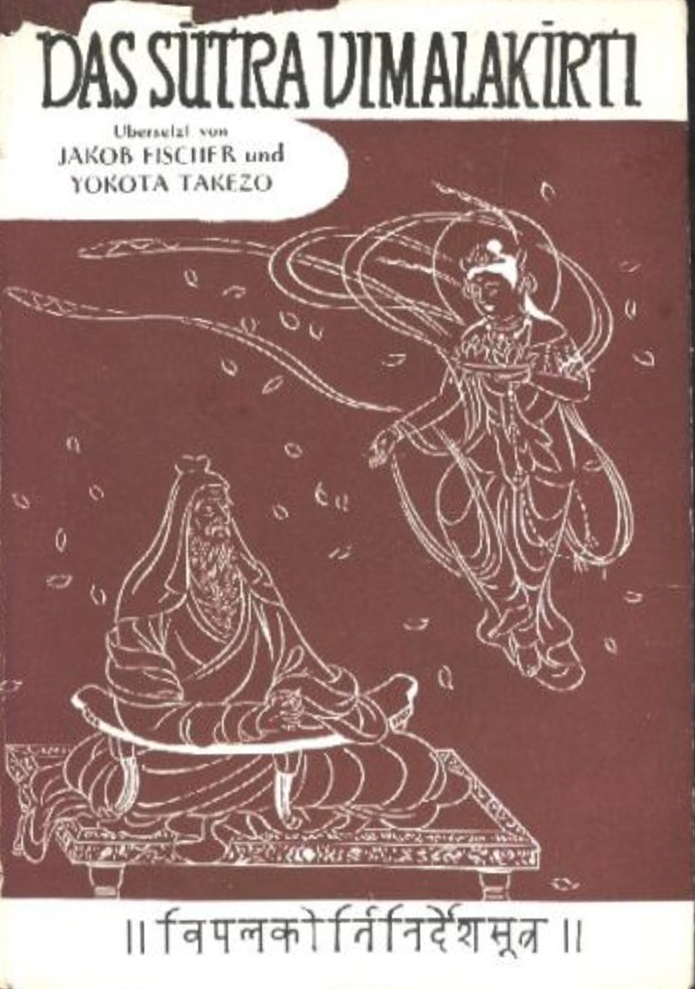
Translation of
Vimalakīrtinirdeśa (T. Dri med grags pas bstan pa'i mdo; C. Weimo jing; J. Yuimagyō; K. Yuma kyǒng 維摩經). In Sanskrit, "Vimalakīrti's Instructions"; one of the most beloved Indian Mahāyāna sūtras, renowned especially for having a layman, the eponymous Vimalakīrti, as its protagonist. The text probably dates from around the second century CE. Among the seven translations of the sūtra into Chinese, the most famous is that made by Kumārajīva in 406. His translation seems to have been adapted to appeal to Chinese mores, emphasizing the worldly elements of Vimalakīrti's teachings and introducing the term "filial piety" into the text. The sūtra was also translated by Xuanzang in 650. The sūtra was translated into Tibetan twice, the more famous being that of Chos nyid tshul khrims in the ninth Century. It has also been rendered into Sogdian, Khotanese, and Uighur. The original Sanskrit of the text was lost for over a millennia until a Sanskrit manuscript was discovered in the Po ta la palace in Tibet in 2001. The narrative of the sūtra begins with the Buddha requesting that his leading Śrāvaka disciples visit his lay disciple Vimalakīrti, who is ill. Each demurs, recounting a previous meeting with Vimalakīrti in which the layman had chastised the monk for his limited understanding of the dharma. The Buddha then instructs his leading bodhisattva disciples to visit Vimalakīrti. Each again demurs until MañjuśrI reluctantly agrees. Vimalakīrti explains that his sickness is the sickness of all sentient beings, and goes on to describe how a sick bodhisattva should understand his sickness, emphasizing the necessity of both wisdom (prajñā) and method (upāya). A large audience of monks and bodhisattvas then comes to Vimalakīrti's house, where he delivers a sermon on "inconceivable liberation" (acintyavimokṣa). Among the audience is Śariputra, the wisest of the Buddha's śrāvaka disciples. As in other Mahāyāna sūtras, the eminent śrāvaka is made to play the fool, repeatedly failing to understand how all dichotomies are overcome in emptiness (śūnyatā), most famously when a goddess momentarily transforms him into a female. Later, a series of bodhisattvas take turns describing various forms of duality and how they are overcome in nonduality. Vimalakīrti is the last to be invited to speak. He remains silent and is praised for this teaching of the entrance into nonduality. The sūtra is widely quoted in later literature, especially on the topics of emptiness, method, and nonduality. It became particularly famous in East Asia because the protagonist is a layman, who repeatedly demonstrates that his wisdom is superior to that of monks. Scenes from the sūtra are often depicted in East Asian Buddhist art. (Source: "Vimalakīrtinirdeśa." In The Princeton Dictionary of Buddhism, 971. Princeton University Press, 2014. http://www.jstor.org/stable/j.ctt46n41q.27.)
Text
