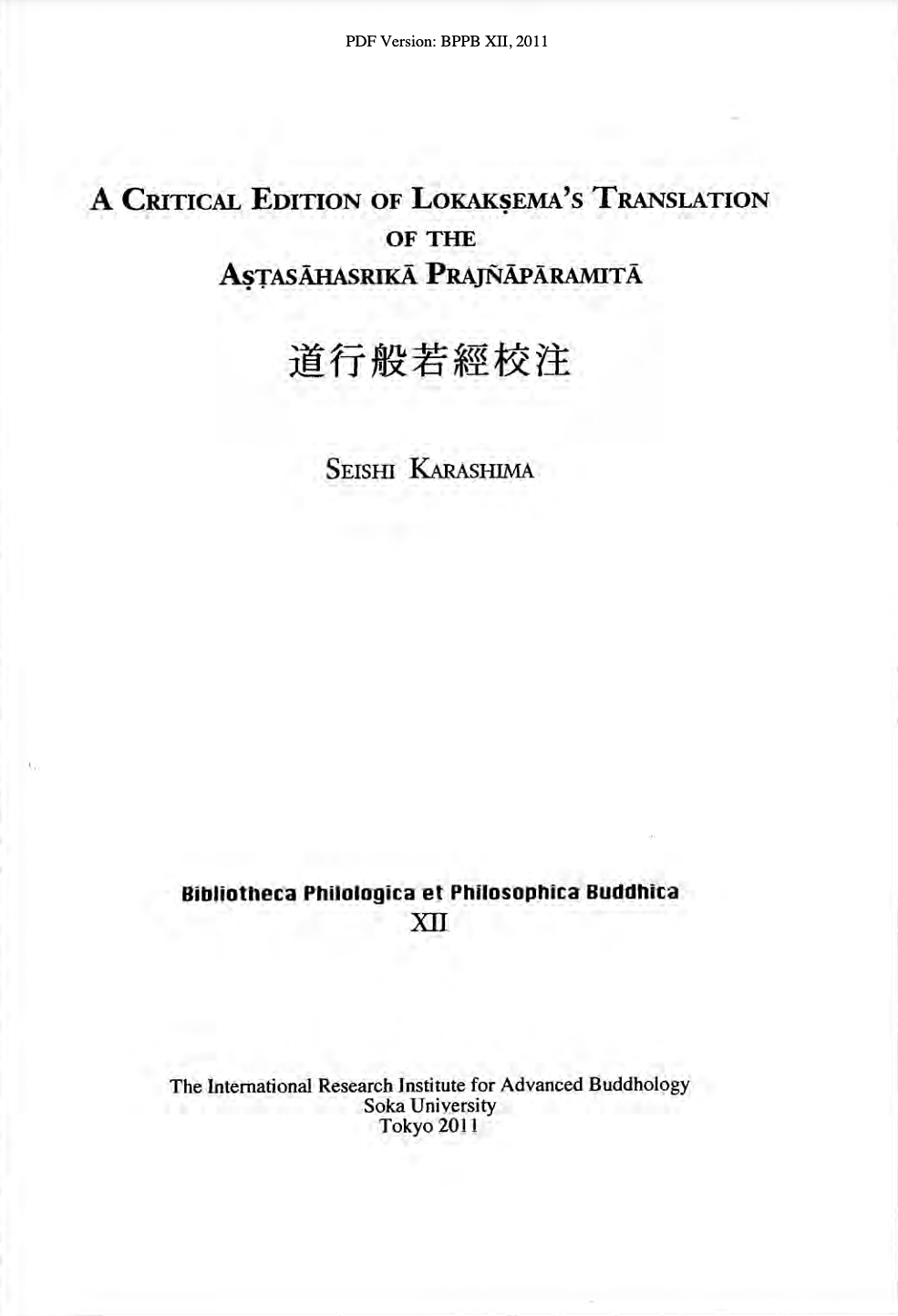
A Critical Edition of Lokakṣema's Translation of the Aṣṭasāhasrikā Prajñāpāramitā
From Bodhicitta
< Books
Books/A Critical Edition of Lokakṣema's Translation of the Aṣṭasāhasrikā Prajñāpāramitā| 🤓 Admin Zone 🛠️ hidden to non-admins | |
A Critical Edition of Lokakṣema's Translation of the Aṣṭasāhasrikā Prajñāpāramitā
Book
- A Critical Edition of Lokakṣema's Translation of the Aṣṭasāhasrikā Prajñāpāramitā
- A Few Good Men
- A Prolegomena to the Śrīmālādevī Sūtra and the Tathāgatagarbha Theory: The Role of Women in Buddhism
- Bodhisatvapiṭaka (Bibliotheca Polyglotta)
- Das Akashagarbha Sutra
- Das Sūtra Vimalakīrti
- Discourse on Samantabhadra's Beneficence Aspirations
- Samantabhadracaryā-praṇidhānarāja (Devi)
- Sūtra of Aṅgulimālika
- The Origins and Early History of the Mahāratnakūṭa Tradition of Mahāyāna Buddhism with a Study of the Ratnarāśisūtra and Related Materials
- The Scripture on the Production of Buddha Images
- The Story of Saṅgharakṣita (Stories 23–25)
- The Ugraparipṛcchā, the Mahāratnakūṭasūtra and Early Mahāyāna Buddhism
- The Vows of Samantabhadra
- The Śālistamba Sūtra
- Upāliparipṛcchāsūtra: ein Text zur buddhistischen Ordensdisziplin
- Vimalakīrtinirdeśa: Transliterated Sanskrit Text Collated with Tibetan and Chinese Translations
Please note that many items in our library are simply pages that represent a detailed library catalog entry and citation of someone else's work, presentation, or performance. Read our General Disclaimer for more information. You can find more information about this item on the publisher website.

Description
The present work is a critical edition of Lokakṣema's translation of the Aṣṭasāhasrika Prajñāpāramitā, the Daoxing banruo jing 道行般若經 (Taisho Vol. 8, No. 224; translated in 179 C.E.)
Citation
Karashima, Seishi, ed. A Critical Edition of Lokakṣema's Translation of the Aṣṭasāhasrikā Prajñāpāramitā. Bibliotheca Philologica et Philosophica Buddhica 12. Tokyo: International Research Institute for Advanced Buddhology, Soka University, 2011. Link
Publisher Link
Table of contents
- How To Use This Edition 使用說明vii
- Bibliography, Abbreviations and Signs 引用文獻 縮略語及符號表xxv
- Critical Edition of Lokakṣema's translation of the Aṣṭasāhasrikā Prajñāpāramitā 道行般若經校注本文
- JUAN I 卷第一
- Chapter 1 道行品1
- Chapter 2 難問品38
- JUAN 2 卷第二
- Chapter 3 功德品57
- JUAN 3 卷第三
- Chapter 4 涵恕拘舍羅勸助品129
- Chapter 5 泥犁品157
- Chapter 6 清淨品175
- JUAN IV 卷第四
- Chapter 7 嗅品193
- Chapter 8 持品207
- Chapter 9 覺品232
- JUAN V 巻第五
- Chapter 10 照明品247
- Chapter 11 不可計品268
- Chapter 12 譬喻品280
- Chapter 13 分別品284
- Chapter 14 本無品293
- JUAN VI 卷第六
- Chapter 15 阿惟越致品303
- Chapter 16 恒竭優婆夷品322
- JUAN VII 卷第七
- Chapter 17 守空品343
- Chapter 18 遠離品353
- Chapter 19 善知識品378
- JUAN VIII 卷第八
- Chapter 20 釋提桓因品395
- Chapter 21 貢高品400
- Chapter 22 學品406
- Chapter 23 守行品423
- Chapter 24 強弱品425
- JUAN IX 卷第九
- Chapter 25 累教品439
- Chapter 26 不可盡品452
- Chapter 27 隨品457
- Chapter 28 薩陀波倫菩薩品464
- JUAN X 卷第十
- Chapter 29 暴無竭菩薩品507
- Chapter 30 屬累品533
- JUAN I 卷第一
- Postscript 後記543
Interconnections
1 Recension of

The Perfection of Wisdom in Eight Thousand Lines, like other sūtras on the Perfection of Wisdom, deals with the topic of emptiness and the understanding of the ultimate truth or the way things are. Modern scholars date the sūtra roughly to the 2nd and 1st century BC and consider it to be the earliest sūtra on which other Perfection of Wisdom sūtras are based. Its adherents claim the sūtra to be a part of the words of the Buddha. It is believed to have been taken to the subterranean world and brought back to the human world by Nāgārjuna. It is sometimes known as the Condensed Mother (ཡུམ་བསྡུས་པ་), the term Mother referring to the Perfection of Wisdom which gives rise to all buddhas and bodhisattvas. It is said to be the condensed version of the long version in one hundred thousand lines and the middle version in twenty-five thousand lines. Having spread across Asia and beyond and having been translated into many languages, it is one of the most common books to be found in the Buddhist Himalayas.
The sūtra takes the form of a series of dialogues between the Buddha Śākyamuni, Subhūti, Śāriputra, and others, such as Indra, the king of gods, and a goddess of the Ganges. In the final chapters, the sūtra contains the inspirational narratives of Sadāprarudita and his quest for the teachings on the Perfection of Wisdom from the Bodhisattva Dharmodgata. The sūtra is also one of the earliest Mahāyāna sources proclaiming the luminous nature of the mind.
1 Scholarship on
The Perfection of Wisdom in Eight Thousand Lines, like other sūtras on the Perfection of Wisdom, deals with the topic of emptiness and the understanding of the ultimate truth or the way things are. Modern scholars date the sūtra roughly to the 2nd and 1st century BC and consider it to be the earliest sūtra on which other Perfection of Wisdom sūtras are based. Its adherents claim the sūtra to be a part of the words of the Buddha. It is believed to have been taken to the subterranean world and brought back to the human world by Nāgārjuna. It is sometimes known as the Condensed Mother (ཡུམ་བསྡུས་པ་), the term Mother referring to the Perfection of Wisdom which gives rise to all buddhas and bodhisattvas. It is said to be the condensed version of the long version in one hundred thousand lines and the middle version in twenty-five thousand lines. Having spread across Asia and beyond and having been translated into many languages, it is one of the most common books to be found in the Buddhist Himalayas.
The sūtra takes the form of a series of dialogues between the Buddha Śākyamuni, Subhūti, Śāriputra, and others, such as Indra, the king of gods, and a goddess of the Ganges. In the final chapters, the sūtra contains the inspirational narratives of Sadāprarudita and his quest for the teachings on the Perfection of Wisdom from the Bodhisattva Dharmodgata. The sūtra is also one of the earliest Mahāyāna sources proclaiming the luminous nature of the mind.