| 🤓 Admin Zone 🛠️ hidden to non-admins | |
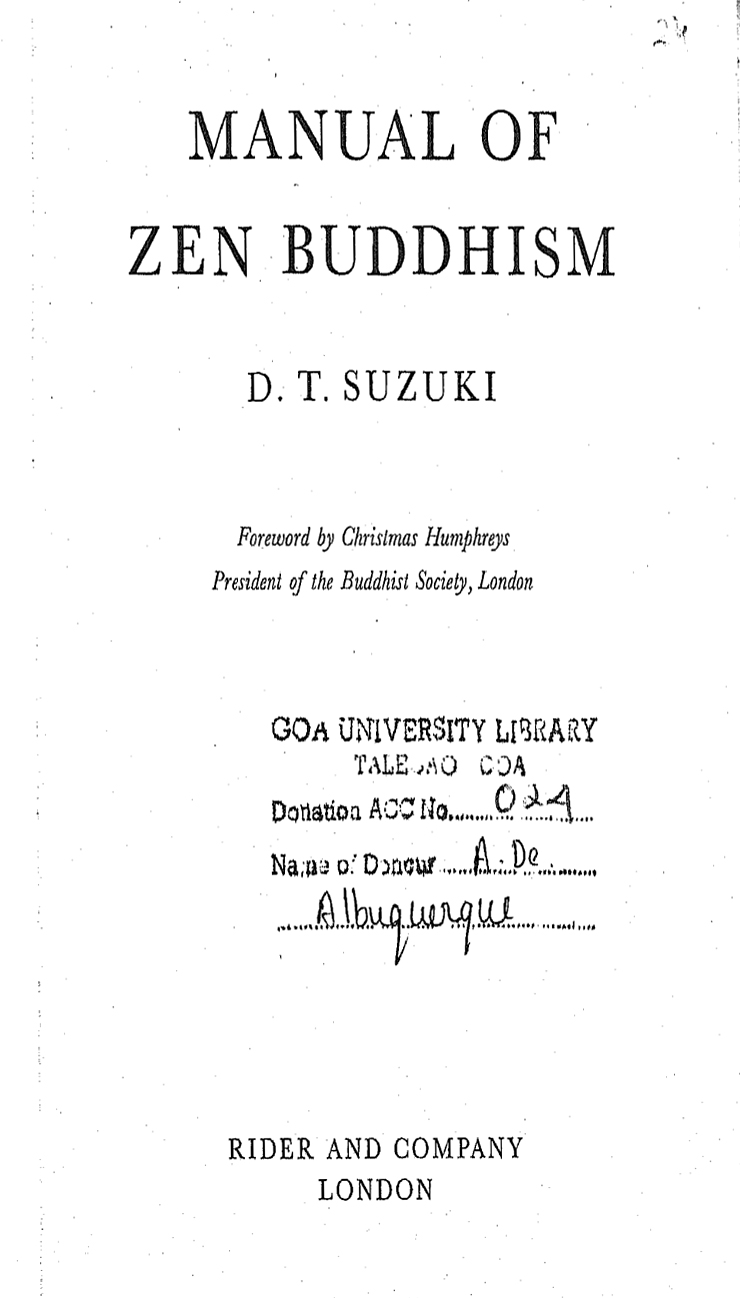
Manual of Zen Buddhism
Book
Please note that many items in our library are simply pages that represent a detailed library catalog entry and citation of someone else's work, presentation, or performance. Read our General Disclaimer for more information.

Description
In my Introduction to Zen Buddhism (published 1934), an outline of Zen teaching is sketched, and in The Training of the Zen Monk (1934) a description of the Meditation Hall and its life is given. To complete a triptych the present Manual has been compiled. The object is to inform the reader of the various literary materials relating to the monastery life. Foreign students often express their desire to know about what the Zen monk reads before the Buddha in his daily service, where his thoughts move in his leisure hours, and what objects of worship he has in the different quarters of his institution. This work will partly, it is hoped, satisfy their desire. Those who find my Essays too bulky or too elaborate may prefer these smaller works on Zen. (Suzuki, preface to the first edition (1935), 11)
Citation
Suzuki, Daisetz Taitaro. Manual of Zen Buddhism. London: Rider, 1974. First published 1950 by Rider (London). https://archive.org/details/dli.ernet.235966/page/n1/mode/2up.
Table of contents
- Editor's Foreword9
- Editor's Note11
- Author's Preface11
- I. Gathas and Prayers (pp. 13–20)
- On Opening the Sutra13
- Confession13
- The Threefold Refuge14
- The Four Great Vows14
- The Worshipping of the Sarira14
- The Teaching of the Seven Buddhas15
- The Gatha of Impermanence15
- The Yemmei Kwannon Ten-Clause Sutra16
- Prayer on the Occasion of Feeding the Hungry Ghosts16
- General Prayer19
- Prayer of the Bell20
- II. The Dharanis (pp. 21–25)
- Dharani of Removing Disasters21
- Dharani of the Great Compassionate One22
- Dharani of the Victorious Buddha-Crown23
- III. The Sutras (pp. 26–72)
- The Prajnaparamita-hridaya-sutra, or Shingyo (complete)26
- The Kwannongyo, or "Samantamukha Parivarta" (complete)30
- The Kongokyo, or Vajracchedika (the first half and extracts from the second half)38
- The Lankavatara Sutra, or Ryogakyo (extracts)50
- The Ryogonkyo, or Surangama Sutra (résumé)64
- IV. From the Chinese Zen Masters (pp. 73–144)
- Bodhidharma on the Twofold Entrance to the Tao73
- The Third Patriarch on "Believing in Mind"76
- From Hui-neng's Tan-ching82
- Yoka Daishi's "Song of Enlightenment"89
- Baso (Ma-tsu) and Sekito (Shih-tou)104
- Obaku's (Huang-po) Sermon from "Treatise on the Essentials of the Transmission of Mind"112
- Gensha on the Three Invalids (from the Hekiganshu or Pi-yen Chi)120
- The Ten Oxherding Pictures, I127
- The Ten Oxherding Pictures, II135
- V. From the Japanese Zen Masters (pp. 145–152)
- Daio Kokushi on Zen145
- Daio Kokushi's Admonition146
- Daito Kokushi's Admonition and Last Poem147
- Kwanzan Kokushi's Admonition149
- Muso Kokushi's Admonition150
- Hakuin's "Song of Meditation"151
- VI. The Buddhist Statues and Pictures in a Zen Monastery (pp. 153–186)
- Buddhas153
- Bodhisattvas161
- Arhats168
- Protecting Gods172
- Historical Figures182
- Index187
- List of Plates
- Vimalakirti, by Hakuinfrontispiece
- Kwannon, by Seisetsu Seki32
- Bodhidharma, a Chinese Stone Rubbing33
- Daito Kokushi, by Hakuin Zenji48
- Hakuin Zenji49
- The Ten Oxherding Pictures, I–IX, by Shubun128
- The Ten Oxherding Pictures, X129
- Bhadrapala, by Soyen144
- Kanzan (Han-shan) and Jittoku (Shi-te), by Kaihoku Yusho145
- List of Illustrations
- The Ten Oxherding Pictures, II, by an unknown master135
- Sakyamuni156
- Buddha with His Attendants157
- Buddha's Birth158
- Buddha's Entrance into Nirvana159
- Bhaishajyaguru160
- Manjusri163
- Samantabhadra164
- Avalokitesvara165
- Maitreya166
- Kshitigarbha167
- The Sixteen Arhats169
- The Two Door-keeping Gods175
- The Four Guardian Gods176
- Benzaiten (Sarasvati)177
- Sambokojin178
- Skandadeva (Idaten)179
- Ucchushma (Ususamaten)180
- Mahakala (Daikokuten)181
- The Sixteen Good Gods of the Prajnaparamita182
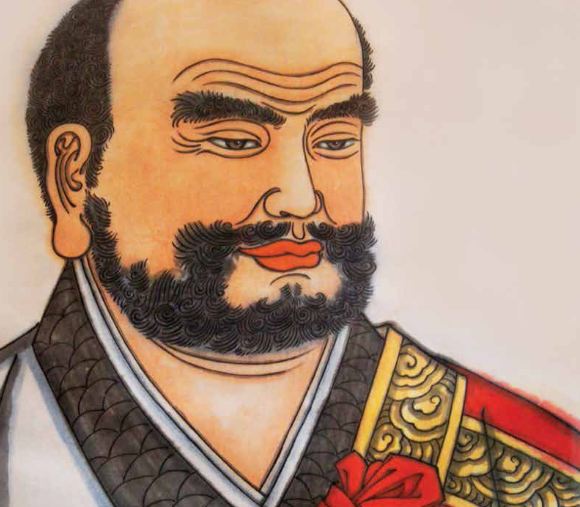
- Daruma (Bodhidharma), Founder of Zen184
- Shotoku Taishi185
- Fudaishi186
Interconnections
3 Partial translation of

An important Mahāyāna sūtra that was highly influential in East Asia as well as in Nepal, where a manuscript was discovered that remains the only extant Sanskrit recension of this text. It is notable for its inclusion of many doctrinal features that would come to be associated with the Yogācāra philosophy of Mind-Only (Cittamātra), such as the ālayavijñāna, or store-house consciousness, that acts as a repository for the seeds of karmic actions. It also includes several lengthy discussions of tathāgatagarbha and, though it is never actually referenced in the Uttaratantra, it is often listed among the so-called tathāgatagarbha sūtras. While its lack of mention in the Uttaratantra has been interpreted by scholars as evidence that the sūtra postdates the treatise, it should be noted that the ways in which the tathāgatagarbha is discussed in the sūtra is often at odds with its presentation in the Uttaratantra.

One of the most revered and recited scriptures of the perfection of wisdom genre (prajñāpāramitāsūtras), perhaps second only to the Heart Sūtra, both of which became especially popular in the East Asian Buddhist traditions. It is a crucial source for Mahāyāna tenets of selflessness and the emptiness of phenomena, and its discourse is framed as an explanation of how to enter into the vehicle of the bodhisattvas by developing and sustaining their enlightened perspective.

Śūraṃgamasūtra. (T. Dpa' bar 'gro ba'i mdo; C. Shoulengyan jing; J. Shuryōgongyō; K. Sunǔngǒm kyǒng 首楞嚴經). A Chinese indigenous scripture (see apocrypha), usually known in the West by its reconstructed Sanskrit title Śūraṃgamasūtra, meaning "Heroic March Sūtra." Its full title is Dafoding rulai miyin xiuzheng liaoyi zhu pusa wanxing Shoulengyan jing, in ten rolls. (This indigenous scripture should be distinguished from an early-fifth century Chinese translation of the Śūraṃgamasamādhsūtra, attributed by Kumārajīva, in two rolls, for which Sanskrit fragments are extant.) According to the account in the Chinese cataloguer Zhisheng's Xu gujin yijing tuji, the Śūraṃgamasūtra was brought to China by a śramaṇa named Pāramiti. Because the Śūraṃgamasūtra had been proclaimed a national treasure, the Indian king had forbidden anyone to take the sūtra out of the country. In order to transmit this scripture to China, Pāramiti wrote the sūtra out in minute letters on extremely fine silk, then he cut open his arm and hid the small scroll inside his flesh. With the sūtra safely hidden away, Pāramiti set out for China and eventually arrived in Guangdong province. There, he happened to meet the exiled Prime Minister Fangrong, who invited him to reside at the monastery of Zhizhisi, where he translated the sūtra in 705 CE. Apart from Pāramiti's putative connection to the Śūraṃgamasūtra, however, nothing more is known about him and he has no biography in the Gaoseng zhuan ("Biographies of Eminent Monks"). Zhisheng also has an entry on the Śūraṃgamasūtra in his Kaiyuan Shijiao lu, but there are contradictions in these two extant catalogue accounts of the sūtra's transmission and translation. The Kaiyuan Shijiao lu merely records that the śramaņa Huidi encountered an unnamed Western monk at Guangdong, who had with him a copy of the Sanskrit recension of this sūtra, and Huidi invited him to translate the scripture together. Since the names of this Western monk and his patron Fangrong are not mentioned, the authenticity of the scripture has been called into question. Although Zhisheng assumed the Śūraṃgamasūtra was a genuine Indian scripture, the fact that no Sanskrit manuscript of the text is known to exist, as well as the inconsistencies in the stories about its transmission to China, have led scholiasts for centuries to questions the scripture's authenticity. There is also internal evidence of the scripture's Chinese provenance, such as the presence of such indigenous Chinese philosophical concepts as yin-yang cosmology and the five elements (wuxing) theory, the stylistic beauty of the literary Chinese in which the text is written, etc. For these and other reasons, the Śūraṃgamasūtra is now generally recognized to be a Chinese apocryphal composition. The sūtra opens with one of the most celebrated stories in East Asian Buddhist literature: the Buddha's attendant Ānanda’s near seduction by the harlot Mātaṅgī. With Ānanda close to being in flagrante delicto, the Buddha sends the bodhisattva Mañjuśrī to save him from a pārājika offense, by employing the śūraṃgama dhāraṇī to thwart Mātaṅgī's seductive magic. The Buddha uses the experience to teach to Ānanda and the congregation the śūraṃgamasamādhi, which counters the false views about the aggregates (skandha) and consciousness (vijñāna) and reveals the tathāgatagarbha that is inherent in all sentient beings. This tathāgatagarbha, or buddha-nature, is made manifest through the śūraṃgamasamādhi, which constitutes the "heroic march" forward toward enlightenment. The Śūraṃgamasūtra was especially influential in the Chan school during the Song and Ming dynasties, which used the text as the scriptural justification for the school's distinctive teaching that Chan "points directly to the human mind" (zhizhi renxin), so that one may "see the nature and achieve buddhahood" (jianxing chengfo). Several noted figures within the Chan school achieved their own awakenings through the influence of the Śūraṃgamasūtra, including the Ming-dynasty master Hanshan Deqing (1546–1623), and the sūtra was particularly important in the writings of such Ming-dynasty Chan masters as Yunqi Zhuhong (1535-1615). The leading Chan monk of modern Chinese Buddhism, Xuyun (1840-1959), advocated the practice of the Śūraṃgamasūtra throughout his life, and it was the only scripture that he ever annotated. As a mark of the sūtra's influence in East Asian Buddhism, the Śūraṃgamasūtra is one of the few apocryphal scriptures that receives its own mention in another indigenous sūtra: the apocryphal Foshuo fa miejin jing ("The Sūtra on the Extinction of the Dharma") states that the first sūtra to disappear from the world during the dharma-ending age (mofa) will in fact be the Śūraṃgamasūtra. The Tibetan translation of this Chinese apocryphon was produced during the Qianlong era (1735-1796) of the Qing dynasty; the scripture was apparently so important in contemporary Chinese Buddhism that it was deemed essential for it to be represented in the Tibetan canon as well. (Source: "*Śūraṃgamasūtra." In The Princeton Dictionary of Buddhism, 873–74. Princeton University Press, 2014. http://www.jstor.org/stable/j.ctt46n41q.27.)
1 Contains chapter or part

An partial English translation of the Vajracchedikāprajñāpāramitāsūtra from the Chinese edition of Kumārajīva (the first half and extracts from the second half).