| 🤓 Admin Zone 🛠️ hidden to non-admins | |
The Kongokyo or Diamond Sutra
Chapter in a Book
Please note that many items in our library are simply pages that represent a detailed library catalog entry and citation of someone else's work, presentation, or performance. Read our General Disclaimer for more information.
Description
An partial English translation of the Vajracchedikāprajñāpāramitāsūtra from the Chinese edition of Kumārajīva (the first half and extracts from the second half).
Citation
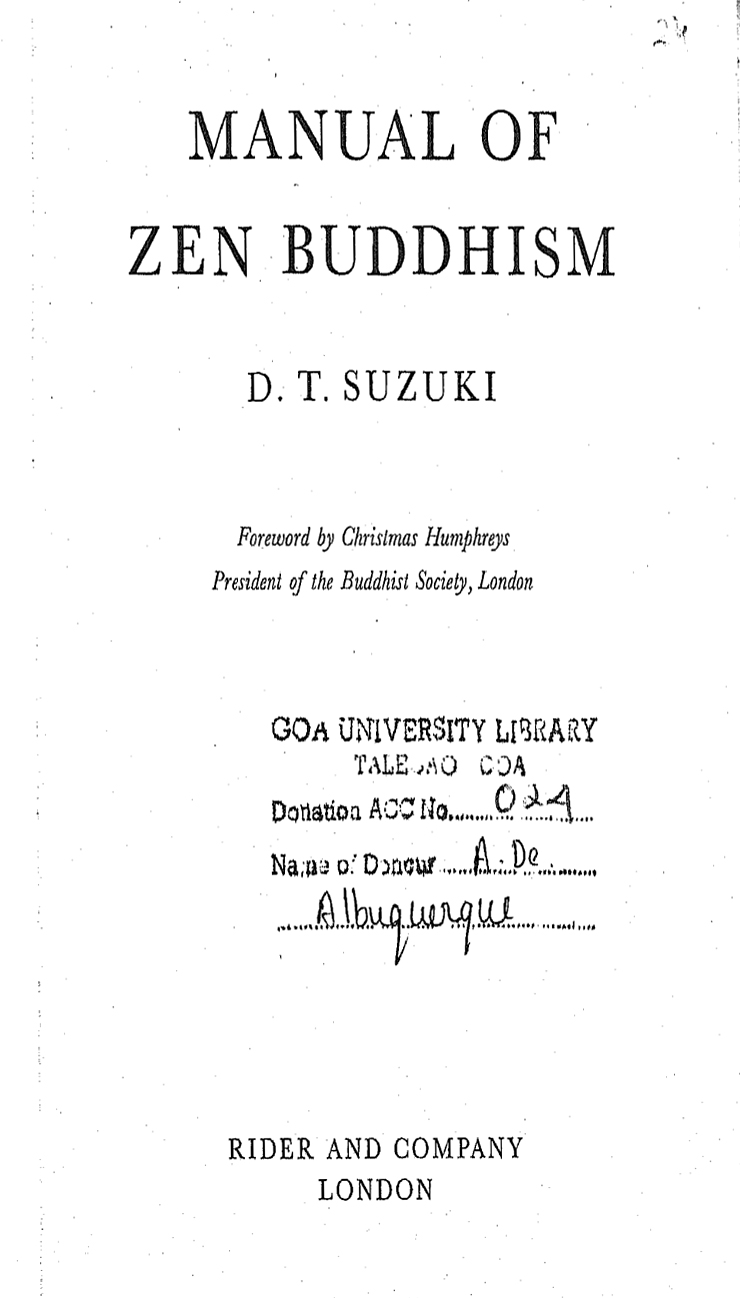
Suzuki, Daisetz Taitaro. "The Kongokyo or Diamond Sutra." In Manual of Zen Buddhism, 38–50. London: Rider, 1974. First published 1950 by Rider (London). https://archive.org/details/dli.ernet.235966/page/n21/mode/2up.
Interconnections
1 Partial translation of

One of the most revered and recited scriptures of the perfection of wisdom genre (prajñāpāramitāsūtras), perhaps second only to the Heart Sūtra, both of which became especially popular in the East Asian Buddhist traditions. It is a crucial source for Mahāyāna tenets of selflessness and the emptiness of phenomena, and its discourse is framed as an explanation of how to enter into the vehicle of the bodhisattvas by developing and sustaining their enlightened perspective.
1 Chapter or part of

In my Introduction to Zen Buddhism (published 1934), an outline of Zen teaching is sketched, and in The Training of the Zen Monk (1934) a description of the Meditation Hall and its life is given. To complete a triptych the present Manual has been compiled. The object is to inform the reader of the various literary materials relating to the monastery life. Foreign students often express their desire to know about what the Zen monk reads before the Buddha in his daily service, where his thoughts move in his leisure hours, and what objects of worship he has in the different quarters of his institution. This work will partly, it is hoped, satisfy their desire. Those who find my Essays too bulky or too elaborate may prefer these smaller works on Zen. (Suzuki, preface to the first edition (1935), 11)