Minor Buddhist Texts Parts I and II
From Bodhicitta
< BooksBooks/Minor Buddhist Texts Parts I and II (Tucci 1986)
| 🤓 Admin Zone 🛠️ hidden to non-admins | |
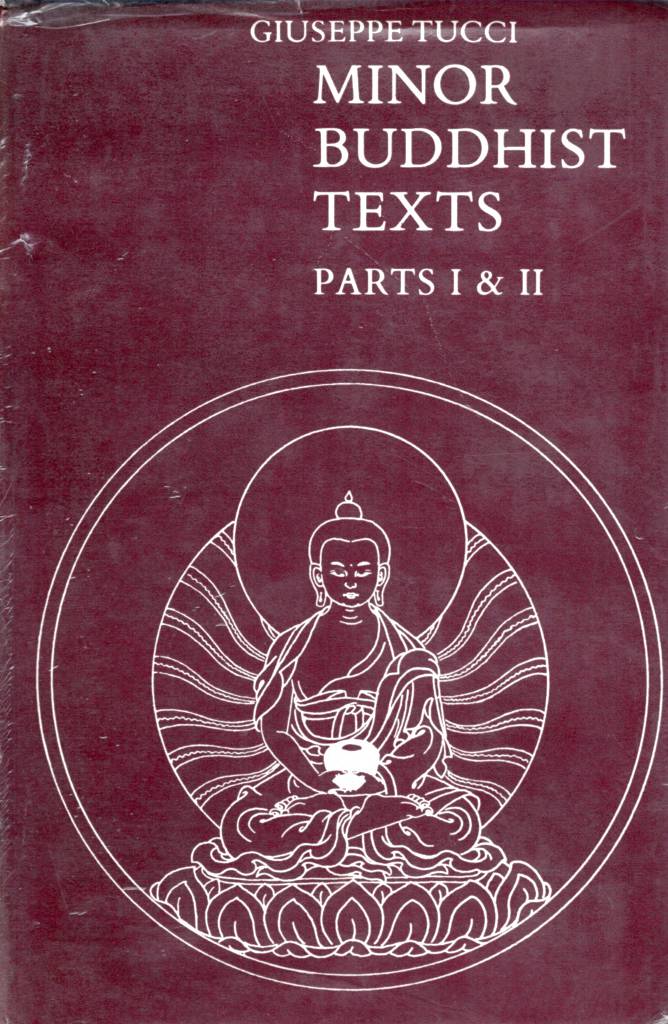
Minor Buddhist Texts Parts I and II
Book
Please note that many items in our library are simply pages that represent a detailed library catalog entry and citation of someone else's work, presentation, or performance. Read our General Disclaimer for more information.

Description
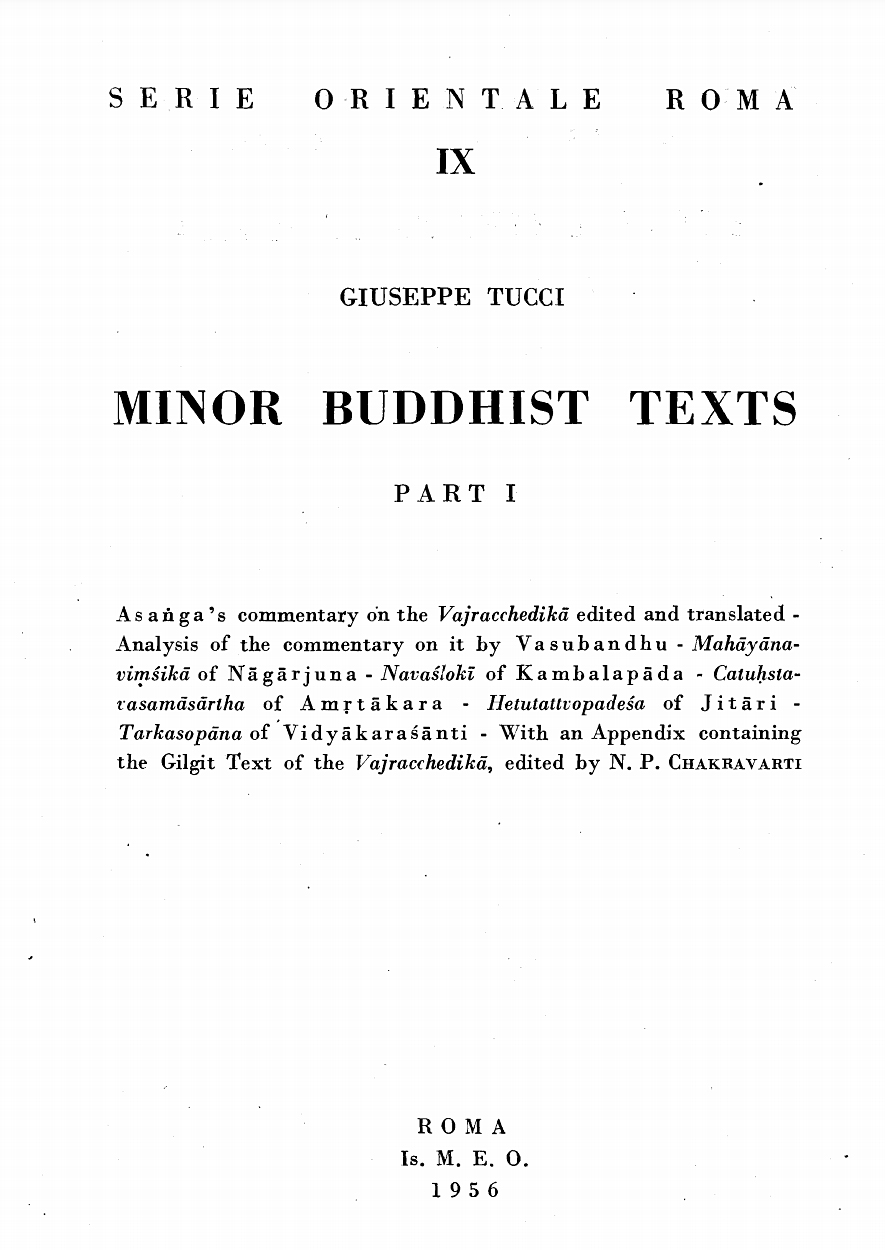
Asaṅga's commentary on the Vajracchedikā edited and translated—Analysis of the commentary on it by Vasubandhu—Mahāyānaviṃśikā of Nāgārjuna—Navaślokī of Kambalapāda—Catuḥstavasamāsārtha of Amṛtākara—Hetutattvopadeśa of Jitāri—Tarkasopāna of Vidyākaraśānti—With an Appendix containing the Gilgit Text of the Vajracchedikā, edited by N. P. Chakravarti. First Bhāvanākrama of Kamalaśīla, Sanskrit and Tibetan Texts with Introduction and English Summary.
Citation
Tucci, Giuseppe. Minor Buddhist Texts. Parts 1 and 2. 1st Indian ed. Delhi: Motilal Banarsidass, 1986.
Table of contents
- List of Abbreviations (pt. I)v
- –––––––––––––––––(pt. II)vii
- Table of Contents (pt. I & II)ix
- Preface (pt. I)xi
- –––––––––––––––––(pt. II)xii
- pt. I SECTION I The Triśatikāyāḥ Prajñāpāramitāyāḥ Kārikāsaptatiḥ by Asaṅga
- Introduction3
- Appendix I-Comparison of Taishō 1510 a and Taishō 1510 b39
- Chapter 1-Sanskrit text, Chinese, Tibetan and English Translations51
- Chapter 2-Analysis of the Vajracchedikā according to Vasubandhu (Taishō 1510) (compared with Kamalaśīla's commentary129
- Appendix II-The Gilgit text of the Vajracchedikā by N. P. Chakravarti173
- pt. I SECTION II-Mahāyāna-Viṃśikā of Nāgārjuna193
- pt. I SECTION III-Navaśloki of Kambalapāda209
- pt. I SECTION IV-Catuḥstavasamāsārth of Amṛtākara233
- pt. I SECTION V-Introduction-Hetutattvopadeśa of Jitāri and Tarkasopāna of Vidyākaraśānti247
- 1-Hetutattvopadeśa of Jitāri261
- 2-Tarkasopāna of Vidyākaraśānti275
- pt. II SECTION I-Introduction
- Chapter 1-The debate of bsam yas according to Tibetan sources313
- Chapter 2-The contents of the Bhāvanākrama465
- pt. II SECTION II-Texts
- The Sanskrit and Tibetan texts of the first Bhāvanākrama495
- ADDENDA ET CORRIGENDA (pt I & II)593
Interconnections
3 Recension of

One of the most revered and recited scriptures of the perfection of wisdom genre (prajñāpāramitāsūtras), perhaps second only to the Heart Sūtra, both of which became especially popular in the East Asian Buddhist traditions. It is a crucial source for Mahāyāna tenets of selflessness and the emptiness of phenomena, and its discourse is framed as an explanation of how to enter into the vehicle of the bodhisattvas by developing and sustaining their enlightened perspective.

The second Bhāvanākrama considers many of [the] same topics [as the first], stressing that the achievement of the fruition of buddhahood requires the necessary causes, in the form of the collection of merit (puṇyasaṃbhāra) and the collection of wisdom (jñānasaṃbhāra). Both the first and second works espouse the doctrine of mind only (cittamātra); it is on the basis of these and other statements that Tibetan doxographers classified Kamalaśīla as a Yogācāra-Svātantrika-Madhyamaka. (Source: "Bhāvanākrama." In The Princeton Dictionary of Buddhism, 112–13. Princeton University Press, 2014. http://www.jstor.org/stable/j.ctt46n41q.27.)
.jpg)
This is a two-layer commentarial work on the Vajracchedikāprajñāpāramitāsūtra (the "Diamond Cutter" sūtra), combining root verses by Asaṅga with prose explanation by his half-brother Vasubandhu. In the Sanskrit tradition, Asaṅga's verses are known as the Triśatikāyāḥ Prajñāpāramitāyāḥ Kārikāsaptatiḥ ("Seventy Verses on the Perfection of Wisdom in Three Hundred [Lines]," so named for the sūtra's approximate length), and survive independently in Sanskrit as critically edited by Giuseppe Tucci (Minor Buddhist Texts, part I, Rome, 1956). The same verse-and-commentary combination is also preserved in two separate Chinese translations (Taishō 1511 and 1513). This Tengyur text represents the Tibetan transmission of the same commentarial tradition.
Together with Vasubandhu's independently authored Saptārthaṭīkā (RKTST 3161) and Kamalaśīla's explicitly Madhyamaka-framed Vajracchedikāṭīkā (RKTST 3162), this text forms part of a substantial cluster of Indian commentarial literature on the Vajracchedikā preserved in the Tengyur, reflecting sustained scholarly engagement with the sūtra across differing structural approaches and philosophical framings.
1 Partial translation of
This is a two-layer commentarial work on the Vajracchedikāprajñāpāramitāsūtra (the "Diamond Cutter" sūtra), combining root verses by Asaṅga with prose explanation by his half-brother Vasubandhu. In the Sanskrit tradition, Asaṅga's verses are known as the Triśatikāyāḥ Prajñāpāramitāyāḥ Kārikāsaptatiḥ ("Seventy Verses on the Perfection of Wisdom in Three Hundred [Lines]," so named for the sūtra's approximate length), and survive independently in Sanskrit as critically edited by Giuseppe Tucci (Minor Buddhist Texts, part I, Rome, 1956). The same verse-and-commentary combination is also preserved in two separate Chinese translations (Taishō 1511 and 1513). This Tengyur text represents the Tibetan transmission of the same commentarial tradition.
Together with Vasubandhu's independently authored Saptārthaṭīkā (RKTST 3161) and Kamalaśīla's explicitly Madhyamaka-framed Vajracchedikāṭīkā (RKTST 3162), this text forms part of a substantial cluster of Indian commentarial literature on the Vajracchedikā preserved in the Tengyur, reflecting sustained scholarly engagement with the sūtra across differing structural approaches and philosophical framings.
2 Other editions

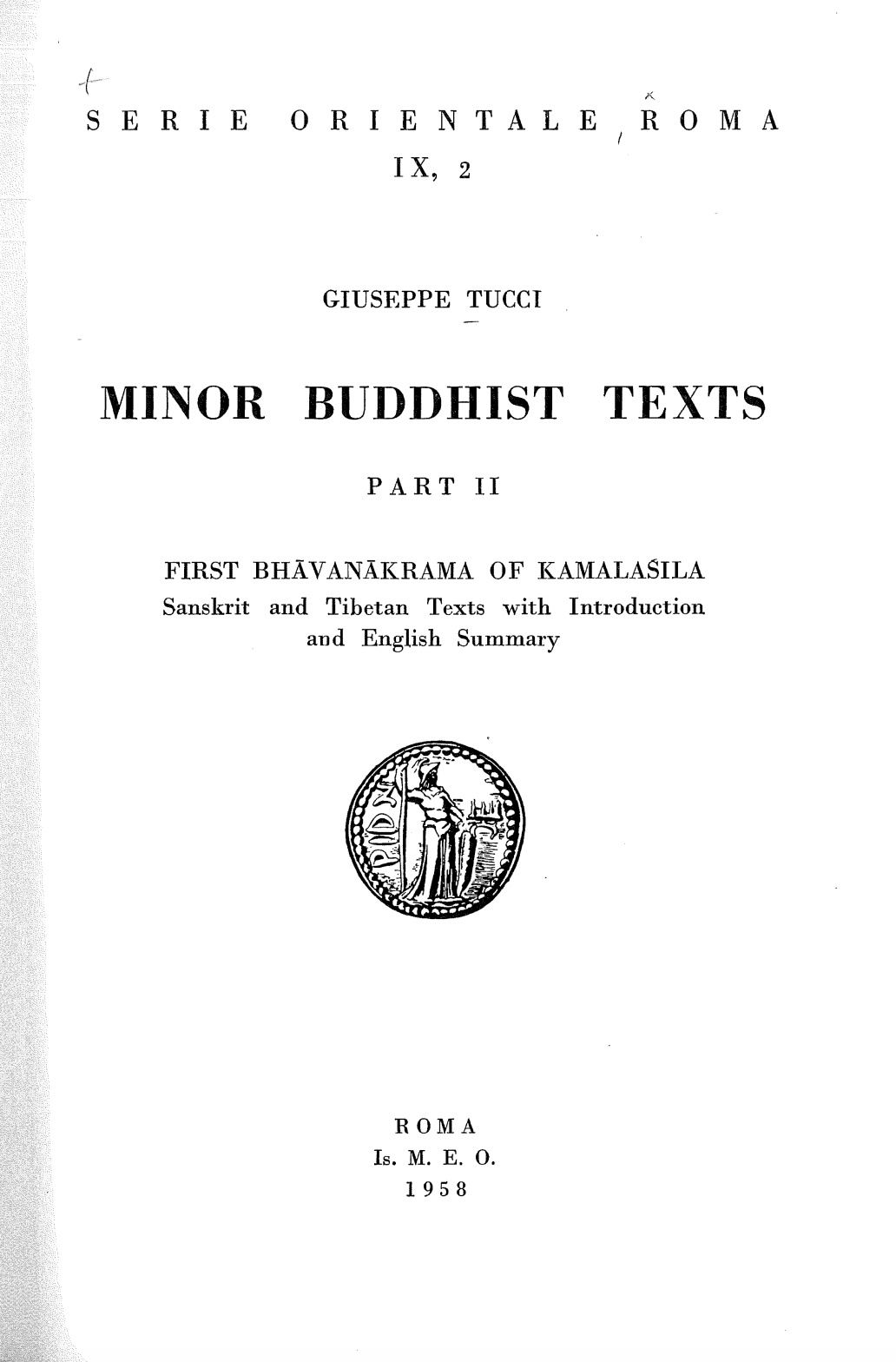
Contains the First Bhāvanākrama of Kamalaśīla, with Sanskrit and Tibetan texts and an English summary.

Contents of pt. 1 includes: Triśatikāyāḥ prajñāpāramitāyāḥ kārikāsaptatiḥ / Asaṅga--Mahāyānaviṁśikā / Nāgārjuna--Navaślokī / Kambalapāda--Catuḥstavasamāsārtha / Amr̥tākara--Hetutattvopadeśa / Jitāri--Tarkasopāna / Vidyākaraśānti / Vajracchedikā (Gilgit text).