| 🤓 Admin Zone 🛠️ hidden to non-admins | |
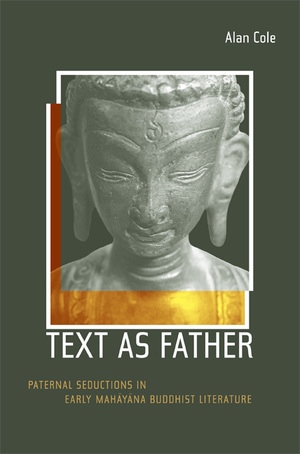
Text as Father Paternal Seductions in Early Mahayana Buddhist Literature
Book
Please note that many items in our library are simply pages that represent a detailed library catalog entry and citation of someone else's work, presentation, or performance. Read our General Disclaimer for more information. You can find more information about this item on the publisher website.

Description
This beautifully written work sheds new light on the origins and nature of Mahayana Buddhism with close readings of four well-known texts—the Lotus Sutra, Diamond Sutra, Tathagatagarbha Sutra, and Vimalakirtinirdesa. Treating these sutras as literary works rather than as straightforward philosophic or doctrinal treatises, Alan Cole argues that these writings were carefully sculpted to undermine traditional monastic Buddhism and to gain legitimacy and authority for Mahayana Buddhism as it was veering away from Buddhism’s older oral and institutional forms. His sophisticated and sustained analysis of the narrative structures and seductive literary strategies used in these sutras suggests that they were specifically written to encourage devotion to the written word instead of other forms of authority, be they human, institutional, or iconic. (Source: University of California Press)
Citation
Cole, Alan. Text as Father: Paternal Seductions in Early Mahayana Buddhist Literature. Berkeley: University of California Press, 2005.
Publisher Link
Table of contents
- Acknowledgmentsxi
- Introduction1
- 1. Text as Father25
- 2. Who's Your Daddy Now? Reissued Paternity in the Lotus Sūtra48
- 3. The Domino Effect: Everyone and His Brother Convert to the Lotus Sūtra99
- 4. "Be All You Can’t Be" and Other Gainful Losses in the Diamond Sūtra160
- 5. Sameness with a Difference in the Tathāgatagarbha Sūtra197
- 6. Vimalakīrti, or Why Bad Boys Finish First236
- Conclusion: A Cavalier Attitude
- Toward Truth-Fathers327
- Bibliography347
- Index351
Interconnections
4 Scholarship on

Vimalakīrtinirdeśa (T. Dri med grags pas bstan pa'i mdo; C. Weimo jing; J. Yuimagyō; K. Yuma kyǒng 維摩經). In Sanskrit, "Vimalakīrti's Instructions"; one of the most beloved Indian Mahāyāna sūtras, renowned especially for having a layman, the eponymous Vimalakīrti, as its protagonist. The text probably dates from around the second century CE. Among the seven translations of the sūtra into Chinese, the most famous is that made by Kumārajīva in 406. His translation seems to have been adapted to appeal to Chinese mores, emphasizing the worldly elements of Vimalakīrti's teachings and introducing the term "filial piety" into the text. The sūtra was also translated by Xuanzang in 650. The sūtra was translated into Tibetan twice, the more famous being that of Chos nyid tshul khrims in the ninth Century. It has also been rendered into Sogdian, Khotanese, and Uighur. The original Sanskrit of the text was lost for over a millennia until a Sanskrit manuscript was discovered in the Po ta la palace in Tibet in 2001. The narrative of the sūtra begins with the Buddha requesting that his leading Śrāvaka disciples visit his lay disciple Vimalakīrti, who is ill. Each demurs, recounting a previous meeting with Vimalakīrti in which the layman had chastised the monk for his limited understanding of the dharma. The Buddha then instructs his leading bodhisattva disciples to visit Vimalakīrti. Each again demurs until MañjuśrI reluctantly agrees. Vimalakīrti explains that his sickness is the sickness of all sentient beings, and goes on to describe how a sick bodhisattva should understand his sickness, emphasizing the necessity of both wisdom (prajñā) and method (upāya). A large audience of monks and bodhisattvas then comes to Vimalakīrti's house, where he delivers a sermon on "inconceivable liberation" (acintyavimokṣa). Among the audience is Śariputra, the wisest of the Buddha's śrāvaka disciples. As in other Mahāyāna sūtras, the eminent śrāvaka is made to play the fool, repeatedly failing to understand how all dichotomies are overcome in emptiness (śūnyatā), most famously when a goddess momentarily transforms him into a female. Later, a series of bodhisattvas take turns describing various forms of duality and how they are overcome in nonduality. Vimalakīrti is the last to be invited to speak. He remains silent and is praised for this teaching of the entrance into nonduality. The sūtra is widely quoted in later literature, especially on the topics of emptiness, method, and nonduality. It became particularly famous in East Asia because the protagonist is a layman, who repeatedly demonstrates that his wisdom is superior to that of monks. Scenes from the sūtra are often depicted in East Asian Buddhist art. (Source: "Vimalakīrtinirdeśa." In The Princeton Dictionary of Buddhism, 971. Princeton University Press, 2014. http://www.jstor.org/stable/j.ctt46n41q.27.)
The White Lotus of the Good Dharma, popularly known as the Lotus Sūtra, is taught by Buddha Śākyamuni on Vulture Peak to an audience that includes bodhisattvas from countless realms, as well as bodhisattvas who emerge from under the ground, from the space below this world. Buddha Prabhūtaratna, who has long since passed into nirvāṇa, appears within a floating stūpa to hear the sūtra, and Śākyamuni enters the stūpa and sits beside him. The Lotus Sūtra is celebrated, particularly in East Asia, for its presentation of crucial elements of the Mahāyāna tradition, such as the doctrine that there is only one yāna, or "vehicle"; the distinction between expedient and definite teachings; and the notion that the Buddha's life, enlightenment, and parinirvāṇa were simply manifestations of his transcendent buddhahood, while he continues to teach eternally. A recurring theme in the sūtra is its own significance in teaching these points during past and future eons, with many passages in which the Buddha and bodhisattvas such as Samantabhadra describe the great benefits that come from devotion to it, the history of its past devotees, and how it is the Buddha's ultimate teaching, supreme over all other sūtras. (Source: 84000)

The Tathāgatagarbhasūtra (TGS) is a relatively short text that represents the starting point of a number of works in Indian Mahāyāna Buddhism centering around the idea that all living beings have the buddha-nature. The genesis of the term tathāgatagarbha (in Tibetan de bzhin gshegs pa'i snying po, in Chinese rulai zang 如來藏, the key term of this strand of Buddhism and the title of the sūtra), can be observed in the textual history of the TGS. (Zimmermann, A Buddha Within: The Tathāgatagarbhasūtra, p. 7)
One of the most revered and recited scriptures of the perfection of wisdom genre (prajñāpāramitāsūtras), perhaps second only to the Heart Sūtra, both of which became especially popular in the East Asian Buddhist traditions. It is a crucial source for Mahāyāna tenets of selflessness and the emptiness of phenomena, and its discourse is framed as an explanation of how to enter into the vehicle of the bodhisattvas by developing and sustaining their enlightened perspective.