- Prince Mahāsattva and the Tigress
- The Boy Who Made Flowers Fall from the Sky
- The Golden Deer King
- The Golden Elephant and the Monk's Journey
- The Lamp That Changed Destiny
- The Patient Buffalo
- The Silver Tusked Savior
- The White Cloth
- The Mirror Clarifying the Results of Karma: Chapter 1
- The Mirror Clarifying the Results of Karma: Chapter 10
- The Mirror Clarifying the Results of Karma: Chapter 2
- The Mirror Clarifying the Results of Karma: Chapter 3
- The Mirror Clarifying the Results of Karma: Chapter 4
- The Mirror Clarifying the Results of Karma: Chapter 5
- The Mirror Clarifying the Results of Karma: Chapter 6
- The Mirror Clarifying the Results of Karma: Chapter 7
- The Mirror Clarifying the Results of Karma: Chapter 8
- The Mirror Clarifying the Results of Karma: Chapter 9
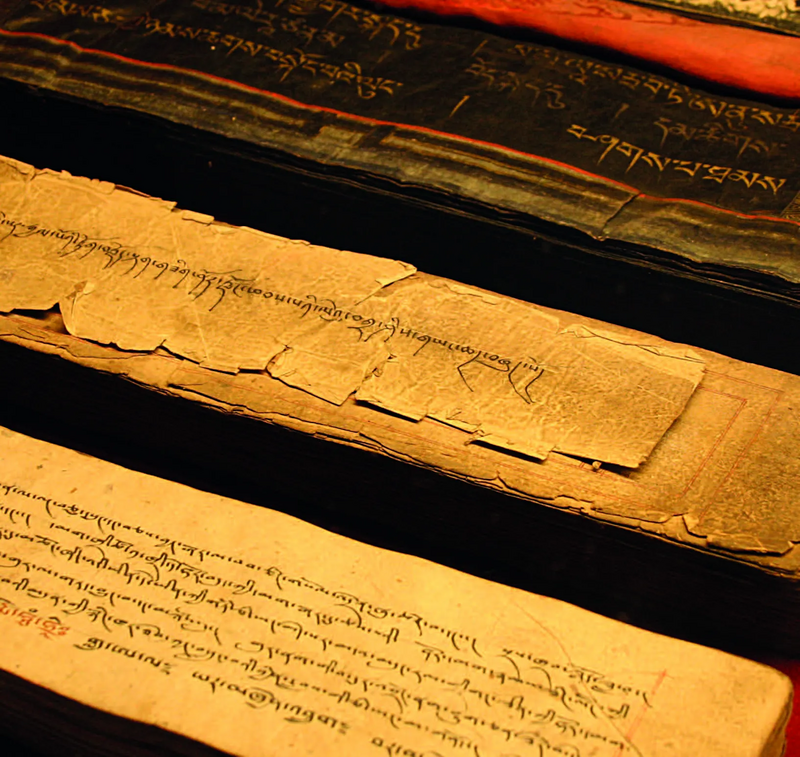
The Mirror Clarifying the Results of Karma (Byang chub sems dpa'i spyod pa la 'jug pa'i sgrung 'grel las 'bras gsal ba'i me long) is a narrative commentary on the anecdotes that appear in the ten chapters of the Bodhicaryāvatāra by Wangchuk Rinchen (c. 12th cent), who was a disciple of Latö Könchok Khar and became the abbot of Nering. The stories presented here were translated by Gregory Forgues and Khenpo Könchok Tamphel.
Chapter 2 Introduction
[In this chapter, stories are about:]
Good Source, Glorious Birth, Aged Enterer, The four individuals: Divine Child, Vajra Lady and so on. The Born Old, Demon’s Child, and Parrot, Born Like Wheat, and Pair of Mouse, Desire, Hatred, Ignorance, Pride and Jealousy: the eighteen of them.
Story 1 of Chapter 2
To the Buddhas, those thus gone, And to the sacred Dharma, spotless and supremely rare, And to the Buddha’s offspring, oceans of good qualities, That I might gain this precious attitude, I make a perfect offering.36The actual confession, from which this chapter takes its name, begins at stanza 27. It is preceded by the traditional formulas of homage and offering. See note 48
Page(s) 37
Blankleder, Helena, and Wulstan Fletcher (Padmakara Translation Group), trans. The Way of the Bodhisattva: A Translation of the Bodhicharyāvatāra. By Śāntideva. Rev. ed. Shambhala Classics. Boston: Shambhala Publications, 2006.
༈ རིན་ཆེན་སེམས་དེ་གཟུང་བར་བྱ་བའི་ཕྱིར། །
དེ་བཞིན་གཤེགས་པ་རྣམས་དང་དམ་པའི་ཆོས། ། དཀོན་མཆོག་དྲི་མ་མེད་དང་སངས་རྒྱས་སྲས། །
ཡོན་ཏན་རྒྱ་མཚོ་རྣམས་ལ་ལེགས་པར་མཆོད། །!_rin chen sems de gzung bar bya ba'i phyir/_/
de bzhin gshegs pa rnams dang dam pa'i chos/_/ dkon mchog dri ma med dang sangs rgyas sras/_/
yon tan rgya mtsho rnams la legs par mchod/_/Concerning the phrase "That I might gain this precious attitude . . .": In this context, it is necessary to amass the accumulations. For example, like the stories of the youth Good Source and the householder Glorious Birth as follows:
There was a wealthy householder in Śrāvastī who, lacking a son, made offerings to the teachers of the six heretical schools. In due time, a son was born to him, and he was named Good Source. When he grew up, his parents died. He himself was extremely crude and squandered all his wealth, and his name was changed to Immoral Source.
Then, a female servant gathered firewood and provided him with sustenance from it. However, he began to beat and abuse her. Because of that, she became mentally exhausted, and told him, "Although I have strived to support you, you have been hostile with me. There is no way I can live with you any longer. Leave this place and go to the city of Śrāvastī, where the Omniscient One is residing with a spiritual community of thirteen hundred and fifty śrāvakas, and there, become an ordained monk." After saying this, she tied a silver Kāṣāpaṇa coin to the edge of his garment and sent him away.
There, the youth Immoral Source requested the śrāvaka Śāriputra and others to ordain him as a monk. However, perceiving in meditative absorption that he had not yet accumulated sufficient merit, Śāriputra did not grant his request.
Then he approached the Omniscient One, who granted him ordination and said, "You should accumulate merit." Noticing the silver Kāṣāpaṇa coin tied to the edge of his garment, the Omniscient One tied [another] silver Kāṣāpaṇa coin to the edge of his garment, and instructed, "Go and buy some Utpala flowers from the flower seller, the daughter of a wealthy merchant."
As instructed, he went, and the merchant's daughter—glad that Immoral Source was turning toward virtue—sent him back with an entire load of Utpala flowers. When he returned, the Omniscient One instructed, "Now place one flower on the head of each member of the spiritual community." He did as he was told.
Then the Omniscient One said to the assembly, "Smell the flower to aid Immoral Source in completing his accumulations." As they all followed the instruction, his accumulations were completed, and he confessed his wrongdoings. The Blessed One welcomed him, saying, "Welcome, bhikṣu." In that moment, he received full ordination and later attained the result of an arhat.
The Householder Glorious Birth[1]
The householder named Glorious Birth was a miserly man. In his old age, he had five sons, to whom he gave all his wealth and arranged marriages for each of them.
When the householder reached the age of eighty, his young wife passed away, and his eyesight began to fail. He became dependent on his five daughters-in-law, who took turns caring for him. While they served good food to their own husbands, they gave the old man poor-quality food. When he complained to his sons about the inferior food, the sons said to their wives, "He is the householder—the one who labored to accumulate all our wealth. Serve him good chickpeas." So, the wives prepared two kinds of food, one good and one bad, and placed them in each section of a two-compartment earthen bowl. However, when serving, they gave the old man only the bad food.
Once again, the old man said, "The food served to me is bad." The wives dismissed his complaint, saying, "The old man is just making it up!" The sons also agreed, saying, "There is nothing wrong with the food, as it is being served from the same pot." At one point, the householder grew emaciated and, while feeling around in the pot with his hand, he discovered it had two compartments. Utterly disheartened, he wandered off, lamenting, "I labored to accumulate all my wealth, but it is of no use to me." He then went to Jetavana and, one by one, requested ordination from Śāriputra, Maudgalyāyana, and Mahākāśyapa. However, they denied his request, noting his lack of accumulated merit.
At this point, the householder thought, "I do not have the karmic fortune to be ordained. If I return home, my daughters-in-law will not feed me." Utterly despondent, he lay down with his head pillowed on the steps leading to Anāthapiṇḍada's Jetavana, stopping eating with the intention of starving himself to death. On the third day, the Blessed One saw him with compassion and, though already aware, asked Ānanda who he was. When Ānanda explained, he said, "Bring him here." When he entered, the Blessed One said, "Welcome, bhikṣu! Have you come well?" Thus, he was fully ordained and became an arhat.
The assembly was astonished and asked the Blessed One, "This man, due to his miserliness, has no karmic seed, yet he has become what he is. What is the reason?"
The Blessed One replied,
Since I am omniscient, I can see even the tiniest karmic seed in wicked and suffering beings, just as one might spot a small jewel amidst earth and gravel. This householder, in a previous life, served as a wood collector for a king. One day, upon hearing that the [Buddha] had arrived in the city, he rejoiced and, eager to meet the Noble One, took a shortcut to town. Along the way, he encountered a tigress who had just given birth and was killed by her. As he lay dying, he uttered the word "Buddha"—that was the tiny karmic seed I saw in him. That is why.
Story 2 of Chapter 2
Until the essence of enlightenment is reached, I go for refuge to the Buddhas. Also I take refuge in the Dharma And in all the host of Bodhisattvas.
Page(s) 41
Blankleder, Helena, and Wulstan Fletcher (Padmakara Translation Group), trans. The Way of the Bodhisattva: A Translation of the Bodhicharyāvatāra. By Śāntideva. Rev. ed. Shambhala Classics. Boston: Shambhala Publications, 2006.
བྱང་ཆུབ་སྙིང་པོར་མཆིས་ཀྱི་བར། །
སངས་རྒྱས་རྣམས་ལ་སྐྱབས་སུ་མཆི། ། ཆོས་དང་བྱང་ཆུབ་སེམས་དཔའ་ཡི། །
ཚོགས་ལའང་དེ་བཞིན་སྐྱབས་སུ་མཆི། །byang chub snying por mchis kyi bar/_/
sangs rgyas rnams la skyabs su mchi/_/ chos dang byang chub sems dpa' yi/_/
tshogs la'ang de bzhin skyabs su mchi/_/Concerning the phrase "I go for refuge to the Buddhas": In the past, a simpleton who had entered monastic life in old age went out for alms. A devoted female benefactor, moved by faith, offered him a pair of robes and requested a Dharma teaching. But having been ordained late in life and lacking knowledge of the Dharma, he admitted, "Because of not knowing the Dharma, I am suffering." As he said this again and again, the elderly woman realized that suffering stems from ignorance. Thus, she saw the truth and exclaimed, "I am free from samsara!" Offering these and other words of reverence, she departed.
At that time, a thief thought to himself, "I will steal the clothes from this simpleton," and he began to follow him. As the aged monk entered his dwelling, the thief demanded, "Give me the clothes!" The monk replied, "I am terrified and cannot come out. Please, pass me your hands through the door stopper." When the thief complied, the monk tied him up with a rope, came out, and made the thief take refuge in the Three Jewels by giving him a painful blow with a stick for each refuge. As the thief limped away, travelers asked, "Who are you? Why are you limping?" The thief replied, "I am a thief, but there is an even greater thief—a śrāmaṇera who beat me, made me take refuge, and gave me a blow for each refuge vow. The Buddha, endowed with super knowledge, condensed the refuge vows into three. Had there been a fourth, I would have surely lost my life!"
Saying this, he went and sat beneath a bridge, filled with devotion toward the Buddha. As a result, many nonhuman beings found themselves unable to cross the bridge. They began to wonder among themselves, "We used to pass over this bridge with ease—why can’t we now?” They asked the man beneath the bridge, "What kind of magical knowledge do you possess?" He replied, "I know nothing but the refuge vow." Hearing this, they all developed faith and took refuge. The thief, too, eventually became ordained and attained the fruit.
Stainless Jewel,[2] the Celestial Maiden
A celestial maiden named Stainless Jewel received the five signs of impending death, and it was said that she would be reborn in Jambudvīpa through the womb of a pig. Finding no protection from Indra, she turned to the Buddha, who conferred upon her the refuge vows. As a result, she was reborn as a brahmin and later in Tuṣita Heaven. Reflecting on her past lives with super insight, she understood that these fortunate rebirths had come through taking refuge. Moved by devotion, she scattered flowers before the Buddha and recited the following verse:
Whoever takes refuge in the Buddha Will never fall into lower realms. Once they’ve cast off the human form, They will be born in a divine one.
This also applies to the Dharma and the Spiritual Community.
King Prasenajit's Unattractive Daughter
King Prasenajit had many queens, and his chief queen, Barli, gave birth to a daughter who was short in stature, dark in complexion, with coarse skin, and unsightly from every angle. She spoke out of turn to the king and was named Vajri.
The king was deeply ashamed of her, but because she was the daughter of his chief queen, he concealed her in a nine-storied palace. When she came of age and the time for her marriage approached, the king instructed a minister, "Go find someone who once belonged to a higher lineage but is now poor and wandering without wealth." As instructed, when an individual was presented, the king spoke to him privately, "I have a daughter who is extremely unattractive. Though you are poor, you come from a noble lineage, so I will give her to you. Accept her."
The man knelt and replied, "If the king were to bestow even an ordinary person upon me, I would accept. How would I not accept when you offer me someone of royal lineage?" Then, the king instructed the groom, "As my daughter is extremely unattractive, you should keep her locked away, and take the key with you whenever you go out." He provided them with sufficient provisions and appointed her as a cooking maid.
As their livelihood improved, the other ministers and women conspired to harass them. When they came according to their plan, they found the man alone, without his wife. Suspicious, they said among themselves, "Either his wife is exceptionally beautiful, or the complete opposite. Let’s find out!" They then plotted to steal the key while the man was drunk, so they could catch a glimpse of his wife.
At that time, the woman thought, "What karma have I committed in the past to be confined for life in a dark, nine-storied tower, never seeing even a ray of sunlight or moonlight?" Overcome with despair, she resolved, "I will take refuge in the Omniscient One!" With her hair standing on end and tears streaming down her face, she turned her body in the direction of the Teacher and cried out, "Teacher, Blessed One, Omniscient One, I prostrate and take refuge in you! Please liberate me from this suffering!"
The Teacher appeared right there. When she saw his head, her head's defect vanished. When she saw his complete form, all the ugliness of her body was shed, and she became incomparably beautiful and attractive. The friends who had come to spy said, "She is so extraordinarily wondrous—no wonder he dares not reveal her!"
Then her husband came in and saw her. "Who are you?" he asked.
"I am your wife," she replied, and explained the cause of her transformation. She said to him, "Now I am utterly weary of worldly life. I wish to meet my father—please go and inform him."
When he informed the king, the king ordered, "Don’t say that! Lock the door and do not let her out!"
The husband responded, "The princess is no longer as she once was—she now surpasses even gods and humans!" Overjoyed, the king granted permission. With his retinue, he made offerings to the Buddha and asked about the cause.
The Buddha replied, "In a previous life, she was the daughter of a king. She repeatedly insulted an unattractive pratyekabuddha, who was her father's object of veneration, saying: "His head is like a bear's, his ears like a donkey's, his eyes like a monkey's, his nose like a pig's, his teeth like a dog's, and his body like a frog's," and so on.
In response, the pratyekabuddha rose into the sky and performed various miracles. Overcome with remorse, the daughter confessed her misdeeds. The pratyekabuddha then gave a detailed teaching on the importance of adhering to pure conducts, and subsequently established everyone in the refuge vows.
[There are also other stories, such as]: the one in the charnel ground whom nonhumans could not harm; the couple who took a mother devoted to the refuge vows to the charnel ground; the father and son who were unharmed by a cannibalistic rākṣasa; and, as recounted in the Karuṇāpuṇḍarīkasūtra, the ships shattering water-monster who attained the result upon hearing merchants take refuge. These accounts cannot be explained in detail here, to avoid excessive length of writing. For further details, please consult other sources.
Story 3 of Chapter 2
"Whatever I have done against the Triple Gem, Against my parents, teachers, and the rest, Through force of my defilements, In my body, speech, and mind,
Page(s) 41
Blankleder, Helena, and Wulstan Fletcher (Padmakara Translation Group), trans. The Way of the Bodhisattva: A Translation of the Bodhicharyāvatāra. By Śāntideva. Rev. ed. Shambhala Classics. Boston: Shambhala Publications, 2006.
བདག་གིས་དཀོན་མཆོག་གསུམ་དང་ནི། །
ཕ་མའམ་བླ་མ་གཞན་དག་ལ། ། ཉོན་མོངས་སྒོ་ནས་ལུས་ངག་དང་། །
ཡིད་ཀྱིས་གནོད་བགྱིས་གང་ལགས་པ། །bdag gis dkon mchog gsum dang ni/_/
pha ma'am bla ma gzhan dag la/_/ nyon mongs sgo nas lus ngag dang /_/
yid kyis gnod bgyis gang lags pa/_/Concerning the phrase "Through force of my defilements, in my body, speech, and . . .": In Rājagṛha, a young wife of a wealthy merchant conceived a child. Although she later gave birth to ten sons, the first child remained in her womb, unborn. Over time, the woman fell ill. Despite receiving medical treatment, nothing proved effective. As she approached death, she said to her husband, "When I die, cut open my right side with a blade and take out the first child."
She also said:
All that is accumulated will eventually be depleted, All that is elevated will ultimately fall, All that is assembled will eventually part, All that is alive will ultimately die.
Having said this, she died.
Then, a physician carried her body to the charnel ground at Śītavana to cut it open. News of this spread throughout the city of Rājagṛha, and hundreds of thousands gathered to witness it. The Blessed One said to Ānanda, "Ānanda, announce to the monks that the Blessed One intends to go to the charnel ground. Let those who wish to behold a wondrous sight come with me." Then, attended by the śrāvakas, the Blessed One went there, and as the physician cut open the woman's right side, to everyone's astonishment, a living boy emerged, emaciated, wrinkled, with white hair and the appearance of an old man.
Immediately upon emerging, the boy looked at the assembled crowd and said, "Alas! Do not speak harshly to your parents, preceptors, or teachers. I say this because I have suffered for sixty years trapped between my mother's stomach and intestines." After saying this, he remained silent, and the Blessed One asked him, "Are you an old man?" He replied, "Blessed One, I am an old person. Sugata, I am an old person." Based on this, he was named The Old Gentleman.[3]
Based on this event, the Blessed One taught the Dharma, through which hundreds of sentient beings grew weary [of samsara] and attained the fruit. The man, Old Gentleman, remained at home as a layman for ten more years, and at the age of seventy, he took ordination and attained arhatship.
He also rescued five hundred merchants from fear in the ocean and established them in arhatship. The monks then asked, "Blessed One, what is the cause for this man being born old?"
The Buddha replied,
In the past, during the time of Buddha Kāśyapa, a young merchant was ordained by a venerable arhat. During a local festival, the youth said to the Venerable One, "It's time to leave!"—repeating it three times. But the arhat replied each time, "Stay a little longer! Engage in virtuous deeds!"
Frustrated and hungry, the youth finally exclaimed, "Don’t come out of this house for the next sixty years—I'm leaving!" That harsh speech became the cause of his present condition.
Then, the [Blessed One] gave extensive teachings, beginning with the verse: "The karmas of embodied beings," and so forth.
Story 4 of Chapter 2
"All the evil I, a sinner, have committed, All the wicked deeds that cling to me, The frightful things that I contrived I openly declare to you, the teachers of the world.
Page(s) 41
Blankleder, Helena, and Wulstan Fletcher (Padmakara Translation Group), trans. The Way of the Bodhisattva: A Translation of the Bodhicharyāvatāra. By Śāntideva. Rev. ed. Shambhala Classics. Boston: Shambhala Publications, 2006.
ཉེས་པ་དུ་མས་སྐྱོན་ཆགས་པའི། །
སྡིག་ཅན་བདག་གིས་སྡིག་པ་གང་། ། ཤིན་ཏུ་མི་བཟད་བགྱིས་པ་དེ། །
ཐམས་ཅད་འདྲེན་པ་རྣམས་ལ་བཤགས། །nyes pa du mas skyon chags pa'i/_/
sdig can bdag gis sdig pa gang /_/ shin tu mi bzad bgyis pa de/_/
thams cad 'dren pa rnams la bshags/_/Concerning the phrase "I openly declare to you, the teachers of the world": Once, there was a brahmin who lived in his own palace. At that time, there was an extremely unruly man of low birth, with an ugly face—resembling a monkey or a dwarf—who walked with a limp, spoke with a tearful voice, and ate in a way that made others nauseous. This coarse and inhuman man was the husband of a queen named Yoginī, who was exceedingly beautiful and pleasing to behold, yet he constantly mistreated her.
One day, when she failed to greet him, he tried to kill her. Terrified, she trembled and fled. No one was able to protect her—except for the brahmin, who, out of great compassion, offered her refuge. When the man, who was like a demonic son, saw the brahmin, he was overcome with fear and said:
Alas! O elegant human form, Where does one such as you reside? Please look upon me with compassion— I take refuge in your sublime presence!
[The brahmin] replied:
Alas, wondrous sentient being! A human body with a Rākṣasa's face, You have this bad body due to your bad karma. If you feel remorse, it will lead to happiness.
Upon hearing this, the rākṣasa child felt an overwhelming sense of remorse. He felt as though his heart would burst, his eyeballs would pop out, and his body would shatter. His hair stood on end, tears flowed like blood, and his body stiffened. In agony, he lamented:
Alas, alas, evil karma ripens upon oneself! Who else is to blame? I am weary of myself! Wherever karma has been done, may it ripen now! May suffering befall me at this moment!
Uttering these words with remorse and anguish, in that very instant, his body transformed—becoming beautiful, his voice melodious, and his appearance pleasing to behold. Having shed his former guise, people remarked, "The brahmin appeared for the glory of the oppressed queen." Thus, the name of the brahmin became renowned.
Story 5 of Chapter 2
We cannot trust the wanton Lord of Death. The task complete or still to do, he will not wait. In health or sickness, therefore, none of us can trust Our fleeting, momentary lives.
Page(s) 42
Blankleder, Helena, and Wulstan Fletcher (Padmakara Translation Group), trans. The Way of the Bodhisattva: A Translation of the Bodhicharyāvatāra. By Śāntideva. Rev. ed. Shambhala Classics. Boston: Shambhala Publications, 2006.
ཡིད་བརྟན་མི་རུང་འཆི་བདག་འདི། །
བྱས་དང་མ་བྱས་མི་སྡོད་པས། ། ན་དང་མི་ན་ཀུན་གྱིས་ཀྱང་། །
གློ་བུར་ཚེ་ལ་ཡིད་མི་བརྟན། །yid brtan mi rung 'chi bdag 'di/_/
byas dang ma byas mi sdod pas/_/ na dang mi na kun gyis kyang /_/
glo bur tshe la yid mi brtan/_/Concerning the phrase ". . . none of us can trust our fleeting, momentary lives": The householder Gautama's son, named Parrot, developed a sense of impermanence upon seeing the condition of a beehive. He gave away all his wealth in charity, and both he and his father took ordination and became arhats.[4]
Story 6 of Chapter 2
And even in the brief course of this present life, So many friends and foes have passed away, Because of whom, the evils I have done Still lie, unbearable, before me.
Page(s) 42
Blankleder, Helena, and Wulstan Fletcher (Padmakara Translation Group), trans. The Way of the Bodhisattva: A Translation of the Bodhicharyāvatāra. By Śāntideva. Rev. ed. Shambhala Classics. Boston: Shambhala Publications, 2006.
རེ་ཞིག་གསོན་ཚེ་འདི་ཉིད་ལའང་། །
མཛའ་དང་མི་མཛའ་དུ་མ་འདས། ། དེ་དག་དོན་དུ་བྱས་པའི་སྡིག །
མི་བཟད་གང་ཡིན་མདུན་ན་གནས། །re zhig gson tshe 'di nyid la'ang /_/
mdza' dang mi mdza' du ma 'das/_/ de dag don du byas pa'i sdig_/
mi bzad gang yin mdun na gnas/_/Concerning the phrase "Still lie, unbearable, before me": There was a caravan leader named Host of Power.[5] He had several sons, one of whom had a head shaped like an umbrella. In addition, another son was born with jeweled earrings at the time of the Śravaṇā[6] constellation.
At the time of naming him, everyone was asked to assess the value of the jewels, but no one could determine it. Since it was customary to refer to something priceless as "worth a billion in the world,” the boy was given the name Ears Worth a Billion,[7] alias Born at Śravaṇā.[8]
When he came of age, since his father came from a line of caravan leaders, he sought his mother's permission to go in search of jewels. After announcing his intention to the merchants and preparing to join them on a sea journey, his mother said to them, "Do not leave my son behind, nor send him ahead of you—and when you return, bring him back with you!" Having said that, instead of an elephant or a similar mount, she arranged for him a clever but low-maintenance donkey.
As he easily obtained many jewels from the ocean, he remained lost in thought, thinking, "This price for that jewel," and fell asleep by late dawn. In the meantime, all the other merchants had left. When the sun rose, its rays struck Born at Śravaṇā's cheek, waking him up. He looked around and saw that all his companions were gone.
He loaded the donkey and, fearing he would not catch up with his companions, whipped it. As a result, the donkey lost its sense of smell and went astray, causing him to lose the load. Feeling hungry, he saw an iron house and walked through its door, shouting, "Give food and drink befitting Born at Śravaṇā." As he said this, many hungry ghosts emerged and said, "We haven't even heard the names food and drink in twelve years! And now you’re asking us for food and drink."
He asked them, "What karma caused you to be born here?" They replied, "You people from Jambudvīpa are hard to convince, so we will not speak." He insisted, saying, "I can see it directly. Why would I not believe? Tell me!"
So, they said:
We were harsh in speech and full of anger, Tight-fisted due to our miserliness. Because we gave nothing in generosity, We now dwell in the realm of hungry ghosts.
Another said:
Intoxicated by health and satiety, Intoxicated by youth and pride of wealth, We gave nothing in generosity— And now, we are in the realm of hungry ghosts.
Then they added that, in a previous life in the city of Takṣaśilā, they had been children who, just for fun, muddied the water and prevented the spiritual community from accessing it—causing them to miss their meal.
From there, Born at Śravaṇā continued on in another direction. As evening fell, he came upon a mansion in that region where a god resided. He asked for food and drink, and the god generously offered them in abundance. As night came to an end, the god said, "Go now, to a place where evil cannot be seen by the eye!" Curious about what evil might be present, Born at Śravaṇā stayed—and saw the god transform into a hell-being, consumed by flames.
When night fell again, the being returned to his godly form. Born at Śravaṇā asked, "Why do you become a god at night and a hell-being during the day?" The god replied, "In a past life, I was a butcher in the city of Takṣaśilā. The noble Kātyāyana once urged me, 'Give up killing!' I replied, 'I cannot.' He then asked, 'Do you kill during the day or at night?' I said, 'During the day.' So he said, 'Then take a vow not to kill at night.' I agreed—and because of that, this is now my fate."
"If you go to Takṣaśilā," the god continued, "you will find my son, who is also a butcher. Tell him to stop killing. Beneath his butcher's stand is a pot filled with butter and gold. Tell him to take it out and make offerings in my name to the śrāmaṇeras and brahmins—especially to the noble Kātyāyana—and dedicate the merit to me. Perhaps then, my suffering will be eased."
Again, Born at Śravaṇā continued on in yet another direction and came upon a second mansion, where, during the day, a god resided. Again, the god offered plentiful food and drink. But as the sun began to set, he warned, "Go now—go to a place where evil is not seen by the eye!" Curious once more, Born at Śravaṇā remained. The god then transformed into a hell-being, burning in torment. When night fell again, he returned to his divine form.
Born at Śravaṇā asked, "Why do you become a god at night and a hell-being during the day?" The god answered, "In a former life, I was a householder in Takṣaśilā who committed sexual misconduct. The noble Kātyāyana urged me, 'Give up misconduct!' I replied, 'I cannot.' He asked, 'Do you engage in it during the day or at night?' I said, 'At night.' So he said, 'Then take a vow to abstain during the day.' I took that vow—and this is fate now, just as before."
"If you go to Takṣaśilā," continued the god, "my wife and son are there. Tell them that beneath the hearth, a pot full of gold lies hidden. Let them take it out, use it for their own comfort from time to time, and also offer some of it as alms to the great noble Kātyāyana. If they dedicate the merit in my name, perhaps then this suffering of mine will be eased."
Again, when Born at Śravaṇā continued on in another direction, he came upon a mansion where a goddess resided, attended by four hungry ghosts. When he requested food and drink, she offered him plenty but warned, "Do not give any to these hungry ghosts!" Ignoring her, he shared the food with them. For one, it turned into boiling molten metal; for another, burning embers; for a third, chaff-dust; and for the fourth, it became burning ashes, thereby causing them suffering.
The goddess then said, "Why did you give it to them? If giving helped them, I too would offer it—but it only increases their suffering!"
When he asked why these hungry ghosts were her attendants, she replied, "You Jambudvīpans are difficult to convince, so I will not say."
"I’ve seen it with my own eyes—I will believe it. Please, tell me," he insisted. [The goddess replied:]
In a previous life, we were a family in the city of Takṣaśilā. These four were my husband, son, daughter, and servant girl. Once, when the servant girl had gone to work and I was preparing food, the noble Kātyāyana came seeking alms. I cooked a bowl of rice gruel and offered it to him. The others objected, saying, "Our food is inadequate!" I replied, "You should rejoice—because I offered alms to the noble Kātyāyana, your food is inadequate!"
As I said this, my husband said, "Why didn't you give him a handful of burning embers to fill his mouth?" [Likewise, my son suggested] some boiling molten metal; my daughter, some burning ashes; and my servant girl, some chaff-dust.
Then I made this conflicting aspiration: "May I alone bear the karmic result of all of you speaking harshly to such an extraordinary being as this Noble One." Because of that, this is now our fate."
Then she asked Born at Śravaṇā, "Do you wish to be living in the city of Takṣaśilā?"
"Yes," he replied.
"Then lie down facing that direction and go to sleep," she said.
As he slept, the four hungry ghosts lifted the corners of the mat and carried him to Takṣaśilā. When he awoke and looked around, he found himself in Takṣaśilā, and he thought, "I will request ordination from the noble Kātyāyana!"
When he made the request, Kātyāyana said, "Since your parents are still alive, you must first obtain their permission to be ordained. Also, deliver the messages from the hell-beings and hungry ghosts."
He then delivered the message to the butcher's son, who dismissed it, thinking he was lying. But when he pointed to the golden pot, it was exactly as he had described. This made the [butcher's son] convinced and astonished. As Born at Śravaṇā smiled, his golden tooth flashed, and they recognized him. "Are you truly Born at Śravaṇā?" they asked. "That is how the world knows me," he replied. "Since your parents are still alive, you should go and visit them," they suggested.
Then he delivered the second message, and received the same response as before—right up to the suggestion that he go and visit his parents.
When the merchants had returned earlier, he was not among them. When asked about him, those who arrived first said, "He will come later," while those who came later said, "He went ahead." Believing he had died, his family performed acts of merit in his name and recorded their deeds on a stone pillar.
Grieving the loss of their son, his parents had gone blind. But when he finally arrived, they were overwhelmed with joy and wept. Their tears washed away the cataracts from their eyes, and they could see once more.
Then, his parents gladly gave him their blessing to take ordination. He was ordained by the noble Kātyāyana and attained the state of a nonreturner.
Story 7 of Chapter 2
Never halting night or day,
My life drains constantly away,
And from no other source does increase come.
How can there not be death for such as me?[p.43]The Way of the Bodhisattva (2006)
Blankleder, Helena, and Wulstan Fletcher (Padmakara Translation Group), trans. The Way of the Bodhisattva: A Translation of the Bodhicharyāvatāra. By Śāntideva. Rev. ed. Shambhala Classics. Boston: Shambhala Publications, 2006.
Page(s) 42
Blankleder, Helena, and Wulstan Fletcher (Padmakara Translation Group), trans. The Way of the Bodhisattva: A Translation of the Bodhicharyāvatāra. By Śāntideva. Rev. ed. Shambhala Classics. Boston: Shambhala Publications, 2006.
ཉིན་མཚན་སྡོད་པ་ཡོང་མེད་པར། །
ཚེ་འདི་རྟག་ཏུ་གོད་འགྱུར་ཞིང་། །
སྣོན་པ་གུད་ནས་འོང་མེད་ན། །[p.15]Byang chub sems dpa'i spyod pa la 'jug pa rtsa ba dang 'grel pa (1990)
Slob dpon zhi ba lha and Mkhan po kun dpal. Byang chub sems dpa'i spyod pa la 'jug pa rtsa ba dang 'grel pa. Khreng tu'u: Si khron mi rigs dpe skrun khang, 1990. 
nyin mtshan sdod pa yong med par/_/
tshe 'di rtag tu god 'gyur zhing /_/
snon pa gud nas 'ong med na/_/[p.15]Byang chub sems dpa'i spyod pa la 'jug pa rtsa ba dang 'grel pa (1990)
Slob dpon zhi ba lha and Mkhan po kun dpal. Byang chub sems dpa'i spyod pa la 'jug pa rtsa ba dang 'grel pa. Khreng tu'u: Si khron mi rigs dpe skrun khang, 1990.
Concerning the phrase "Never halting night or day": A person became attached to a fruit at the edge of a cliff and held onto a blade of grass to reach it. Two mice, one black and one white, gnawed at the grass in turn until it was cut, and the person fell into the abyss.[9]
Story 8 of Chapter 2
Than words of the all-knowing doctor, Which uproot our every ill, The thought to turn on him deaf ears Is abject and contemptible stupidity.
Page(s) 45
Blankleder, Helena, and Wulstan Fletcher (Padmakara Translation Group), trans. The Way of the Bodhisattva: A Translation of the Bodhicharyāvatāra. By Śāntideva. Rev. ed. Shambhala Classics. Boston: Shambhala Publications, 2006.
དེ་ལ་སྨན་པ་ཐམས་ཅད་མཁྱེན། །
ཟུག་རྔུ་ཐམས་ཅད་འབྱིན་པ་ཡི། ། བཀའ་ལྟར་མི་བྱེད་སེམས་པ་ནི། །
ཤིན་ཏུ་གཏི་མུག་སྨད་པའི་གནས། །de la sman pa thams cad mkhyen/_/
zug rngu thams cad 'byin pa yi/_/ bka' ltar mi byed sems pa ni/_/
shin tu gti mug smad pa'i gnas/_/Concerning the phrase, "Which uproot our every ill . . .": Smṛti refers to [the following stories]:
Nanda, Aṅgulimāla, Lamchungwa, Kapin, and Devadatta— These are examples of the five poisons.
Nanda
First, the way the pain of desire is uprooted:
While the Teacher (the Buddha) was residing in Rājagṛha, his younger brother Nanda remained deeply attached to Sundarīka. To help subdue and liberate his mind, the Buddha traveled to Kapilavastu. Nanda wished to offer him alms, even though Sundarīka objected. Before he left, she marked his forehead with a sandalwood tilaka and said, "Make sure you return before this dries!"
However, when the Buddha asked him if he wanted to see Rājagṛha, Nanda followed him. Upon arrival, the Buddha assigned him the task of cleaning, but as the task seemed endless, Nanda tried to escape—only to encounter the Buddha again along the way. The Buddha then asked him if he wanted to see Trāyastriṃśa Heaven and took him there. In that realm, Nanda saw male and female gods residing together in each mansion—except for one, where a single beautiful goddess, without a male companion, was stringing a garland of flowers. When he asked her why, she replied, "Nanda will be ordained, and after that, he will be reborn here. I am preparing this garland for him." Hearing this, Nanda took ordination—but with the aspiration for fortune.[10]
Then the Buddha asked Nanda if he wanted to see the hell realms and took him there. He saw beings being boiled. In one place, there was no being—only water being heated. Nanda asked why, and they replied, "After Nanda has exhausted the results of upholding discipline with the aspiration for fortune in the human realm, he will be reborn here. We are heating this water in preparation for him." Frightened by this, he upheld the vows of discipline for the sake of definite release,[11] meditated, and attained arhatship.
Aṅgulimāla
First, the way the pain of hatred is uprooted:
In the Aṅgulimālasūtra, it is said that the Buddha was dwelling in Rājagṛha. (According to the Damamūkasūtra, it was "with the intention to benefit.")
At that time, a minister named Candra, serving King Prasenajit, had a son who bore many auspicious signs. When the newborn was presented to an astrologer, he was named "Without Torment," as the mother had experienced no suffering during her pregnancy.
His strength was enough to face a thousand men, his agility was such that he could catch a hawk in mid-flight, and his speed surpassed that of a horse.
As he studied the Vedas under the brahmin Perfect Wealth,[12] he learned more in a single day than the others. As a result, he was admired by all. The teacher’s wife, Perfect Wish-fulfilling Lady,[13] was captivated by his looks and physical charm, but she did not have the opportunity to speak with him about it.
Around that time, the brahmin had to travel south for three months to visit some of his benefactors. He told his wife, Perfect Lady, "I will leave one of my disciples to accompany you." She was pleased and replied, "I request that you leave Without Torment, as he is not only skilled in household chores but also trustworthy."
As instructed, he was left behind. She adorned her body and said to him, "I am attached to you, and since no opportunity has arisen before, please fulfill my desire!" However, the youth remained steadfast. "I too find you pleasing," he replied, "but according to the brahmin Dharma, if one engages in misconduct with the wife of one's teacher, it ruins this life. Even if you kill me, I cannot do this." Ashamed and angered, she devised a deceit. When the teacher was about to return, she tore her clothes, scratched her face, and lay on the ground, pretending to be in distress.
When the teacher asked her the reason, she replied, "It's not worth mentioning." "Is there anyone closer to me than you? What harm is there? Tell me!" the teacher insisted. "This youth, who always sits beside you, tried to sleep with me. When I refused, he did this to me. Kill him now!" she said. "Since he is the son of a powerful minister, I cannot afford to disregard him. Therefore, I will kill him by using a trick," the teacher promised.
When the youth came before the teacher, he asked, "You’re just a beginner—didn't you find it burdensome to do all the household chores? Because I cannot forget your kindness, I'd like to teach you a Dharma I haven't taught to others."
As the youth knelt and made his request, the teacher instructed him: "You must keep pure conduct for seven days, then cut off the heads of a thousand people and make a garland of their fingers to wear as an ornament. By doing this, you will be reborn in the Brahmā realm."
But the youth, being very intelligent, replied, "Teacher, the cause for rebirth in a divine realm is not like that."
"Oh? Then what is it like?" asked the teacher. The youth recited:
Speak the truth, refrain from anger, Give even when asked for a little— Whoever upholds these three qualities Will surely be reborn among the gods.
"These," he said, "are the causes for rebirth among the gods—not killing."
The brahmin said, "You doubt my Dharma? Your samaya is broken!"
As the youth remained silent, the brahmin noticed a change in his expression. At that moment, he cast a malevolent spell he knew—one that agitates the minds of others. Hatred arose in the youth.
The brahmin then empowered a sword with mantras and handed it to him. For seven days, the youth killed nine hundred and ninety-nine people, making an ornament from the fingers he could gather.
Everyone heard about it, and travelers stopped using that road. His mother, thinking that a being in the desire realm cannot survive for seven days without food—and fearing her son might die—brought him something to eat.
As he began chasing her with the intention to kill, she cried out, "I brought you food because I was afraid you'd die! If you kill me, it will be a heinous act of karma!"
He replied, "This is my master's command—I have no choice but to kill you."
"What exactly did your master say?" she asked. He then explained the entire incident.
She said, "Then cut off my finger and take it! That way, you won’t commit a heinous karma, and you'll still complete your count."
He responded, "That's not enough. I have to kill you."
At that moment, the Buddha—knowing the time to tame him had arrived—appeared before him.
Thinking, "I must not kill my mother. Killing that monk over there will suffice," he took his sword and ran. The Buddha walked slowly, yet he could not catch him, and he shouted, "Monk, stop!" Buddha asked, "What are you talking about? I am always stopped, and stopped! You are the one who is always going and going."
He regained his mindfulness and asked, "Monk, why are you making such statements?"
The Buddha replied, "I have upheld moral conduct. Because of this, I stop forever—and stop continuously in the human and god realms. But you, following the instructions of a misleading teacher and engaging in killing, go—and go continuously to the lower realms."
At that moment, he felt deep remorse, threw his sword to the ground, vomited blood, and exclaimed, "Bhikṣu, I take refuge in you!" He then requested to be ordained. The Buddha responded, "Bhikṣu, welcome"—a declaration that formally ordained him as a bhikṣu. As the Buddha gave him instructions, he meditated accordingly and attained arhatship.
Despite the change in him, people still refrained from traveling. So the Buddha said to him, "Go and declare: 'My name is Without Torment, the one with a garland of fingers. I have never killed even a single living being—not even a tiny ant!'"
"Wouldn't that be a lie, since I have killed one hundred and ninety-nine people?" he asked.
The Buddha replied, "It will not be a lie, because you committed those acts as an ordinary being. Since becoming a noble one, you have not killed even a single living being."
As he made the declaration as instructed, people were convinced, thinking, "Aṅgulimāla has been tamed by the Buddha," and they began traveling again.
At that time, King Prasenajit arrived with his army on a mission to subdue Aṅgulimāla. However, his horse faced toward Śrāvastī and stopped moving. A minister explained, "This is because there is a monk in this area with an exceptionally melodious voice."
"Oh? Then turn the army toward Śrāvastī!" Prasenajit commanded.
Upon arriving in the Buddha's presence, they said, "We have heard that such a monk is here. We wish to meet him and offer some presents."
The Buddha said, "Offer your presents now. After that, your wish to meet him may be fulfilled."
The king refused, saying, "What are you saying? One offers presents to someone after meeting them. Nowhere is it the custom to offer them beforehand."
But when the king finally saw the monk, he lost the desire to offer the presents, for the monk appeared very unsightly. He asked the Buddha, "Why is he like this?"
The Buddha replied,
In the past, during the time of Buddha Kāśyapa, there was a king named Lingshrī who wished to build a stūpa. One night, he dreamt that five young brahmins asked him, "Will the stūpa you build be made of jewels?"
As a result, he assigned the task to four of his ministers. Three of them completed their respective parts, but one thought, "This foolish king—how could he possibly accomplish such a thing?" and did nothing. However, the three joined efforts and completed the final side as well, and in the end, a magnificent jewel stūpa was completed.
Later, the slothful minister went to see how much progress had been made. When he saw that a magnificent stūpa had been completed, he too developed faith and adorned it with a golden bell.
As a result of that offering, in his present life this venerable one has a melodious voice. But due to not completing the task assigned to him, he is destined to have an unsightly form for five hundred lifetimes.
After hearing this, the king and his retinue wished to take their leave. Though the Buddha already knew the reason, he asked, "Why do you want to go?"
"To subdue Aṅgulimāla," they replied.
"He is an arhat, right here," the Buddha said.
"If that is true, let me see him," the king requested. But as he approached, Aṅgulimāla coughed, and the king fainted on the spot. When they asked why, the Buddha replied:
In the past, there was a bird of great ferocity. Even its shadow caused all sentient beings to become afflicted. When the bird landed on a tree and cried out, even an elephant standing in the tree's shadow trembled. These two—Aṅgulimāla and the king—were that bird and that elephant.
Lam Chung
First, the way the pain of ignorance is uprooted:
A brahmin once had a son who died shortly after birth. When another son was later born, the father—hoping to ensure his survival—followed a traditional piece of advice: "Take the child to the main road. If he meets a śrāmaṇa, the śrāmaṇa will offer prayers; if he meets a wandering ascetic, the ascetic will utter auspicious words."
Following this counsel, the father carried his newborn to the road. As they passed, one śrāmaṇa offered prayers and named the child Great Path. Another gave him the name Small Path, and yet another called him Minor Path.
However, the boy, even after a full year, could not remember the simple words "Siddham" or "Buddha." He got ordained and was assigned basic tasks such as cleaning shoes and sweeping. However, he failed at those as well. Discouraged and overwhelmed with despair, he contemplated ending his life by jumping from a height.
At that critical moment, the Buddha—knowing that his time for transformation had arrived—intervened. He taught the boy the Dharma, and through that direct instruction, the boy became an arhat.
Later, the Buddha appointed him as a teacher for the community of nuns. But the nuns scorned the decision, saying, "We are nuns well-versed in the Three Baskets of teachings. And, this so-called teacher, Minor Path, is the very embodiment of ignorance!"
To mock him further, they prepared a high teaching throne and publicly announced, "A Buddha-like arhat will soon teach the Dharma!" A large crowd gathered, hoping to shame him, but through miraculous power, he ascended the throne effortlessly and delivered extensive Dharma discourses, thereby inspiring devotion in many people.
King Kapina
First, the way the pain of pride is uprooted:
When the Blessed One was residing in Śrāvastī, the kingdom was ruled by King Prasenajit. In the south, the Kingdom of Serpa was under the rule of Great Kapina, regent of the Kapina Dynasty, who commanded thirty-six thousand vassal kings. Their army moved like flowers scattered by the wind, and merely hearing of their glory made others’ faces turn red.
Once, when some merchants presented fine cloth from the central land to the King of Serpa, he asked, "What a splendid piece of cloth—where is it from?"
"From the central land," they replied.
The king then demanded, "What is this 'central land'? Who is its king? Why has he not come to pay me homage and offer tribute? If he does not appear within seven days, tell him I will erase even his name from the world!"
The message was delivered to King Prasenajit. Alarmed, he reported the matter to the Blessed One, who advised him, "Tell the messenger, 'There is a king greater than I—deliver your message to him instead.'"
As instructed, when the messenger arrived, the Blessed One manifested as a universal monarch, surrounded by Maudgalyāyana and others as his ministers, along with the seven precious possessions and the seven semiprecious attributes. His residence appeared as a hidden, seven-tiered jeweled mansion, adorned with blooming jewel trees and other marvels.
When the messenger saw this, he was astonished. "Our king cannot possibly compete with this one," he thought, yet still presented the letter. The manifested king placed it beneath his feet and declared, "I am the ruler of the four continents! You fool! If, after hearing my command, you still loiter about—eating and idling—and fail to appear before me within seven days, you will be dealt with according to the law!"
Hearing this threat, Kapina's face changed color. He rose from his throne and drew his sword, but upon learning of the power and majesty of the manifested king, he was struck with remorse. "It is not fitting to approach him in such a state. I will inquire once more," he thought. So he sent a message: "We will come to pay homage. I command an army of one million eighty thousand and thirty-six thousand vassal kings. We are all coming gradually."
The manifested king replied, "Come with half of your vassal kings." So Kapina came with tens of thousands of vassal kings and paid homage. Yet he thought to himself, "His appearance may surpass mine, but his power cannot possibly equal mine." At that very moment, the manifested king turned to a minister and said, "Give him my bow." When Kapina tried to lift it, he could not.
Then, as the manifested king struck the bowstring with his little finger and raised it, the entire trichiliocosm trembled. Taking an arrow, he shot it, and it transformed into five arrows. Countless rays of light emanated from their tips, and each transformed into a lotus as large as a chariot wheel. On each lotus sat a universal monarch, adorned with the seven precious articles, working for the benefit of all sentient beings.
Kapina was filled with delight and joy, and his understanding of the Dharma became clear. The vassal kings were also satisfied. Then, the Buddha withdrew the manifestation and appeared in his true form as a Buddha, surrounded by a sangha of monks. The King of Serpa (Kapina) requested ordination. The Buddha responded, "Come here, it is wonderful that you have come!" Thus, Kapina became a monk, diligently practiced, and eventually attained arhatship.
Devadatta
First, the way the pain of jealousy is uprooted:
While the Teacher was residing at Vulture Peak, he became slightly ill with jaundice. To treat him, the physician prepared a medicine by mixing thirty-two kinds of medicinal herbs with butter, and administered thirty-two srang[14] twice a day.
Devadatta, driven by jealousy, said, "Prepare for me the same medicine that Siddhartha is taking." The physician did as requested but warned, "Do not take more than four measures a day."
Devadatta asked, "How much does Siddhartha take?"
They replied, "The Buddha takes thirty-two measures, twice a day."
Then Devadatta snapped, "In that case, don't hold back—give me the same!"
They cautioned him, "You are not the same as the Buddha. If you take that much, it will certainly make you ill."
But Devadatta retorted, "I know how much I can digest! If Siddhartha can handle it, why can’t I? Is there any difference between us in terms of birth, family, or anything else?"
Ignoring their warnings, he took thirty-two measures. It was not digested. Pain shot through all his channels, his body writhed in agony, he cried out in distress, and his mind was overwhelmed with suffering.
Out of compassion, the Buddha extended his hand from afar and touched Devadatta's head. Instantly, the medicine was digested and he was relieved of the illness.
Recognizing whose hand had touched him, Devadatta shouted, "This didn’t happen because of Siddhartha’s blue hand! I am stronger than him. From now on, make sure he never touches me again!"
The physician replied, "You were healed by the Buddha before, and surely you will need his blessings again."
But Devadatta stubbornly declared, "I will never rely on Siddhartha for anything, least of all for illness!"
Again, when he heard that the Buddha would be taking the remaining medicine the next morning, he said, "Give it to me as well!"
The physicians warned, "Your stomach is already damaged—you must not take even a bit of it now."
But Devadatta ignored them once more and took the medicine. It went deep into his vital organs and he was close to death.
Ananda, unable to bear watching his brother suffer and die, went to the Blessed One and requested him to come. The Buddha replied, "Ask Rahula to sit beside him. I will come right away." Ananda did as instructed, but it was of no help. Devadatta was overcome with attachment and aversion—how could Rahula alone be enough to reach him? Others said coldly, "Let him die, who cares?"
Ananda rushed back to the Buddha and pleaded, "He is about to die! Please, consider him with compassion—come quickly!" The Buddha came without delay. He placed his hand on Devadatta's head and, with a mind of loving equanimity—equal toward Rahula, who was deeply devoted, and Devadatta, who was deeply hostile—he said, "May this illness of Devadatta be healed right now!" Immediately, Devadatta was cured. But he scoffed, "Well, Siddhartha knows a bit about healing! Maybe he can make a living with it when he's old—but I still won’t rely on him!" Shortly afterward, his life came to an end. Because of the karmic weight of his five heinous actions, including causing a schism in the Saṅgha, he fell into Avīci Hell.
Later, when Ananda attained arhatship—after receiving a strong rebuke from Mahākāśyapa—he used his divine eye to look upon the realms of suffering and saw Devadatta in torment. Overcome with compassion, Ananda took a stūpa in his hand and went to see him. But the suffering all around distracted him from his meditative concentration. Wandering lost, he asked the hell guardians for directions. They responded, "Whom are you looking for? Kāśyapa? Dīpaṅkara? One of those?" Ananda replied, "I’m looking for Devadatta." They pointed him out, saying, "There he is, undergoing immense suffering."
Ananda asked, "When will he be liberated from this?" The guardians answered with a verse:
A bodhisattva who does not act in accordance with the teachings Is gravely ignorant and worthy of reproach. The karmic results of their evil deeds are endless, And they will suffer for countless eons.
Hearing this, Ananda approached Devadatta and asked, "Are you suffering?"
Devadatta replied, "Venerable one, I am suffering terribly!"
Ananda said, "This is the result of your slandering the Teacher. Take refuge in him and confess your misdeeds!"
Devadatta retorted, "Ananda, I have no say in this! How can a single hand clap? If I accumulated negative karma, then he is the one in whom that karma was placed. Tell him to come here!"
Ananda responded, "Don’t speak like that. The Teacher has gone from bliss to bliss. He is utterly free of fault. You slandered him before, and that is why you suffer now. If you continue this way, there is no hope of release. But if you take refuge in this stūpa and give rise to true remorse, the Teacher has said you can be freed."
Devadatta mocked him, saying,
Ananda, you have no spine! Not every statement should be taken as truth, not every word as a declaration. Don’t be like wet grain mash, always siding with whatever water it's soaked in. You seem to be closer to him, who is far away, than me, your own brother in front of you. What else can I expect but that you'd tell me to take refuge in the bones of that deceitful śrāmaṇa? No matter what happens, I will never rely on the bone fragments of that old fraud!
With that, he chose the path of eternal wandering.
In some sūtras, it is explained that Devadatta eventually confessed and was liberated through perseverance. In others, it is said that, to illustrate the greatness of the Teacher, he was a manifested monk.
End of second chapter.
Notes
- ↑ Khyim bdag dpal skyes.
- ↑ Norbu dri ma med pa.
- ↑ Skyes bu rgan po.
- ↑ In the Gtam rgyud, this story is connected with verse 2.34. There the tale is complete, but here it is summarized:
- Once upon time in central India, there was a householder named Gautama. He had a son, a young man named Parrot, who was as wealthy as the son of Vaishravana. This young householder went to a place where many people were dismantling a beehive. He saw many people collecting honey, killing the bees, killing some of the mother bees, and some of them fleeing. Seeing this, he thought, "The people and wealth of a householder are like a broken beehive." He grew weary, abandoned his farming work, and gave away his wealth and possessions to others.
- When he did so, the father said, "Son, do not abandon your farming, and be careful not to squander your wealth and possessions."
- The son replied, "Great householder, what is the point of accumulating? Everything is like a broken beehive."
- The father said, "How is it like that?"
- The son said, "We are awaiting an undefeatable enemy along the way."
- The father said, "Did you receive any sign of the enemy's approach? What is it like?"
- The son said, "White hair, wrinkles, and other signs are evident, but no one seems to recognize them. The body is like dew on the verge of falling. The breath is ready to vanish like mist. The mind is fleeting, like lightning. Enjoyments may be seen, but they are nonexistent by nature, like an illusion. In short, everything is like a broken beehive."
- The father said, "Who has the skill to subdue that enemy?"
- The son replied, "The Buddha possesses the skill to subdue that enemy."
- They went before the Buddha and asked, and he answered:
- Samsara is impermanent, like a broken beehive;
All who grasp at permanence will be doomed.
But those who give rise to weariness of impermanence
Will be freed from suffering and transcend sorrow.
- Samsara is impermanent, like a broken beehive;
- Upon hearing this, the householder and his son gave away all their wealth and possessions and embraced the practice of Dharma.
- ↑ Stobs kyi sde.
- ↑ The name of a lunar asterism. Its chief star is known as Alpha Aquilae in the occidental tradition.
- ↑ Rna ba bye ba ri.
- ↑ Gro zhun skyes.
- ↑ This story is a bit more elaborate in the Gtam rgyud as follows: Tale 10:
- The statement "Day and night, without halting" means that life is short and impermanent. For example, imagine a man falling from a precipice, beneath which lies a vast ocean. He clings to a tuft of grass and reeds and he keeps hanging. A drop of honey falls from above into his mouth, and he becomes attached to it. Meanwhile, two mice—one white and one black—take turns gnawing at the tuft of grass. When it wears away, the man falls into the ocean. In this event, if the man does not make an effort to climb up and does not guard against the mice, he would be extremely foolish. Likewise, compare these events to the ocean of samsara, the precipice of the lower realms, the attachment to the fleeting pleasures of desire this moment when one has attained leisure and endowments, and the unwillingness to practice the Dharma despite the exhausting nature of life, day and night, and the certainty of death.
- ↑ Legs smon.
- ↑ Nges 'byung
- ↑ Suratna; Nor bzang can.
- ↑ Cintābhadrā; Yid bzhin bzang mo.
- ↑ A unit of weight.

