- Prince Mahāsattva and the Tigress
- The Boy Who Made Flowers Fall from the Sky
- The Golden Deer King
- The Golden Elephant and the Monk's Journey
- The Lamp That Changed Destiny
- The Patient Buffalo
- The Silver Tusked Savior
- The White Cloth
- The Mirror Clarifying the Results of Karma: Chapter 1
- The Mirror Clarifying the Results of Karma: Chapter 10
- The Mirror Clarifying the Results of Karma: Chapter 2
- The Mirror Clarifying the Results of Karma: Chapter 3
- The Mirror Clarifying the Results of Karma: Chapter 4
- The Mirror Clarifying the Results of Karma: Chapter 5
- The Mirror Clarifying the Results of Karma: Chapter 6
- The Mirror Clarifying the Results of Karma: Chapter 7
- The Mirror Clarifying the Results of Karma: Chapter 8
- The Mirror Clarifying the Results of Karma: Chapter 9
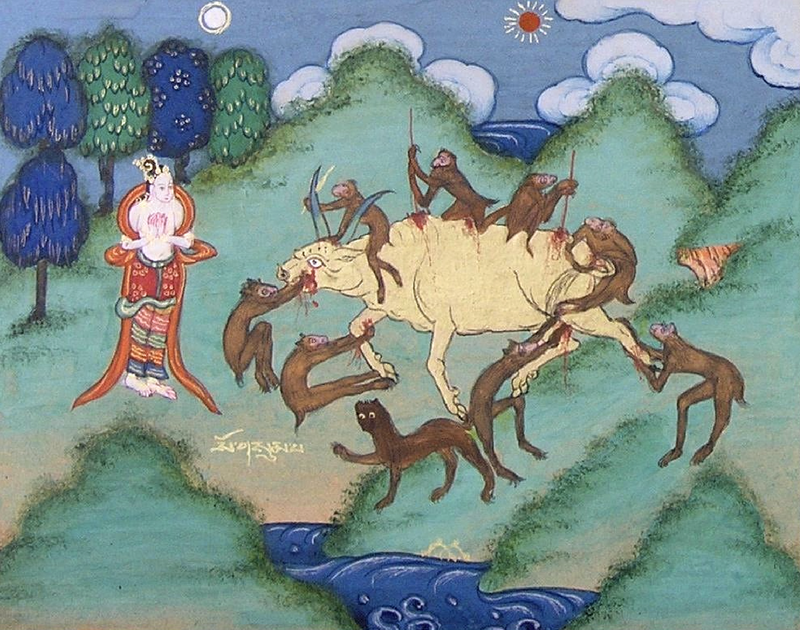
The "Patient Buffalo" Jātaka tale recounts how the Buddha, in a previous life as a magnificent water buffalo, endured constant torment from a mischievous monkey without retaliating. When questioned by a forest spirit about his extraordinary patience, the buffalo explains that true strength lies in restraint and compassion toward those weaker than oneself, not in retaliation. The tale illustrates the Buddhist virtues of patience and nonviolence, demonstrating that maintaining compassion during difficult circumstances represents the highest form of spiritual strength.
- This is a creative retelling of a story from the traditional Jātakamāla and not an exact translation of the text.
Long ago, in the lush forests at the foot of the Himalayas, there lived a magnificent water buffalo with a coat as deep blue-black as storm clouds gathering at dusk. This was no ordinary buffalo—though he appeared to be just another forest creature, his eyes held a wisdom and compassion that seemed almost human.
This buffalo was actually the bodhisattva—the Buddha in a previous life—who had taken this animal form due to the mysterious workings of karma. Even in this humble animal birth, a profound awareness of compassion and patience remained his constant companions.
The forest where he lived teemed with life. Songbirds called from the canopy, deer grazed in sunlit clearings, and monkeys swung through the trees. Among these monkeys was one particularly troublesome individual—small in size but enormous in mischief.
This monkey had noticed something unusual about the great buffalo. While other forest animals would charge or flee when provoked, this buffalo responded to aggression with a calm, steady gaze. The monkey, being naturally curious and unfortunately quite cruel, decided to test the limits of the buffalo's patience.
At first, the monkey's pranks were small—throwing twigs at the buffalo while he grazed, or making alarming noises to startle him. When these antics drew no reaction, the monkey grew bolder.
One hot afternoon, as the buffalo dozed peacefully in the shade, the monkey leapt onto his broad back. The buffalo's eyes opened slowly, but he made no move to shake off his unwelcome passenger. Taking this as permission, the monkey began to treat the mighty buffalo as his personal mount.
Day after day, the monkey's behavior grew more outrageous. He would yank painfully on the buffalo's ears to steer him. He would cover the buffalo's eyes with his hands as the great beast tried to drink from the forest pool. Sometimes he would even strike the buffalo with sticks, laughing as he pretended to be a mighty hunter.
Through it all, the buffalo remained serene. Where others would have seen torment, he saw opportunity—each provocation was a chance to practice patience, each moment of restraint a victory of compassion over instinct.
One day, as the monkey was performing his usual antics—standing on the buffalo's back, beating a rhythm on his head, and yanking his ears—they passed a clearing where a forest spirit had taken form. This spirit, appearing as a handsome young hunter, watched the scene with growing outrage.
"Stop!" the spirit called out, approaching them with fire in his eyes. "Great buffalo, why do you allow this worthless creature to treat you so shamefully? With one toss of your mighty horns, you could send him flying. With one strike of your powerful hooves, you could crush him. Are you a coward? Are you afraid of this puny tormentor?"
The buffalo regarded the spirit with gentle eyes and spoke in a voice deep and resonant as distant thunder: "I am neither a coward nor afraid."
"Then why?" demanded the spirit. "Why endure such disrespect?"
The buffalo considered his answer carefully. "When we face those weaker than ourselves, patience is not weakness but strength in its purest form. This monkey acts from ignorance, not malice. If I harm him in anger, two beings suffer—he from my retaliation and I from betraying my own nature."
The monkey, for once silent, listened with wide eyes.
"But surely," the spirit persisted, "there must be justice! This creature deserves punishment for his cruelty."
"Perhaps," the buffalo acknowledged, "but it need not come from me. The world has ways of teaching its lessons. My task is not to punish but to remain true to compassion, even when it is difficult—especially when it is difficult."
The spirit studied the buffalo with growing wonder. "No ordinary animal speaks with such wisdom. Who are you really?"
The buffalo simply smiled, if buffaloes can smile, and said, "I am but a traveler on the path, like all beings."
Suddenly, the spirit reached out and plucked the startled monkey from the buffalo's back, holding him at eye level. "You have been riding on greatness without recognizing it, little one. Your "mount" has been your teacher all along, though you were too foolish to see it."
To the monkey's astonishment, the spirit then bowed deeply to the buffalo. "I will ensure this one troubles you no more," the spirit promised.
As the forest spirit vanished with the protesting monkey, a strange transformation came over the forest. The sunlight seemed to shine more golden, the air felt more alive with possibility, and for a moment, all the forest creatures fell silent, as if acknowledging that they had witnessed something extraordinary.
The great buffalo continued his peaceful life in the forest, but something had changed. Word of his patience spread among the animals. Many came to sit quietly in his presence, somehow soothed by his calm demeanor. Even the monkey, when he eventually returned to the forest, approached the buffalo not with mischief but with newfound respect.
For in that moment of perfect patience, a simple truth had been revealed: true strength lies not in the power to harm but in the courage to withhold harm when it would be easy to inflict it. And in this way, the Buddha-to-be continued to teach the Dharma, even without words, even in the form of a humble buffalo.[1]
Other Stories from the Jātaka Tales
Notes
- ↑ Source for this story: http://www.rkts.org/etexts/complete.php?id=D341&coll=D.
