- Prince Mahāsattva and the Tigress
- The Boy Who Made Flowers Fall from the Sky
- The Golden Deer King
- The Golden Elephant and the Monk's Journey
- The Lamp That Changed Destiny
- The Patient Buffalo
- The Silver Tusked Savior
- The White Cloth
- The Mirror Clarifying the Results of Karma: Chapter 1
- The Mirror Clarifying the Results of Karma: Chapter 10
- The Mirror Clarifying the Results of Karma: Chapter 2
- The Mirror Clarifying the Results of Karma: Chapter 3
- The Mirror Clarifying the Results of Karma: Chapter 4
- The Mirror Clarifying the Results of Karma: Chapter 5
- The Mirror Clarifying the Results of Karma: Chapter 6
- The Mirror Clarifying the Results of Karma: Chapter 7
- The Mirror Clarifying the Results of Karma: Chapter 8
- The Mirror Clarifying the Results of Karma: Chapter 9
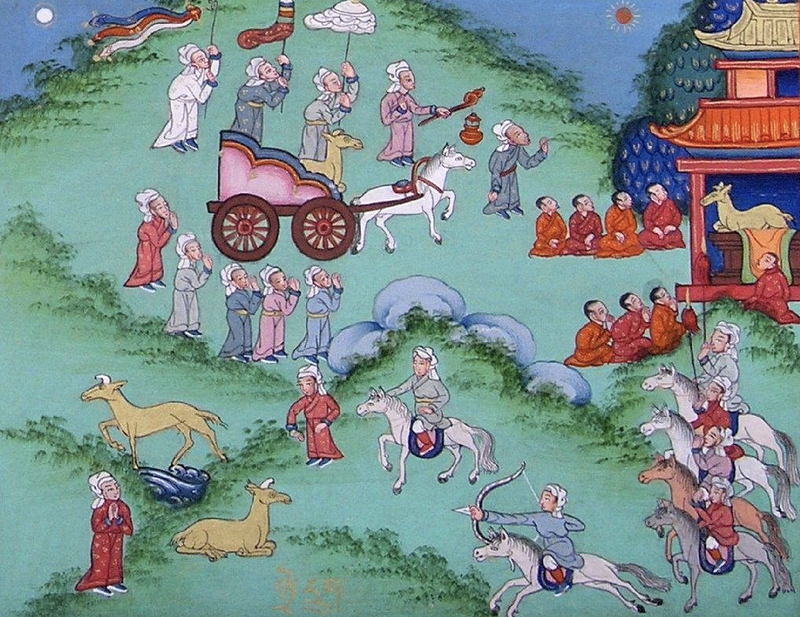
"The Golden Deer King" is a Jātaka tale about Ruru, an extraordinary deer with golden fur and human speech. After rescuing a drowning man named Devadatta, Ruru asks only for secrecy in return. When poverty leads Devadatta to betray Ruru to the king for a reward, the deer confronts him but responds with compassion rather than vengeance. Moved by Ruru's wisdom, King Brahmadatta honors the deer as a teacher rather than a captive, establishes animal sanctuaries throughout his realm, and assigns Devadatta to care for injured animals as a path to redemption. The tale illustrates that true strength lies in compassion, even toward those who have wronged us.
- This is a creative retelling of a story from the traditional Jātakamāla and not an exact translation of the text.
Long ago, beneath a sky that seemed closer to the earth, there lived a magnificent deer unlike any other. His coat shimmered with molten gold that caught the dappled forest light, and his eyes held a depth of wisdom that transcended his animal form. The forest creatures called him Ruru, but he was known by many names in the legends of distant valleys—the Golden One, the Compassionate King, the Deer Who Spoke.
Unlike ordinary deer, Ruru possessed extraordinary intelligence. He could understand human speech and, when necessary, speak their language with perfect clarity. But this gift remained his secret, for he knew well the dangers of the human world.
Each morning, Ruru would lead his herd through the winding forest paths, teaching them which plants were safe to eat and where hunters had laid their traps. The younger deer marveled at how he could sense danger long before it appeared—a skill born from many seasons of watchful survival.
"Stay close to the deep forest," he would often counsel them. "Humans rarely venture so far from their paths."
One stormy afternoon, as wind lashed through the forest canopy, Ruru's sensitive ears caught a sound different from the storm's fury—a human cry for help, desperate and fading. Following the sound, he emerged at the banks of a river swollen with rain, its waters churning with dangerous force.
There, being swept away by the current, was a man fighting hopelessly against the water's strength. His arms thrashed wildly as he gasped for breath between waves.
"Help me!" the man cried out. "I cannot hold on much longer!"
Ruru stood frozen for just a moment. Every instinct warned against revealing himself to a human. His mother had taught him long ago about hunters who would kill without hesitation for his golden coat. Yet the man's terror echoed something universal—a fear of death that crossed the boundaries between all living beings.
"Hold on!" Ruru called in a clear human voice, and without further hesitation, plunged into the raging waters.
The current pulled at his legs with fierce determination, but Ruru's powerful muscles fought back. He reached the drowning man and positioned himself alongside him.
"Grab onto my back," he commanded. "Hold tight to my neck."
The man, eyes wide with disbelief at being addressed by a deer, nevertheless grasped the golden coat. With tremendous effort, Ruru swam against the current, each stroke a battle against nature itself. Finally, exhausted but triumphant, he reached the riverbank.
The man slid from his back and collapsed on the shore, coughing up water and trembling from cold and fear. Ruru stood beside him, warming him with his body heat until the shivering subsided.
"You... you speak," the man finally whispered, staring at his savior.
"Yes," Ruru replied simply. "And now I must ask something of you."
The man bowed his head. "Anything. My life is yours."
"Tell no one about me," Ruru said. "Not about my golden coat, nor that I speak, nor where you found me. Humans are drawn to rare things, and I wish to live in peace with my herd."
The man placed his hand over his heart. "I swear it. Not a word will pass my lips. I am Devadatta, and my promise is unbreakable."
Ruru studied him carefully. "Remember, Devadatta, that betrayal of kindness is the heaviest burden a soul can carry."
With these words, Ruru showed the man the path back to human settlements and disappeared into the forest shadows.
Weeks passed, and life in the forest returned to its peaceful rhythm. Then one morning, Ruru awoke to an unfamiliar sound—the distant beating of drums. As the day progressed, the noise grew closer, accompanied by the shouts of men and the barking of dogs.
A young fawn rushed through the underbrush to where Ruru grazed. "Hunters!" she gasped. "Many of them, with nets and spears!"
Ruru raised his head, alert. "How many? From which direction?"
"From all directions," the fawn replied, trembling. "They speak of a golden deer and a king's reward."
In that moment, Ruru understood. Devadatta had broken his promise.
In the royal city, events had unfolded rapidly after Devadatta's return. The queen, known for her prophetic dreams, had awakened one morning with extraordinary news for her husband, King Brahmadatta.
"I dreamed of a deer with a coat of pure gold," she told him excitedly. "It sat upon a throne and spoke wisdom in a human voice. Such a creature would bring unparalleled glory to your court."
The king, eager to please his queen and intrigued by such a marvel, had immediately issued a proclamation: Whoever could lead him to the golden deer would receive wealth beyond measure—land, gold, and position at court.
Devadatta had resisted at first. Each morning he awoke remembering the deer's kindness, but each night he dreamed of riches. His small home seemed shabbier by the day, his clothes more threadbare, his future more bleak. Finally, poverty and ambition overwhelmed gratitude, and he approached the royal palace.
Now, standing beside the king himself, Devadatta pointed toward the section of forest where he had last seen Ruru. His arm fell limp at his side the moment he completed the gesture—a strange numbness overtaking it as though severed by an invisible blade.
Ruru could have fled deeper into the forest, where even the king's hunters might never find him. Instead, he made a decision that surprised even himself. He walked deliberately into a clearing where the king could see him.
King Brahmadatta gasped at the sight. The deer's coat truly shone like molten gold in the midday sun, more beautiful than any legend had suggested. He raised his bow, arrow nocked, ready to claim his prize.
"Wait, great king," came a voice so unexpected that the king nearly dropped his weapon. "Before you shoot, may I ask who revealed my presence to you?"
The king, astonished to hear human speech from a deer, lowered his bow slightly. "That man there," he said, pointing to Devadatta, who had grown pale and was clutching his numb arm.
Ruru looked directly at Devadatta, his eyes reflecting not anger but profound disappointment. "Is this how you honor your debt to me? I saved your life at risk of my own, and you repay me with betrayal?"
The king turned to Devadatta, his expression darkening. "What is the meaning of this? Explain yourself!"
Trembling, Devadatta confessed how the golden deer had rescued him from certain death in the river. Upon hearing this, the king's face flushed with anger.
"You wretched ingrate!" he thundered. "To betray one who saved your very life—there can be no lower act!" He raised his bow again, but this time aiming at Devadatta.
"Stop!" Ruru called out. "Great king, do not add one wrong deed to another. This man has already destroyed himself through his actions. His conscience will be punishment enough."
The king lowered his weapon again, moved by the deer's extraordinary compassion. "You show mercy to one who showed you none. Tell me, golden one, what wisdom guides such a heart?"
Ruru approached closer, his movement graceful and unafraid. "Compassion is not measured by the worthiness of its object, but by the capacity of the heart that offers it. Through countless lives, I have learned that to answer betrayal with vengeance only continues suffering's cycle."
So impressed was the king by these words that he dismounted from his horse and bowed before the deer. "You must come to my palace—not as a captive, but as an honored teacher. The kingdom would flourish under such wisdom."
And so it came to pass that Ruru, the golden deer, entered the city not in chains but seated in the king's own chariot. The people lined the streets in wonder as the procession passed, whispering of miracles and divine visitations.
In the royal court, seated upon a throne of honor, Ruru shared his wisdom:
"The essence of life's purpose is simple—cultivate compassion for all beings as you would feel for yourself. From this single seed grow all virtues worth possessing. Compassion cools anger, dissolves fear, and bridges differences that seem uncrossable.
"A ruler guided by compassion is remembered long after treasuries of gold have been forgotten. A kingdom founded on compassion stands when even mountains crumble."
The king, deeply moved, declared that from that day forward, no deer or other forest creature would be hunted in his realm. He established sanctuaries where animals could live without fear of human harm.
As for Devadatta, the king did not punish him as many demanded. Instead, following Ruru's example, he assigned him to care for injured animals brought to the royal sanctuary—that through service, he might learn the compassion he had failed to show.
And Ruru? He divided his time between the forest herd that needed his protection and the king's court where his wisdom transformed a kingdom. His golden form became a symbol throughout the land—a living reminder that the most valuable treasures are not those that glitter on the surface, but those that shine from within.
In villages and towns, parents now tell their children: "Remember the Golden Deer, who taught us that true strength lies not in power over others, but in the courage to show compassion—even to those who may not deserve it."[1]
Other Stories from the Jātaka Tales
Notes
- ↑ Source for this story: https://www.dsbcproject.org/canon-text/book/22.
