- Prince Mahāsattva and the Tigress
- The Boy Who Made Flowers Fall from the Sky
- The Golden Deer King
- The Golden Elephant and the Monk's Journey
- The Lamp That Changed Destiny
- The Patient Buffalo
- The Silver Tusked Savior
- The White Cloth
- The Mirror Clarifying the Results of Karma: Chapter 1
- The Mirror Clarifying the Results of Karma: Chapter 10
- The Mirror Clarifying the Results of Karma: Chapter 2
- The Mirror Clarifying the Results of Karma: Chapter 3
- The Mirror Clarifying the Results of Karma: Chapter 4
- The Mirror Clarifying the Results of Karma: Chapter 5
- The Mirror Clarifying the Results of Karma: Chapter 6
- The Mirror Clarifying the Results of Karma: Chapter 7
- The Mirror Clarifying the Results of Karma: Chapter 8
- The Mirror Clarifying the Results of Karma: Chapter 9
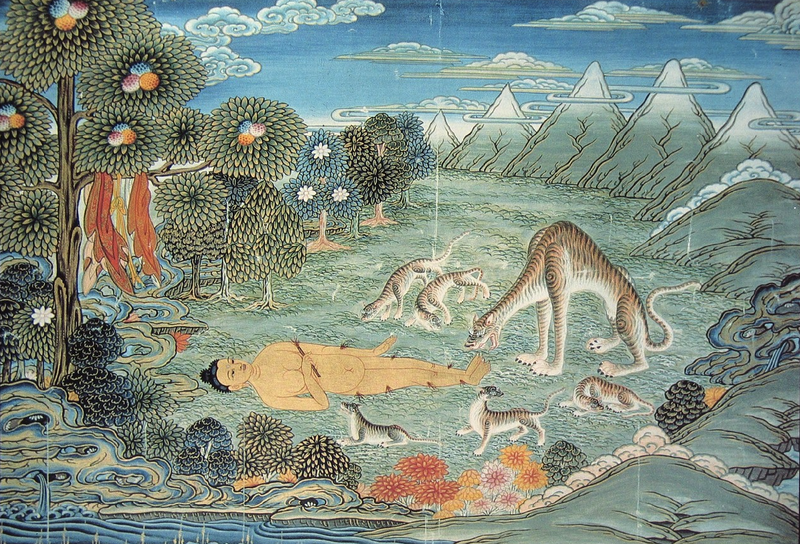
The tale "Prince Mahāsattva and the Tigress" illustrates the Buddhist virtue of supreme self-sacrifice. When Prince Mahāsattva, known for his exceptional compassion, encounters a starving tigress about to devour her newborn cubs, he sacrifices his own body to feed her. After his death, he appears to his grieving family as a radiant being, explaining that his compassionate act has led to his rebirth in a higher realm. Years later, the grown tiger cubs return as men to thank the prince's brothers, demonstrating how selfless compassion creates lasting positive effects across generations.
- This is a creative retelling of a story from the traditional Jātakamāla and not an exact translation of the text.
Long ago, when the world was younger and the boundary between humans and animals less fixed, there lived a great emperor named Mahāyāna. His realm stretched across mountains and valleys, with a thousand lesser kings bowing to his authority.
The emperor had three sons who brought him great joy. The eldest was called Mahānāda, who was strong and capable. The middle son was Mahādeva, who was wise beyond his years. But it was the youngest, Mahāsattva, who was most exceptional. From his earliest days, the young prince showed such extraordinary compassion that people said his heart must be twice the size of ordinary men's.
"He looks at the poorest beggar the same way he looks at me," the emperor once remarked to his wife. "As if each person were his only child."
The young prince's compassion extended beyond humans to all living creatures. Where others saw pests or prey, Mahāsattva saw fellow beings deserving of kindness and protection.
One perfect spring day, when wildflowers painted the meadows in brilliant colors, the emperor decided to take his family to the royal forest for relaxation and hunting—though Mahāsattva never participated in the latter. While the adults prepared a feast under flowering trees, the three brothers wandered deeper into the woods, exploring as they had done since childhood.
Their path led them to a part of the forest they had never seen before—where ancient trees stood like silent witnesses to countless seasons, and the undergrowth grew thick and wild. As they pushed through a tangle of bushes, they emerged into a hidden ravine.
There, they encountered a sight that stopped them in their tracks.
A tigress lay collapsed on the ground, her once-magnificent body now desperately thin. Around her mewled five tiny cubs, newly born and helpless. The mother's eyes were clouded with a terrible hunger, and as the brothers watched, she turned toward her cubs with a predator's calculating gaze.
"She's going to eat her own children," whispered Mahāsattva, his voice breaking.
Mahānāda shook his head. "She's too weak even to stand. Nature can be cruel, brother."
"What would she normally eat?" Mahāsattva asked quietly.
"Fresh meat," Mahādeva answered. "But she's clearly too weak to hunt."
The three stood in silence, the weight of the inevitable settling upon them. The cubs would either starve slowly or be consumed by their desperate mother—a horror that would haunt the tigress if she survived.
"We should go," said the eldest brother finally. "There's nothing we can do."
As they turned to leave, Mahāsattva hung back. "You two go ahead," he said. "I have something private I need to do in the woods. I'll catch up shortly."
His brothers continued on, but something in Mahāsattva's voice made Mahādeva glance back. There was a strange finality in his brother's eyes that troubled him, but he continued walking.
Alone with the tigress and her cubs, Mahāsattva approached carefully. The tigress was too weak to attack, her body trembling with hunger and the exhaustion of birth.
"Poor mother," he said softly. "You've given life, but at what cost?"
The prince sat on a nearby rock and considered what he had learned from his teachers about the interconnectedness of all beings, about the endless cycle of life and death that bound all creatures together.
"Throughout countless lives," he thought, "how many times has my body been given up for nothing? How many times have I died for pride, for greed, for foolishness? But now, I have the chance to give this body for something meaningful."
His decision made, Prince Mahāsattva removed his outer robe and placed it carefully on a rock. Taking a sharp stick from the ground, he approached the tigress and, with unwavering determination, pierced his own flesh so his blood began to flow.
The scent of blood roused the tigress from her stupor. She lifted her head weakly, her predator's instincts awakening.
Mahāsattva lay down before her. "Take this body freely given," he whispered. "Live, so your cubs might live also."
But the tigress, despite her desperate hunger, could not bring herself to attack. Seeing this, the prince used the stick to open his wounds further until the blood flowed more freely. At last, driven by starvation and the primal need to feed her young, the tigress began to feed.
Meanwhile, the two elder brothers had reached the main party but, noticing Mahāsattva's continued absence, grew concerned and retraced their steps. When they came upon the ravine again, a horrifying sight awaited them. There lay the remains of their beloved brother, being consumed by the tigress who already showed signs of renewed strength.
The brothers cried out in anguish, their screams echoing through the forest. They fell to the ground unconscious with grief.
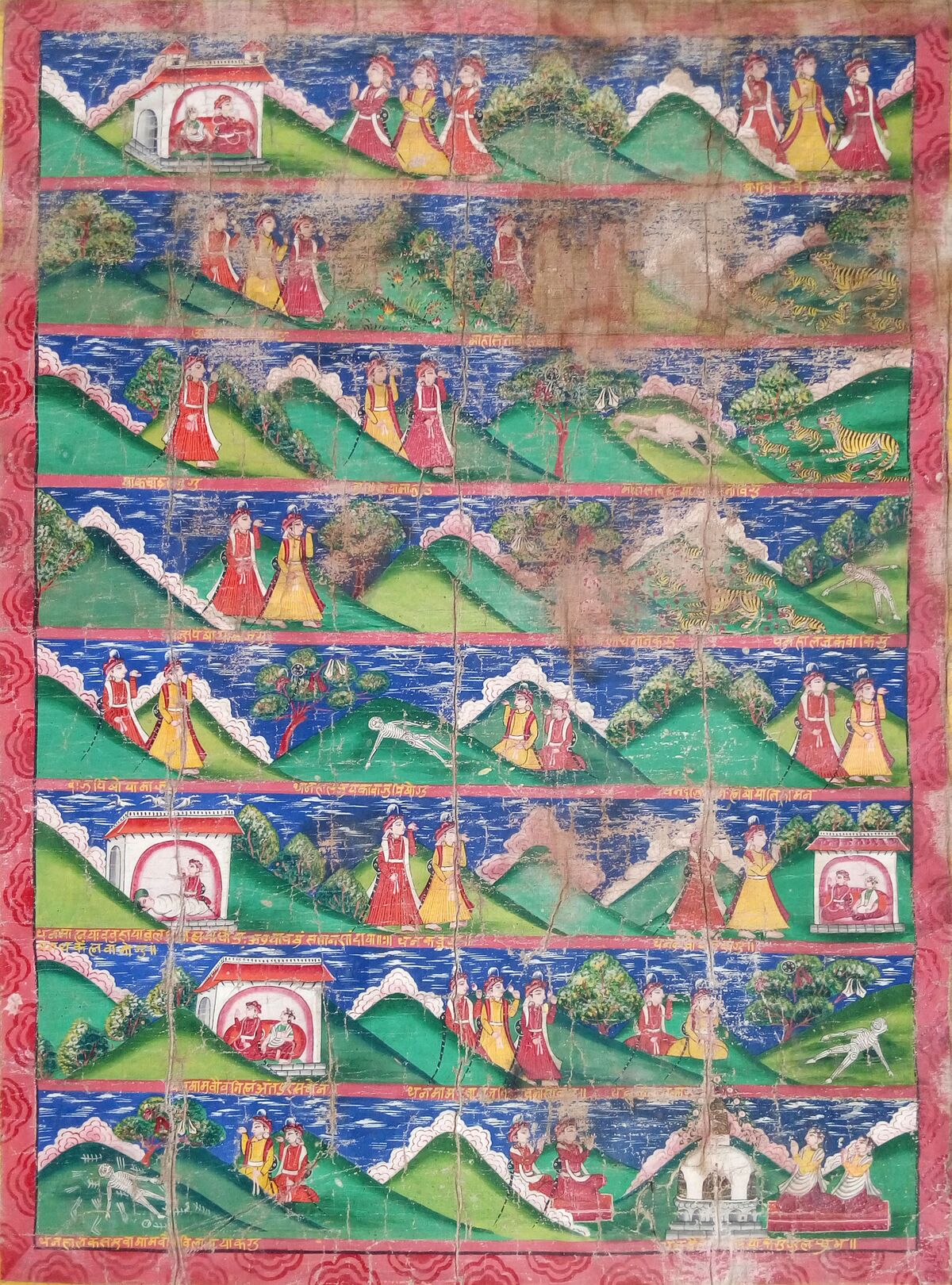
At the sound of their cries, the emperor and his entourage rushed to the scene. When the empress saw what remained of her youngest son, she tore at her clothes and wailed with such grief that even the birds fell silent in the trees.
"My son, my precious son," she cried, cradling the few remaining bones. "What madness took you from us?"
That night, as the royal family kept vigil over Mahāsattva's remains, something extraordinary happened. The empress, exhausted by grief, fell into a troubled sleep and dreamed of three doves flying playfully together. Suddenly, a hawk swooped down and carried away the smallest.
She awoke with a start, her heart pounding. "Where is my son? Where is his spirit now?" she cried.
As if in answer to her question, a soft light began to fill the royal tent where they had placed the prince's remains. The light grew brighter until it took the form of a radiant being—It was Mahāsattva, transformed but recognizable.
"Mother, father, brothers—do not grieve for me," the luminous figure said. "By giving my body to save the tigress and her cubs, I have been reborn in the Realm of Perfect Joy."
The spectral Mahāsattva explained how the merit of his compassionate sacrifice had carried him to a higher realm of existence, where suffering was unknown.
"All beings must experience birth and death," he told his family gently. "What matters is not how long we live, but how much love we express while living. The tigress and her cubs will live because of my choice, and I too live on—just in a different form."
The empress, though still heartbroken, felt a measure of peace enter her heart. "But my son," she asked, "how could you leave us who love you so?"
"Beloved mother," Mahāsattva answered, "when you see one drowning, do you not jump in to save them, even at risk to yourself? I saw beings drowning in suffering and did what anyone with open eyes would do. This body is like a borrowed garment—eventually, we all must return it."
Before departing, the prince's spirit offered one last teaching: "Look beyond the illusion of separation. The tigress, her cubs, you, me—we are all manifestations of the same life force, different waves on the same ocean. When you truly see this, sacrifice becomes as natural as a mother feeding her child."
With these words, the radiant presence faded, leaving behind a sense of profound peace.
The emperor ordered a beautiful casket made of seven precious jewels to hold his son's remains. They buried it with great ceremony and built a magnificent stūpa over the site, which became a place of pilgrimage for centuries.
As for the tigress and her cubs, they disappeared into the forest. But in the years that followed, shepherds and travelers reported strange sightings—tigers that would approach humans not with aggression but with something akin to reverence, as if recognizing distant family.
And it is said that many years later, when the two brothers had become wise rulers themselves, they encountered a group of five men of unusual strength and nobility. Though they could not explain why, but both brothers felt an immediate connection to these strangers—as if they had known them in another life.
The eldest of these men approached and bowed deeply. "You do not recognize us," he said, "but long ago, your brother gave his life so that our mother might live and we might grow to adulthood. We have come to express our endless gratitude and to let you know that his sacrifice was not in vain."
In this way, the compassion of Prince Mahāsattva continued to ripple outward through time, touching countless lives and reminding all who heard the story that our greatest purpose is found not in clinging to life but in using it to ease the suffering of others.[1]
Other Stories from the Jātaka Tales
Notes
- ↑ Source for this story: https://www.dsbcproject.org/canon-text/book/22.
