- Prince Mahāsattva and the Tigress
- The Boy Who Made Flowers Fall from the Sky
- The Golden Deer King
- The Golden Elephant and the Monk's Journey
- The Lamp That Changed Destiny
- The Patient Buffalo
- The Silver Tusked Savior
- The White Cloth
- The Mirror Clarifying the Results of Karma: Chapter 1
- The Mirror Clarifying the Results of Karma: Chapter 10
- The Mirror Clarifying the Results of Karma: Chapter 2
- The Mirror Clarifying the Results of Karma: Chapter 3
- The Mirror Clarifying the Results of Karma: Chapter 4
- The Mirror Clarifying the Results of Karma: Chapter 5
- The Mirror Clarifying the Results of Karma: Chapter 6
- The Mirror Clarifying the Results of Karma: Chapter 7
- The Mirror Clarifying the Results of Karma: Chapter 8
- The Mirror Clarifying the Results of Karma: Chapter 9
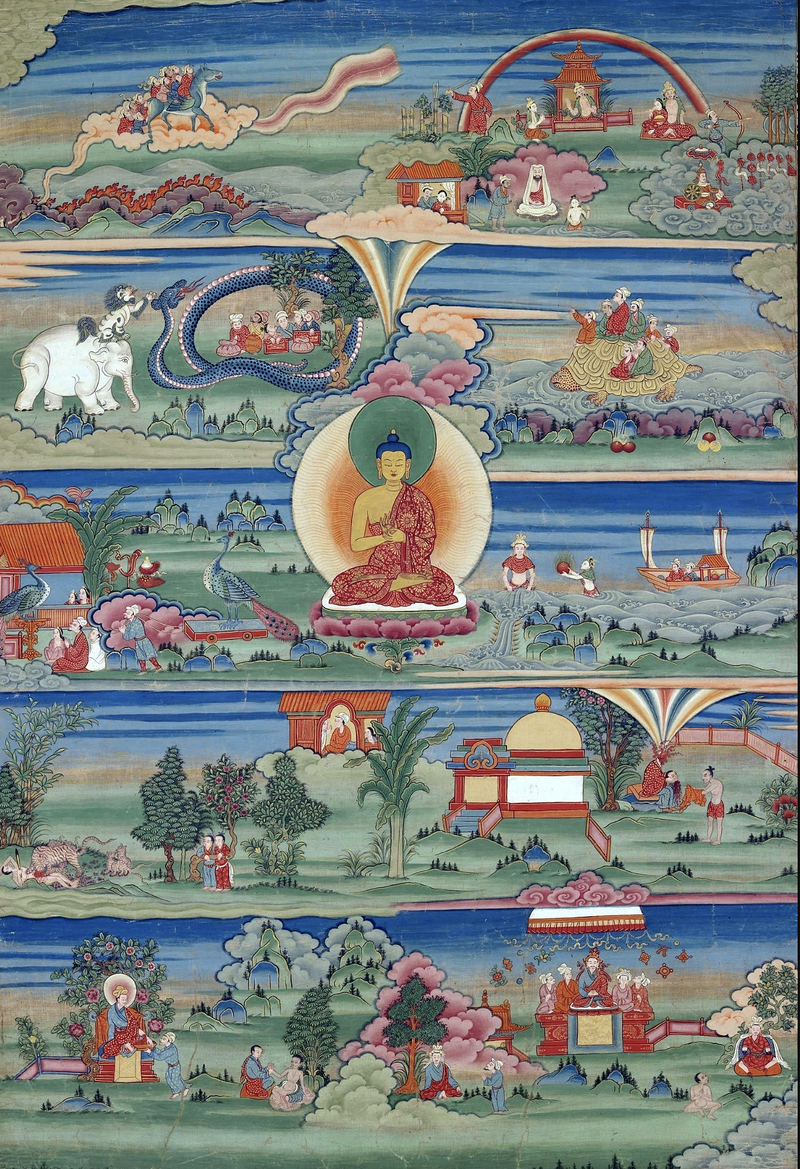
This Jātaka tale tells the story of Ke and her husband, who owned only a single cloth between them. When a monk invites them to hear the Buddha teach, Ke makes the extraordinary decision to donate their only possession. The Buddha recognizes this as the most precious offering, declaring that true generosity means giving all one has. The tale illustrates how Ke's selfless act brings not only material rewards but spiritual transformation, as she becomes a revered Buddhist nun whose wisdom attracts students from far and wide. The story teaches that the greatest spiritual gift is an open heart willing to give without reservation.
- This is a creative retelling of a story from the traditional Jātakamāla and not an exact translation of the text.
In the bustling ancient city of Śrāvastī, where merchants haggled in crowded markets and nobles paraded in silken finery, lived a couple so poor they owned just one piece of cloth between them.
Ke and her husband had devised a system out of necessity. When he needed to venture out for work, he wore their single threadbare cloth while Ke hid naked among straw piles in their tiny hut. When it was her turn to forage for food, she wrapped the cloth around herself, and her husband took refuge in the straw.
They hadn't always been this destitute. Both remembered childhoods with at least enough to eat and wear. "What did we do wrong in our past lives," Ke would sometimes wonder aloud, "to deserve such hardship in this one?"
One sweltering afternoon as Ke huddled in her straw nest, a gentle knock came at their door. Peering through a crack, she saw a monk standing outside, his expression serene despite the heat.
"I cannot answer," she whispered to herself. "I have nothing to cover myself."
But the monk called out, "I know someone is home. Please, I have something important to share."
His voice carried such kindness that Ke called back, "Venerable sir, I cannot come out. My husband has our only cloth, and I have nothing to wear."
The monk's face showed no judgment, only compassion. "The Buddha is teaching nearby. His wisdom could change your life, as it has changed mine and countless others. Consider coming to hear him when you can."
"Even the Buddha would not want someone like me," Ke replied, tears welling in her eyes. "What offerings could I bring? I have nothing."
"The greatest offering is an open heart," the monk said. "Think about it. I'll return tomorrow."
That night when her husband returned, Ke told him about the monk's visit.
"The monk says our poverty comes from not being generous in past lives," she explained. "If we don't change now, what awaits us in future lives?"
Her husband sighed. "What can we possibly give? This cloth is all we have. Without it, neither of us can leave to find food or work."
Ke lay awake that night, watching moonlight filter through their thatched roof. By morning, her mind was made up.
When the monk returned, Ke called out, "Please wait a moment!" She turned to her husband and said with determination, "I'm going to give our cloth."
"But then what?" her husband protested. "We'll both be trapped here, naked and starving!"
"Perhaps," Ke said, her voice steady. "But I'd rather die having given something than live forever taking. Something must break this cycle of poverty."
Before her husband could argue further, Ke slipped behind their door and pushed their precious cloth through a crack.
"I cannot come out to hand this to you properly," she called to the monk. "But please take our only cloth as an offering to the Buddha. It's all we have."
The monk was stunned. "Sister, I cannot take your only possession."
"Please," Ke insisted. "If you don't take it, my resolve might weaken. I've thought about this all night."
Reluctantly, the monk accepted the cloth, promising to take it directly to the Buddha.
That afternoon, the Buddha sat teaching a large gathering that included King Prasenajit and his royal court. When the monk approached with the dirty cloth, many nobles wrinkled their noses in disgust.
The Buddha, however, reached out both hands to receive it. "Of all the offerings made today," he announced, "none is more precious than this."
The king was puzzled. "More precious than our gold and jewels? How can that be?"
The Buddha smiled. "This cloth represents everything its giver possessed. What greater generosity exists than giving all one has?"
When the queen heard this story, she was so moved that she removed her own silken robes and jewelry, sending servants to deliver them to Ke's hut. The king, not to be outdone, sent gold coins and food.
When the royal messengers arrived at the tiny hut, they found Ke and her husband huddled in straw, exactly as the monk had described. But despite their nakedness and hunger, the couple's faces showed no regret, only serenity.
Moved by their story, the messengers quickly wrapped Ke in the queen's finest robe and her husband in clothing they had brought. As Ke felt the silk against her skin, something miraculous happened—a soft white cloth materialized beneath the queen's garments, fitting her perfectly.
The royal servants gasped. "A miracle!" they exclaimed.
Word spread quickly through Śrāvastī. By evening, Ke and her husband were brought before the Buddha himself.
"What you've done," the Buddha told her, "will echo through countless lifetimes. From this day forward, wherever you are born, you will never lack for clothing or necessities."
Ke bowed her head. "I seek not comfort for myself, but wisdom to end all suffering."
"Then become my disciple," the Buddha said, "and find liberation."
As Ke stepped forward, the soft white cloth that had appeared on her body transformed into the simple robes of a nun. Her hair fell away without being cut, and in that moment, all who watched knew they were witnessing the birth of a great spiritual being.
In the years that followed, the nun who had once been a beggar named Ke became renowned for her wisdom and compassion. Students traveled from far and wide to learn from her, never knowing that the radiant teacher before them had once owned nothing but a single cloth—and the courage to give it away.
And it is said that whenever someone gives their last possession to help another, a white cloth appears somewhere in the world, wrapping itself around someone in need, continuing the cycle of generosity that can never be broken.[1]
Other Stories from the Jātaka Tales
Notes
- ↑ Source for this story: http://www.rkts.org/etexts/complete.php?id=D341&coll=D.
