- Prince Mahāsattva and the Tigress
- The Boy Who Made Flowers Fall from the Sky
- The Golden Deer King
- The Golden Elephant and the Monk's Journey
- The Lamp That Changed Destiny
- The Patient Buffalo
- The Silver Tusked Savior
- The White Cloth
- The Mirror Clarifying the Results of Karma: Chapter 1
- The Mirror Clarifying the Results of Karma: Chapter 10
- The Mirror Clarifying the Results of Karma: Chapter 2
- The Mirror Clarifying the Results of Karma: Chapter 3
- The Mirror Clarifying the Results of Karma: Chapter 4
- The Mirror Clarifying the Results of Karma: Chapter 5
- The Mirror Clarifying the Results of Karma: Chapter 6
- The Mirror Clarifying the Results of Karma: Chapter 7
- The Mirror Clarifying the Results of Karma: Chapter 8
- The Mirror Clarifying the Results of Karma: Chapter 9
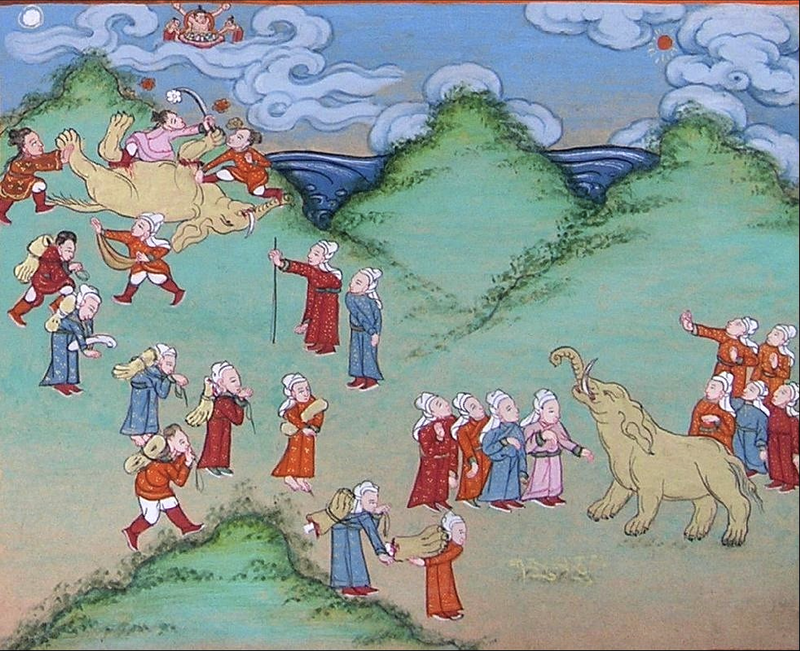
This Jataka tale recounts the story of Dānapāla, a solitary elephant with distinctive silver tusks who discovers a group of seven hundred banished travelers dying of thirst and hunger in a wasteland. Recognizing their desperate situation, Dānapāla directs them to water and then sacrifices himself by leaping from a cliff, offering his body as sustenance for their journey. The travelers, upon realizing the elephant's selfless sacrifice, proceed with profound reverence and gratitude. The tale illustrates the Buddhist virtue of perfect compassion (dāna pāramitā), showing how the elephant's boundless generosity inspires the rescued humans to contemplate their own capacity for selflessness.
- This is a creative retelling of a story from the traditional Jātakamāla and not an exact translation of the text.
In the emerald depths of an ancient forest stood a magnificent elephant with tusks that gleamed like polished silver in the sunlight. He was unlike any other elephant in the wilderness—not just because of his immense size or the unusual silvery sheen of his tusks, but because of something that shone from within him, a quality that made even the wildest creatures of the forest pause in his presence.
The mighty elephant, whom the forest creatures called Dānapāla (Guardian of Generosity), lived alone by choice. While other elephants roamed in herds, he found peace in solitude, drinking from crystal pools, feasting on succulent lotus stems, and meditating in dappled glades. His days passed in tranquil contentment as he wandered his lush homeland—a paradise bordered on one side by treacherous, sun-scorched barrens that stretched beyond sight.
One dawn, as golden light filtered through the canopy, Dānapāla's sensitive ears caught something unusual—human voices carried on the wind. These voices were not the confident calls of hunters or travelers following established paths, but the weak, desperate cries of those in terrible distress.
Dānapāla tilted his massive head, listening intently. The sounds came from the wasteland, a place no living creature entered willingly. It was a place of death.
"No travelers use this route," he thought, his heart quickening. "And these are not the voices of strength, but of desperation."
Following the sounds, Dānapāla emerged from his green sanctuary into the harsh glare of the barrens. In the distance, he saw them—hundreds of humans stumbling toward the forest, their bodies frail from hunger and thirst, their eyes hollow with suffering.
When they spotted him, terror flashed across their exhausted faces. Several collapsed to their knees, too weak to run, others clutched one another, certain their end had come.
"Don't be afraid!" Dānapāla called out, his voice surprisingly gentle for such a massive being. He raised his trunk in greeting, a gesture of peace. "I mean you no harm."
The travelers stared in astonishment. An elephant that spoke? That showed compassion?
Their leader, a gaunt man with dignity still evident in his bearing despite his ragged appearance, stepped forward on trembling legs.
"Mighty one," he said, his voice cracking from thirst, "we were seven hundred strong when banished by our king for challenging his unjust decrees. Many have already perished. We have wandered for days without water, without hope."
Dānapāla's heart clenched as he looked upon them—mothers clutching children, elders supported by those barely stronger, young men and women with determination still flickering in their eyes despite their suffering.
"How will they cross these barrens?" he wondered. "Even if they reach my forest, what will sustain so many? The nearest human settlement is days away across this wasteland."
As he contemplated their plight, a solution crystallized in his mind—terrible yet perfect in its simplicity. It was a solution that would require the ultimate sacrifice.
"Listen carefully," Dānapāla said, his voice steady despite the weight of his decision. "Beyond that ridge lies a small lake with sweet water. Follow this path I show you, and there you will find rest."
The travelers' faces brightened with hope as he continued.
"After you have refreshed yourselves, you will find . . . ," here he paused for just a breath, "the body of an elephant. Its flesh will provide you food for your journey, and its hollow limbs can carry water."
The people bowed in gratitude, too desperate to question this strange providence. As they began their slow procession toward the ridge, Dānapāla slipped away, taking a different path up the mountain.
Standing on the precipice, the silver-tusked elephant gazed across the land he had called home. The emerald forest sparkled like jewels in the sunlight. A warm breeze brought the scent of flowering trees. For a moment, just a moment, he closed his eyes and savored it all one last time.
"This body has served me well," he thought, "but what greater purpose could it serve than to save seven hundred lives? What greater joy than this final gift?"
With that thought burning bright in his mind, Dānapāla made his solemn vow:
"By this deed, may I someday lead all beings across the greater wilderness—the endless cycle of suffering. This is not for heavenly reward or royal rebirth, but that I might become a true savior to all caught in life's harsh deserts."
Then, with unwavering resolve, Dānapāla leaped from the cliff.
The earth itself seemed to mourn as he fell, a great trembling passing through the forest. The trees bent as if bowing in respect. Animals froze, sensing that something momentous had occurred.
Meanwhile, the travelers had found the lake and drank deeply, feeling life return to their parched bodies. Following the path as instructed, they soon came upon the body of a magnificent elephant, its silver tusks gleaming in the sun.
One young man knelt beside the massive form. "This elephant," he whispered, tracing a hand along its trunk, "it resembles the one who spoke to us."
An elder woman nodded slowly. "The placement of the spots on its shoulders," she said, "the unusual silver of its tusks . . ."
Understanding dawned among them, spreading like ripples on water. Falling to their knees, they wept freely—not from hunger or exhaustion now but from overwhelming gratitude and sorrow.
"He knew," the leader said, his voice breaking. "He knew all along what he would do."
Some argued they could not possibly use the body of their savior this way. Others, more practical, gently reminded them that to refuse would render his sacrifice meaningless.
"He leapt from that cliff so that we might live," said a mother, her child sleeping peacefully against her now-hydrated body. "We honor him not by leaving his gift unused but by surviving as he intended."
With profound reverence, they prepared what was needed for their journey. And as they did, they shared stories of families waiting for them, of hopes and dreams not yet fulfilled, of the lives that would continue because of one elephant's boundless compassion.
Days later, as they finally emerged from the wasteland into fertile lands where humans dwelled, each traveler carried not just the memory of their silver-tusked savior but a transformed understanding of sacrifice and compassion.
They built a memorial at the edge of the settlement—not grand or ornate but a simple stone marker where travelers would pause and hear the tale of Dānapāla, the elephant who valued seven hundred strange lives above his own.
And in the hearts of those he saved grew a question that changed them forever: "If an elephant could show such perfect compassion, what then might be possible from us?"[1]
Other Stories from the Jātaka Tales
Notes
- ↑ Source for this story: https://www.dsbcproject.org/canon-text/book/22
