Vimalakīrtinirdeśasūtra (Joshi and Prāsādika)
From Bodhicitta
< Books
Books/Vimalakīrtinirdeśasūtra (Joshi and Prāsādika)| 🤓 Admin Zone 🛠️ hidden to non-admins | |
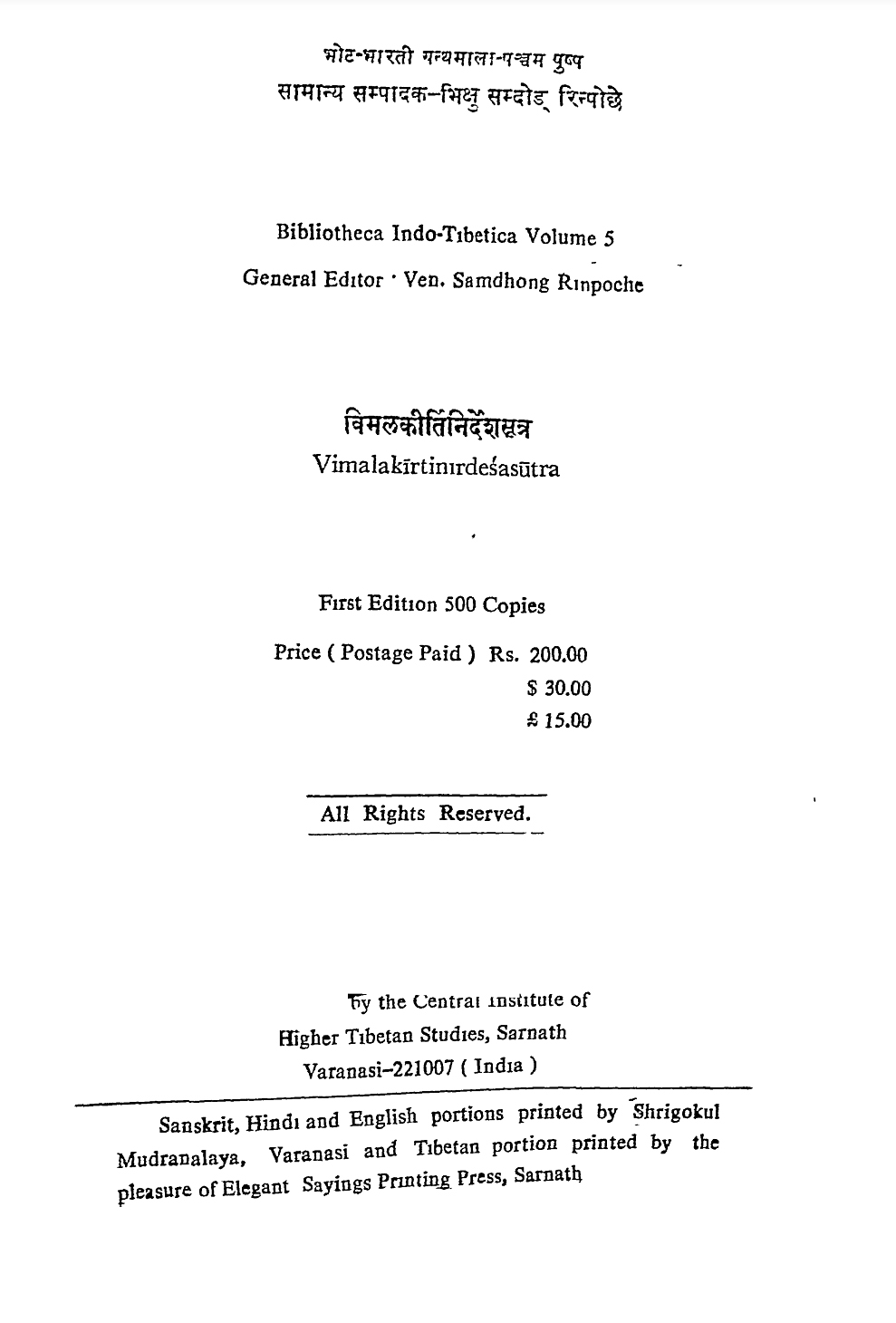
Vimalakīrtinirdeśasūtra: Tibetan Version, Sanskrit Restoration, and Hindi Translation
Book
- A Few Good Men
- A New Translation of the Sanskrit Bhadracarī with Introduction and Notes
- A Revised Edition of the Laṅkāvatāra-Sūtra, Kṣaṇika-Parivarta
- A Revised Edition of the Laṅkāvatāra-sūtra, "Kṣaṇika-parivarta" (in Collected Papers)
- Affirmation in Negation: A Study of the Tathāgatagarbha Theory in the Light of the Bodhisattva Practices
- Akṣayamatinirdeśasūtra, Vol. 1 (Braarvig, J.)
- Akṣayamatinirdeśasūtra, Vol. 2 (Braarvig, J.)
- Amida Dhāraṇī Sūtra and Jñānagarbha's Commentary
- Annotated Translation of the Daśabhūmika-sūtra
- Ashṭasāhasrikā: A Collection of Discourses on the Metaphysics of the Mahāyāna School of the Buddhists
- Aṣṭa-sāhasrikā prajñāparamitā: A Sanskrit Manuscript from Nepal
- Aṣṭasāhasrikā Prajñāpāramitā, with Haribhadra's Commentary called Ālokā
- Bhaisajya-guru-sutra: Original Sanskrit Text with Introduction and Commentary
- Bhaiṣajyaguruvaidūryaprabharājasūtram (Dutt, N.)
- Bhaiṣajyaguruvaidūryaprabharājasūtram (Vaidya, P. L.)
- Bhaiṣajyaguruvaiḍūryaprabharājasūtra (Vira and Chandra)
- Bodhisatvapiṭaka (Bibliotheca Polyglotta)
- Bouddhisme: Notes et Bibliographie
- Buddhist Wisdom Books Containing the Diamond Sutra and the Heart Sutra (1972)
- Catalogue of Buddhist Sanskrit Manuscripts in the Possession of the Royal Asiatic Society (Hodgson Collection)
- Caturdharmikasūtra (Tseng, V.)
- Cuṇḍīdevīdhāraṇī (Zieme, P.)
- Das Gilgit-Fragment Or. 11878A im Britischen Museum zu London
- Daśabhūmikasūtra (Rahder, J.)
- Daśabhūmikasūtra et Bodhisattvabhūmi
- Daśabhūmikasūtram
- Daśabhūmīśvaro nāma Mahāyānasūtraṃ
- Dharma-Samuccaya: Compendium de la Loi, Vol. 1
- Dharma-Samuccaya: Compendium de la Loi, Vol. 2
- Dharma-Samuccaya: Compendium de la Loi, Vol. 3
- Die Bhadracari, eine probe buddhistisch-religiöser lyrik
- Die Überlieferung vom Lebensende des Buddha, Part 1
- Gaṇḍavyūhasūtra (Vaidya, P. L.)
- Gilgit Manuscripts, Vol. 2 (Part 1)
- Gilgit Manuscripts, Vol. 2 (Part 2)
- Gilgit Manuscripts, Vol. 2 (Part 3)
- Lalita Vistara: Leben und Lehre des Çâkya-Buddha, Erster Teil: Text
- Lalita-Vistara (Vaidya, P. L.)
- Lankavatara-Sutra (Das, Sarat Chandra)
- Laṅkāvatāra-sūtra: Sanskrit Manuscript from Nepal
- Mahā-megha-sūtra
- Mārīcīdhāraṇī (Zieme, P.)
- Narayanapariprccha: Sanskrit and Tibetan Texts
- Rāṣṭrapālaparipṛcchā (Vaidya, P. L.)
- Rāṣṭrapālaparipṛcchā: Sūtra du Mahāyāna (1901)
- Saddharma-Puṇḍarīka or the Lotus of the True Law (1963)
- Saddharma-Puṇḍarīka-Sūtra: Kashgar Manuscript
- Saddharmalankavatarasutram (Vaidya, P. L.)
- Saddharmapuṇḍarīka (1908)
- Saddharmapuṇḍarīka-sūtram (Wogihara and Tsuchida)
- Saddharmapuṇḍarīkanāmamahāyānasūtram (Kawaguchi and Ikeda)
- Saddharmapuṇḍarīkasūtra (Vaidya, P. L.)
- Saddharmapuṇḍarīkasūtram (Dutt, N.)
- Samantabhadracaryā-praṇidhānarāja (Devi)
- Samādhirāja-Sūtram (Das, Sarat)
- Samādhirājasūtra (Vaidya, P. L.)
- Samādhirājasūtra (Vira and Chandra)
- Sarvadharmāpravṛttinirdeśa (Braarvig, J.)
- Saṃgharakshita (Cowell and Neil)
- Saṃgharakṣitāvadāna (Bibliotheca Polyglotta)
- Saṃgharakṣitāvadānam (Vaidya, P. L.)
- Saṅgharakṣita-avadāna (Hiraoka)
- Scripture of the Lotus Blossom of the Fine Dharma
- Siṃhaparipṛcchāsūtra (Tseng, V.)
- Studies in the Divyāvadāna: I. Sūkarikāvadāna
- Studies in the Literature of the Great Vehicle
- Suvarna Prabhā
- Suvarṇaprabhāsasūtram (Bagchi, S.)
- Suvarṇaprabhāsottamasūtra: Das Goldglanz-Sūtra (Nobel 1937)
- Sūkarikāvadāna (Cowell and Neil)
- Sūkarikāvadānam (Vaidya, P. L.)
- Sūtra of Aṅgulimālika
- The Acceptance of Evil Acts in the Śīla-paṭala of the Yogācārabhūmi
- The Bhaiṣajyaguru-Sūtra and the Buddhism of Gilgit
- The Diamond Sutra (Conze)
- The Diamond Sutra: The Perfection of Wisdom
- The Diamond Sutra: Transforming the Way We Perceive the World
- The Final Leaves of the Pravrajyāvastu Portion of the Vinayavastu Manuscript Found Near Gilgit: Part 1 Saṃgharakṣitāvadāna
- The Gandavyuha Sutra (1949)
- The Gilgit Text of the Vajracchedikā
- The Gāthās of the Daśabhūmika-Sūtra (1–5)
- The Gāthās of the Daśabhūmika-Sūtra (6–10)
- The Hymn of the Life and Vows of Samantabhadra
- The Khotanese Bhadracaryādeśanā
- The Khotanese Śūraṅgamasamādhisūtra
- The Lalita-Vistara, or Memoirs of the Early Life of Śákya Siñha (English)
- The Lalita-Vistara, or Memoirs of the Early Life of Śákya Siñha (Sanskrit)
- The Lankavatara Sutra (1966)
- The Laṅkāvatāra Sūtra (1978)
- The Laṅkāvatāra Sūtra (2003)
- The Laṅkāvatāra Sūtra (Bunyu)
- The Laṅkāvatāra-ratna-sūtram: Sarva-buddha-pravacana-hṛdayam
- The Manuscript of the Vajracchedikā Found at Gilgit
- The Perfection of Wisdom (Jamieson)
- The Perfection of Wisdom (Schopen)
- The Perfection of Wisdom in Eight Thousand Lines (1994) (South Asia Books)
- The Perfection of Wisdom in Eight Thousand Lines (1994) (Sri Satguru Publications)
- The Perfection of Wisdom in Eight Thousand Lines (Four Seasons Foundation)
- The Ratnarāśisūtra Quoted in the Śikṣāsamuccaya
- The Saddharma Laṅkāvatārasūtra (Vaipulya Sūtra)
- The Samādhi Lists of the Akṣayamatinirdeśasūtra and the Mahāvyutpatti
- The Skill in Means (Upāyakauśalya) Sūtra
- The Story of Saṅgharakṣita (Stories 23–25)
- The Story of a Wretched Pig: Sūkarika-avadāna
- The Suvarṇaprabhāsa Sūtra (Nanjio and Idzumi)
- The Suvarṇaprabhāsa Sūtra: A Mahayana Text called "The Golden Splendour"
- The Sūtra of the Golden Light
- The Sūtra of the Young Rice Plant (Śālistambasūtra)
- The Tathāgatagarbha Sūtra
- The Ten Grounds Sutra
- The Śālistamba Sūtra
- Two Sanskrit Manuscripts of the Daśabhūmikasūtra
- Unique Sanskrit Fragments of the "Sūtra of the Golden Light" in the Manuscript Collection of the St. Petersburg Branch of the Institute of Oriental Studies (Russian Academy of Sciences)
- Vajracchedikā Prajñāpāramitā (Conze)
- Vajracchedikā Prajñāpāramitā (Dutt)
- Vajracchedikā Prajñāpāramitā (English)
- Vajracchedikā Prajñāpāramitā (Sanskrit)
- Vajracchedikā Prajñāpāramitāsūtra (Joshi, L.)
- Vajracchedikā in the Original Sanskrit
- Vajracchedikā nāma Triśatikā Prajñāpāramitā
- Vimalakīrtinirdeśa: A Sanskrit Edition Based upon the Manuscript Newly Found at the Potala Palace
- Vimalakīrtinirdeśa: Transliterated Sanskrit Text Collated with Tibetan and Chinese Translations
- Vimalakīrtinirdeśasūtra (Joshi and Prāsādika)
- Vinayaviniścaya Upāliparipṛcchā (Dutt, N.)
- Çatasāhasrikā-Prajñā-Pāramitā: A Theological and Philosophical Discourse of Buddha with His Disciples (in a Hundred-Thousand Stanzas), Vol. 1
- Çatasāhasrikā-Prajñā-Pāramitā: A Theological and Philosophical Discourse of Buddha with His Disciples (in a Hundred-Thousand Stanzas), Vol. 2
- Ārya Śrīaṣṭasāhasrikāprajñāpāramitāsūtram (Vajrācārya, H.)
- Ārya Śālistamba Sūtra (Sastri, N.)
- Āryaśrīdaśabhūmikasūtram (Herākājī Vajrācārya)
Please note that many items in our library are simply pages that represent a detailed library catalog entry and citation of someone else's work, presentation, or performance. Read our General Disclaimer for more information.

Description
A translation of the Vimalakīrtinirdeśasūtra into Hindi by Lal Mani Joshi based on the Tibetan version and Sanskrit reconstruction prepared by Bhikṣu Prāsādika.
Citation
Joshi, Lal Mani, and Bhikṣu Prāsādika. Vimalakīrtinirdeśasūtra: Tibetan Version, Sanskrit Restoration, and Hindi Translation. Bibliotheca Indo-Tibetica 5. Sarnath, India: Central Institute of Higher Tibetan Studies, 1981. https://archive.org/details/in.ernet.dli.2015.345763/mode/2up.
Table of contents
- General Editor's Note—Bhikṣu Samdhong Rinpochevii-viii
- Foreword—Bhikṣu Prāsādikaix
- Preface—Lal Mani Joshixiii
- Analysis of Contents of the Sūtraxvii
- Analysis of Contents of the Introductionxxi
- Introduction to the Vimalakīrtinirdeśa—Lal Mani Joshi1
- Sanskrit Restoration of the Vimalakīrtinirdeśa—Bhikṣu Prāsādika67
- Hindi Translation of the Vimalakīrtinirdeśa—Lal Mani Joshi189
- Bibliography—Lal Mani Joshi361
- Index of Proper Names—Lal Mani Joshi376 (क ) to (ञ)
- Edited Tibetan Text of the Vimalakīrtinirdeśa—Bhikṣu Prāsādika377
Interconnections
1 Recension of

Vimalakīrtinirdeśa (T. Dri med grags pas bstan pa'i mdo; C. Weimo jing; J. Yuimagyō; K. Yuma kyǒng 維摩經). In Sanskrit, "Vimalakīrti's Instructions"; one of the most beloved Indian Mahāyāna sūtras, renowned especially for having a layman, the eponymous Vimalakīrti, as its protagonist. The text probably dates from around the second century CE. Among the seven translations of the sūtra into Chinese, the most famous is that made by Kumārajīva in 406. His translation seems to have been adapted to appeal to Chinese mores, emphasizing the worldly elements of Vimalakīrti's teachings and introducing the term "filial piety" into the text. The sūtra was also translated by Xuanzang in 650. The sūtra was translated into Tibetan twice, the more famous being that of Chos nyid tshul khrims in the ninth Century. It has also been rendered into Sogdian, Khotanese, and Uighur. The original Sanskrit of the text was lost for over a millennia until a Sanskrit manuscript was discovered in the Po ta la palace in Tibet in 2001. The narrative of the sūtra begins with the Buddha requesting that his leading Śrāvaka disciples visit his lay disciple Vimalakīrti, who is ill. Each demurs, recounting a previous meeting with Vimalakīrti in which the layman had chastised the monk for his limited understanding of the dharma. The Buddha then instructs his leading bodhisattva disciples to visit Vimalakīrti. Each again demurs until MañjuśrI reluctantly agrees. Vimalakīrti explains that his sickness is the sickness of all sentient beings, and goes on to describe how a sick bodhisattva should understand his sickness, emphasizing the necessity of both wisdom (prajñā) and method (upāya). A large audience of monks and bodhisattvas then comes to Vimalakīrti's house, where he delivers a sermon on "inconceivable liberation" (acintyavimokṣa). Among the audience is Śariputra, the wisest of the Buddha's śrāvaka disciples. As in other Mahāyāna sūtras, the eminent śrāvaka is made to play the fool, repeatedly failing to understand how all dichotomies are overcome in emptiness (śūnyatā), most famously when a goddess momentarily transforms him into a female. Later, a series of bodhisattvas take turns describing various forms of duality and how they are overcome in nonduality. Vimalakīrti is the last to be invited to speak. He remains silent and is praised for this teaching of the entrance into nonduality. The sūtra is widely quoted in later literature, especially on the topics of emptiness, method, and nonduality. It became particularly famous in East Asia because the protagonist is a layman, who repeatedly demonstrates that his wisdom is superior to that of monks. Scenes from the sūtra are often depicted in East Asian Buddhist art. (Source: "Vimalakīrtinirdeśa." In The Princeton Dictionary of Buddhism, 971. Princeton University Press, 2014. http://www.jstor.org/stable/j.ctt46n41q.27.)
1 Full translation of
Vimalakīrtinirdeśa (T. Dri med grags pas bstan pa'i mdo; C. Weimo jing; J. Yuimagyō; K. Yuma kyǒng 維摩經). In Sanskrit, "Vimalakīrti's Instructions"; one of the most beloved Indian Mahāyāna sūtras, renowned especially for having a layman, the eponymous Vimalakīrti, as its protagonist. The text probably dates from around the second century CE. Among the seven translations of the sūtra into Chinese, the most famous is that made by Kumārajīva in 406. His translation seems to have been adapted to appeal to Chinese mores, emphasizing the worldly elements of Vimalakīrti's teachings and introducing the term "filial piety" into the text. The sūtra was also translated by Xuanzang in 650. The sūtra was translated into Tibetan twice, the more famous being that of Chos nyid tshul khrims in the ninth Century. It has also been rendered into Sogdian, Khotanese, and Uighur. The original Sanskrit of the text was lost for over a millennia until a Sanskrit manuscript was discovered in the Po ta la palace in Tibet in 2001. The narrative of the sūtra begins with the Buddha requesting that his leading Śrāvaka disciples visit his lay disciple Vimalakīrti, who is ill. Each demurs, recounting a previous meeting with Vimalakīrti in which the layman had chastised the monk for his limited understanding of the dharma. The Buddha then instructs his leading bodhisattva disciples to visit Vimalakīrti. Each again demurs until MañjuśrI reluctantly agrees. Vimalakīrti explains that his sickness is the sickness of all sentient beings, and goes on to describe how a sick bodhisattva should understand his sickness, emphasizing the necessity of both wisdom (prajñā) and method (upāya). A large audience of monks and bodhisattvas then comes to Vimalakīrti's house, where he delivers a sermon on "inconceivable liberation" (acintyavimokṣa). Among the audience is Śariputra, the wisest of the Buddha's śrāvaka disciples. As in other Mahāyāna sūtras, the eminent śrāvaka is made to play the fool, repeatedly failing to understand how all dichotomies are overcome in emptiness (śūnyatā), most famously when a goddess momentarily transforms him into a female. Later, a series of bodhisattvas take turns describing various forms of duality and how they are overcome in nonduality. Vimalakīrti is the last to be invited to speak. He remains silent and is praised for this teaching of the entrance into nonduality. The sūtra is widely quoted in later literature, especially on the topics of emptiness, method, and nonduality. It became particularly famous in East Asia because the protagonist is a layman, who repeatedly demonstrates that his wisdom is superior to that of monks. Scenes from the sūtra are often depicted in East Asian Buddhist art. (Source: "Vimalakīrtinirdeśa." In The Princeton Dictionary of Buddhism, 971. Princeton University Press, 2014. http://www.jstor.org/stable/j.ctt46n41q.27.)