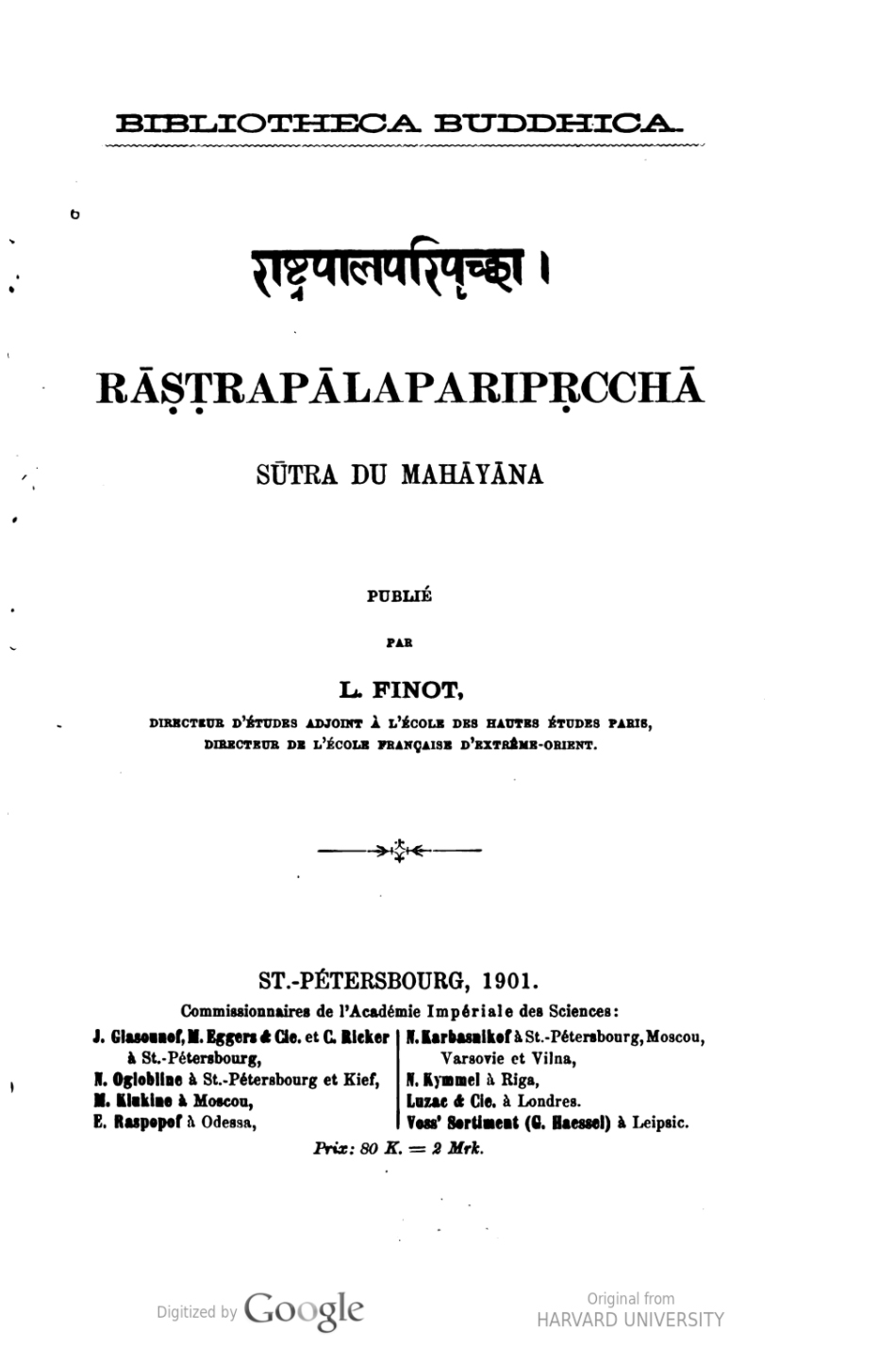
Rāṣṭrapālaparipṛcchā: Sūtra du Mahāyāna (1901)
From Bodhicitta
< Books
Books/Rāṣṭrapālaparipṛcchā: Sūtra du Mahāyāna (1901)| 🤓 Admin Zone 🛠️ hidden to non-admins | |
Rāṣṭrapālaparipṛcchā: Sūtra du Mahāyāna
Book
- A Revised Edition of the Laṅkāvatāra-Sūtra, Kṣaṇika-Parivarta
- A Revised Edition of the Laṅkāvatāra-sūtra, "Kṣaṇika-parivarta" (in Collected Papers)
- Akṣayamatinirdeśasūtra, Vol. 1 (Braarvig, J.)
- Akṣayamatinirdeśasūtra, Vol. 2 (Braarvig, J.)
- Amida Dhāraṇī Sūtra and Jñānagarbha's Commentary
- Ashṭasāhasrikā: A Collection of Discourses on the Metaphysics of the Mahāyāna School of the Buddhists
- Aṣṭa-sāhasrikā prajñāparamitā: A Sanskrit Manuscript from Nepal
- Aṣṭasāhasrikā Prajñāpāramitā, with Haribhadra's Commentary called Ālokā
- Bhaisajya-guru-sutra: Original Sanskrit Text with Introduction and Commentary
- Bhaiṣajyaguruvaidūryaprabharājasūtram (Dutt, N.)
- Bhaiṣajyaguruvaidūryaprabharājasūtram (Vaidya, P. L.)
- Bhaiṣajyaguruvaiḍūryaprabharājasūtra (Vira and Chandra)
- Bodhisatvapiṭaka (Bibliotheca Polyglotta)
- Bouddhisme: Notes et Bibliographie
- Buddhist Wisdom Books Containing the Diamond Sutra and the Heart Sutra (1972)
- Catalogue of Buddhist Sanskrit Manuscripts in the Possession of the Royal Asiatic Society (Hodgson Collection)
- Caturdharmikasūtra (Tseng, V.)
- Cuṇḍīdevīdhāraṇī (Zieme, P.)
- Das Gilgit-Fragment Or. 11878A im Britischen Museum zu London
- Daśabhūmikasūtra (Rahder, J.)
- Daśabhūmikasūtra et Bodhisattvabhūmi
- Daśabhūmikasūtram
- Daśabhūmīśvaro nāma Mahāyānasūtraṃ
- Dharma-Samuccaya: Compendium de la Loi, Vol. 1
- Dharma-Samuccaya: Compendium de la Loi, Vol. 2
- Dharma-Samuccaya: Compendium de la Loi, Vol. 3
- Die Bhadracari, eine probe buddhistisch-religiöser lyrik
- Die Überlieferung vom Lebensende des Buddha, Part 1
- Gaṇḍavyūhasūtra (Vaidya, P. L.)
- Gilgit Manuscripts, Vol. 2 (Part 1)
- Gilgit Manuscripts, Vol. 2 (Part 2)
- Gilgit Manuscripts, Vol. 2 (Part 3)
- Lalita Vistara: Leben und Lehre des Çâkya-Buddha, Erster Teil: Text
- Lalita-Vistara (Vaidya, P. L.)
- Lankavatara-Sutra (Das, Sarat Chandra)
- Laṅkāvatāra-sūtra: Sanskrit Manuscript from Nepal
- Mahā-megha-sūtra
- Mārīcīdhāraṇī (Zieme, P.)
- Narayanapariprccha: Sanskrit and Tibetan Texts
- Rāṣṭrapālaparipṛcchā (Vaidya, P. L.)
- Rāṣṭrapālaparipṛcchā: Sūtra du Mahāyāna (1901)
- Saddharma-Puṇḍarīka-Sūtra: Kashgar Manuscript
- Saddharmalankavatarasutram (Vaidya, P. L.)
- Saddharmapuṇḍarīka (1908)
- Saddharmapuṇḍarīka-sūtram (Wogihara and Tsuchida)
- Saddharmapuṇḍarīkanāmamahāyānasūtram (Kawaguchi and Ikeda)
- Saddharmapuṇḍarīkasūtra (Vaidya, P. L.)
- Saddharmapuṇḍarīkasūtram (Dutt, N.)
- Samantabhadracaryā-praṇidhānarāja (Devi)
- Samādhirāja-Sūtram (Das, Sarat)
- Samādhirājasūtra (Vaidya, P. L.)
- Samādhirājasūtra (Vira and Chandra)
- Sarvadharmāpravṛttinirdeśa (Braarvig, J.)
- Saṃgharakshita (Cowell and Neil)
- Saṃgharakṣitāvadāna (Bibliotheca Polyglotta)
- Saṃgharakṣitāvadānam (Vaidya, P. L.)
- Siṃhaparipṛcchāsūtra (Tseng, V.)
- Studies in the Divyāvadāna: I. Sūkarikāvadāna
- Studies in the Literature of the Great Vehicle
- Suvarna Prabhā
- Suvarṇaprabhāsasūtram (Bagchi, S.)
- Suvarṇaprabhāsottamasūtra: Das Goldglanz-Sūtra (Nobel 1937)
- Sūkarikāvadāna (Cowell and Neil)
- Sūkarikāvadānam (Vaidya, P. L.)
- Sūtra of Aṅgulimālika
- The Acceptance of Evil Acts in the Śīla-paṭala of the Yogācārabhūmi
- The Bhaiṣajyaguru-Sūtra and the Buddhism of Gilgit
- The Final Leaves of the Pravrajyāvastu Portion of the Vinayavastu Manuscript Found Near Gilgit: Part 1 Saṃgharakṣitāvadāna
- The Gandavyuha Sutra (1949)
- The Gilgit Text of the Vajracchedikā
- The Gāthās of the Daśabhūmika-Sūtra (1–5)
- The Gāthās of the Daśabhūmika-Sūtra (6–10)
- The Hymn of the Life and Vows of Samantabhadra
- The Khotanese Bhadracaryādeśanā
- The Khotanese Śūraṅgamasamādhisūtra
- The Lalita-Vistara, or Memoirs of the Early Life of Śákya Siñha (Sanskrit)
- The Laṅkāvatāra Sūtra (Bunyu)
- The Laṅkāvatāra-ratna-sūtram: Sarva-buddha-pravacana-hṛdayam
- The Manuscript of the Vajracchedikā Found at Gilgit
- The Perfection of Wisdom (Schopen)
- The Ratnarāśisūtra Quoted in the Śikṣāsamuccaya
- The Saddharma Laṅkāvatārasūtra (Vaipulya Sūtra)
- The Samādhi Lists of the Akṣayamatinirdeśasūtra and the Mahāvyutpatti
- The Story of Saṅgharakṣita (Stories 23–25)
- The Suvarṇaprabhāsa Sūtra (Nanjio and Idzumi)
- The Suvarṇaprabhāsa Sūtra: A Mahayana Text called "The Golden Splendour"
- The Tathāgatagarbha Sūtra
- The Śālistamba Sūtra
- Two Sanskrit Manuscripts of the Daśabhūmikasūtra
- Unique Sanskrit Fragments of the "Sūtra of the Golden Light" in the Manuscript Collection of the St. Petersburg Branch of the Institute of Oriental Studies (Russian Academy of Sciences)
- Vajracchedikā Prajñāpāramitā (Conze)
- Vajracchedikā Prajñāpāramitā (Dutt)
- Vajracchedikā Prajñāpāramitā (Sanskrit)
- Vajracchedikā Prajñāpāramitāsūtra (Joshi, L.)
- Vajracchedikā in the Original Sanskrit
- Vajracchedikā nāma Triśatikā Prajñāpāramitā
- Vimalakīrtinirdeśa: A Sanskrit Edition Based upon the Manuscript Newly Found at the Potala Palace
- Vimalakīrtinirdeśa: Transliterated Sanskrit Text Collated with Tibetan and Chinese Translations
- Vimalakīrtinirdeśasūtra (Joshi and Prāsādika)
- Vinayaviniścaya Upāliparipṛcchā (Dutt, N.)
- Çatasāhasrikā-Prajñā-Pāramitā: A Theological and Philosophical Discourse of Buddha with His Disciples (in a Hundred-Thousand Stanzas), Vol. 1
- Çatasāhasrikā-Prajñā-Pāramitā: A Theological and Philosophical Discourse of Buddha with His Disciples (in a Hundred-Thousand Stanzas), Vol. 2
- Ārya Śrīaṣṭasāhasrikāprajñāpāramitāsūtram (Vajrācārya, H.)
- Ārya Śālistamba Sūtra (Sastri, N.)
- Āryaśrīdaśabhūmikasūtram (Herākājī Vajrācārya)
Please note that many items in our library are simply pages that represent a detailed library catalog entry and citation of someone else's work, presentation, or performance. Read our General Disclaimer for more information.

Description
Critical Sanskrit edition of the Rāṣṭrapālaparipṛcchāsūtra edited by Louis Finot, with an introduction in French.
Interconnections
1 Recension of

Rāṣṭrapālaparipṛcchā (T. Yul 'khor skyong gis zhus pa; C. Huguo pusahui [jing]; J. Gokoku bosatsue[kyō]; K. Hoguk posal hoe [kyǒng] 護國菩薩會[經]). In Sanskrit, "The Questions of Rāṣṭrapāla," one of the earliest Mahāyāna sūtras; the terminus ad quem for its composition is the third century CE, when Dharmarakṣa (c. 233–310) translated the sūtra into Chinese (c. 270 CE), probably following a manuscript from the Gandhāra region in the Kharoṣṭhī script. (The extant Sanskrit recension is much later.) There are also two later Chinese translations, one made c. 585–600 by Jnānagupta and other c. 980 by Dānapāla. The Raṣṭrapāla represents a strand of early Mahāyāna (found also in such sūtras as the Kāśyapaparivarta and the Ugraparipṛcchā) that viewed the large urban monasteries as being ill-suited to serious spiritual cultivation because of their need for constant fund-raising from the laity and their excessive entanglements in local politics. The Rāṣṭrapāla strand of early Mahāyāna instead dedicated itself to forest dwelling . . . away from the cities, like the "rhinoceros" (khaḍgaviṣāṇa), and advocated a return to the rigorous asceticism (S. dhūtaguṇa) . . . that was thought to characterize the early saṃgha. To the Rāṣṭrapāla author(s), the Buddha's own infinitely long career as a bodhisattva was an exercise in self-sacrifice and physical endurance, which they in turn sought to emulate through their own asceticism. The physical perfection the Buddha achieved through this long training, as evidenced in his acquisition of the thirty-two major marks of the superman (mahāpuruṣalakṣaṇa), receives special attention in the sūtra. This approach is in marked contrast to other early Mahāyāna sūtras, such as the Aṣṭasāhasrikāprajñāpāramitā, which were suspicious of the motives of forest dwellers and supportive of cenobitic monasticism in the towns and cities, where monks and nuns would be in a better position to serve the laity by preaching the dharma to them. (Source: "Rāṣṭrapālaparipṛcchā." In The Princeton Dictionary of Buddhism, 700. Princeton University Press, 2014. http://www.jstor.org/stable/j.ctt46n41q.27.)
1 Other editions

Critical Sanskrit edition of the Rāṣṭrapālaparipṛcchāsūtra edited by Louis Finot, with an introduction in French.
1 Scholarship on
Rāṣṭrapālaparipṛcchā (T. Yul 'khor skyong gis zhus pa; C. Huguo pusahui [jing]; J. Gokoku bosatsue[kyō]; K. Hoguk posal hoe [kyǒng] 護國菩薩會[經]). In Sanskrit, "The Questions of Rāṣṭrapāla," one of the earliest Mahāyāna sūtras; the terminus ad quem for its composition is the third century CE, when Dharmarakṣa (c. 233–310) translated the sūtra into Chinese (c. 270 CE), probably following a manuscript from the Gandhāra region in the Kharoṣṭhī script. (The extant Sanskrit recension is much later.) There are also two later Chinese translations, one made c. 585–600 by Jnānagupta and other c. 980 by Dānapāla. The Raṣṭrapāla represents a strand of early Mahāyāna (found also in such sūtras as the Kāśyapaparivarta and the Ugraparipṛcchā) that viewed the large urban monasteries as being ill-suited to serious spiritual cultivation because of their need for constant fund-raising from the laity and their excessive entanglements in local politics. The Rāṣṭrapāla strand of early Mahāyāna instead dedicated itself to forest dwelling . . . away from the cities, like the "rhinoceros" (khaḍgaviṣāṇa), and advocated a return to the rigorous asceticism (S. dhūtaguṇa) . . . that was thought to characterize the early saṃgha. To the Rāṣṭrapāla author(s), the Buddha's own infinitely long career as a bodhisattva was an exercise in self-sacrifice and physical endurance, which they in turn sought to emulate through their own asceticism. The physical perfection the Buddha achieved through this long training, as evidenced in his acquisition of the thirty-two major marks of the superman (mahāpuruṣalakṣaṇa), receives special attention in the sūtra. This approach is in marked contrast to other early Mahāyāna sūtras, such as the Aṣṭasāhasrikāprajñāpāramitā, which were suspicious of the motives of forest dwellers and supportive of cenobitic monasticism in the towns and cities, where monks and nuns would be in a better position to serve the laity by preaching the dharma to them. (Source: "Rāṣṭrapālaparipṛcchā." In The Princeton Dictionary of Buddhism, 700. Princeton University Press, 2014. http://www.jstor.org/stable/j.ctt46n41q.27.)