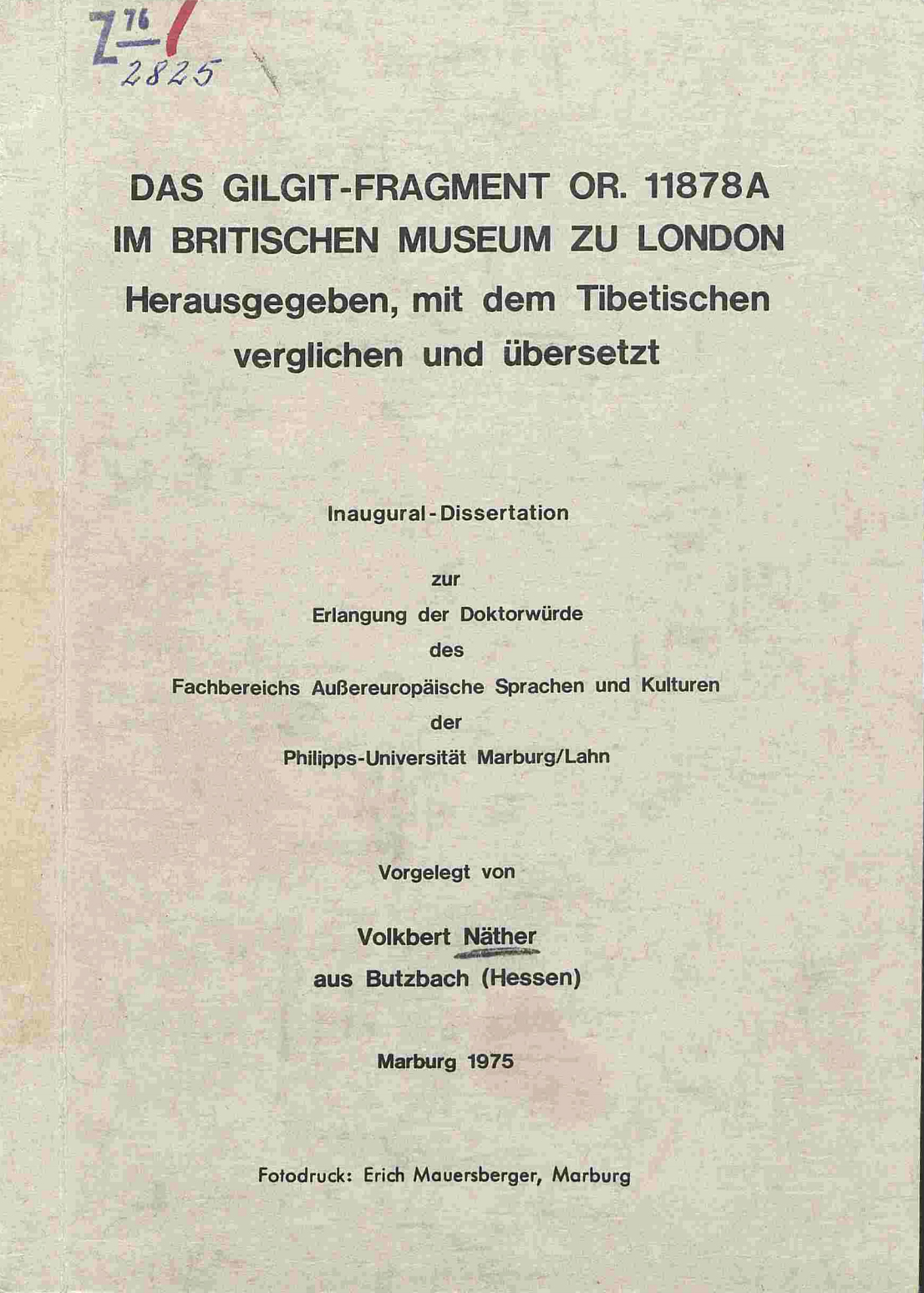
Das Gilgit-Fragment Or. 11878A im Britischen Museum zu London
From Bodhicitta
< DissertationsDissertations/Das Gilgit-Fragment Or. 11878A im Britischen Museum zu London
| 🤓 Admin Zone 🛠️ hidden to non-admins | |
Das Gilgit-Fragment Or. 11878A im Britischen Museum zu London
Dissertation
- A Revised Edition of the Laṅkāvatāra-Sūtra, Kṣaṇika-Parivarta
- A Revised Edition of the Laṅkāvatāra-sūtra, "Kṣaṇika-parivarta" (in Collected Papers)
- Akṣayamatinirdeśasūtra, Vol. 1 (Braarvig, J.)
- Akṣayamatinirdeśasūtra, Vol. 2 (Braarvig, J.)
- Amida Dhāraṇī Sūtra and Jñānagarbha's Commentary
- Ashṭasāhasrikā: A Collection of Discourses on the Metaphysics of the Mahāyāna School of the Buddhists
- Aṣṭa-sāhasrikā prajñāparamitā: A Sanskrit Manuscript from Nepal
- Aṣṭasāhasrikā Prajñāpāramitā, with Haribhadra's Commentary called Ālokā
- Bhaisajya-guru-sutra: Original Sanskrit Text with Introduction and Commentary
- Bhaiṣajyaguruvaidūryaprabharājasūtram (Dutt, N.)
- Bhaiṣajyaguruvaidūryaprabharājasūtram (Vaidya, P. L.)
- Bhaiṣajyaguruvaiḍūryaprabharājasūtra (Vira and Chandra)
- Bodhisatvapiṭaka (Bibliotheca Polyglotta)
- Bouddhisme: Notes et Bibliographie
- Buddhist Wisdom Books Containing the Diamond Sutra and the Heart Sutra (1972)
- Catalogue of Buddhist Sanskrit Manuscripts in the Possession of the Royal Asiatic Society (Hodgson Collection)
- Caturdharmikasūtra (Tseng, V.)
- Cuṇḍīdevīdhāraṇī (Zieme, P.)
- Das Gilgit-Fragment Or. 11878A im Britischen Museum zu London
- Daśabhūmikasūtra (Rahder, J.)
- Daśabhūmikasūtra et Bodhisattvabhūmi
- Daśabhūmikasūtram
- Daśabhūmīśvaro nāma Mahāyānasūtraṃ
- Dharma-Samuccaya: Compendium de la Loi, Vol. 1
- Dharma-Samuccaya: Compendium de la Loi, Vol. 2
- Dharma-Samuccaya: Compendium de la Loi, Vol. 3
- Die Bhadracari, eine probe buddhistisch-religiöser lyrik
- Die Überlieferung vom Lebensende des Buddha, Part 1
- Gaṇḍavyūhasūtra (Vaidya, P. L.)
- Gilgit Manuscripts, Vol. 2 (Part 1)
- Gilgit Manuscripts, Vol. 2 (Part 2)
- Gilgit Manuscripts, Vol. 2 (Part 3)
- Lalita Vistara: Leben und Lehre des Çâkya-Buddha, Erster Teil: Text
- Lalita-Vistara (Vaidya, P. L.)
- Lankavatara-Sutra (Das, Sarat Chandra)
- Laṅkāvatāra-sūtra: Sanskrit Manuscript from Nepal
- Mahā-megha-sūtra
- Mārīcīdhāraṇī (Zieme, P.)
- Narayanapariprccha: Sanskrit and Tibetan Texts
- Rāṣṭrapālaparipṛcchā (Vaidya, P. L.)
- Rāṣṭrapālaparipṛcchā: Sūtra du Mahāyāna (1901)
- Saddharma-Puṇḍarīka-Sūtra: Kashgar Manuscript
- Saddharmalankavatarasutram (Vaidya, P. L.)
- Saddharmapuṇḍarīka (1908)
- Saddharmapuṇḍarīka-sūtram (Wogihara and Tsuchida)
- Saddharmapuṇḍarīkanāmamahāyānasūtram (Kawaguchi and Ikeda)
- Saddharmapuṇḍarīkasūtra (Vaidya, P. L.)
- Saddharmapuṇḍarīkasūtram (Dutt, N.)
- Samantabhadracaryā-praṇidhānarāja (Devi)
- Samādhirāja-Sūtram (Das, Sarat)
- Samādhirājasūtra (Vaidya, P. L.)
- Samādhirājasūtra (Vira and Chandra)
- Sarvadharmāpravṛttinirdeśa (Braarvig, J.)
- Saṃgharakshita (Cowell and Neil)
- Saṃgharakṣitāvadāna (Bibliotheca Polyglotta)
- Saṃgharakṣitāvadānam (Vaidya, P. L.)
- Siṃhaparipṛcchāsūtra (Tseng, V.)
- Studies in the Divyāvadāna: I. Sūkarikāvadāna
- Studies in the Literature of the Great Vehicle
- Suvarna Prabhā
- Suvarṇaprabhāsasūtram (Bagchi, S.)
- Suvarṇaprabhāsottamasūtra: Das Goldglanz-Sūtra (Nobel 1937)
- Sūkarikāvadāna (Cowell and Neil)
- Sūkarikāvadānam (Vaidya, P. L.)
- Sūtra of Aṅgulimālika
- The Acceptance of Evil Acts in the Śīla-paṭala of the Yogācārabhūmi
- The Bhaiṣajyaguru-Sūtra and the Buddhism of Gilgit
- The Final Leaves of the Pravrajyāvastu Portion of the Vinayavastu Manuscript Found Near Gilgit: Part 1 Saṃgharakṣitāvadāna
- The Gandavyuha Sutra (1949)
- The Gilgit Text of the Vajracchedikā
- The Gāthās of the Daśabhūmika-Sūtra (1–5)
- The Gāthās of the Daśabhūmika-Sūtra (6–10)
- The Hymn of the Life and Vows of Samantabhadra
- The Khotanese Bhadracaryādeśanā
- The Khotanese Śūraṅgamasamādhisūtra
- The Lalita-Vistara, or Memoirs of the Early Life of Śákya Siñha (Sanskrit)
- The Laṅkāvatāra Sūtra (Bunyu)
- The Laṅkāvatāra-ratna-sūtram: Sarva-buddha-pravacana-hṛdayam
- The Manuscript of the Vajracchedikā Found at Gilgit
- The Perfection of Wisdom (Schopen)
- The Ratnarāśisūtra Quoted in the Śikṣāsamuccaya
- The Saddharma Laṅkāvatārasūtra (Vaipulya Sūtra)
- The Samādhi Lists of the Akṣayamatinirdeśasūtra and the Mahāvyutpatti
- The Story of Saṅgharakṣita (Stories 23–25)
- The Suvarṇaprabhāsa Sūtra (Nanjio and Idzumi)
- The Suvarṇaprabhāsa Sūtra: A Mahayana Text called "The Golden Splendour"
- The Tathāgatagarbha Sūtra
- The Śālistamba Sūtra
- Two Sanskrit Manuscripts of the Daśabhūmikasūtra
- Unique Sanskrit Fragments of the "Sūtra of the Golden Light" in the Manuscript Collection of the St. Petersburg Branch of the Institute of Oriental Studies (Russian Academy of Sciences)
- Vajracchedikā Prajñāpāramitā (Conze)
- Vajracchedikā Prajñāpāramitā (Dutt)
- Vajracchedikā Prajñāpāramitā (Sanskrit)
- Vajracchedikā Prajñāpāramitāsūtra (Joshi, L.)
- Vajracchedikā in the Original Sanskrit
- Vajracchedikā nāma Triśatikā Prajñāpāramitā
- Vimalakīrtinirdeśa: A Sanskrit Edition Based upon the Manuscript Newly Found at the Potala Palace
- Vimalakīrtinirdeśa: Transliterated Sanskrit Text Collated with Tibetan and Chinese Translations
- Vimalakīrtinirdeśasūtra (Joshi and Prāsādika)
- Vinayaviniścaya Upāliparipṛcchā (Dutt, N.)
- Çatasāhasrikā-Prajñā-Pāramitā: A Theological and Philosophical Discourse of Buddha with His Disciples (in a Hundred-Thousand Stanzas), Vol. 1
- Çatasāhasrikā-Prajñā-Pāramitā: A Theological and Philosophical Discourse of Buddha with His Disciples (in a Hundred-Thousand Stanzas), Vol. 2
- Ārya Śrīaṣṭasāhasrikāprajñāpāramitāsūtram (Vajrācārya, H.)
- Ārya Śālistamba Sūtra (Sastri, N.)
- Āryaśrīdaśabhūmikasūtram (Herākājī Vajrācārya)
Please note that many items in our library are simply pages that represent a detailed library catalog entry and citation of someone else's work, presentation, or performance. Read our General Disclaimer for more information.

Description
This is a Sanskrit critical edition and German translation of the Saṅgharakṣitāvadāna and Nāgakumārāvadāna made by Volkbert Näther in 1975. These texts belong to the Pravrajyāvastu section of the Mūlasarvāstivāda Vinayavastu.
Citation
Näther, Volkbert. Das Gilgit-Fragment Or. 11878A im Britischen Museum zu London. Herausgegeben, mit dem Tibetischen verglichen und übersetzt. PhD diss., Philipps-Universität Marburg/Lahn, 1975. https://dfg-viewer.de/show/?tx_dlf%5Bid%5D=http%3A%2F%2Farchiv.ub.uni-marburg.de%2Feb%2F2010%2F0264%2Fmets-3066.xml.
Table of contents
- Einleitung5
- Abkuerzungsverzeichnis9
- Literaturangaben10
- Phonetische Besonderheiten15
- Grammatische Besonderheiten16
- Beschreibung ausgewaehlter Akṣaras17
- Woerterverzeichnis19
- Text
- A Saṃgharakṣitāvadāna21
- B Nāgakumārāvadāna41
- C "Text Lévi"45
- Uebersetzung
- A Saṃgharakṣitāvadāna59
- B Nāgakumārāvadāna83
- C "Text Lévi"88
Interconnections
1 Recension of

The following description of the Saṃgharakṣitāvadāna is an extract from: Vogel, Claus, and Klaus Wille, ed. and trans. The Pravrajyāvastu of the Mūlasarvāstivāda Vinaya. Göttingen: Akademie der Wissenschaften, Sanskrit-Wörterbuch der buddhistischen Texte aus den Turfan-Funden, 2014. http://gretil.sub.uni-goettingen.de/gretil_elib/VoW014__Vogel_Wille_The_Pravrajyavastu_of_the_Mulasarvastivada_Vinaya.pdf.
. . . Saṃgharakṣitāvadāna, that is, the legend of a merchant's son named Saṃgharakṣita, who, after entering the Buddhist congregation, happened to get into the submarine world of serpent-demons and, back on earth, to reach various places of recompense[9]. It is meant to illustrate the precept that a monk shall not teach the Law without request[10], which was violated in this case inasmuch as Saṃgharakṣita was deemed to have been kidnapped by the serpent-demons for the purpose of preaching[11]. The said precept was formulated by the Buddha in the context of another legend, the so-called Nāgakumārāvadāna, which treats of a serpent-demon having turned monk[12] and makes up, as it were, the frame story of the Saṃgharakṣitāvadāna, with the tale of the present preceding and that of the past succeeding it. The aim of this superordinate Avadāna is to exemplify the maxim that a so-called phantom creature — an animal able to transform itself into a human being — must be removed from the congregation[13].
The whole former part of the Nāgakumārāvadāna and roughly the first quarter of the Saṃgharakṣitāvadāna have been lost in the original Sanskrit; they are, however, still extant in a Tibetan translation of the Vinayavastu dating from the latter half of the eighth century[14] and handed down in the Kanjur division of the Lamaist canon[15].
The gap at the outset of the Saṃgharakṣitāvadāna may be filled in a measure by means of the Divyāvadāna, the celebrated Mūlasarvāstivāda-oriented compilation of Buddhist legends probably dating from the third century, chapters XXIII and XXV of which are a shortened version of the same Avadāna but in a form subsequently vitiated by errors and alterations[16]. Owing to a mistake by its compiler, the Divyāvadāna also gives the final portion of the tale of the present relative to the Nāgakumārāvadāna, which is hardly comprehensible by itself and hence caused many a difficulty of interpretation and classification[17].
There are at least two canonical translations of the Saṃgharakṣitāvadāna in the Chinese Tripiṭaka. One introduces the fourth fascicle of the 出家事 Ch'u-chia shih[18]; done between 703 and 710 by I-ching, it sets in with the five hundred merchants sailing back to the seashore after Saṃgharakṣita's reappearance from the realm of serpent-demons[19]. The other is a separate sūtra from the time of the Eastern Chin dynasty (317-419) bearing the title 因緣僧護經 Yin–yüan Seng–hu ching[20]; it opens with a résumé of the tale of the present of the Nāgakumārāvadāna[21] and has the Saṃgharakṣitāvadāna proper start with the five hundred merchants making up their minds to go on a business voyage, and to ask Saṃgharakṣita to keep them company and teach them the Law[22]. The latter version, without the 'preamble', has been quoted almost in full by Tao-shih (d. 683) towards the close of fascicle 92 of his 法苑珠林 Fa yüan chu lin[23].
The whole former part of the Nāgakumārāvadāna and roughly the first quarter of the Saṃgharakṣitāvadāna have been lost in the original Sanskrit; they are, however, still extant in a Tibetan translation of the Vinayavastu dating from the latter half of the eighth century[14] and handed down in the Kanjur division of the Lamaist canon[15].
The gap at the outset of the Saṃgharakṣitāvadāna may be filled in a measure by means of the Divyāvadāna, the celebrated Mūlasarvāstivāda-oriented compilation of Buddhist legends probably dating from the third century, chapters XXIII and XXV of which are a shortened version of the same Avadāna but in a form subsequently vitiated by errors and alterations[16]. Owing to a mistake by its compiler, the Divyāvadāna also gives the final portion of the tale of the present relative to the Nāgakumārāvadāna, which is hardly comprehensible by itself and hence caused many a difficulty of interpretation and classification[17].
There are at least two canonical translations of the Saṃgharakṣitāvadāna in the Chinese Tripiṭaka. One introduces the fourth fascicle of the 出家事 Ch'u-chia shih[18]; done between 703 and 710 by I-ching, it sets in with the five hundred merchants sailing back to the seashore after Saṃgharakṣita's reappearance from the realm of serpent-demons[19]. The other is a separate sūtra from the time of the Eastern Chin dynasty (317-419) bearing the title 因緣僧護經 Yin–yüan Seng–hu ching[20]; it opens with a résumé of the tale of the present of the Nāgakumārāvadāna[21] and has the Saṃgharakṣitāvadāna proper start with the five hundred merchants making up their minds to go on a business voyage, and to ask Saṃgharakṣita to keep them company and teach them the Law[22]. The latter version, without the 'preamble', has been quoted almost in full by Tao-shih (d. 683) towards the close of fascicle 92 of his 法苑珠林 Fa yüan chu lin[23].
1 Full translation of
The following description of the Saṃgharakṣitāvadāna is an extract from: Vogel, Claus, and Klaus Wille, ed. and trans. The Pravrajyāvastu of the Mūlasarvāstivāda Vinaya. Göttingen: Akademie der Wissenschaften, Sanskrit-Wörterbuch der buddhistischen Texte aus den Turfan-Funden, 2014. http://gretil.sub.uni-goettingen.de/gretil_elib/VoW014__Vogel_Wille_The_Pravrajyavastu_of_the_Mulasarvastivada_Vinaya.pdf.
. . . Saṃgharakṣitāvadāna, that is, the legend of a merchant's son named Saṃgharakṣita, who, after entering the Buddhist congregation, happened to get into the submarine world of serpent-demons and, back on earth, to reach various places of recompense[9]. It is meant to illustrate the precept that a monk shall not teach the Law without request[10], which was violated in this case inasmuch as Saṃgharakṣita was deemed to have been kidnapped by the serpent-demons for the purpose of preaching[11]. The said precept was formulated by the Buddha in the context of another legend, the so-called Nāgakumārāvadāna, which treats of a serpent-demon having turned monk[12] and makes up, as it were, the frame story of the Saṃgharakṣitāvadāna, with the tale of the present preceding and that of the past succeeding it. The aim of this superordinate Avadāna is to exemplify the maxim that a so-called phantom creature — an animal able to transform itself into a human being — must be removed from the congregation[13].
The whole former part of the Nāgakumārāvadāna and roughly the first quarter of the Saṃgharakṣitāvadāna have been lost in the original Sanskrit; they are, however, still extant in a Tibetan translation of the Vinayavastu dating from the latter half of the eighth century[14] and handed down in the Kanjur division of the Lamaist canon[15].
The gap at the outset of the Saṃgharakṣitāvadāna may be filled in a measure by means of the Divyāvadāna, the celebrated Mūlasarvāstivāda-oriented compilation of Buddhist legends probably dating from the third century, chapters XXIII and XXV of which are a shortened version of the same Avadāna but in a form subsequently vitiated by errors and alterations[16]. Owing to a mistake by its compiler, the Divyāvadāna also gives the final portion of the tale of the present relative to the Nāgakumārāvadāna, which is hardly comprehensible by itself and hence caused many a difficulty of interpretation and classification[17].
There are at least two canonical translations of the Saṃgharakṣitāvadāna in the Chinese Tripiṭaka. One introduces the fourth fascicle of the 出家事 Ch'u-chia shih[18]; done between 703 and 710 by I-ching, it sets in with the five hundred merchants sailing back to the seashore after Saṃgharakṣita's reappearance from the realm of serpent-demons[19]. The other is a separate sūtra from the time of the Eastern Chin dynasty (317-419) bearing the title 因緣僧護經 Yin–yüan Seng–hu ching[20]; it opens with a résumé of the tale of the present of the Nāgakumārāvadāna[21] and has the Saṃgharakṣitāvadāna proper start with the five hundred merchants making up their minds to go on a business voyage, and to ask Saṃgharakṣita to keep them company and teach them the Law[22]. The latter version, without the 'preamble', has been quoted almost in full by Tao-shih (d. 683) towards the close of fascicle 92 of his 法苑珠林 Fa yüan chu lin[23].
The whole former part of the Nāgakumārāvadāna and roughly the first quarter of the Saṃgharakṣitāvadāna have been lost in the original Sanskrit; they are, however, still extant in a Tibetan translation of the Vinayavastu dating from the latter half of the eighth century[14] and handed down in the Kanjur division of the Lamaist canon[15].
The gap at the outset of the Saṃgharakṣitāvadāna may be filled in a measure by means of the Divyāvadāna, the celebrated Mūlasarvāstivāda-oriented compilation of Buddhist legends probably dating from the third century, chapters XXIII and XXV of which are a shortened version of the same Avadāna but in a form subsequently vitiated by errors and alterations[16]. Owing to a mistake by its compiler, the Divyāvadāna also gives the final portion of the tale of the present relative to the Nāgakumārāvadāna, which is hardly comprehensible by itself and hence caused many a difficulty of interpretation and classification[17].
There are at least two canonical translations of the Saṃgharakṣitāvadāna in the Chinese Tripiṭaka. One introduces the fourth fascicle of the 出家事 Ch'u-chia shih[18]; done between 703 and 710 by I-ching, it sets in with the five hundred merchants sailing back to the seashore after Saṃgharakṣita's reappearance from the realm of serpent-demons[19]. The other is a separate sūtra from the time of the Eastern Chin dynasty (317-419) bearing the title 因緣僧護經 Yin–yüan Seng–hu ching[20]; it opens with a résumé of the tale of the present of the Nāgakumārāvadāna[21] and has the Saṃgharakṣitāvadāna proper start with the five hundred merchants making up their minds to go on a business voyage, and to ask Saṃgharakṣita to keep them company and teach them the Law[22]. The latter version, without the 'preamble', has been quoted almost in full by Tao-shih (d. 683) towards the close of fascicle 92 of his 法苑珠林 Fa yüan chu lin[23].