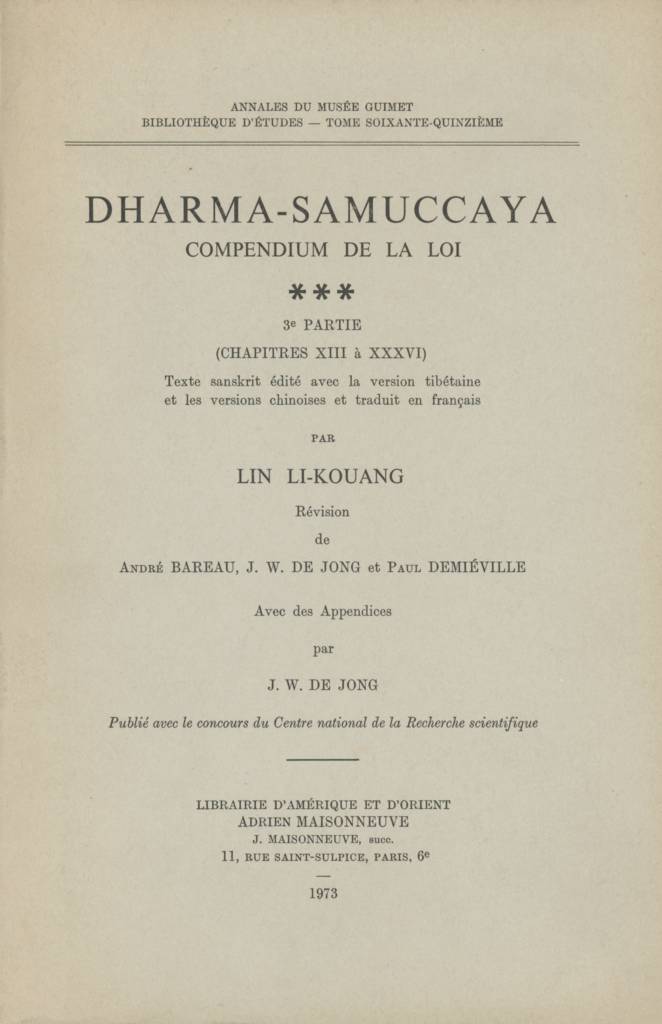
Dharma-Samuccaya: Compendium de la Loi, Vol. 3

From Bodhicitta
LibraryBooksDharma-Samuccaya: Compendium de la Loi, Vol. 3
< Books
Books/Dharma-Samuccaya: Compendium de la Loi, Vol. 3

Dharma-Samuccaya: Compendium de la Loi, Vol. 3
Book


Please note that many items in our library are simply pages that represent a detailed library catalog entry and citation of someone else's work, presentation, or performance. Read our General Disclaimer for more information.
Dharma-Samuccaya Compendium de la Loi, Vol. 3-front.jpg

Description

Dharma-Samuccaya: Compendium of the law: collection of stanzas extracted from the Saddharmasmṛtyupasthānasūtra by Avalokitasiṃha, volume 3: chapters XIII–XXXVI, Sanskrit text edited with the Tibetan version and the Chinese versions and translated into French by Lin Li-kouang, revision of André Bareau, J. W. de Jong and Paul Demiéville, Paris: Adrien-Maisonneuve, 1973.
Citation
Li-Kouang, Lin, ed. and trans. Dharma-Samuccaya: Compendium de la Loi; Recueil de stances extraites du Saddharma-smṛty-upasthāna-sūtra par Avalokitasiṃha. 3e Partie (Chapitres XIII à XXXVI). Revised by André Bareau, J. W. de Jong, and Paul Demiéville. Publications du Musée Guimet Bibliothèque d'Études 75. Paris: Adrien-Maisonneuve, 1973.


Recension of

 
Saddharmasmṛtyupasthānasūtra
While on the way to Rājagṛha to collect alms, a group of newly ordained monks are approached by some non-Buddhists, who suggest that their doctrine is identical to that of the Buddha, since everyone agrees that misdeeds of body, speech, and mind are to be given up. The monks do not know how to reply, and when they later return to the brahmin town of Nālati, where the Buddha is residing, Śāradvatīputra therefore encourages them to seek clarification from the Blessed One himself. In response to the monks’ request, the Buddha delivers a comprehensive discourse on the effects of virtuous and unvirtuous actions, explaining these matters from the perspective of an adept practitioner of his teachings, who sees and understands all this through a process of personal discovery. As the teaching progresses, the Buddha presents an epic tour of the realm of desire—from the Hell of Ultimate Torment to the Heaven Free from Strife—all the while introducing the specific human actions and attitudes that cause the experience of such worlds and outlining the ways to remedy and transcend them. In the final section of the sūtra, which is presented as an individual scripture on its own, the focus is on mindfulness of the body and the ripening of karmic actions that is experienced among humans in particular. (Source: 84000)
Text

Partial translation of

 
Saddharmasmṛtyupasthānasūtra
While on the way to Rājagṛha to collect alms, a group of newly ordained monks are approached by some non-Buddhists, who suggest that their doctrine is identical to that of the Buddha, since everyone agrees that misdeeds of body, speech, and mind are to be given up. The monks do not know how to reply, and when they later return to the brahmin town of Nālati, where the Buddha is residing, Śāradvatīputra therefore encourages them to seek clarification from the Blessed One himself. In response to the monks’ request, the Buddha delivers a comprehensive discourse on the effects of virtuous and unvirtuous actions, explaining these matters from the perspective of an adept practitioner of his teachings, who sees and understands all this through a process of personal discovery. As the teaching progresses, the Buddha presents an epic tour of the realm of desire—from the Hell of Ultimate Torment to the Heaven Free from Strife—all the while introducing the specific human actions and attitudes that cause the experience of such worlds and outlining the ways to remedy and transcend them. In the final section of the sūtra, which is presented as an individual scripture on its own, the focus is on mindfulness of the body and the ripening of karmic actions that is experienced among humans in particular. (Source: 84000)
Text

  • Avertissement, par Paul DEMIÉVILLEV
  • Sigles et abréviationsVI
  • Chapitre XIII, stances 1215-1363 : L'acte bénéfique et l'acte maléfique1
  • Chapitre XIV, stances 1364-1439 : Les liens54
  • Chapitre XV, stances 1440-1516: Le mal88
  • Chapitre XVI, stances 1517-1678: L'enfer127
  • Chapitre XVII, stances 1679-1714: Les mânes196
  • Chapitre XVIII, stances 1715-1723: Les animaux213
  • Chapitre XIX, stances 1724-17 43 : La faim217
  • Chapitre XX, stances 1744-1775: La paresse226
  • Chapitre XXI, stances 1776-1802: La compassion240
  • Chapitre XXII, stances 1803-1853: Le don252
  • Chapitre XXIII, stances 1854-1939: La discipline274
  • Chapitre XXIV, stances 1940-1954: La patience309
  • Chapitre XXV, stances 1955-1964: L'énergie316
  • Chapitre XXVI, stances 1965-1978: La méditation321
  • Chapitre XXVII, stances 1979-1989: La sagesse328
  • Chapitre XXVIII, stances 1990-1999: Le Nirvāṇa333
  • Chapitre XXIX, stances 2000-2022 : Le chemin338
  • Chapitre XXX, stances 2023-2212 : Le Bhikṣu348
  • Chapitre XXXI, stances 2213-2279 : Le mérite427
  • Chapitre XXXII, stances 2280-2404: Les dieux455
  • Chapitre XXXIII, stances 2405-2475: Le bonheur506
  • Chapitre XXXIV, stances 2476-2496: L'ami536
  • Chapitre XXXV, stances 2497-2533: Le gouvernement du roi545
  • Chapitre XXXVI, stances 2534-2549: La louange560
  • Appendices, par J. W. DE JONG
    • I. Notes additionnelles sur le texte des chapitres I-V3
    • II. Notes additionnelles sur le texte des chapitres VI-XII4
    • III. Notes sur le texte des chapitres XIII-XXXVI10
    • IV. Notes sur la traduction française des chapitres XVI-XXXV35
    • V. Textes sanskrit et tibétain de XXXII, 1-838
    • VI. Traduction du texte tibétain de XIII, 43-139, de XIV, 1-28, et de XVI, 109-13139