Saddharmasmṛtyupasthānasūtra

From Bodhicitta
< TextsTexts/Saddharmasmṛtyupasthānasūtra

🤓 Admin Zone 🛠️ hidden to non-admins
सद्धर्मस्मृत्युपस्थान
Saddharmasmṛtyupasthānasūtra
Saddharmasmṛtyupasthāna
འཕགས་པ་དམ་པའི་ཆོས་དྲན་པ་ཉེ་བར་གཞག་པ།
'phags pa dam pa'i chos dran pa nye bar gzhag pa
Mindfulness of the True Dharma (84000)
Text


Please note that many items in our library are simply pages that represent a detailed library catalog entry and citation of someone else's work, presentation, or performance. Read our General Disclaimer for more information.

Description

While on the way to Rājagṛha to collect alms, a group of newly ordained monks are approached by some non-Buddhists, who suggest that their doctrine is identical to that of the Buddha, since everyone agrees that misdeeds of body, speech, and mind are to be given up. The monks do not know how to reply, and when they later return to the brahmin town of Nālati, where the Buddha is residing, Śāradvatīputra therefore encourages them to seek clarification from the Blessed One himself. In response to the monks’ request, the Buddha delivers a comprehensive discourse on the effects of virtuous and unvirtuous actions, explaining these matters from the perspective of an adept practitioner of his teachings, who sees and understands all this through a process of personal discovery. As the teaching progresses, the Buddha presents an epic tour of the realm of desire—from the Hell of Ultimate Torment to the Heaven Free from Strife—all the while introducing the specific human actions and attitudes that cause the experience of such worlds and outlining the ways to remedy and transcend them. In the final section of the sūtra, which is presented as an individual scripture on its own, the focus is on mindfulness of the body and the ripening of karmic actions that is experienced among humans in particular. (Source: 84000)
Quoted in the aligned translations
Reference
Saddharmasmṛtyupasthāna [सद्धर्मस्मृत्युपस्थान]. 'phags pa dam pa'i chos dran pa nye bar gzhag pa [འཕགས་པ་དམ་པའི་ཆོས་དྲན་པ་ཉེ་བར་གཞག་པ།]. [Mindfulness of the True Dharma (84000)]. Translated by Śāntākaragupta, Abhayākaragupta, Śākyarakṣita, Vīryākaraśānti, Subhūticandra, Aḍitacandra, Pa tshab Tshul khrims rgyal mtshan, Gautama Prajñāruci, Jih-ch'eng, Dharmarakṣa. Kangyur, RKTSK 287 http://www.rkts.org/cat.php?id=287&typ=1.
Interconnections
All 35Books 22Articles 10Dissertations 3
6 Recensions
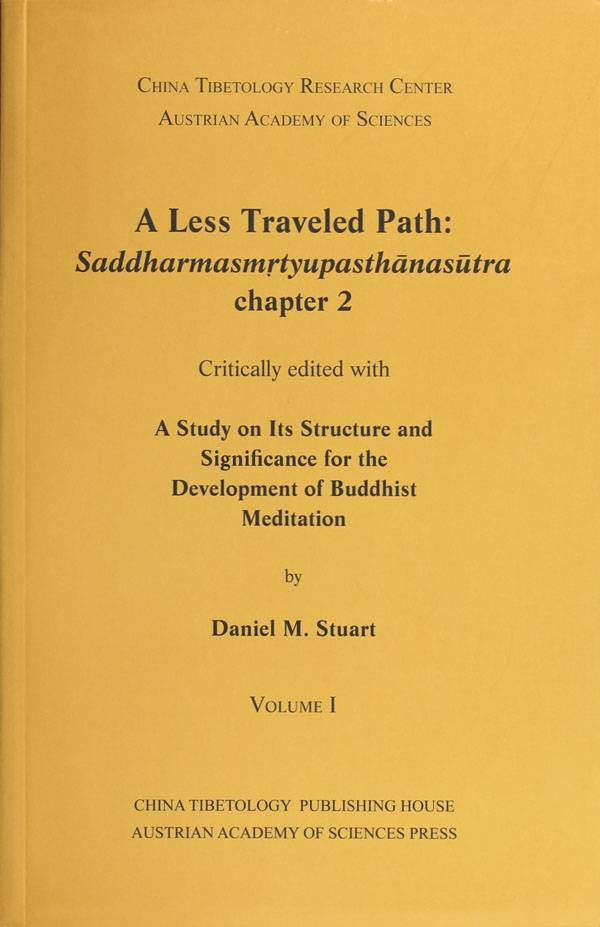
A Less Traveled Path Vol. 1-front.jpg
Books2015About this item
A Less Traveled Path brings to light unique textual evidence of an important transitional moment in Indian Buddhism. In this book, Daniel Stuart introduces the recently discovered Sanskrit manuscript of a third- or fourth-century Buddhist Sanskrit text, the Saddharmasmṛtyupasthānasūtra, which sheds light on the so-called "Middle Period" of Indian Buddhism.

The book argues that meditative practice, rhetoric, and philosophy were intimately tied to one another when the Saddharmasmṛtyupasthānasūtra was redacted, and that it serves as an important historical touchstone for understanding the development of a Buddhist mind-centered metaphysics. The text offers perhaps the clearest available evidence for the process through which philosophical developments grew organically out of specific meditation practices rooted in the early canonical Buddhist tradition. It also evidences an emergent historical ideology of cosmic power, one that ties ethical conduct, contemplative knowledge, and literary practice to a spiritual goal of selfless cosmographical sovereignty. This development is historically significant because it marks a major shift in Indian Buddhist religious practice, which conditioned the emergence of fully developed Mahāyāna path schemes and power-oriented tantric ritual traditions in the centuries that followed the text's compilation.

The study includes a critical edition and translation of the text's second chapter based on the recently discovered manuscript, the first installment of a series of critical editions of the chapters of the Saddharmasmṛtyupasthānasūtra. (Source Accessed Apr 8, 2022)
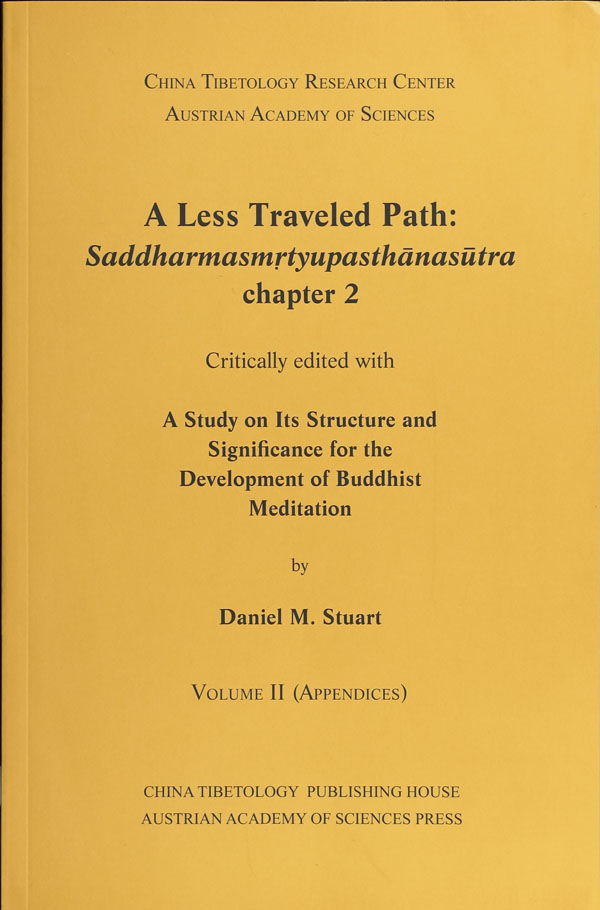
A Less Traveled Path Vol. 2-front.jpg
Books2015About this item
A Less Traveled Path brings to light unique textual evidence of an important transitional moment in Indian Buddhism. In this book, Daniel Stuart introduces the recently discovered Sanskrit manuscript of a third- or fourth-century Buddhist Sanskrit text, the Saddharmasmṛtyupasthānasūtra, which sheds light on the so-called "Middle Period" of Indian Buddhism.

The book argues that meditative practice, rhetoric, and philosophy were intimately tied to one another when the Saddharmasmṛtyupasthānasūtra was redacted, and that it serves as an important historical touchstone for understanding the development of a Buddhist mind-centered metaphysics. The text offers perhaps the clearest available evidence for the process through which philosophical developments grew organically out of specific meditation practices rooted in the early canonical Buddhist tradition. It also evidences an emergent historical ideology of cosmic power, one that ties ethical conduct, contemplative knowledge, and literary practice to a spiritual goal of selfless cosmographical sovereignty. This development is historically significant because it marks a major shift in Indian Buddhist religious practice, which conditioned the emergence of fully developed Mahāyāna path schemes and power-oriented tantric ritual traditions in the centuries that followed the text's compilation.

The study includes a critical edition and translation of the text's second chapter based on the recently discovered manuscript, the first installment of a series of critical editions of the chapters of the Saddharmasmṛtyupasthānasūtra. (Source Accessed Apr 8, 2022)
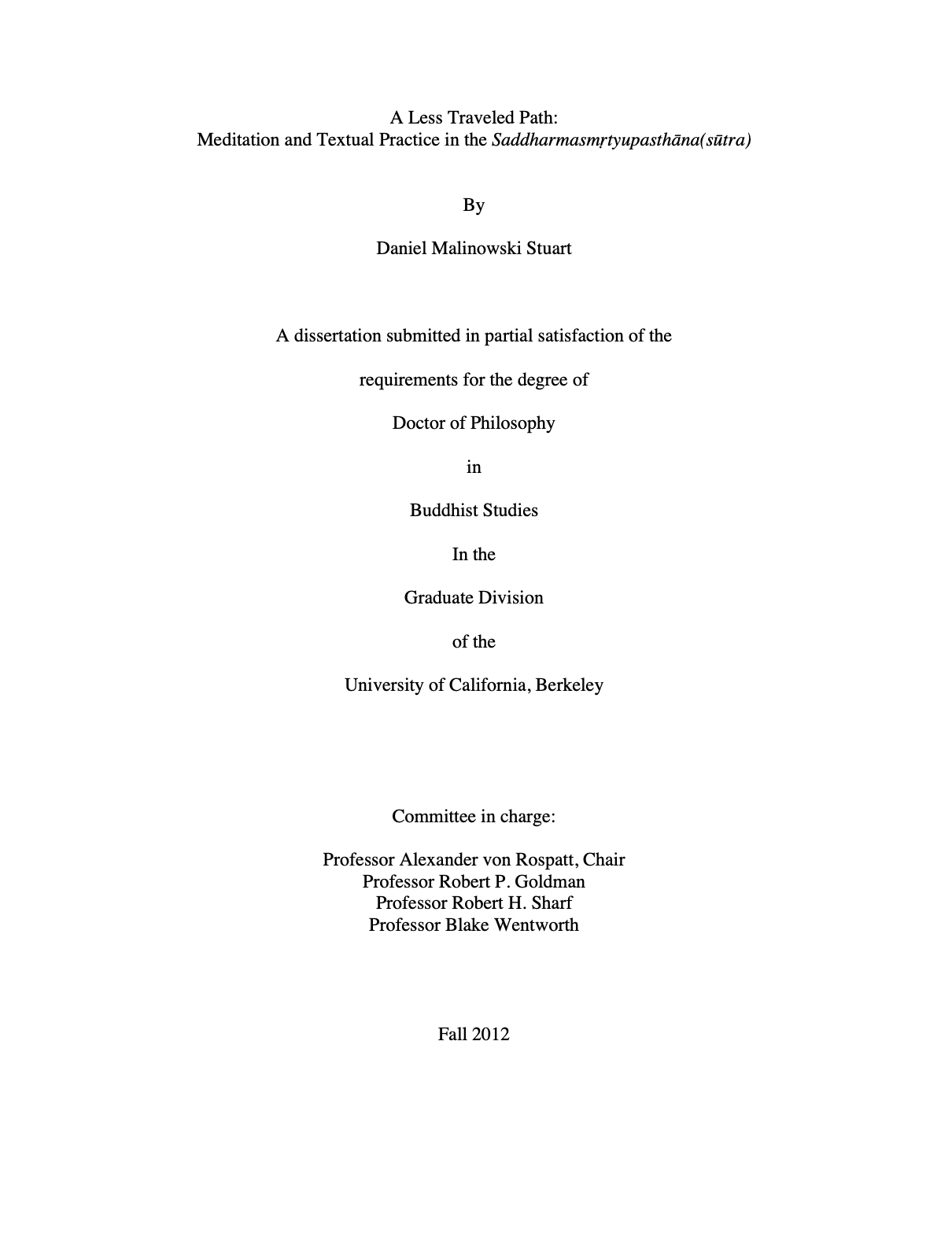
A Less Traveled Path Meditation and Textual Practice in the Saddharmasmrtyupasthana(sutra) PhD diss-front.jpg
Dissertations2012About this item
Abstract This dissertation is a study of a third/fourth-century Buddhist Sanskrit text, the Saddharmasmṛtyupasthāna(sūtra), which reveals a unique literary culture at an important transitional moment in the religious and philosophical life of early Northwest Indian Buddhists. I argue that meditative practice, rhetoric, and philosophy were intimately tied to one another when the Saddharmasmṛtyupasthāna(sūtra) was redacted, and that the text serves as an important yet unnoticed historical touchstone for an understanding of the development of a Buddhist mind-centered metaphysics. The study suggests that such philosophical developments grew organically out of specific meditation practices rooted in the early canonical Buddhist tradition, and that the Saddharmasmṛtyupasthāna(sūtra) offers perhaps the clearest evidence available attesting to this process. Further, the text evidences an emergent historical ideology of cosmic power, one that ties ethical conduct, contemplative knowledge, and literary practice to a spiritual goal of selfless cosmographical sovereignty. This development is historically significant because it marks a major shift in Indian Buddhist religious practice, which conditioned the emergence of fully developed Mahāyāna path schemes and power-oriented tantric ritual traditions in the centuries that followed the text's compilation. As part of this study, I critically edit and translate the second chapter of the Saddharmasmṛtyupasthāna(sūtra) based on a recently discovered codex unicus.
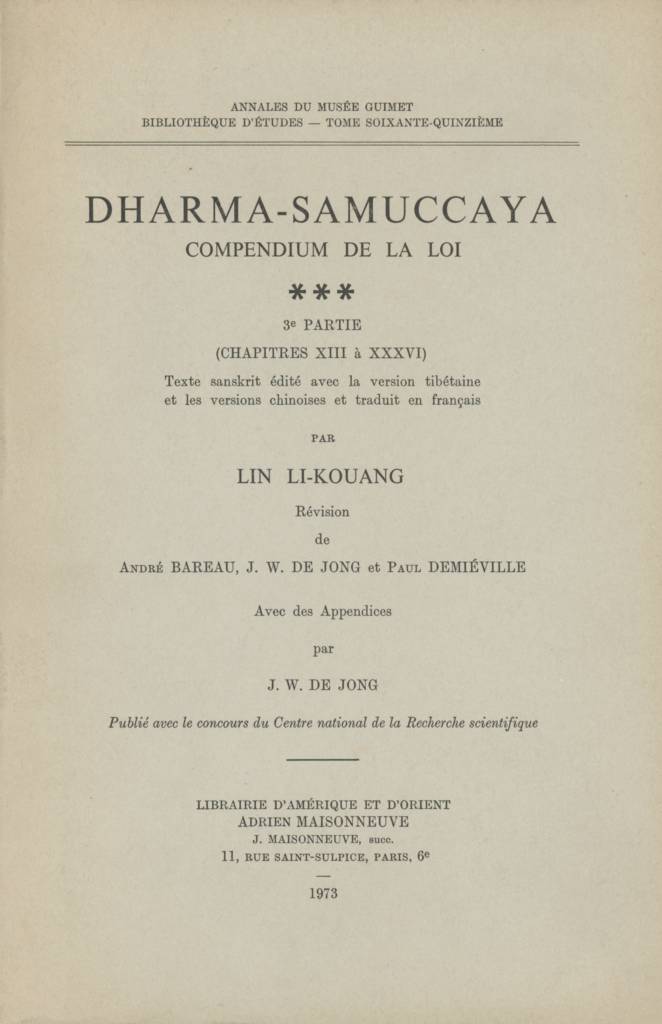
Dharma-Samuccaya Compendium de la loi 1-front.jpg
Books1946About this item
Dharma-Samuccaya [諸法集要經]. Compendium of the law: collection of stanzas extracted from Saddharmasmṛtyupasthānasūtra by Avalokitasiṃha, volume 1: chapters I–V.
2 Full translations
The Application of Mindfulness of the Sacred Dharma 84000-front.jpg
Books2022About this item
An English translation of the Saddharmasmṛtyupasthānasūtra by Thomas Doctor, with assistance from Benjamin Collet-Cassart and Timothy Hinkle. Published by 84000.
3 Partial translations
Dharma-Samuccaya Compendium de la loi 1-front.jpg
Books1946About this item
Dharma-Samuccaya [諸法集要經]. Compendium of the law: collection of stanzas extracted from Saddharmasmṛtyupasthānasūtra by Avalokitasiṃha, volume 1: chapters I–V.
10 Scholarship
A Less Traveled Path Vol. 1-front.jpg
Books2015About this item
A Less Traveled Path brings to light unique textual evidence of an important transitional moment in Indian Buddhism. In this book, Daniel Stuart introduces the recently discovered Sanskrit manuscript of a third- or fourth-century Buddhist Sanskrit text, the Saddharmasmṛtyupasthānasūtra, which sheds light on the so-called "Middle Period" of Indian Buddhism.

The book argues that meditative practice, rhetoric, and philosophy were intimately tied to one another when the Saddharmasmṛtyupasthānasūtra was redacted, and that it serves as an important historical touchstone for understanding the development of a Buddhist mind-centered metaphysics. The text offers perhaps the clearest available evidence for the process through which philosophical developments grew organically out of specific meditation practices rooted in the early canonical Buddhist tradition. It also evidences an emergent historical ideology of cosmic power, one that ties ethical conduct, contemplative knowledge, and literary practice to a spiritual goal of selfless cosmographical sovereignty. This development is historically significant because it marks a major shift in Indian Buddhist religious practice, which conditioned the emergence of fully developed Mahāyāna path schemes and power-oriented tantric ritual traditions in the centuries that followed the text's compilation.

The study includes a critical edition and translation of the text's second chapter based on the recently discovered manuscript, the first installment of a series of critical editions of the chapters of the Saddharmasmṛtyupasthānasūtra. (Source Accessed Apr 8, 2022)
A Less Traveled Path Vol. 2-front.jpg
Books2015About this item
A Less Traveled Path brings to light unique textual evidence of an important transitional moment in Indian Buddhism. In this book, Daniel Stuart introduces the recently discovered Sanskrit manuscript of a third- or fourth-century Buddhist Sanskrit text, the Saddharmasmṛtyupasthānasūtra, which sheds light on the so-called "Middle Period" of Indian Buddhism.

The book argues that meditative practice, rhetoric, and philosophy were intimately tied to one another when the Saddharmasmṛtyupasthānasūtra was redacted, and that it serves as an important historical touchstone for understanding the development of a Buddhist mind-centered metaphysics. The text offers perhaps the clearest available evidence for the process through which philosophical developments grew organically out of specific meditation practices rooted in the early canonical Buddhist tradition. It also evidences an emergent historical ideology of cosmic power, one that ties ethical conduct, contemplative knowledge, and literary practice to a spiritual goal of selfless cosmographical sovereignty. This development is historically significant because it marks a major shift in Indian Buddhist religious practice, which conditioned the emergence of fully developed Mahāyāna path schemes and power-oriented tantric ritual traditions in the centuries that followed the text's compilation.

The study includes a critical edition and translation of the text's second chapter based on the recently discovered manuscript, the first installment of a series of critical editions of the chapters of the Saddharmasmṛtyupasthānasūtra. (Source Accessed Apr 8, 2022)
A Less Traveled Path Meditation and Textual Practice in the Saddharmasmrtyupasthana(sutra) PhD diss-front.jpg
Dissertations2012About this item
Abstract This dissertation is a study of a third/fourth-century Buddhist Sanskrit text, the Saddharmasmṛtyupasthāna(sūtra), which reveals a unique literary culture at an important transitional moment in the religious and philosophical life of early Northwest Indian Buddhists. I argue that meditative practice, rhetoric, and philosophy were intimately tied to one another when the Saddharmasmṛtyupasthāna(sūtra) was redacted, and that the text serves as an important yet unnoticed historical touchstone for an understanding of the development of a Buddhist mind-centered metaphysics. The study suggests that such philosophical developments grew organically out of specific meditation practices rooted in the early canonical Buddhist tradition, and that the Saddharmasmṛtyupasthāna(sūtra) offers perhaps the clearest evidence available attesting to this process. Further, the text evidences an emergent historical ideology of cosmic power, one that ties ethical conduct, contemplative knowledge, and literary practice to a spiritual goal of selfless cosmographical sovereignty. This development is historically significant because it marks a major shift in Indian Buddhist religious practice, which conditioned the emergence of fully developed Mahāyāna path schemes and power-oriented tantric ritual traditions in the centuries that followed the text's compilation. As part of this study, I critically edit and translate the second chapter of the Saddharmasmṛtyupasthāna(sūtra) based on a recently discovered codex unicus.
Articles.jpeg
Articles1949About this item
A Japanese translation of chapter 4 of the Saddharmasmṛtyupasthānasūtra. The source of the translation is unclear, but see the editions by Gautama Prajñāruci T721 and Jih-ch'eng and Dharmarakṣa T728.
L aide memoire de la vraie loi Saddharma-smrtyupasthanasutra-front.jpg
Books1949About this item
Li-Kouang, Lin. L'aide mémoire de la vraie loi (Saddharma-smṛtyupasthānasūtra): Recherches sur un sutra développé du Petit Véhicule. Introduction de P. Demiéville. Annales du Musée Guimet, Bibliothèque d'études 54. Paris: Adrien-Maisonneuve, 1949.
Articles.jpeg
Articles1941About this item
Kimura, Hideo. "Nepānj Shutsudo Bonpon Shohoshūokyo (Dharmasamuccaya) ni Okeru Sho Issho." Ryūkoku Gakuho 331 (1941): 1-10.
Bhikkhu Pāsādika.jpg
Articles1998About this item
Pāsādika, Bhikkhu. "The Smṛtyupasthānasūtra of the Ekottarāgama (EĀ) Translated from the Chinese Version." In Facets of Indian Culture: Gustov Roth Felicitation Volume, Published on the Occasion of His 82nd Birthday, edited by Chitta Ranjan Prasad Sinha, 494–502. Patna, India: Bihar Puravid Parishad, 1998.
14 A topic of
A Less Traveled Path Vol. 1-front.jpg
Books2015About this item
A Less Traveled Path brings to light unique textual evidence of an important transitional moment in Indian Buddhism. In this book, Daniel Stuart introduces the recently discovered Sanskrit manuscript of a third- or fourth-century Buddhist Sanskrit text, the Saddharmasmṛtyupasthānasūtra, which sheds light on the so-called "Middle Period" of Indian Buddhism.

The book argues that meditative practice, rhetoric, and philosophy were intimately tied to one another when the Saddharmasmṛtyupasthānasūtra was redacted, and that it serves as an important historical touchstone for understanding the development of a Buddhist mind-centered metaphysics. The text offers perhaps the clearest available evidence for the process through which philosophical developments grew organically out of specific meditation practices rooted in the early canonical Buddhist tradition. It also evidences an emergent historical ideology of cosmic power, one that ties ethical conduct, contemplative knowledge, and literary practice to a spiritual goal of selfless cosmographical sovereignty. This development is historically significant because it marks a major shift in Indian Buddhist religious practice, which conditioned the emergence of fully developed Mahāyāna path schemes and power-oriented tantric ritual traditions in the centuries that followed the text's compilation.

The study includes a critical edition and translation of the text's second chapter based on the recently discovered manuscript, the first installment of a series of critical editions of the chapters of the Saddharmasmṛtyupasthānasūtra. (Source Accessed Apr 8, 2022)
A Less Traveled Path Vol. 2-front.jpg
Books2015About this item
A Less Traveled Path brings to light unique textual evidence of an important transitional moment in Indian Buddhism. In this book, Daniel Stuart introduces the recently discovered Sanskrit manuscript of a third- or fourth-century Buddhist Sanskrit text, the Saddharmasmṛtyupasthānasūtra, which sheds light on the so-called "Middle Period" of Indian Buddhism.

The book argues that meditative practice, rhetoric, and philosophy were intimately tied to one another when the Saddharmasmṛtyupasthānasūtra was redacted, and that it serves as an important historical touchstone for understanding the development of a Buddhist mind-centered metaphysics. The text offers perhaps the clearest available evidence for the process through which philosophical developments grew organically out of specific meditation practices rooted in the early canonical Buddhist tradition. It also evidences an emergent historical ideology of cosmic power, one that ties ethical conduct, contemplative knowledge, and literary practice to a spiritual goal of selfless cosmographical sovereignty. This development is historically significant because it marks a major shift in Indian Buddhist religious practice, which conditioned the emergence of fully developed Mahāyāna path schemes and power-oriented tantric ritual traditions in the centuries that followed the text's compilation.

The study includes a critical edition and translation of the text's second chapter based on the recently discovered manuscript, the first installment of a series of critical editions of the chapters of the Saddharmasmṛtyupasthānasūtra. (Source Accessed Apr 8, 2022)

A Less Traveled Path Meditation and Textual Practice in the Saddharmasmrtyupasthana(sutra) PhD diss-front.jpg
Dissertations2012About this item
Abstract This dissertation is a study of a third/fourth-century Buddhist Sanskrit text, the Saddharmasmṛtyupasthāna(sūtra), which reveals a unique literary culture at an important transitional moment in the religious and philosophical life of early Northwest Indian Buddhists. I argue that meditative practice, rhetoric, and philosophy were intimately tied to one another when the Saddharmasmṛtyupasthāna(sūtra) was redacted, and that the text serves as an important yet unnoticed historical touchstone for an understanding of the development of a Buddhist mind-centered metaphysics. The study suggests that such philosophical developments grew organically out of specific meditation practices rooted in the early canonical Buddhist tradition, and that the Saddharmasmṛtyupasthāna(sūtra) offers perhaps the clearest evidence available attesting to this process. Further, the text evidences an emergent historical ideology of cosmic power, one that ties ethical conduct, contemplative knowledge, and literary practice to a spiritual goal of selfless cosmographical sovereignty. This development is historically significant because it marks a major shift in Indian Buddhist religious practice, which conditioned the emergence of fully developed Mahāyāna path schemes and power-oriented tantric ritual traditions in the centuries that followed the text's compilation. As part of this study, I critically edit and translate the second chapter of the Saddharmasmṛtyupasthāna(sūtra) based on a recently discovered codex unicus.
Dharma-Samuccaya Compendium de la loi 1-front.jpg
Books1946About this item
Dharma-Samuccaya [諸法集要經]. Compendium of the law: collection of stanzas extracted from Saddharmasmṛtyupasthānasūtra by Avalokitasiṃha, volume 1: chapters I–V.
Articles.jpeg
Articles1949About this item
A Japanese translation of chapter 4 of the Saddharmasmṛtyupasthānasūtra. The source of the translation is unclear, but see the editions by Gautama Prajñāruci T721 and Jih-ch'eng and Dharmarakṣa T728.
L aide memoire de la vraie loi Saddharma-smrtyupasthanasutra-front.jpg
Books1949About this item
Li-Kouang, Lin. L'aide mémoire de la vraie loi (Saddharma-smṛtyupasthānasūtra): Recherches sur un sutra développé du Petit Véhicule. Introduction de P. Demiéville. Annales du Musée Guimet, Bibliothèque d'études 54. Paris: Adrien-Maisonneuve, 1949.
Articles.jpeg
Articles1941About this item
Kimura, Hideo. "Nepānj Shutsudo Bonpon Shohoshūokyo (Dharmasamuccaya) ni Okeru Sho Issho." Ryūkoku Gakuho 331 (1941): 1-10.
The Application of Mindfulness of the Sacred Dharma 84000-front.jpg
Books2022About this item
An English translation of the Saddharmasmṛtyupasthānasūtra by Thomas Doctor, with assistance from Benjamin Collet-Cassart and Timothy Hinkle. Published by 84000.
Bhikkhu Pāsādika.jpg
Articles1998About this item
Pāsādika, Bhikkhu. "The Smṛtyupasthānasūtra of the Ekottarāgama (EĀ) Translated from the Chinese Version." In Facets of Indian Culture: Gustov Roth Felicitation Volume, Published on the Occasion of His 82nd Birthday, edited by Chitta Ranjan Prasad Sinha, 494–502. Patna, India: Bihar Puravid Parishad, 1998.